A New Express Bus From Suwon to Seoul Offers a Window Into How South Korea’s Mega-Commute Really Works
A New Route for a Very Familiar Problem
For many Americans, the idea of a bus route making headlines might sound unusual. In the United States, transit stories often rise to national attention only when they involve a major rail expansion, a costly infrastructure fight or a system breakdown. In South Korea, especially in the greater Seoul metropolitan area, the launch of a single new commuter bus line can carry outsized significance because it touches one of the most important realities of everyday life: how people get from a rapidly growing suburb to the center of the country’s economic and political capital.
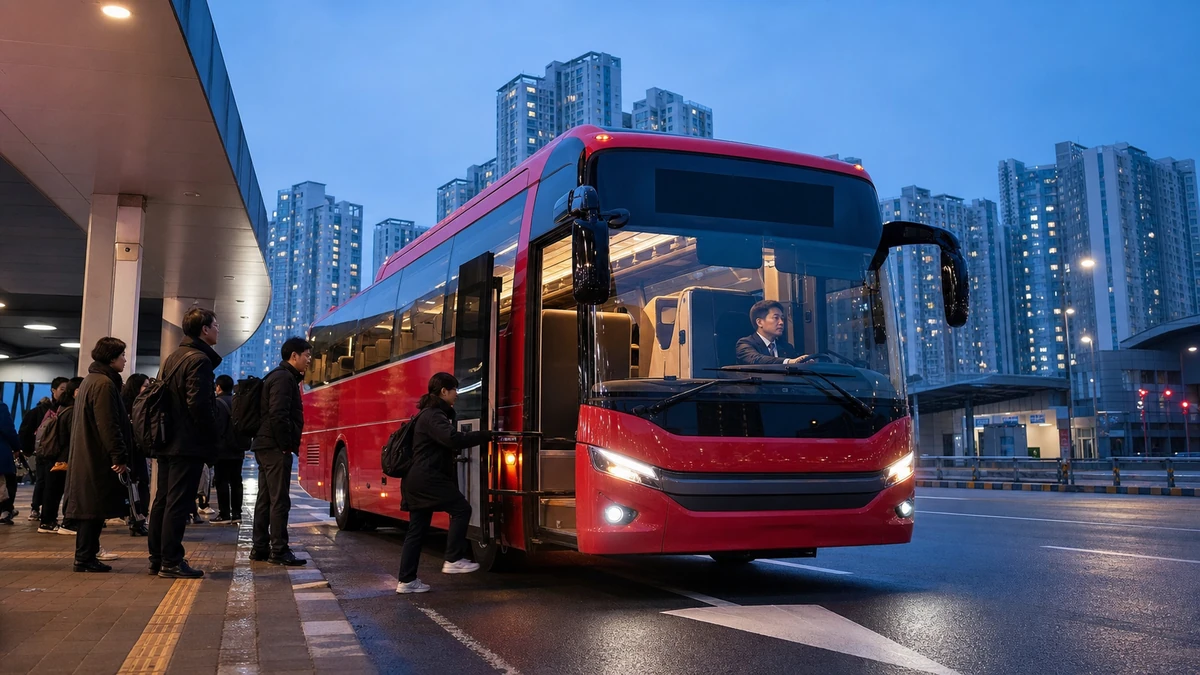
That is the context behind the start of service on the M5165, a new metropolitan express bus linking Mangpo, a fast-growing residential area in Suwon, with Seoul Station, one of the busiest transit hubs in South Korea. The route began service at 4:50 a.m. on the morning of the launch, underscoring just how early the daily commute begins for many people living outside Seoul but working, studying or conducting business in the capital.
The bus departs from the Suwon South Public Bus Garage and stops at Mangpo Station, Yeongtong Station and Cheongmyeong Station before heading north to the Seoul Station Bus Transfer Center. On paper, that may look like a routine route adjustment. In practice, it reflects a much bigger story about housing growth, commuter overload and the delicate balancing act of moving millions of people across one of the densest urban regions in the world.
South Korea’s Seoul metropolitan area — which includes Seoul, Incheon and much of Gyeonggi Province, where Suwon is located — functions as a vast integrated labor market. People routinely live in one city and work in another. A trip that crosses municipal boundaries is not considered exceptional; it is part of normal life. The new route is designed to serve that reality, giving residents of a major apartment district in southern Gyeonggi a more direct connection to the heart of Seoul.
In an American frame of reference, the change is less like adding a neighborhood shuttle and more like introducing a new premium commuter line from a booming New Jersey or Northern Virginia suburb directly into Manhattan or downtown Washington. It is an acknowledgment that the suburb is no longer peripheral. Its residents are deeply tied to the central city, and the transportation network must catch up.
Why Mangpo Matters
Mangpo is not a household name outside South Korea, but it helps illustrate a defining feature of Korean urban development. Large-scale apartment complexes — often built in clusters and marketed as self-contained residential communities — can transform the population profile of an area in a relatively short period of time. In this case, the Mangpo district has seen the growth of apartment communities totaling roughly 18,000 households, a scale that immediately creates pressure on roads, rail stations, schools, retail and, perhaps most urgently, transportation to major job centers.
In Korea, the word “apartment” can carry a different cultural meaning than it often does in the United States. Rather than referring mainly to low-rise or mid-rise rental buildings, it frequently describes large, master-planned residential towers where middle-class families and professionals buy homes. These developments are often central to the identity of a neighborhood. When thousands of new households move into such a district, the question is not simply whether there is enough housing. It is whether the area is truly livable.
That is where transit becomes a measuring stick for urban success. A residential district may have modern buildings, shops and schools, but if residents cannot reliably reach offices, transfer hubs and commercial centers, quality of life suffers. In the Seoul region, commuting patterns are heavily directional and intensely concentrated during rush hour. A neighborhood like Mangpo does not just generate random travel demand throughout the day. It sends waves of commuters toward Seoul in the morning and brings them back in the evening.
The M5165 route is a response to that pattern. By linking Mangpo with nearby stations and pushing on to Seoul Station, it does more than connect point A to point B. It stitches together a wider living sphere that includes home, rail access, business districts and transfer points. That broader concept matters in Korea, where urban life is often organized around seamless connections between buses, subways and regional travel.
It also reflects the political sensitivity of transit in fast-growing housing areas. When local governments approve or support major residential expansion, residents expect transportation improvements to follow. New apartments without practical commuter access can quickly become a source of frustration. In that sense, the M5165 is not just a bus line. It is part of the unwritten social contract of metropolitan growth.
The Commute Bottleneck South of Seoul
The immediate reason for the new line is congestion on an existing express bus route, the M5107. As demand toward Seoul Station increased, riders near Yeongtong Station and Cheongmyeong Station reportedly had trouble boarding because buses were already crowded. That kind of problem may sound mundane, but it gets at one of the most important distinctions in public transportation policy: a route can exist on paper and still fail in practice if riders cannot get on when they need it.
Transit planners sometimes talk about “access” as though it begins and ends with map coverage. But commuters measure access in more human terms. Can I board at my stop? Will the trip be predictable? Will I need to leave home even earlier because buses are passing me by full? For workers, students and office staff navigating the Seoul region, those questions shape sleep schedules, child care routines and even career decisions.
The boarding difficulty around Yeongtong and Cheongmyeong appears to have become a visible symptom of a larger mismatch between housing growth and transportation capacity. The M5165 is intended to spread demand across more than one express option, relieving pressure not only for its own passengers but also for riders who continue using the older line. In other words, even people who never set foot on the new bus could benefit if crowding eases on the existing service.
This is the kind of practical, highly localized fix that often defines good transit policy. It is not as dramatic as unveiling a high-speed rail extension or constructing a new subway corridor, but it may do more in the short term to improve the daily experience of commuters. By focusing on a known choke point and adding another path to the same major destination, local officials are trying to address a problem residents feel in immediate, personal ways.
For Americans used to transit systems that can be fragmented across agencies and jurisdictions, South Korea’s approach can look strikingly integrated. The bus is being used not as a backup mode for people without cars, but as a core piece of regional mobility strategy. Express buses in the Seoul area often serve a role that lies somewhere between commuter rail, park-and-ride service and intercity bus, depending on the route. They are a routine part of middle-class life and a major tool for moving workers efficiently into Seoul.
That makes crowding on a line like the M5107 more than a minor inconvenience. It is evidence that the transportation system, however sophisticated, is under strain from the metropolitan region’s continuing expansion. The new route is a reminder that even in transit-rich countries, success creates its own pressure.
Why Seoul Station Is More Than a Destination
One of the most revealing aspects of the new route is not where it starts, but where it ends. Seoul Station is far more than a final stop. It is one of the country’s most important transfer hubs, linking local subway lines, regional rail, intercity trains and the Korea Train Express, or KTX, the high-speed rail system often compared to the Shinkansen in Japan or the Acela’s more efficient cousins in Europe and Asia.
For that reason, ending the route at the Seoul Station Bus Transfer Center signals that the bus is designed for a broad range of passenger needs. Some riders may work near Seoul Station. Others may transfer to the subway to reach office districts such as City Hall, Gwanghwamun or Yeouido. Still others could be connecting to trains bound for other cities. In the logic of the Seoul metro area, arriving at Seoul Station does not mean the trip is over. It means the rest of the network opens up.
This is an important distinction for readers outside Korea. In many American cities, major train stations are important but often not the central organizing principle of everyday commuting in the same way. Seoul Station, by contrast, sits at the intersection of local life, national mobility and symbolic identity. It is both a practical transit center and one of the gateways to the capital. A direct bus there has value that goes beyond convenience.
The route therefore serves as a first-mile-to-major-hub solution. It takes residents from a suburban housing district through a sequence of neighborhood and district-level stations before depositing them at a node where they can continue nearly anywhere. For planners, that kind of network effect matters as much as the route’s origin and destination. A commuter is not just going from Suwon to Seoul. The commuter is entering a layered mobility system where bus, subway and rail are meant to work together.
That also helps explain why this launch is significant without involving any new large-scale construction. No new tunnel was bored. No rail line was laid. Instead, officials are trying to improve metropolitan connectivity by reconfiguring how existing roads, stops and transfer centers function together. It is the kind of incremental but meaningful transportation intervention that can be overlooked by outsiders but deeply felt by residents.
In that sense, the M5165 reflects a broader lesson in urban policy: sometimes the most consequential infrastructure decision is not building something entirely new, but making the current network work better for the way people actually live.
The 4:50 A.M. Detail Says Almost Everything
The launch time of 4:50 a.m. may be the single most telling detail in the story. It captures the intensity of commuting life in the Seoul region, where distance is not always vast in miles but can feel large in time, competition for space and the social pressure to arrive early. People who live in outer residential districts often begin their day long before sunrise to reach offices, schools, hospitals or commercial workplaces in Seoul.
To Americans, especially those outside the Northeast Corridor or other dense metro areas, a bus leaving before 5 a.m. for what is effectively a suburban-to-downtown commute may seem extreme. But in the Korean capital region, it fits a familiar rhythm. The region’s geography is shaped not only by physical development but by synchronized daily movement: apartment districts emptying out in the early morning, train platforms filling, express buses boarding and central Seoul absorbing workers from across the metro area.
This pattern has social and economic consequences. Early commutes can affect family life, sleep, health and spending habits. They can determine when parents see children, when students begin cram school or part-time jobs, and how neighborhoods function during daylight hours. Transportation timetables, in other words, are also timetables for everyday life.
The new bus route therefore represents more than added capacity. It is an attempt to give residents a little more control over their mornings. If the service reduces crowding and improves boarding reliability, that could mean fewer people leaving home with a sense of uncertainty about whether they will make it onto the first bus that arrives. Reliability is a technical word in transit planning, but for commuters it often translates into something more personal: less stress.
The early start time also shows how South Korea’s major cities and surrounding suburbs have become functionally inseparable. Suwon is its own city, with a substantial population, corporate presence and historical significance. Yet for many residents, daily life still orbits Seoul in some way. That relationship resembles patterns seen around New York, Los Angeles or Chicago, but South Korea’s density and transit usage make the connections more visible and more structured.
In a metropolitan area where governments constantly navigate the relationship between housing supply and transportation demand, a 4:50 a.m. bus is not a footnote. It is a public acknowledgment that the day’s first race for access begins before dawn.
What This Says About South Korea’s Urban Future
The start of M5165 service is, on one level, a local transportation update. On another, it offers a useful snapshot of where South Korean urban life is heading. The country continues to wrestle with the concentration of jobs, education and opportunity in and around Seoul. As housing pushes farther into suburban districts and satellite cities, the need for fast, dependable links into the capital only grows.
That challenge is not unique to Korea. Across the world, metropolitan regions are struggling with a familiar cycle: build housing where land is more available or relatively affordable, then scramble to provide the transportation needed to make that housing function. What stands out in the Korean case is how quickly those pressures can emerge and how central public transit remains to the solution.
The M5165 route illustrates a response rooted in adaptation rather than spectacle. Instead of waiting for years on a major capital project, officials have introduced an additional express service based on observed demand. They appear to be treating transit as a living network that must be adjusted as neighborhoods grow, rather than a static system that changes only through megaprojects.
Whether the route fully delivers on its promise will depend on what happens next. If enough riders shift from the older M5107 line, congestion at key stops could ease. If demand continues to climb as more households settle in the Mangpo area, further service adjustments may be needed. And if the route proves successful, it could become an example for how local governments in the Seoul region respond to residential expansion elsewhere.
There is also a broader civic dimension. Transportation is one of the most tangible ways people judge whether growth is being managed well. Residents may not track every zoning discussion or infrastructure budget line, but they know whether they can get to work without being left at the curb. In that way, a bus line can shape public confidence in local government as much as any ribbon-cutting ceremony.
For international readers, the story offers an instructive contrast to the way transit is often discussed abroad. South Korea is famous for technology, pop culture and export-driven industry, but one of the quieter engines of its success is the constant, granular maintenance of urban systems that make dense metropolitan life possible. A new express bus may not attract the global attention that K-pop, Samsung or a summit meeting does. Yet it reveals a great deal about how the country functions day to day.
In the end, the significance of the M5165 may lie less in the bus itself than in what it represents: a growing suburb demanding recognition, a capital region trying to keep pace with its own success and a reminder that for millions of people, the shape of modern urban life is decided not only by where homes are built, but by whether there is a reliable seat — or at least standing room — on the bus that gets them where they need to go.
A Practical Change With Outsized Meaning
There is a temptation, when covering transportation, to separate the technical from the human. Routes, garages, transfer centers and ridership demand can sound like abstractions. But the launch of the M5165 shows why those details matter. Behind every timetable is a commuter trying to reduce uncertainty. Behind every crowded stop is a neighborhood growing faster than its infrastructure. Behind every new connection to Seoul Station is a larger story about how South Korea’s capital continues to pull people, labor and opportunity into its orbit.
For residents of Mangpo, Yeongtong and Cheongmyeong, the line’s success will likely be judged in practical terms: whether it shortens waits, reduces crowding and makes the trip to Seoul feel manageable. For transportation officials, it will be a test of whether targeted service expansion can absorb demand generated by large apartment developments. For outside observers, it is a compact example of how a highly urbanized society handles the everyday consequences of growth.
That may be why this bus launch resonates beyond local boundaries. It is not simply a story about getting from Suwon to Seoul. It is about the infrastructure of ordinary life — the mundane systems that quietly determine whether a booming metropolitan region feels connected or strained. And in a place where daily mobility is inseparable from housing, work and family routine, adding one new express bus line can amount to a meaningful shift in how a city region breathes.
The M5165 began rolling before dawn, but the issues it reflects are likely to remain in view long after the novelty of its first run fades. As South Korea continues to expand outward while remaining centered on Seoul, the real question will not be whether this is the last such route, but how many more like it the metropolitan future will require.
Comments
Post a Comment