Image to help understand the article
A modest ratings debut, and a familiar K-drama question
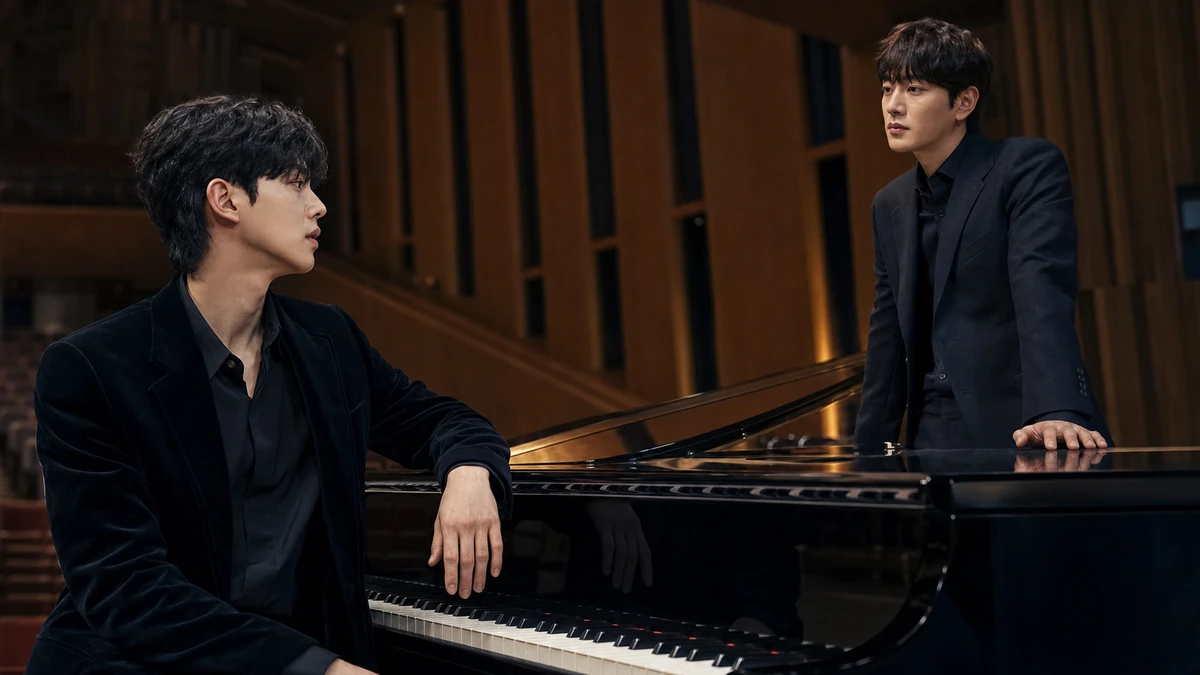
A new South Korean television drama built around elite young pianists opened to a nationwide rating of 3.4%, according to Nielsen Korea, a modest but closely watched first number in the country’s highly competitive weekend drama lineup. The series, “Four Hands,” stars Song Kang and Lee Jun-young and premiered on tvN, one of South Korea’s major cable networks and a frequent launchpad for dramas that later travel well internationally.
On paper, the opening rating is simply an industry benchmark: a first snapshot, not a verdict. In the Korean television business, as in the United States, premiere numbers often matter less than the direction of travel. A series can begin quietly and build through word of mouth, strong performances, social media conversation and international streaming attention. That is especially true for Korean dramas, which increasingly live two lives at once — one on domestic television and another on global platforms where audience discovery follows a different rhythm.
What makes “Four Hands” worth watching is not the 3.4% itself, but the storytelling choice behind its opening episode. Rather than presenting classical music as a glamorous backdrop alone, the premiere frames piano performance through rivalry, class pressure, family expectations and the unequal distribution of opportunity. Those are themes American audiences will recognize immediately, even if the setting — a Korean arts high school and the world of youth music competitions — may feel more specific.
The title itself points to the larger dramatic promise. In classical music, “four hands” refers to two pianists performing together at one piano. That idea naturally suggests collaboration, listening and shared timing. Yet the first episode reportedly leans more heavily into competition: two gifted young men, Kang Bio and Choi Jeong-yo, are reunited seven years after a formative contest. The tension between those two meanings — partnership and rivalry — may be where the drama finds its emotional center.
That tension is also one reason Korean dramas continue to resonate well beyond Korea. They often begin with highly local institutions — a school, a family hierarchy, a workplace, a neighborhood — and then use them to tell stories about insecurity, ambition and emotional debt that translate almost anywhere. “Four Hands” appears to be trying exactly that, using the language of classical training to tell a broader story about what talent can and cannot protect you from.
More than a music drama: a story about rank, memory and social disadvantage
The first episode, as described in Korean coverage, centers on the reunion of two former child competitors whose lives have moved in sharply different ways. Song Kang’s character, Kang Bio, is already marked as a standout talent, a winner of an international competition and a student recognized at his arts school for exceptional ability. But his achievements do not shield him from humiliation. He is looked down on by classmates because he is described as an illegitimate child, and he is denied full recognition by his grandfather, Kang Seung-woon, a world-class conductor.
For American readers, the term “illegitimate child” may sound dated, even harsh, and that is precisely part of the point. In South Korea, family background and perceived legitimacy can still carry social stigma in ways that may feel more overt than in many parts of the United States. Korean dramas frequently explore how lineage, status and parental reputation shape a young person’s standing in school or society. Here, the show appears to place a brilliant student inside a system where technical excellence does not erase inherited shame.
Lee Jun-young’s character, Choi Jeong-yo, carries a different burden. He has talent, but not stability. His father’s heavy debt threatens his ability to continue studying piano at all. That setup introduces a second kind of inequality, one Americans will also understand well: the gap between ability and access. In the United States, the arts have long reflected the same tension. Classical training often demands money, time, lessons, instruments and institutional support. Raw talent alone rarely pays for years of development.
The drama’s opening seems to understand that competition is rarely just about who plays better. It is about who can afford to keep going, who receives validation, who is protected by family networks and who is made to feel disposable even while succeeding. Korean coverage of the premiere emphasized that one protagonist lacks recognition while the other lacks opportunity. That is a strong dramatic engine because it resists easy hero-versus-villain framing. Each young man has something the other does not. Each is wounded in a different way.
That balance matters. Too many youth competition stories, whether in television, sports movies or prestige dramas, flatten conflict into a simple battle between first and second place. “Four Hands” appears to be aiming for something more layered. Kang Bio’s success is shadowed by insecurity; Choi Jeong-yo’s setbacks are tempered by the fact that he once defeated the boy who now seems untouchable. The rivalry is therefore not merely external. It lives in memory. One character remembers being surpassed. The other remembers nearly being pushed out of the art form altogether.
Why the school setting matters in Korea
One of the most revealing details in the story summary is where the two rivals meet again: not on a concert stage, but in a classroom. Choi Jeong-yo transfers into the same class as Kang Bio after receiving a full scholarship from Yoon Sun-joo, the chair of an arts high school who recognizes his ability. That choice places the rivalry inside everyday life. Instead of episodic competition, the show creates sustained proximity, where status, gossip, social alliances and daily humiliation can matter as much as performance itself.
For Americans unfamiliar with South Korea’s specialized arts schools, these institutions occupy a potent place in the country’s imagination. They are associated with high achievement, rigorous training and a pipeline toward elite artistic careers. They can also symbolize the pressure-cooker culture often associated with South Korea’s education system, where rankings, discipline and institutional prestige carry extraordinary weight. In Korean popular culture, schools are rarely just schools; they are often miniature social orders where class, ambition and emotional survival play out in compressed form.
That context helps explain why a scholarship is not simply a plot device. A full scholarship in this setting signals recognition, rescue and vulnerability all at once. It is an opening, but also a reminder that someone else’s patronage now matters. The adults around the boys are not passive background figures. Kang Seung-woon, the accomplished conductor who does not affirm his grandson’s gifts, and Yoon Sun-joo, the school leader who identifies Choi Jeong-yo’s promise, function as gatekeepers. One withholds legitimacy. The other grants possibility.
This is a dynamic Korean dramas return to often because it reflects broader realities in highly competitive societies: talent is noticed through institutions, and institutions are run by adults whose judgments shape futures. American audiences can find easy parallels. Think of the role conservatories, scholarship committees, private coaches, college admissions offices or influential artistic directors play in deciding who gets to keep pursuing a dream. Merit matters, but so do endorsement, timing and the willingness of powerful adults to invest in someone’s future.
There is also a specifically Korean emotional texture here. Dramas set in schools frequently dramatize not only academic or artistic pressure but also the need for acknowledgment from elders. That craving is especially visible in Kang Bio’s storyline. Winning is not enough if the person whose approval you most want refuses to grant it. In that sense, “Four Hands” may be less about prodigy culture than about the emotional economy surrounding talent: who validates it, who resents it and who uses it as a measure of worth.
For the United States, this is another sign of how Korean storytelling keeps finding universal entry points
For American audiences and companies, “Four Hands” matters less as a single ratings story and more as another example of how South Korean entertainment continues to build globally legible dramas out of intensely local material. Over the last decade, U.S. viewers have become increasingly comfortable entering Korean stories through unfamiliar settings — corporate offices, palace politics, legal systems, medical hierarchies and high schools — because the emotional stakes are quickly recognizable. A piano drama set in a Korean arts school fits that pattern.
The U.S. market has already shown that it is open to Korean stories driven by pressure, competition and social inequality. American audiences embraced works as different as “Parasite,” with its class divide; “Squid Game,” with its debt and desperation; and a wide range of Korean series centered on youth ambition, romantic longing and family strain. “Four Hands” is obviously operating in a much gentler register than those titles, but it taps into a similar engine: the idea that success in modern life is shaped by structures far larger than the individual.
There is also a natural American hook in the arts-world setting. U.S. viewers are familiar with stories about elite training and the emotional cost of excellence, from ballet dramas and conservatory films to sports series that turn discipline into identity. “Four Hands” appears to bring that same logic to piano performance, using competitions and school rankings in place of game-day scoreboards. For American viewers who grew up with stories like “Black Swan,” “Whiplash” or teen dramas built around auditions and scholarship anxiety, the dramatic grammar will feel familiar even when the cultural details do not.
That has practical implications for the American business side of entertainment. Korean dramas no longer need a crime hook, a zombie premise or a high-concept thriller element to attract overseas interest. A well-cast character drama can travel if it offers emotional clarity and visual polish. Song Kang in particular already has name recognition among international K-drama fans, which can help turn a domestic cable launch into a title with global streaming potential. American distributors and platforms have learned that star familiarity, genre accessibility and social media discussion can matter as much as domestic overnight ratings.
For the broader U.S.-Korea cultural relationship, the significance is cumulative. Every additional Korean series that asks foreign viewers to invest in Korean institutions and emotional codes broadens cultural fluency. Americans who watch enough Korean television begin to recognize recurring patterns: the social importance of school placement, the force of family obligation, the symbolic role of scholarships, the hierarchy between juniors and seniors, the stigma tied to debt or parentage and the authority wielded by teachers and patrons. That familiarity deepens the market for future imports and makes Korean storytelling less of a niche category and more of a standard part of global entertainment consumption.
A trend story, not just a one-night ratings story
If “Four Hands” becomes more than a modest premiere, it will likely be because it is arriving at a moment when viewers in many countries are especially receptive to stories about pressure, precarity and uneven access. In that sense, the show can be read as part of a larger trend in Korean television: dramas increasingly use genre or profession-specific settings to explore structural inequality. The courtroom, the hospital, the startup office and now the music school become ways of asking the same question: what happens when talent meets a system that is neither fair nor emotionally neutral?
The summary of the first episode suggests a series interested in that question from multiple angles. Kang Bio has already done what the world says should bring security: he has won. Yet victory has not settled the deeper problem of belonging. Choi Jeong-yo has the skill to compete, but the material conditions of his life threaten to cut the story short before merit can matter. This is a powerful contemporary formula because it reflects a widespread anxiety across affluent, high-pressure societies, including the United States: achievement alone no longer guarantees dignity, stability or acceptance.
That may be why a drama about piano, a niche subject in purely commercial terms, can still feel timely. Classical music itself may not command mass attention in the way pop music or sports does. But elite artistic competition is a clean metaphor for modern aspiration. It combines public ranking with private sacrifice. It invites admiration while exposing the hidden infrastructure behind brilliance: money, teachers, family support, mental endurance and institutional sponsorship. A drama built around those tensions can speak to viewers far beyond the conservatory crowd.
It is also worth watching how the series handles the meaning of its own title. If the narrative remains purely adversarial, “Four Hands” risks becoming just another prestige rivalry story. If it gradually moves toward interdependence — showing that each young pianist forces the other to confront a wound he cannot solve alone — the show could carve out a more distinctive identity. The most compelling competition dramas understand that rivals do not merely block one another; they reveal one another. The Korean summary hints at exactly that possibility, describing the two protagonists as mirrors for each other’s injuries and limitations.
In the near term, the practical questions are straightforward. Will domestic viewers stay with the show? Will the chemistry between Song Kang and Lee Jun-young become a draw? Will the adults around them deepen the story rather than simply control it? And perhaps most important for international audiences, will the series make piano performance itself emotionally intelligible on screen? It is one thing to tell viewers a character is brilliant; it is another to make the act of playing feel cinematic, consequential and inseparable from character.
What to watch next
The strongest takeaway from the premiere is that “Four Hands” is positioning itself around emotional asymmetry rather than simple triumph. One young man has status but not security. The other has promise but not protection. That is fertile ground for a long-form drama, especially if the series resists easy redemption arcs. Viewers do not need either character to become a saint or a villain. They need the show to remain honest about the costs each one carries.
For American audiences, this is where Korean television often distinguishes itself. The best Korean dramas are comfortable letting success and pain coexist. They do not always treat achievement as emotional closure. A trophy can intensify loneliness. A scholarship can sharpen pressure. A reunion can reopen humiliation rather than heal it. Those contradictions give Korean dramas their staying power abroad because they feel truer to lived ambition than the cleaner myths of victory often found in conventional entertainment narratives.
The 3.4% launch, then, should be read as context, not destiny. In Korean media coverage, premiere ratings are a headline because they offer a simple number in a crowded market. But in today’s transnational television environment, a series can matter for reasons that do not show up fully in its first domestic audience measurement. It can generate conversation online, attract overseas viewers, strengthen a star’s profile or signal an emerging trend in what kinds of Korean stories are being made for a world audience.
“Four Hands” appears to have the ingredients to do at least some of that. It has recognizable stars, a visually expressive artistic setting and a rivalry built not only on excellence but on injury, class strain and the search for acknowledgment. For U.S. viewers, it may become another reminder that some of the most exportable Korean dramas are not the loudest or the most sensational. Sometimes they are the ones that take a culturally specific institution — here, the Korean arts high school and the youth competition circuit — and use it to tell a story that feels immediately legible in Los Angeles, New York, Chicago or anywhere else young talent is asked to prove itself under unequal conditions.
If the series develops that premise with patience, its opening-night rating may end up as little more than trivia. The more important question is whether “Four Hands” can turn a familiar setup — two gifted rivals, one shared art form, one unresolved past — into a sharper portrait of what ambition sounds like when it is shaped by shame, money, memory and the hope that someone, finally, will say you are enough.
Comments
Post a Comment