A Rail-Hub Development in South Korea Shows the Real Bottleneck in Housing: It’s Not Just Land, It’s What Cities Let That Land Become
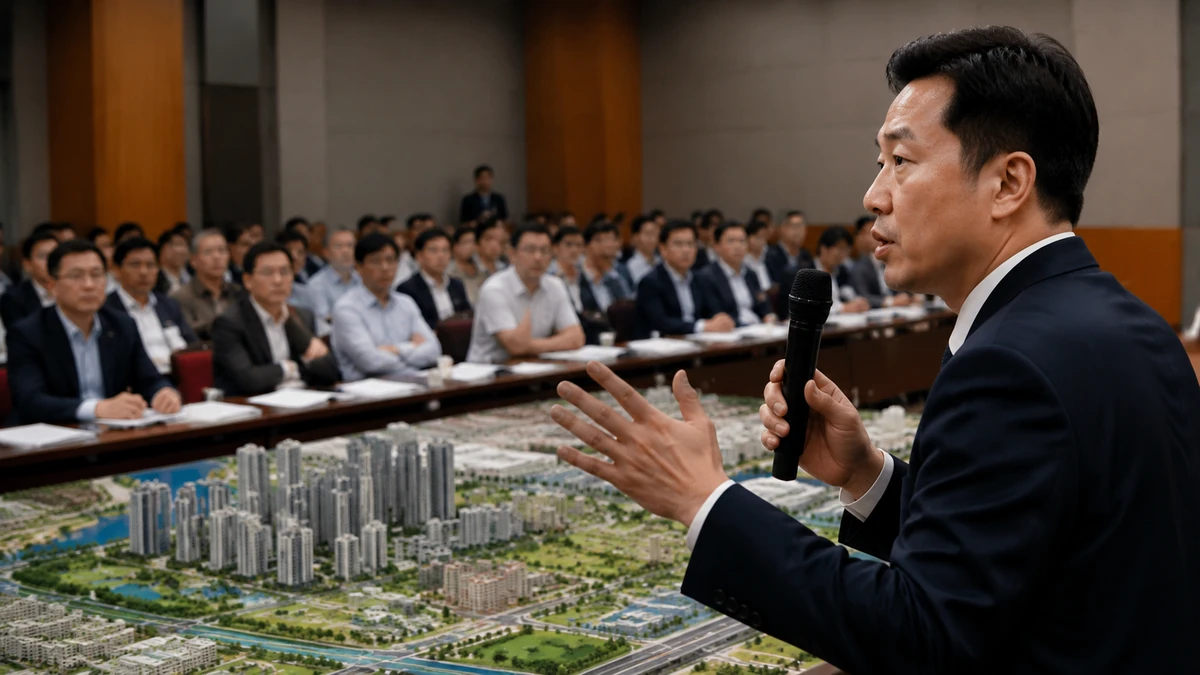
Image to help understand the article
South Korea’s housing push is running into a familiar problem
South Korea’s government has been promising faster housing supply, a politically sensitive goal in a country where real estate prices, urban density and access to transit can shape family finances as much as wages do. But a case now emerging from the Geomam Station area in Incheon, west of Seoul, underscores a lesson that urban planners and developers in the United States would instantly recognize: Finding land is only the beginning. The harder part is often getting permission to use it in a way that matches what the market actually needs.
At an industry briefing held Aug. 21 in Seoul by South Korea’s Ministry of Land, Infrastructure and Transport, a developer involved in a land-compensation project in the Geomam Station district asked the government to quickly convert a parcel currently designated for “urban support facilities” into land zoned for a mixed-use residential complex. In plain English, the developer is saying this: The land has already been secured through the public compensation process, but it cannot move efficiently into housing development unless officials change what the land is allowed to be used for.
That request may sound technical, even obscure. It is not. It goes to the heart of why governments can announce ambitious housing plans and still struggle to get apartments built at the pace voters expect. Policy announcements tend to focus on supply in broad terms — more land, more units, more projects, faster timelines. What often gets less attention is the chain of approvals that comes afterward: zoning, land-use conversion, infrastructure coordination, school capacity, transportation planning and the rules governing what kind of housing can be built where.
The Geomam case matters because it shows that South Korea’s “rapid supply” strategy is now entering a more difficult phase. The easy political message is that the government is opening the pipeline. The harder administrative task is making sure land already in the pipeline can actually turn into homes. The distinction may sound bureaucratic, but in fast-growing metropolitan areas, it can determine whether a project advances in months or stalls for years.
For American readers, the dynamic is easy to map onto debates in places like California, the New York region or greater Washington, where elected officials often agree on the need for more housing near transit but encounter resistance and delay when converting that principle into approved projects. In both countries, the friction point is not always whether housing should be built. Often it is whether a specific parcel, under a specific set of rules, can be adapted to a specific type of housing at the moment demand is strongest.
What the Geomam Station dispute is really about
The Geomam Station area is what Koreans call a “station area,” meaning land surrounding a rail stop that is seen as especially valuable for concentrated development. In Korean urban policy, station-area projects often carry outsized significance because they can combine commuting convenience, retail access and higher-density housing in one place. That makes them central to any strategy aimed at easing housing pressure without pushing people farther from jobs and public transportation.
In this case, the developer received land through a compensation framework known in Korea as “daeto bosang,” or land compensation. Rather than being paid only in cash when public development reshapes an area, stakeholders may receive land that can later be used for new projects. In theory, this creates a bridge from compensation to redevelopment. In practice, that bridge works only if the land’s official designation aligns with real market demand.
That is exactly where Geomam appears to have hit a wall. According to the summary of the industry meeting, the developer argued that although the land was supplied under government policy, changing market conditions and regulatory constraints have made it difficult to move forward. The parcel in question is designated as urban support facility land, a category intended for functions that support city activity rather than straightforward housing. The developer wants it switched to mixed-use residential land, a category that would permit a combined residential-and-commercial project.
Mixed-use complexes are a familiar feature in South Korea’s urban landscape, especially around train stations. Americans might think of them as a cousin to the transit-oriented developments that have reshaped parts of Arlington, Virginia; the Seattle region; or neighborhoods around commuter rail in New Jersey. In Korea, these projects often bring apartments, shops and neighborhood services together in a compact footprint. The rationale is practical: If people are going to live in dense housing near a station, they also need daily amenities in walking distance.
What is notable here is not that a developer wants more flexibility. Developers nearly always do. What matters is that the request was made in the context of the government’s Aug. 13 housing supply plan, which is meant to accelerate delivery. The Geomam example suggests that the final barrier to supply may not be raw land acquisition. It may be the administrative conversion of already-secured land into a legally usable housing site.
Why land-use categories can make or break housing policy
To outsiders, arguments over land use can sound like bureaucratic inside baseball. But zoning and land designation are among the most powerful tools in any housing market. They determine not only what can be built, but also whether financing is viable, whether timelines are predictable and whether developers believe a project is worth pursuing at all.
The Geomam case highlights a broader truth about urban development in South Korea: Housing supply is not just a numbers problem. It is a systems problem. If a government identifies a site, compensates stakeholders and folds the parcel into a public housing district, that does not guarantee homes will follow. The land still has to be matched to a viable product — apartments, mixed-use towers, office space, retail, or some combination — and that match must reflect current demand rather than yesterday’s planning assumptions.
That challenge is particularly acute near transit. Rail-adjacent land is scarce and politically valuable. Officials want it to serve multiple public purposes at once: housing, economic activity, walkability, infrastructure efficiency and a livable neighborhood environment. Those goals can complement one another, but they can also collide. If too much land is reserved for nonresidential support uses, the pace of housing may lag. If too much is shifted into housing, communities may worry about overcrowding, inadequate schools or insufficient local services.
The Korean summary makes clear that no decision was reached at the Aug. 21 session. No formal timetable for conversion was announced. That restraint matters. This is not yet a story about a policy victory for developers or a confirmed rule change by the ministry. It is a story about where pressure is building inside the system. The request itself is newsworthy because it reveals what the industry believes is now blocking supply on the ground.
It also reveals a tension at the center of South Korea’s housing politics. Governments want speed. Cities need balance. Developers want flexibility. Residents usually want proof that infrastructure will keep up. The Korean article explicitly notes that faster conversion alone is not enough; infrastructure and educational conditions also have to be considered if the result is to be a sustainable residential environment. That is a reminder that “build faster” is often the easiest slogan and the hardest policy to execute responsibly.
The offictel question points to a second layer of regulatory friction
The same developer also raised another issue that will resonate with anyone who follows urban housing policy: the possibility of building residential offictels on commercial land in the public housing district. An offictel is a distinctly Korean real estate product — originally combining characteristics of an office and a studio-style residence. Over time, offictels have often functioned as housing, especially for singles, young professionals and smaller households, but they remain subject to rules that reflect their hybrid status.
For American readers, the closest comparison is not exact, but think of a building type that sits somewhere between micro-apartments, live-work units and compact multifamily housing allowed under specialized regulations. Because offictels blur categories, they can become useful pressure valves in tight housing markets. They can also trigger regulatory disputes over whether commercial land is being used as housing by another name.
In Geomam, the developer said public-housing offictel guidelines are making it difficult to move ahead and asked for looser rules in cases where infrastructure and educational conditions are already in place. That caveat is important. The request, at least as described, is not for a blanket deregulation of commercial sites. It is for more flexible standards in locations that can plausibly support additional residential use.
This is where the story becomes less about one district and more about a trend. Korea’s urban planners are wrestling with the same question facing many developed economies: Should rules treat land-use categories as fixed and mutually exclusive, or should they adapt when demographic demand shifts and certain neighborhoods are ready for more housing? The answer increasingly appears to be the latter — but only through selective, conditional adjustment rather than wholesale deregulation.
That distinction matters because it frames what to watch next. The real issue is not whether South Korea will eliminate controls. It is whether it can create a faster and more predictable process for granting exceptions, especially in rail-linked areas where the case for higher-density living is strongest. If the government’s broader supply plan is to succeed, these intermediate approvals may matter more than the headline announcement that launched the policy in the first place.
What this means for the United States
For Americans, the Geomam debate is not simply an interesting Korean zoning story. It is a window into how one of the United States’ closest allies is confronting a housing problem that looks increasingly global. South Korea, like the U.S., faces the political consequences of expensive urban housing, the economic importance of construction and the social pressure to create livable communities near transit rather than farther and farther out on the suburban edge.
That makes this case relevant to U.S. audiences in several ways. First, it reinforces a lesson that American policymakers have learned repeatedly, often the hard way: Land supply metrics can be misleading if entitlement and use restrictions remain unresolved. A governor, mayor or federal official can tout the release of sites for development, but unless those sites can be converted into product types people will actually buy or rent, the supply effect may be delayed or diluted.
Second, it underscores how closely transportation and housing are linked. In the U.S., the phrase “transit-oriented development” has become something of a planning cliché, but the principle is still contested in practice. Communities want the benefits of stations — access, commerce, rising land values — yet often resist the density that makes transit-centered neighborhoods function efficiently. South Korea’s station-area politics are different in scale and style, but the underlying trade-off is familiar.
Third, there is a business angle. American investors, engineering firms, architecture practices, materials suppliers and real estate analysts watch South Korea because it is a sophisticated urban market with advanced public transportation and high-density development experience. Regulatory signals from Korea can influence how global firms think about mixed-use construction, compact housing formats and the balance between public planning and private execution. While the Geomam request itself is local, the structural issue it reveals — whether governments can translate pro-supply rhetoric into workable approvals — has implications far beyond one Incheon district.
Fourth, there is a diplomatic and comparative-policy angle. U.S.-South Korea ties are usually discussed in terms of security, semiconductors, trade, electric vehicles and pop culture. But urban policy is another sphere where the two countries increasingly confront parallel pressures: affordability, aging populations, household fragmentation and the need to make better use of transit-served land. Korea’s housing experiments may not transplant neatly to the U.S., yet they can still offer case studies in what happens when a state tries to accelerate supply without abandoning planning controls altogether.
American readers should also note what this story does not show. It does not show a uniquely Korean dysfunction. If anything, it illustrates a universal one. From Los Angeles to Boston, from Seoul to Incheon, housing systems often get stuck not at the moment of grand policy design, but in the slower, less glamorous stage where agencies must reconcile land designation, infrastructure obligations and local feasibility. That is the part of housing politics that rarely produces dramatic headlines, even though it often determines the final number of homes built.
Why this matters now in South Korea’s policy cycle
The timing is significant. The Aug. 21 briefing was jointly hosted by major industry groups in housing, homebuilding and real estate development, and it centered on the details of the government’s Aug. 13 rapid housing supply measures. That sequence suggests the conversation in Korea is moving from announcement to implementation. In other words, the political phase of saying what the government intends to do is giving way to the operational phase of determining whether projects can actually move.
That transition is often where housing agendas succeed or fail. Early announcements can create momentum and reassure markets. But once developers begin identifying the exact rules that stand in their way, policymakers face tougher choices. Do they preserve existing land-use categories and risk delay? Do they selectively relax standards and risk criticism that planning principles are being bent for expedience? Do they require more infrastructure commitments first, which may improve long-term outcomes but slow near-term delivery?
The Geomam case captures that moment of transition with unusual clarity. The project is not asking the government to discover entirely new land. It is asking the government to make administratively usable what has already been supplied through a public process. That is why the case can be read as a test of execution capacity. If a flagship supply strategy cannot resolve this kind of bottleneck, then headline promises of faster delivery may struggle to translate into visible housing starts.
It also points to a broader evolution in how Korea is thinking about urban land. The summary notes that the country’s housing debate is expanding beyond the search for new sites and toward the redesign of existing land near stations so that residential, commercial and support functions work together. That shift matters. Mature metropolitan regions rarely solve housing shortages simply by finding empty space. More often, they revisit what already exists and ask whether the rules governing it still make sense.
In that respect, Geomam is less a one-off dispute than a live stress test for a new phase of Korean urban policy. It raises the question of whether the state can move beyond land banking and toward dynamic land-use adjustment without losing sight of schools, infrastructure and neighborhood function. The answer will shape not only this project, but the credibility of future supply measures as well.
What to watch next
The most immediate question is whether South Korea’s land ministry creates a mechanism to review these kinds of requests more quickly. That does not necessarily mean approving every conversion. It could mean setting clearer criteria for when urban support land near transit can shift to mixed-use residential use, or when residential offictels on commercial parcels may be permitted if surrounding conditions are strong enough.
Another question is whether Geomam becomes a precedent. If one developer publicly argues that already-supplied land is unusable without reclassification, others may make similar claims in different public housing districts. That could pressure the government to articulate a broader framework rather than handling each case ad hoc.
A third issue is whether Korea can maintain the balance emphasized in the source summary itself: speed on one hand, urban function on the other. Faster approvals can increase supply, but poorly sequenced development can strain schools, roads and neighborhood services. The politically sustainable path is likely to involve targeted flexibility tied to concrete local readiness, not a blanket loosening of every rule.
For U.S. observers, the Geomam story is worth following precisely because it is so specific. Big trends in housing often reveal themselves through small procedural fights. One parcel near one station in one Korean city can illuminate a much larger truth about modern development: The real chokepoint is often not whether a government says it wants more housing, but whether its rules can adapt quickly enough to let that housing happen in the places that make the most sense.
That is as true in South Korea as it is in the United States. And in both countries, the future of housing policy may depend less on dramatic announcements than on whether planners, regulators and developers can agree on a practical answer to a deceptively simple question: Now that the land is there, what are we actually allowed to build on it?
Comments
Post a Comment