A simple shift at the dinner table: Korean study suggests eating vegetables first may blunt blood sugar spikes
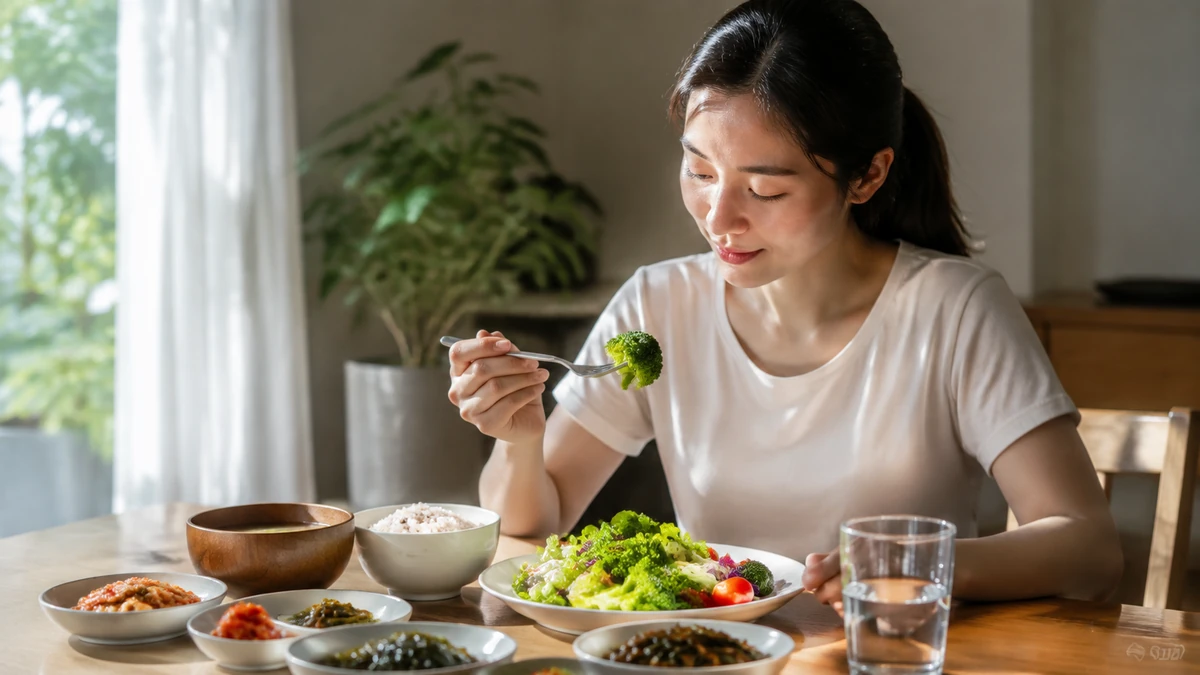
Image to help understand the article
A small Korean study points to a big question Americans are already asking
For years, nutrition advice in the United States has tended to focus on what people should cut out: less sugar, fewer refined carbohydrates, smaller portions, fewer late-night snacks. But a new study from South Korea highlights a different and, for many people, far more practical question: Not just what are you eating, but in what order are you eating it?
Researchers at Ewha Womans University in Seoul found that healthy young women who ate vegetables first during a meal had a lower average post-meal blood sugar peak than when they ate carbohydrates first, even though the meal itself and the portion sizes stayed the same. According to the study, the average peak blood glucose level after eating vegetables first was 6.92 mmol/L, compared with 8.18 mmol/L when carbohydrates came first. The timing changed, too. When vegetables came first, blood sugar peaked at an average of 104 minutes after the meal; when carbohydrates came first, the peak came in about 49 minutes.
That does not mean a salad is now a miracle drug, or that meal order matters more than overall diet quality. It does mean that a deceptively simple behavior, eating vegetables and protein before rice, bread or other starches, may influence how sharply blood sugar rises after a meal. In a country like the United States, where prediabetes and Type 2 diabetes are widespread and where consumers are bombarded with expensive hacks, powders and wearable glucose gadgets, the appeal of that message is obvious.
The study, published in the journal Diabetes, Obesity and Metabolism, does not offer a cure or a universal rule. It does, however, add to a growing body of research suggesting that the mechanics of a meal, its pacing, sequencing and composition, can shape the body’s response in ways that go beyond calorie counts alone.
That idea also travels well across cultures. In Korea, the finding resonates because rice is a staple at many meals, just as bread, pasta, potatoes and packaged snack foods anchor much of the American diet. The study’s premise is not that people must abandon carbohydrates entirely. Instead, it suggests that when vegetables, protein and carbohydrates are all on the table, the order may matter.
What the Korean researchers found, and what they did not
The basic result is straightforward. In a group of 33 healthy young Korean women, eating vegetables first was associated with both a lower and slower post-meal blood sugar rise than eating carbohydrates first. The gap in the average peak glucose reading was 1.26 mmol/L. The time to reach that peak differed by roughly 55 minutes.
Those numbers matter because blood sugar is not only about how high it goes, but how fast it gets there. A meal that produces a quick, steep spike may leave people feeling different afterward than a meal that produces a slower, flatter curve, even if the ingredients are the same. In recent years, that has become a larger topic in nutrition science and among consumers, especially with the rise of continuous glucose monitors, or CGMs, that let people watch those curves in real time.
Still, the study’s limits are just as important as its findings. The participants were a small, narrow group: healthy young women in Korea. That means the results cannot automatically be applied to men, older adults, children, people with diabetes, or people in different dietary environments. Americans should be especially careful not to treat the reported figures as a promise that everyone will see the same effect from the same strategy.
The research also does not say that eating vegetables first overrides everything else. It does not suggest that people can load up on refined carbohydrates without concern so long as they start with greens. And it does not show long-term outcomes such as weight loss, lower A1C levels, or reduced diabetes risk over time. What it shows is more modest and more useful: Under controlled conditions, meal order was linked to meaningfully different post-meal glucose responses.
That distinction matters in an era when health news often gets flattened into click-friendly absolutes. “Vegetables first” is not a treatment plan. It is better understood as a potentially helpful eating habit, one that may fit alongside broader nutrition guidance rather than replace it.
Why meal order is getting attention in nutrition science
The Korean findings land at a moment when blood sugar management has moved from specialist clinics into mainstream wellness culture. In the United States, people with diabetes have long monitored glucose as a medical necessity. More recently, a broader market of health-conscious consumers has begun paying attention to glucose spikes as part of everyday eating, fitness and weight management. Social media influencers discuss “glucose hacks.” Startups market sensors and apps. Grocery brands advertise higher protein and lower sugar as a way to avoid energy crashes.
Underneath some of the hype is a legitimate scientific question: How do different eating patterns affect the body’s metabolic response? One reason meal order has drawn interest is that it appears easier to implement than strict carbohydrate restriction. For many people, cutting rice, bread or noodles entirely is unrealistic. It can clash with family meals, cultural traditions, budgets and simple enjoyment. Reordering the same plate is less disruptive.
There is also a plausible biological logic. Vegetables, especially non-starchy ones, often contain fiber, which can slow digestion. Protein can also affect how quickly food leaves the stomach and how the body processes incoming glucose. If a person starts a meal with fiber-rich vegetables and protein, then eats starch later, the carbohydrates may enter a system that is responding differently than if the meal began with white rice or bread alone.
That does not make the strategy new in a broad sense. Many traditional eating patterns around the world, including in parts of Asia, the Mediterranean and even older American home-style cooking, naturally separate meals into courses or side dishes that slow down the rush toward starch and sugar. What feels novel now is the framing. Instead of talking about “balanced meals” in a general way, researchers and consumers are discussing the shape of the glucose curve after lunch.
In that sense, the Korean study is less about a one-day finding than about a broader shift in how people think about nutrition. The old model emphasized totals: calories, grams of fat, grams of carbs. The newer model still cares about those totals, but it also looks at timing, sequence and individual response. That is a more complicated story, but also a more realistic one. People do not eat nutrients in a lab. They eat meals in a sequence, in a culture, often while rushing through workdays.
Why this resonates in Korea, where rice is central but food is shared
To understand why this study drew attention in South Korea, it helps to understand the structure of a Korean meal. In many Korean households and restaurants, rice is not the entire meal but one central component alongside multiple side dishes, known as banchan, which can include vegetables, fermented foods such as kimchi, proteins, soups and other small plates. That means a Korean table often naturally presents the possibility of rearranging the order of eating without changing the menu itself.
That cultural detail matters. In the United States, advice about blood sugar often comes packaged as deprivation: skip the bread basket, hold the fries, avoid dessert, trade pasta for zucchini noodles. In a Korean meal structure, the question can be framed more subtly: If vegetables, protein and rice are all already present, what happens if rice comes later?
The study’s practical appeal lies there. It is not asking people to buy a specialty food, subscribe to a health program, or learn a complicated formula. It is asking whether an ordinary meal can be reorganized in a slightly different way. That is especially relevant in Korea, where many meals already involve alternating bites of different foods rather than consuming one large, single-item dish.
At the same time, the study pushes back against a simplistic anti-carbohydrate message. Rice, in Korea, is not merely another processed starch. It is tied to daily life, comfort, etiquette and memory, much as bread or potatoes may be for many Americans. A finding that suggests people do not necessarily have to banish carbohydrates, but may instead rethink how they approach them, is likely to feel more realistic and less culturally disruptive.
That is one reason the study has broader appeal outside Korea as well. It speaks to a universal tension in modern nutrition: how to improve health without turning every meal into a battle against tradition, pleasure or practicality.
What this means in the United States
For Americans, the most immediate takeaway is not that Korea has discovered a secret, but that the study underscores how much room there may be for low-cost, behavior-based nutrition strategies in a country with enormous metabolic health challenges. The United States spends billions dealing with diabetes, obesity and related conditions. At the same time, consumers are inundated with products promising better blood sugar control, from high-protein snack bars to subscription-based glucose monitoring services.
Against that backdrop, the Korean findings are notable because they point in the opposite direction of commercial complexity. If meal sequencing can meaningfully affect post-meal glucose, then one useful intervention may be almost comically simple: Start dinner with the salad, vegetables or protein, and save the bread, rice, pasta or potatoes for later in the meal.
That message is particularly relevant in an American food environment built around convenience and speed. Many U.S. meals begin with the most rapidly digestible carbohydrates by default: a breakfast of toast or cereal, a lunch built around bread, a drive-thru meal of fries and a bun, a snack that is mostly crackers or chips. In that context, “carbs first” is not a special case. It is often the norm. The Korean study raises the possibility that part of the glucose challenge in American eating may not only be the amount of carbohydrate consumed, but the structure of the meal itself.
There is also a business angle. American food companies have spent years reformulating products around protein, fiber and lower added sugar. Restaurant chains increasingly market bowls, salads and customizable plates that let diners choose vegetables and protein before adding grains. Wearable health technology companies, many of them targeting affluent consumers, have helped popularize the language of glucose spikes. Research like this could further encourage product design and restaurant marketing built around sequencing, not just ingredients.
For U.S.-Korea ties, the story is a reminder that health and food research are another underappreciated area of exchange between the two countries. South Korea is often discussed in the United States through the lens of semiconductors, autos, defense ties and pop culture exports like K-pop and Korean dramas. But Korean universities and researchers also contribute to conversations that matter to American daily life, including diet, aging and chronic disease. As Korean food continues to grow in popularity in the United States, from bibimbap chains to grocery-store kimchi, studies like this may also shape how Americans think about Korean eating patterns beyond trendiness.
None of that means Americans should suddenly treat Korean meal customs as medical instructions. But it does suggest that the Korean research may land in the United States at exactly the right moment, when consumers, doctors, public health officials and food companies are all looking for realistic ways to improve metabolic health without requiring perfect compliance or radical restriction.
The larger trend: From cutting foods out to redesigning how meals work
If there is a bigger trend embedded in this study, it is the growing shift from elimination to design. Much of modern diet culture has been organized around subtraction: fewer carbs, less fat, fewer calories, no eating after a certain hour. That approach can work for some people, but it often fails in the real world because it collides with hunger, habit, economics and culture.
Meal-order strategies belong to a different category. They ask whether health can be improved by redesigning routines rather than outlawing foods. That is a more flexible framework, and one that may prove more sustainable for people who are not trying to optimize every bite. In practical terms, it is the difference between saying “never eat rice” and saying “if you are eating rice anyway, consider eating your vegetables and protein first.”
American readers have seen versions of this logic before. Public health campaigns have encouraged people to fill half the plate with fruits and vegetables. Diabetes educators have long discussed pairing carbohydrates with protein and fiber. Parents tell children not to spoil dinner with sweets. What is changing is the level of specificity and the use of measurable glucose data to support everyday meal habits.
That, in turn, could influence how doctors, dietitians and even app developers talk to patients and consumers. Instead of assuming dietary change must begin with subtraction, they may increasingly focus on sequence, pacing and combination. Those are less glamorous interventions than prescription drugs or viral wellness trends, but they may be more scalable for ordinary households.
The caution is that this emerging conversation can also be oversold. Once a concept enters the wellness marketplace, nuance often disappears. A preliminary or limited finding becomes a universal commandment. Consumers may start treating minor glucose fluctuations as dangerous for everyone, even though the clinical implications differ widely depending on a person’s health status. The Korean study is best viewed as a piece of a larger puzzle, not the final picture.
What readers should watch next
The most important next step is replication in broader groups. Do similar results appear in men, older adults, people with prediabetes or diabetes, and people from non-Korean dietary backgrounds? Do the effects hold up over months, not just individual meals? Can changing meal order improve long-term markers such as A1C, energy regulation or appetite? Those are the questions that would determine whether this finding remains an interesting insight or becomes a more durable part of mainstream guidance.
Researchers will also need to sort out how much the effect depends on the kind of carbohydrate and the kind of vegetable. There is a major difference between eating leafy greens and then a modest portion of rice, versus eating a token side salad before a stack of pancakes drenched in syrup. In the American context, where ultra-processed foods are common and portion sizes are often larger than in Asia, meal order alone may have limits.
Still, the study offers something valuable precisely because it is modest. It does not promise to revolutionize nutrition. It suggests that small structural changes in how meals unfold may influence the body in measurable ways. In a health culture often dominated by all-or-nothing thinking, that is a useful reminder.
For readers trying to make sense of conflicting diet advice, the practical lesson is simple and cautious: If your meal includes vegetables, protein and carbohydrates, it may be worth trying vegetables and protein first, with starches later, especially if you are concerned about blood sugar. But that is not a substitute for medical care, personalized dietary guidance or attention to overall eating patterns.
In other words, the Korean researchers are not telling Americans to fear bread or worship broccoli. They are pointing to something more ordinary and perhaps more powerful: Sometimes the most meaningful change at the table is not eating less, but eating the same foods in a different order.
Comments
Post a Comment