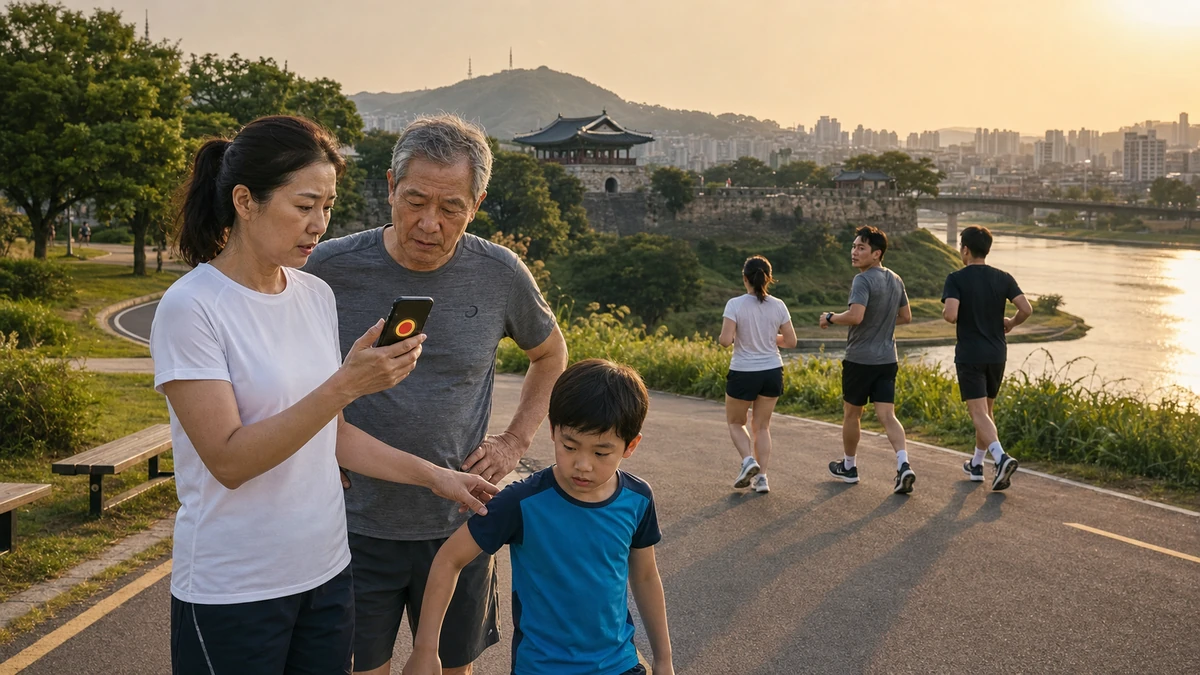
When the air turns risky after sunset
For many people, the logic of a hot summer day is simple: Wait until the sun goes down, then head outside. Go for a walk after dinner. Take the kids to the park. Squeeze in a run when the worst of the heat has passed. But in two cities in South Korea on Friday evening, that common summer instinct no longer held up.
At 7 p.m., authorities issued an ozone advisory for Jinju and Sacheon, two cities in South Gyeongsang province in the country’s southeast, after one-hour average ozone concentrations climbed above the government’s alert threshold. Jinju recorded 0.1347 parts per million, while Sacheon measured 0.1231 ppm, both above the 0.12 ppm benchmark that triggers an advisory under South Korean air-quality rules.
The numbers did not reach the higher levels required for a more serious ozone warning or a severe warning. But health officials’ message was still clear: Older adults, children, and people with respiratory or heart conditions should limit outdoor activity, and even healthy residents should avoid strenuous exercise outside.
That matters because the advisory arrived not in the blistering middle of the afternoon, when many people already assume conditions are dangerous, but in the evening, the very time many residents would normally consider safer. In practical terms, the alert meant a family planning a neighborhood stroll, an office worker heading out for a bike ride, or grandparents taking children outside after dinner all had reason to reconsider.
For American readers, the situation may sound familiar in broad outline but different in timing and intensity. In the United States, people are accustomed to checking heat advisories, Air Quality Index readings or wildfire smoke updates. South Korea is increasingly asking residents to do something similar: monitor not just the thermometer, but a layered mix of heat, humidity, and hour-by-hour air chemistry that can reshape daily life even after sunset.
The advisory in Jinju and Sacheon offers a small but revealing window into what summer now looks like in many dense, modern cities. The danger is no longer just obvious heat. It is also the less visible risk of polluted air, measured in decimals and delivered by smartphone alerts, weather apps and public-health notices that can change how a city moves on a summer night.
What an ozone advisory means in South Korea
Ground-level ozone is not emitted directly into the air. It forms when pollutants such as nitrogen oxides and volatile organic compounds react in sunlight and heat. Unlike the protective ozone layer high in the atmosphere, ground-level ozone is considered harmful. It can irritate the lungs, worsen asthma, strain the cardiovascular system and make exercise outdoors risky, particularly for vulnerable groups.
South Korea’s system sets specific thresholds. An ozone advisory is issued when the one-hour average concentration reaches 0.12 ppm or higher. A stronger ozone warning begins at 0.30 ppm, and a severe warning starts at 0.50 ppm. By those standards, Friday’s readings in Jinju and Sacheon were in the first stage, but clearly beyond the point where health officials want the public to change behavior.
The Korea Environment Corp., a public agency affiliated with the Environment Ministry, tracks such readings. The decimal-heavy figures may look technical or even deceptively small, but the unit matters. Ppm, or parts per million, is a standard measure of concentration. In air-quality reporting, a tiny shift can be enough to cross a regulatory line that carries real health guidance.
That is why officials and public-health experts typically urge residents not to get hung up on comparing one city’s number to another city’s by a few thousandths of a point. What matters most is whether the place where you are standing has entered a category that calls for caution. In this case, Jinju exceeded the advisory threshold by 0.0147 ppm, while Sacheon was 0.0031 ppm above it. The gap between the two cities may be interesting to analysts, but for ordinary residents, the practical conclusion is the same: reduce outdoor exertion.
That message especially applies to people who might otherwise assume advisories are mainly for the sick or elderly. South Korean guidance, much like public-health guidance elsewhere, does place special emphasis on people at higher risk. But it also extends to healthy adults if they are planning intense outdoor exercise such as running, cycling or sports drills. In other words, this was not simply a warning for hospital patients. It was also a warning for the after-work runner and the weekend fitness crowd.
Americans may think of summer air alerts through the lens of AQI colors, smog days in Los Angeles or wildfire smoke drifting across the Midwest and East Coast. South Korea’s approach uses different thresholds and categories, but the underlying principle is similar: air quality is not abstract environmental data. It is actionable public-health information that determines whether normal outdoor activity is wise.
Why the 7 p.m. timing stood out
What made the advisory particularly notable was not only the concentration but the hour. Summer in South Korea can be punishingly hot and humid, and as in many places, residents often reorganize their days around the heat. Outdoor exercise shifts later. Parents take children outside after dinner. Older adults wait until evening for walks. Side streets, river paths and neighborhood parks often become more active after dark rather than less.
That is why a 7 p.m. ozone advisory carries a specific kind of disruption. It challenges the assumption that once direct sunlight fades and the temperature eases, the outdoors automatically becomes safer. On this day, that assumption failed. Heat was still part of the story, but so was the lingering chemical aftermath of a hot summer day.
For residents of Jinju and Sacheon, the advisory functioned less as a scientific bulletin than as a practical signal: rethink tonight’s routine. A short walk to run errands is different from a 45-minute jog. A child’s quick trip outside is different from a long stretch on a playground. Advisories often leave room for judgment, but they also ask people to think more carefully about intensity, duration and personal health status.
That kind of recalibration is increasingly familiar in modern cities. In the U.S., people routinely check whether it is too hot to walk the dog on pavement or whether wildfire smoke makes it unsafe to exercise outside. In South Korea, summer evening decisions are increasingly shaped by a similar blend of weather awareness and real-time health alerts, even though the specific hazards may differ.
The timing also underscores how public understanding of “summer safety” is changing. It is no longer enough to ask, “Is it cooler now?” A better question may be, “What does the air look like right now?” In places where pollution and heat interact, a lower temperature alone may not tell the full story. People need to know whether ozone concentrations remain elevated, whether humidity is pushing the heat index higher, and whether local authorities have issued official guidance.
That shift has implications beyond one evening in two South Korean cities. It points to a broader urban reality in which public-health awareness becomes more granular and more immediate. Safety is no longer based on instinct alone. It increasingly depends on live data, local alerts and the ability of governments to translate technical measurements into simple advice that residents can act on quickly.
A heat wave made the warning more urgent
The ozone advisory did not arrive in isolation. South Korea was already under widespread heat-wave alerts, with much of the country experiencing extreme summer conditions. Forecasts for the following day called for continued sweltering heat and tropical nights, a term commonly used in Korea and Japan to describe nights when temperatures remain so high that they offer little relief after sunset. In parts of the southern regions, including Jeolla and Gyeongsang areas, daytime highs were expected to rise above 39 degrees Celsius, or about 102 degrees Fahrenheit. Elsewhere, the heat index was projected to hover around 35 degrees Celsius, roughly 95 degrees Fahrenheit.
For American readers, that is the kind of heat more often associated with the Deep South, desert Southwest or major East Coast heat emergencies. What makes the Korean case notable is the combination of intensity, humidity, urban density and a public-alert culture that increasingly treats weather and air quality as linked threats rather than separate issues.
When heat and ozone overlap, the burden on residents becomes more complicated. A person may already be trying to avoid midday exposure because of heatstroke risk, dehydration or extreme humidity. If ozone remains high into the evening, the usual fallback plan, going out later, may no longer work. The result is a narrower safe window for outdoor life.
That narrowing matters in a society where summer evenings are socially and practically important. In South Korea, many workers finish long office days and reclaim personal time only after dark. Families often depend on evenings for errands, exercise and outdoor recreation. During hot weather, that routine becomes even more pronounced. An ozone advisory in the evening therefore cuts into one of the few periods people expect to be usable.
Officials were also responding to the broader health risks of the heat wave itself. South Korea’s Health and Welfare Ministry said the central disaster and safety headquarters for heat had been raised to Level 2, prompting requests to local governments and related organizations to strengthen protection for vulnerable groups. Health Minister Chung Eun-kyung called for extra attention to older adults at high risk, especially those with mobility difficulties or those doing agricultural or fishing work in rural areas. The guidance included checking on people by phone or in person at least once a day during heat advisories and twice a day during severe heat alerts.
That aspect of the story may be especially resonant for U.S. readers. Much as American cities now focus on cooling centers, welfare checks and outreach to seniors during extreme heat, South Korean authorities are refining their own systems of contact and care. The shared lesson is that climate-linked risks are no longer just meteorological. They are social, requiring institutions to identify who is most exposed and how to reach them fast.
How Korean daily life is adapting to real-time risk alerts
One of the most revealing parts of the Jinju-Sacheon advisory is how ordinary and immediate the response has become. In South Korea, where smartphone penetration is extremely high and public alerts are a routine part of civic life, information about weather, air quality, infectious disease and emergency conditions can circulate quickly through texts, apps, local notices and messaging platforms such as KakaoTalk, the country’s dominant mobile app.
That matters because the effectiveness of an air-quality advisory depends on speed and clarity. Ozone levels can change by time of day and by location. Two neighboring cities can register different concentrations. A parent deciding whether to let a child play outside, or a caregiver deciding whether an elderly relative should go for a walk, needs current local information, not a vague regional impression.
South Korean officials have increasingly emphasized that point. The safest decision is based not on what the weather felt like an hour ago or what another town reported, but on the official conditions in the specific place and time where a person plans to be outdoors. That may sound obvious, but it reflects a larger transition in urban living. Real-time safety information is becoming part of daily planning, like traffic conditions or transit updates.
The article summary also notes outreach to elderly people registered with dementia safety centers and their caregivers through rapid messaging about heat-wave behavior guidelines. That detail speaks to a highly organized style of public administration that can seem striking to outsiders. In South Korea, local governments and health systems often maintain structured communication networks for vulnerable populations, allowing guidance to reach families quickly during fast-changing conditions.
For Americans, there is a recognizable parallel in local emergency text alerts, county heat advisories, school sports cancellations and air-quality notifications tied to wildfire smoke. But South Korea’s dense cities, digital infrastructure and culture of fast public messaging can compress that process into an even more immediate part of everyday life.
In practical terms, that means the modern Korean summer evening may now require a checklist: not just “Is it dark yet?” or “Has the temperature dropped?” but “What is the local ozone level?” “Is a heat alert still in effect?” “How strenuous is the activity?” and “Who is going outside?” That is a subtle but important shift. It turns safety from a general sense into a more precise, data-driven habit.
What this story says about climate, cities and public health
It would be easy to view an ozone advisory in two South Korean cities as a narrowly local story. In one sense, it is. The specific readings applied to Jinju and Sacheon at a particular hour on a particular day. But the broader meaning travels well beyond those city limits.
The advisory highlights a challenge that cities around the world are confronting: summer risk is becoming more layered. Heat alone can be dangerous. Air pollution alone can be dangerous. Together, they complicate daily life in ways that are less visible than a typhoon or flood but no less consequential for public health.
It also shows how climate-era adaptation increasingly happens through information systems. The response to a threat like elevated ozone is not dramatic in the cinematic sense. There are no evacuation orders or closed highways. Instead, there are thresholds, dashboards, alerts, guidance and countless small acts of adjustment by individuals: postpone the run, keep the child indoors, call an elderly parent, shorten the outing, skip the bike ride. A city changes course by degrees.
That may be one reason this kind of story resonates internationally. In the United States, people have become more accustomed to the idea that environmental hazards can shape routine decisions on ordinary days. Smoke from distant fires, dangerous heat in school sports, bad air during a city marathon, or alerts warning sensitive groups to stay indoors, these are no longer unusual headlines. South Korea is experiencing its own version of that reality, filtered through its climate, geography and urban rhythms.
The Jinju and Sacheon advisories also underscore the importance of communication that ordinary people can understand. Most residents do not need a detailed lecture on atmospheric chemistry. They need to know whether tonight is a good night to go outside, who should be most careful, and what kind of activity is worth postponing. In that respect, the best public-health messaging is often the simplest: do less outside, especially if you are vulnerable or planning strenuous exercise.
There is, finally, something deeply modern about a summer evening being redirected by a notification on a phone. The old signals, sunshine, darkness, how hot the pavement feels, are still relevant, but they are no longer enough. Life in many advanced urban societies now depends on invisible measurements interpreted by public systems and delivered in real time to citizens who are expected to act on them.
That is the bigger takeaway from South Korea’s latest ozone advisory. In Jinju and Sacheon, the issue was not panic or catastrophe. It was adjustment. A walk delayed. A run canceled. A child kept indoors. A caregiver making one more check-in call. Those changes may sound small, but they capture how public health increasingly works in an era of hotter summers and more complex environmental stress. Safety is becoming less about waiting for obvious danger and more about reading the signals before the risk becomes visible.
On one summer evening in South Korea, those signals said that sunset was not enough. And for cities everywhere learning to live with more extreme weather and more volatile air, that message may feel increasingly familiar.
Comments
Post a Comment