A Summer Virus Is Rising Among Young Children in South Korea. Here’s Why Health Officials Are Focused on Toys, Doorknobs and Day Care Centers.
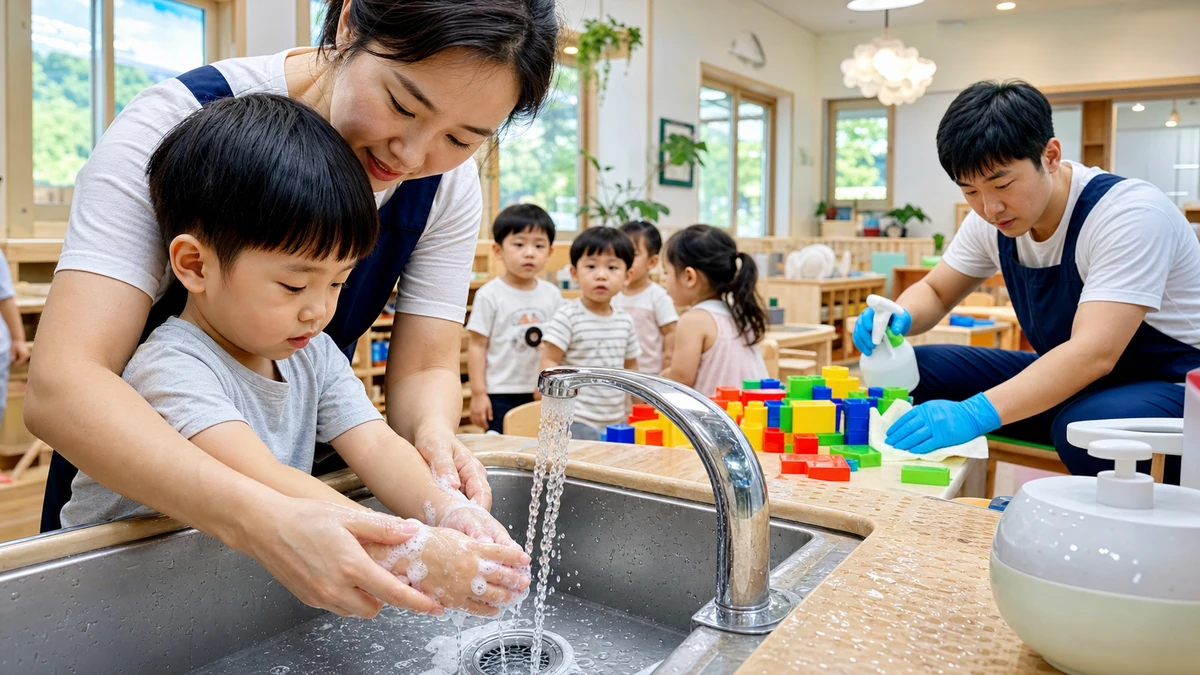
A seasonal warning for families in South Korea
Health officials in South Korea’s Gangwon province are warning that enteroviruses — a common group of viruses that can spread quickly among babies and young children — are being detected at sharply higher rates this summer, prompting renewed calls for tighter hygiene practices in child care settings and at home.
The alert, issued by the Gangwon Province Institute of Health and Environment, centers on enteroviruses that can cause hand, foot and mouth disease, an illness many American parents may recognize from day care notices, pediatrician visits and late-summer outbreaks. The disease often brings fever and blister-like rashes on the hands, feet and inside the mouth. In some cases, enterovirus infections can also lead to more serious conditions, including viral meningitis.
What makes the Korean announcement notable is not a single severe case or a hospital cluster, but the broader pattern being picked up through regional surveillance. Local officials said the virus began showing up in patient samples starting in the second week of July, and that the detection rate has since climbed enough to justify a public warning aimed at nurseries, kindergartens and families with very young children.
For American readers, the basic public health message will sound familiar: this is less about panic than about prevention. In the United States, hand, foot and mouth disease regularly circulates in day cares, preschools and homes with toddlers, especially in warmer months. South Korean officials are making a similar point. When children spend long hours together, share toys, crawl and play on common floors, and touch the same doors and surfaces over and over, the most effective response is often not dramatic medical intervention but disciplined, repeated sanitation and close observation of symptoms.
Still, the Korean health authorities are emphasizing something worth paying attention to beyond South Korea: prevention works best when child care centers and families act together. Watching one child for symptoms is important, officials say, but it is not enough if the shared environment remains contaminated or if hygiene habits are inconsistent between school and home.
What enteroviruses are, and why young children are especially vulnerable
Enteroviruses are a large group of viruses that frequently infect infants and children younger than 6. Many cases are mild. Some children may run a fever, complain of a sore mouth, become fussy, or develop the blister-like rash associated with hand, foot and mouth disease. Others can carry and spread the virus with less obvious symptoms.
In the U.S., the phrase “hand, foot and mouth disease” often causes confusion because it sounds similar to foot-and-mouth disease, the livestock illness that affects cattle and other animals. They are not the same. Hand, foot and mouth disease is a human viral illness, usually mild but highly contagious in settings where young children play, eat and nap together.
That same dynamic is at the center of the warning in Gangwon, a mountainous and coastal region in northeastern South Korea better known to many international audiences for ski resorts, scenic beaches and the 2018 Winter Olympics than for public health alerts. Local authorities there said rising detection rates suggest the virus is now circulating at a meaningful level among the region’s youngest residents.
Young children are especially susceptible for reasons that will be familiar to pediatricians anywhere. Infants and toddlers have developing immune systems. They put hands and toys in their mouths. They may not wash well on their own. They share space closely and constantly. In child care rooms, one runny nose, one toy passed from child to child, or one contaminated surface can quickly become part of a larger chain of transmission.
That is why South Korean officials are not only reminding parents to watch for fever or mouth sores, but also asking facilities to think in terms of routines and touch points. In other words, the question is not simply whether one child appears sick. It is whether the places children touch most often are being cleaned often enough to interrupt spread.
Why Gangwon officials are testing the environment, not just children
One of the more striking parts of the Korean response is how explicitly officials are talking about environmental sampling. The Gangwon Province Institute of Health and Environment said it is not limiting its work to samples taken from patients. It is also collecting samples from places inside child care environments, including toys, doorknobs and floors, to check for viral contamination.
That detail matters because it offers a window into how South Korea often approaches outbreak monitoring: not only by tracking the patients who show up at clinics, but by closely studying the everyday settings where transmission can occur. In the Korean system, provincial research institutes often work alongside the Korea Disease Control and Prevention Agency, or KDCA, and local medical institutions in surveillance programs meant to catch patterns before they become larger public health problems.
For American readers, think of it as a more targeted version of what many schools and day care centers learn the hard way every cold and flu season: children do not live their lives in isolated bubbles. Shared crayons, plastic blocks, foam mats, bathroom fixtures, nap areas and snack tables are part of the health story, too.
Officials in Gangwon say those environmental test results are being used as practical guidance for sanitation and hygiene management, not simply filed away as research data. That means testing is supposed to feed directly into real-world cleaning decisions. If a commonly handled surface or object is a repeated concern, facilities can focus staff attention there rather than resorting to vague or overly broad cleaning messages that are harder to sustain.
The distinction is important. Public health experts often stress that effective infection control depends on habits that can be repeated day after day, not one-time “deep cleans” that create a sense of action but may do little if high-contact items are neglected later. South Korean officials appear to be making the same argument. The goal is not to sterilize every inch of a child’s world, which is unrealistic, but to identify the places where repeated contact happens and manage those places consistently.
That approach also reflects a practical understanding of family life. Parents of toddlers already know that children’s environments cannot be kept spotless at all times. The smarter strategy is prioritization: toys that many hands touch, doorknobs used during pick-up and drop-off, floors where children sit and crawl, and communal items that move from one child to the next.
A familiar illness, but one that can still cause concern
Most cases of hand, foot and mouth disease resolve without serious complications, and health authorities in Gangwon are not framing the current increase as a reason for public alarm. But they are reminding families that enteroviruses can sometimes lead to more severe illness, including meningitis, an inflammation of the protective membranes around the brain and spinal cord.
That is one reason officials are urging parents not to rely on guesswork, internet rumors or isolated anecdotes. Instead, they are encouraging careful observation of symptoms and coordination with child care providers and medical professionals when needed.
The symptoms highlighted by the Korean authorities are straightforward: fever, and blister-like rashes on the hands, feet and inside the mouth. Put in everyday terms, parents are being told not to focus only on whether a child “feels warm” or seems cranky, but to look at the broader picture. Has the child developed mouth sores? Are there small blisters on the palms, soles or around the mouth? Is eating painful? Is the child drooling more than usual because the mouth is sore?
That kind of symptom-watching is common in the United States as well, where hand, foot and mouth disease often moves through child care centers in waves. Parents may first notice that a child does not want to eat, seems uncomfortable drinking, or has an unexplained fever. Only later does the telltale rash appear. What South Korean officials are underscoring is that observation should be systematic, not casual, especially during a period when surveillance suggests the virus is already circulating.
At the same time, the broader Korean message is that symptoms are only part of the story. A family can be vigilant at home, but if common-use objects in a child care setting are not disinfected regularly, the chain of transmission can continue. The reverse is also true: a center can follow strong sanitation practices, but the effort is weakened if hygiene routines fall apart at home. Public health officials are effectively arguing for continuity across the two spaces that define most young children’s daily lives.
What this says about child care culture in South Korea
To understand why the warning is directed so specifically at nurseries and kindergartens, it helps to understand how central those institutions are to family life in South Korea. Like many developed countries, South Korea relies heavily on organized early childhood care, particularly in households where both parents work. Children often spend long hours in close-contact group settings, making those facilities important both for learning and for disease prevention.
There is also a cultural dimension to the Korean response. South Korea has, over the years, developed a highly visible and systematized public health culture shaped by experiences ranging from seasonal infectious disease management to larger national crises such as MERS in 2015 and the COVID-19 pandemic. Public messaging often stresses collective responsibility, routine compliance and cooperation between institutions and households.
That does not mean Korean officials are recommending extraordinary measures here. Quite the opposite. The emphasis in the Gangwon alert is on ordinary, repeatable behavior: disinfect shared objects regularly, maintain personal hygiene and pay attention to symptoms. It is a classic public health formula, but one delivered in a way that reflects a broader Korean tendency to translate surveillance findings into concrete instructions for everyday life.
For Americans, there is an echo here of the signs posted outside many pediatric waiting rooms and preschool classrooms: wash hands, sanitize surfaces, keep sick children home and notify staff about symptoms. The difference in this case is the degree to which regional authorities are publicly linking laboratory surveillance, environmental testing and facility operations in a single message.
That may also help explain why officials in Gangwon are talking so specifically about “shared” items. In any communal child care setting, the objects that matter most are not necessarily the ones belonging to one child, but the ones everyone touches. A plush toy passed around at story time, a plastic kitchen set in a play corner, a bathroom door handle, a classroom floor where children gather for songs or snacks — those are the places where the abstract concept of transmission becomes very concrete.
Why officials are urging calm, not fear
The Korean authorities’ message is notable for what it does not do. It does not call for broad closures. It does not present the virus as unavoidable doom. And it does not suggest that families can eliminate all risk if they just clean hard enough. Instead, it argues for a middle path that public health experts often prefer but that can be harder to sustain in real life: steady, practical vigilance.
That means parents and caregivers should not ignore the warning, but they also should not interpret rising detection rates as a sign that ordinary life must stop. Enteroviruses are common. They circulate seasonally. Outbreaks in young children are not unusual. The real issue is whether adults respond in ways that reduce spread without creating unnecessary fear.
In Gangwon, officials said the increase in detections began showing up from the second week of July, a summer period when families may already be juggling travel, heat, camp schedules and changes in child care routines. Summer also means more shared indoor and outdoor play, and in some cases, less structured routine than during the school year. Those factors can make it easier for a virus to move quietly among young children before adults notice a pattern.
By speaking now, local health officials appear to be trying to shift behavior early, before numbers rise further. The message is simple: this is the moment to review cleaning schedules, make sure staff understand which surfaces require extra attention, and remind families about handwashing and symptom checks. In public health terms, that is a low-cost, high-value intervention.
That point may resonate beyond South Korea. In the United States, public attention tends to surge when a disease is new, mysterious or severe, and fade when an illness is familiar, even if it still disrupts families and burdens pediatric care. But for parents of babies and preschoolers, “routine” childhood viruses can still mean missed work, miserable children, doctor visits and anxiety over whether symptoms are getting worse. A measured warning, delivered before a larger spike, can make a meaningful difference.
The practical takeaways for parents and child care providers
So what should families and facilities actually do? The Korean guidance points to a set of practical steps that will be recognizable to anyone who has managed a toddler through cold-and-flu season.
First, pay close attention to the surfaces and objects children share most often. In Gangwon, officials specifically mentioned toys, doorknobs and floors. That list is less about those three items alone than about a larger principle: prioritize high-contact, communal spaces. A toy bin that every child reaches into, a classroom entrance touched by dozens of small and adult hands, and a floor used for crawling and group play are all natural sites for repeated exposure.
Second, keep hygiene routines consistent between child care and home. If a facility is disinfecting shared items regularly but children are not being guided through basic hand hygiene at home — or if sick children are being sent back too quickly — the protective effect weakens. Likewise, attentive parents benefit when child care providers are equally disciplined in the classroom.
Third, watch for symptoms without jumping to conclusions. Fever and blister-like rashes on the hands, feet and inside the mouth are the main signs officials want caregivers to notice. But the advice is not to self-diagnose with certainty based on one symptom. It is to recognize patterns, monitor changes carefully and seek medical guidance when appropriate.
Fourth, think in terms of routines, not reactions. A one-time cleaning blitz after a warning can be reassuring, but it is repeated action that matters more. Daily wiping of shared toys, regular disinfection of high-touch surfaces and clear expectations for staff and families are more effective than panic-driven overcorrection.
Finally, remember that the point of surveillance is action. The current increase in enterovirus detections in Gangwon is not just a statistic. It is a signal — one telling adults around young children that this is the time to tighten habits that are easy to let slide when everyone is busy.
That may be the most universally relevant lesson from this Korean story. Whether in a South Korean kindergarten, an American day care center or a family living room full of plastic blocks and sippy cups, the fundamentals of protecting very young children are often less glamorous than people hope. They involve paying attention, cleaning what gets touched most, watching for symptoms and making sure the adults in a child’s life are working from the same playbook.
In Gangwon, officials are betting that those ordinary steps can help keep a seasonal virus from becoming a bigger problem. For families anywhere, that is a reminder that some of the most important public health defenses begin not in hospitals, but on classroom floors, in toy baskets and at the front door.
Comments
Post a Comment