Image to help understand the article
Amazon Moves Drone Delivery From Experiment Toward Everyday Commerce
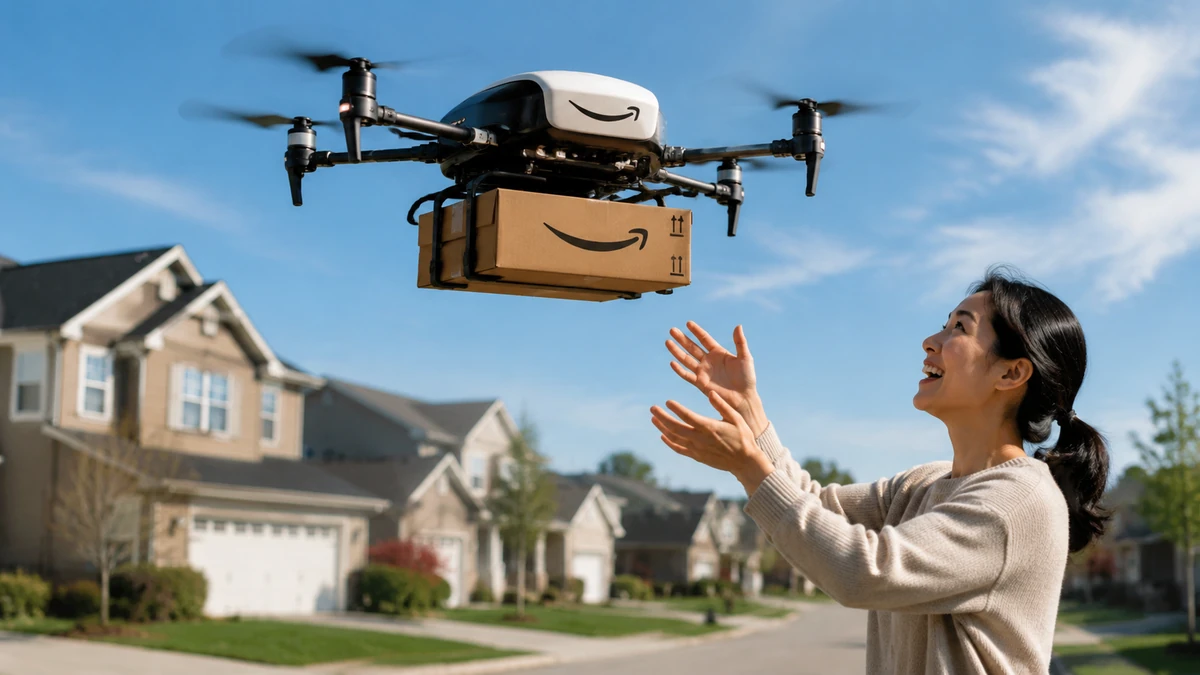
Amazon is preparing for a major expansion of its drone delivery program in the United States, a move that could mark a turning point in the race to automate how Americans receive everyday goods. The company plans to expand its drone delivery service to roughly 500 cities and towns by the end of the year, according to reports, growing far beyond the limited number of locations where the service currently operates.
For many American consumers, the idea of a package arriving by drone has remained more of a futuristic concept than a normal shopping experience. While companies have tested autonomous delivery technology for years, large-scale deployment has faced challenges involving aviation rules, neighborhood acceptance, weather conditions and operational reliability. Amazon’s expansion plan represents an effort to move drone delivery closer to mainstream use.
The development is significant because Amazon is not simply adding another delivery option. The company is attempting to reshape the final stage of the supply chain, often called the “last mile,” where products travel from a distribution center to a customer’s home. This stage is among the most expensive and complicated parts of modern logistics because it depends heavily on roads, drivers and local traffic conditions.
By using drones for certain deliveries, Amazon is exploring whether autonomous aircraft can complement traditional delivery vans and improve speed and efficiency. The company’s approach reflects a broader global trend in which technology firms are combining artificial intelligence, robotics and automated systems to transform commerce.
How Drone Delivery Works and Why Regulation Matters
Amazon’s drone delivery model is designed around specialized delivery hubs that serve communities within a limited radius. Instead of replacing all traditional shipping methods, drones are intended to handle certain types of deliveries in areas where the system can operate effectively.
The company has stated that it has received approval from the Federal Aviation Administration for drone operations in many areas of the United States. However, regulatory approval remains one of the most important factors determining how quickly the service can expand. Commercial drone operations must meet strict requirements related to flight safety, aircraft monitoring and interaction with existing airspace.
For Americans, the issue is similar to other moments when new transportation technologies entered daily life. Electric vehicles, autonomous driving systems and ride-sharing platforms all required not only technological improvements but also changes in regulation, public trust and infrastructure. Drone delivery faces a comparable challenge: proving that the technology can operate safely and consistently at a community level.
The expansion into hundreds of cities and towns will provide a larger real-world test of how consumers respond. Questions remain about how frequently customers will choose drone delivery, how communities react to increased drone activity and whether the service can maintain reliability during different weather conditions.
The challenge also highlights the difference between developing a technology and integrating it into society. A drone that can technically deliver a package is only one part of the equation. Companies must also build systems that customers trust and communities are willing to accept.
Amazon’s Strategy Reflects a New Era of Automated Logistics
Amazon has spent decades building one of the world’s largest e-commerce and logistics networks. The company operates fulfillment centers, delivery networks and technology platforms designed to shorten the time between clicking “buy” and receiving a package. Drone delivery fits into this broader strategy of controlling more parts of the customer experience.
The company’s expansion plan comes as logistics providers worldwide are investing in automation. Warehouses increasingly use robots to organize products, artificial intelligence systems help predict demand, and companies are testing autonomous vehicles and delivery technologies.
In this environment, drones represent one possible solution to a long-standing industry challenge: delivering small packages quickly without increasing dependence on traditional transportation networks. A drone does not face the same road congestion as a delivery truck and may offer advantages for certain suburban and low-density communities.
However, drone delivery is unlikely to completely replace human drivers or traditional shipping methods in the near future. Large packages, long-distance transportation and complex delivery situations will still require established logistics systems. Instead, drones are expected to become one tool among many in a more flexible delivery ecosystem.
The larger significance is that major technology companies are increasingly competing not only through software but also through physical infrastructure. Amazon’s investment shows how digital platforms are becoming deeply connected with robotics, transportation and real-world services.
What Amazon’s Drone Expansion Means for the United States
For the American market, Amazon’s drone delivery expansion could influence how consumers think about convenience and speed. The United States has one of the world’s largest e-commerce markets, and expectations for fast delivery have increased dramatically over the past decade. Services offering same-day or next-day shipping have changed consumer behavior, creating pressure for companies to find faster and more efficient delivery methods.
The growth of drone delivery could also affect American businesses beyond Amazon. Retailers, logistics companies and technology developers are watching closely to see whether autonomous delivery becomes commercially viable. If successful, the technology could encourage more investment in robotics and artificial intelligence applications across transportation and supply chains.
The development is also relevant in the context of U.S.-Korea technology relations. South Korea has become a major global player in areas such as robotics, semiconductor manufacturing and digital infrastructure. Korean companies and researchers have closely followed advances in automation and smart logistics as they seek opportunities in future industries.
For American consumers familiar with rapid technological change, from smartphones to electric vehicles, drone delivery represents another possible shift in everyday life. The question is not only whether drones can fly, but whether they can become a trusted part of the American shopping experience.
American communities will likely play a major role in determining the future of this technology. Local acceptance, privacy concerns and neighborhood preferences could influence how quickly drone networks expand. As with previous innovations, consumer confidence may become just as important as engineering progress.
Lessons From Other Industries: Technology Must Earn Public Trust
The history of American technology adoption shows that convenience alone does not guarantee success. Companies introducing new systems must address concerns about safety, privacy and social impact. Drone delivery will face similar questions as it moves from limited testing into broader public use.
Autonomous vehicles provide one example of the difficulty involved in bringing advanced technology into everyday environments. Although self-driving technology has made significant progress, widespread adoption has required continued testing, regulatory review and public discussion. Drone delivery may encounter many of the same challenges.
Another important factor is the relationship between technology and local communities. A successful delivery system must fit into people’s daily lives rather than simply demonstrate technical capability. Noise levels, flight paths and the appearance of drones in residential areas could influence public opinion.
Amazon’s expansion therefore represents more than a corporate announcement. It is a test of whether automated logistics can move from innovation labs into neighborhoods across America. The results could influence how companies around the world approach the future of delivery.
The Global Future of Delivery Begins With American Testing Grounds
Amazon’s plan to expand drone delivery to hundreds of U.S. cities and towns highlights a broader transformation taking place in global commerce. As consumers demand faster service and companies seek greater efficiency, automated transportation technologies are becoming an increasingly important part of business strategy.
The coming expansion period will reveal whether drone delivery can overcome the practical barriers that have limited adoption until now. Success will depend on more than advanced aircraft. It will require reliable operations, regulatory cooperation and public acceptance.
For global observers, including technology companies and consumers in South Korea and other innovation-driven economies, the United States serves as a major testing ground for new commercial models. If Amazon can successfully integrate drones into everyday delivery networks, it could influence how goods move in cities and communities around the world.
The future of shopping may not arrive through one single invention. Instead, it may emerge through a combination of artificial intelligence, robotics and new forms of transportation working together. Amazon’s drone delivery expansion is one of the clearest examples yet of that future moving closer to everyday reality.
Comments
Post a Comment