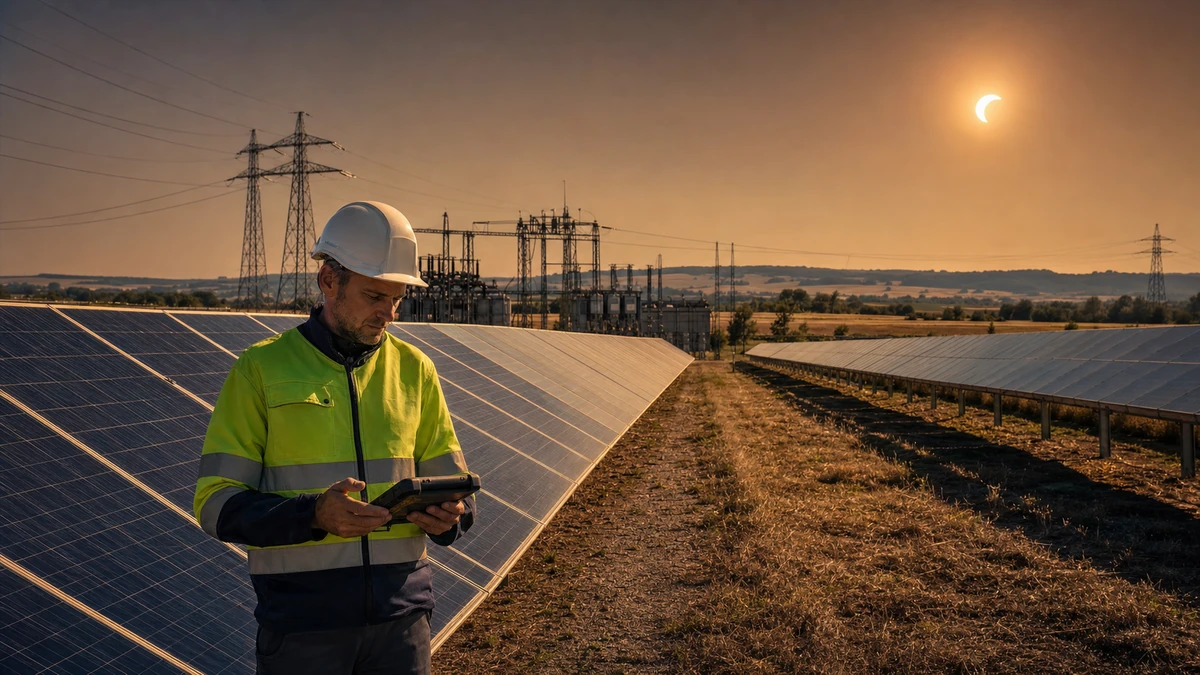
A celestial event meets an energy system under strain
Europe is preparing for an unusual power challenge on Aug. 12: not a cyberattack, not a sudden fuel shortage, not an unexpected plant outage, but a solar eclipse arriving in the middle of a punishing summer heat wave.
On its own, an eclipse is the kind of predictable natural event that usually inspires school science lessons, amateur stargazing and social media photos. But in today’s Europe, where solar energy has become a major part of the electricity mix, the moon briefly passing in front of the sun has taken on a very different meaning. Grid operators are watching it as a serious energy management problem.
The concern is straightforward. As the eclipse dims sunlight in the late afternoon, solar panels across parts of Europe are expected to generate less electricity for a short period. According to projections cited in recent reporting, the drop in solar output could be comparable to losing the power supply of nine nuclear reactors at once. That comparison is dramatic, but it helps explain why the event is getting close attention from utilities, traders and energy officials across the continent.
For American readers, it may help to think of this less as a quirky weather story and more as a stress test for a modern grid. In the United States, grid operators routinely prepare for spikes in air conditioning demand during heat waves, especially in states like Texas, California and Arizona. Europe is now confronting a version of that challenge shaped by its own energy transition: as solar power grows, predictable changes in sunlight can have systemwide consequences.
That does not mean Europe is facing inevitable blackouts. An eclipse is not like a power plant unexpectedly tripping offline. Operators know when it will begin, how it will move and roughly how much sunlight will be lost. But predictability does not erase risk. Electricity must be balanced in real time. If supply drops sharply and then rebounds quickly, the grid has to respond just as quickly, especially when the system is already under pressure.
That is what makes Aug. 12 more than an astronomy footnote. It is a real-world measure of how well Europe can manage a power system that is cleaner than it used to be, but also more sensitive to the rhythms of weather, temperature and daylight.
Why the timing matters more than the eclipse itself
The central issue is not simply that an eclipse will occur. It is when it will occur.
In parts of Europe, including France, sunset in mid-August comes after 9 p.m. That means late afternoon is still a meaningful period for solar generation. On an ordinary summer day, solar power would still be contributing to the grid at the very time the eclipse is expected to reduce sunlight. Instead of a gradual evening decline in output, operators could see a sharper-than-normal dip followed by a recovery once the moon moves on.
That pattern matters because power grids are built around constant balancing. Supply and demand must match second by second. When millions of homes, offices and factories are using electricity, even a temporary mismatch can create instability. If the drop in solar production happens quickly across a wide geographic area, other sources of power must ramp up to fill the gap. Then, as solar generation returns, those backup sources may need to scale back just as quickly.
In American terms, this is somewhat like managing the evening “duck curve” in California, where solar production falls as people return home and turn on lights, appliances and air conditioners. The difference here is that the eclipse compresses and complicates the change. Instead of a familiar sunset pattern, operators face an artificial dimming that interrupts normal generation during an already sensitive part of the day.
The fact that the event spans multiple countries raises the stakes. Europe’s electricity system is deeply interconnected, which is usually a strength. Power can move across borders, allowing one country with extra generation to help another facing a shortfall. But when a broad natural phenomenon affects many solar installations around the same time, the challenge becomes continental rather than local. It is no longer about one faulty plant or one stressed city. It becomes a question of how smoothly the entire regional network can absorb simultaneous change.
That is why the eclipse has emerged as a headline energy issue rather than a curiosity. It highlights how a renewable-heavy grid behaves when nature changes conditions on a large scale all at once.
The heat wave is the bigger danger behind the headline
If the eclipse were happening during a mild, uneventful week, Europe would still have to manage the disruption, but the overall risk would likely look more manageable. What has elevated concern this time is the broader backdrop: a heat wave that is already stretching the power system.
Extreme heat pushes demand higher as homes and businesses use more electricity for cooling. That dynamic is familiar in the United States, where summer power emergencies often track with rising temperatures. Europe has historically had lower air-conditioning use than the U.S., but that is changing as hotter summers become more frequent and more intense. The continent’s power networks are increasingly being asked to handle demand patterns that once seemed exceptional.
At the same time, heat can make electricity supply harder to maintain. Power plants and transmission systems operate less comfortably in high temperatures. Some generating units can be forced to reduce output or shut down because cooling becomes more difficult or because equipment faces thermal stress. In other words, the same weather event can push demand up while limiting supply — a double hit that utilities fear.
That is the real significance of the Aug. 12 eclipse. The problem is not just a temporary dip in solar output. The problem is a temporary dip arriving when the system may already have less breathing room than usual.
Analysts and grid operators often talk about reserve margins — the extra available power beyond expected demand that helps absorb surprises. When reserve margins are comfortable, a short-lived drop in one power source may be manageable. When several plants are already offline and temperatures are high, that same drop feels much more serious. A system with little cushion becomes far more sensitive to sudden swings.
The comparison to nine nuclear reactors shutting down at once is striking for precisely that reason. It is not meant to suggest that Europe will literally lose those reactors. It is meant to convey the scale of the missing supply that operators may have to replace in a compressed window. Even if the shortfall is brief, the grid has to find substitute power immediately, not eventually.
This is a reminder that modern electricity security is about more than how many power plants exist on paper. A country or region can have significant installed capacity, yet still struggle if weather conditions, equipment outages and timing all align in the wrong way. Energy resilience depends not only on what resources are available, but also on how quickly those resources can respond when the system lurches.
Solar power’s success has created a new operational challenge
There is an irony at the center of this story. The eclipse is a concern precisely because solar power has become important.
If solar energy still occupied only a tiny slice of Europe’s electricity supply, an eclipse would barely register as a grid issue. The temporary decline in sunlight would matter to individual rooftop owners and perhaps a few utilities, but not to the stability of a continent-spanning network. The fact that it is now being discussed in terms of major generation loss is evidence of how much the energy landscape has changed.
Across Europe, governments have spent years expanding renewable energy to cut carbon emissions, reduce dependence on imported fossil fuels and improve long-term energy security. Solar has been central to that shift. Panels now sit on warehouse roofs, apartment buildings, suburban homes and utility-scale solar farms across the continent. In some periods, especially during sunny summer days, solar makes a substantial contribution to overall supply.
That transformation carries clear benefits. Solar power is domestic, emissions-free at the point of generation and increasingly cheap. But it also changes the operational logic of the grid. Traditional systems built around coal, gas, nuclear and hydropower were designed around large, controllable plants. Solar is different. It depends on irradiance — the amount of sunlight reaching the panels — and that changes with clouds, seasons, time of day and, in rare cases like this one, astronomical events.
The lesson is not that solar is a problem. Rather, it is that the surrounding grid must evolve along with it. A power system with growing renewable penetration needs flexible backup generation, strong forecasting, fast-response balancing markets, ample transmission capacity and, increasingly, large-scale energy storage. Batteries, hydropower reservoirs, demand-response programs and cross-border interconnections all become more important when supply can rise and fall quickly.
For Americans, there is a parallel in places like California and Texas, where renewable energy growth has already forced grid planners to rethink how they manage peaks and ramps. Europe is dealing with a similar reality, but on a multinational scale and under the pressure of recent geopolitical and climate shocks.
The eclipse, then, is not an argument against clean energy. It is evidence that the clean energy era requires a more agile system. The engineering challenge is no longer simply building enough generation. It is coordinating a more variable mix without sacrificing reliability.
Europe’s interconnected grid is both a shield and a vulnerability
One of Europe’s greatest energy advantages is that its power systems are linked across borders. Countries can import electricity from neighbors when domestic generation is tight and export when they have extra supply. In theory, this helps smooth local imbalances and lowers the risk that one country’s shortage becomes a full-blown crisis.
That interconnection may help on Aug. 12 as well. If one area sees a sharper decline in solar output or a stronger spike in demand, power can potentially be rerouted from other parts of the network. Grid operators can also schedule dispatchable generation — power from sources that can be turned up or down on command — to cover the expected decline. Because the eclipse is known in advance, market participants and system planners have time to prepare.
Still, interconnectedness is not a magic solution. When the same broad event affects many countries at once, the burden is shared rather than isolated. If solar generation falls across a wide region during hot weather, every operator may be looking for additional supply at roughly the same moment. Cross-border links help most when stress is uneven. They are less powerful when stress is synchronized.
This is one reason energy experts increasingly focus on “system flexibility” instead of just raw capacity. The question is not only whether Europe has enough megawatts somewhere on the map. It is whether those megawatts can be mobilized fast enough, transmitted where they are needed and withdrawn again when solar production recovers.
The rebound matters as much as the decline. Once the eclipse passes, solar output is expected to rise again. That means backup sources called upon during the dip may then need to pull back to avoid oversupply. Managing both the descent and the recovery requires precision. Too slow on the way down, and the grid risks shortage. Too slow on the way up, and operators risk congestion or wasted power.
For an American audience, this is analogous to air traffic control during rapidly changing weather. The planes are there, the runways are there and the routes exist — but safe operation depends on timing, coordination and constant adjustment. Europe’s grid is facing a similar choreography, only with electrons rather than aircraft.
The eclipse is, in that sense, a test not of any single plant’s durability but of the system’s collective reflexes.
A warning about climate, infrastructure and energy security
The deeper significance of this moment goes beyond a single day in August. It reveals how climate conditions, energy infrastructure and the shift to renewables are becoming inseparable.
Heat waves are no longer occasional anomalies for Europe. They are becoming a recurring feature of summer, with consequences for public health, agriculture, transportation and energy demand. At the same time, the drive to decarbonize has accelerated investment in wind and solar, which are essential to lowering emissions but also require new tools for balancing the grid. Add in the lingering effects of plant outages, fuel-market disruptions and political pressure to keep power affordable, and the challenge becomes more complex than simply generating more electricity.
In that sense, Aug. 12 offers a vivid example of how energy security works in the 21st century. It is not just about having fuel in storage or building more power plants. It is about resilience under compound stress — the ability to keep the lights on when different kinds of risks overlap. A prolonged heat wave, temporary plant shutdowns and a short-lived but predictable drop in solar output may each be manageable on their own. Together, they can expose weak points in the system.
That lesson matters far beyond Europe. Around the world, countries are adding solar at a rapid pace. From the American Southwest to the Middle East to South Asia, more grids are becoming dependent on sunlight during key hours of the day. As that dependence grows, even predictable natural events can have outsized operational consequences.
For policymakers, the takeaway is not to slow the clean energy transition. It is to invest more seriously in the hardware and market rules that make renewable-heavy systems reliable: batteries, transmission lines, regional coordination, advanced forecasting, demand management and backup generation that can respond quickly without undercutting climate goals.
For the public, the story is a reminder that the energy transition is not just about replacing one fuel with another. It is about redesigning the system around a different physical reality. Sun and wind are abundant, but they do not behave like coal piles or gas pipelines. That means reliability increasingly depends on forecasting, flexibility and network management — issues that can sound technical until a headline like this brings them into view.
And for Europe’s grid operators, the eclipse is a real-time exam with unusual visibility. Because the event is known in advance, failure would be hard to excuse. Success, on the other hand, may pass with little public notice — exactly how utilities prefer it.
An eclipse as a measure of readiness
There is something almost symbolic about a modern power grid being tested by a phenomenon humanity has understood for centuries. Ancient cultures viewed eclipses with fear or wonder. Today, Europe’s concern is less mystical but no less serious: whether a brief shadow over the sun can disrupt an electricity system already strained by extreme heat.
The answer will depend on preparation and flexibility. Operators can forecast the eclipse’s timing. They can line up other power sources. They can manage cross-border flows and monitor demand. But they cannot eliminate the basic fact that in a solar-rich grid, a sudden reduction in sunlight is no longer merely an astronomical curiosity. It is a supply event.
That marks a profound change in how energy systems work. The rise of solar power has given countries cleaner electricity and, in many cases, greater independence from imported fuels. It has also made them more attentive to patterns in nature that older fossil-fuel systems could largely ignore. The movement of clouds, the timing of sunset and the path of the moon now matter in new ways.
If Europe handles Aug. 12 smoothly, the day may ultimately be remembered as a quiet success — proof that an advanced, renewable-heavy grid can absorb even unusual disturbances with enough planning. If it struggles, the episode will likely be cited as evidence that clean energy targets must be matched by equally serious investment in system flexibility.
Either way, the story speaks to a broader reality confronting energy planners from Brussels to Sacramento: reliability in the clean energy age is no longer only about generation. It is about orchestration.
And on Aug. 12, with the continent baking under summer heat and the afternoon sun briefly dimmed, Europe’s ability to orchestrate its power supply will be on display for the world to see.
Comments
Post a Comment