As South Korea Bakes in Record Heat, Older Residents in Hillside Neighborhoods Face a Dangerous Choice: Endure the Heat or Pay to Escape It
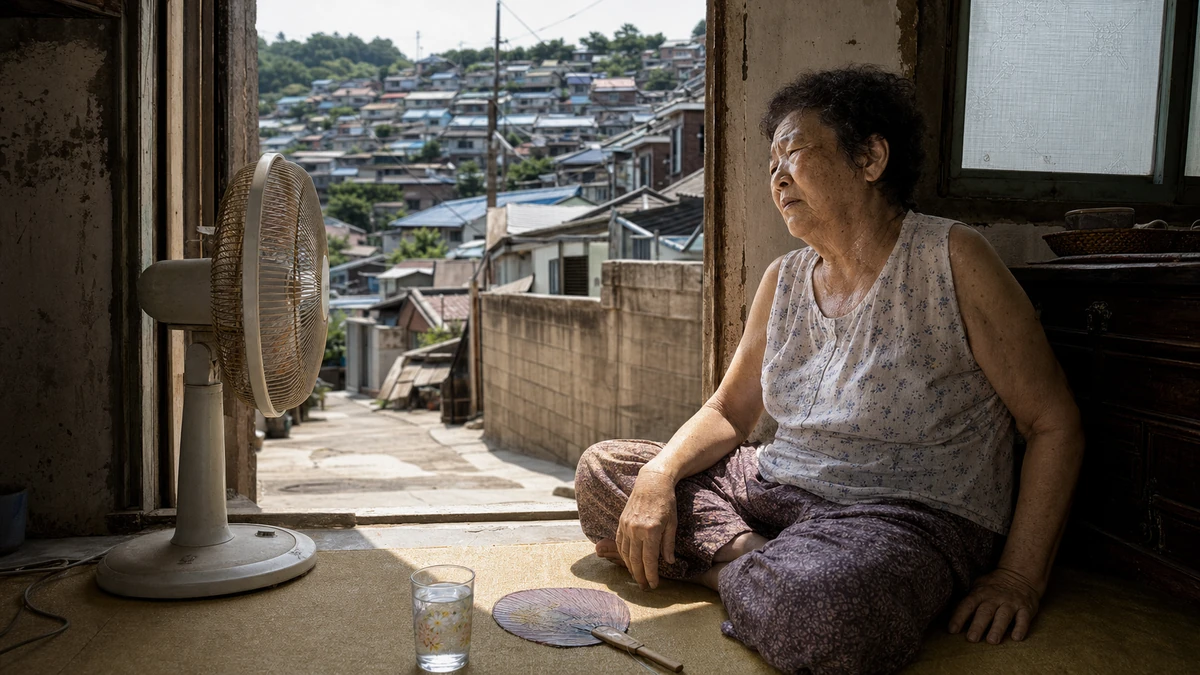
A heat wave turns ordinary homes into hazards
South Korea is enduring a brutal summer heat wave that is testing not only weather records, but also the country’s aging housing stock, its social safety net and the daily survival strategies of older people living on the margins of fast-modernized cities.
In the southern city of Changwon, where temperatures on Aug. 2 climbed close to 104 degrees Fahrenheit, or about 40 degrees Celsius, some elderly residents in older hillside neighborhoods spent the day inside homes that offered little real relief from the heat. Even when they had fans or air conditioners, some said they were reluctant to use them freely, a sign that extreme weather is colliding with energy costs, fixed incomes and housing conditions that make staying cool far more difficult than simply flipping a switch.
The scenes from Changwon underscore a growing reality in South Korea, much as they do in parts of the United States and other countries facing hotter summers: Heat is no longer just a matter of uncomfortable weather. It is becoming a social dividing line. Who can cool their home, who can walk safely to a public building, who can afford to run a fan all day and who has a nearby place to rest in air conditioning all increasingly shape how people live through summer.
That dynamic is especially stark in neighborhoods known in Korean as “daldongne,” literally “moon villages,” a term used for older, often poorer settlements built along steep hillsides or elevated edges of cities. Historically, such communities were associated with migrants, working-class families and people who settled wherever land was available as South Korea industrialized rapidly in the decades after the Korean War. In many places, they remain clusters of aging homes, narrow lanes and limited infrastructure. On postcard-style travel shows, hillside Korean neighborhoods may appear picturesque. In a heat emergency, they can become dangerous.
For older residents who have lived in those communities for decades, midday heat can transform both indoors and outdoors into punishing spaces. The walls and roofs of older homes absorb sunlight for hours. Ventilation is often poor. Streets can be steep and physically demanding even in normal weather. During an extreme heat event, a short trip to buy groceries, visit a clinic or reach a cooling center can feel like crossing a parking lot in Phoenix at noon — except uphill, and for someone in their 70s or 80s.
One resident who had lived in the area for more than 60 years said he had never experienced heat like this. That sentiment has become increasingly common across South Korea, where summer heat waves have grown longer, more intense and more disruptive, echoing what many Americans have heard from longtime residents in places from Portland, Oregon, to Miami: The weather people thought they understood is changing faster than daily life is prepared to adapt.
Why these neighborhoods are especially vulnerable
Changwon is a major industrial city on South Korea’s southeast coast, better known to many outsiders for manufacturing, shipbuilding links and baseball than for climate vulnerability. But like many Korean cities, it contains sharp internal contrasts. Newer apartment towers, now the dominant form of middle-class housing in South Korea, often have better insulation, more reliable cooling and easier elevator access. Older hillside neighborhoods are a different story.
Many houses in these areas were built decades ago, before extreme heat adaptation became a serious concern. Their materials and layouts often trap warmth. Some are small and closely packed together, leaving little airflow between structures. Residents may be retired, live alone or depend on modest pensions, making electricity bills a real source of anxiety. In that setting, having an air conditioner does not necessarily mean using it enough to stay safe.
That distinction matters. Public officials often count cooling devices, but household resilience is about actual use, not ownership. It is similar to the gap in the United States between having central air and being able to afford to keep it running during a long stretch of triple-digit temperatures. In both countries, people on lower incomes sometimes ration comfort as if it were a luxury, even when it has become a matter of health.
For older adults, heat risk is compounded by age. The body’s ability to regulate temperature declines over time. Chronic conditions, medications, mobility limitations and social isolation can make extreme heat deadlier. Public health experts have long warned that older adults are among the most vulnerable in any heat emergency. In places where the built environment adds more stress — steep streets, old houses, poor ventilation, long sun exposure — that vulnerability deepens.
South Korea also has one of the fastest-aging populations in the world. That demographic shift means stories like the one unfolding in Changwon are not niche or isolated. They point toward a larger policy challenge: how a highly urbanized, rapidly aging country protects seniors not just from spectacular disasters like typhoons and floods, but from the quieter, cumulative danger of days and nights that never cool down enough.
The burden falls heaviest on people least able to relocate. Younger residents may leave older neighborhoods for newer apartments elsewhere. Seniors who remain often do so because of cost, community ties or simple familiarity. Their homes may be uncomfortable, but they are close to neighbors, routines and memories. In a heat wave, that attachment to place can become a trap if the surrounding environment is not adapted for a hotter future.
A three-minute walk can make the difference
In Changwon, one of the clearest signs of what helps came not from high-tech infrastructure, but from something much smaller: a publicly available cooling shelter within walking distance.
At a senior cultural center in the city’s Hoiwon area, local officials opened a “heat shelter,” a Korean public service commonly used during summer emergencies. These shelters are air-conditioned spaces — often located in community centers, senior centers, libraries or other public buildings — where residents can come in, sit down, cool off and wait out the hottest hours of the day. Think of them as a mix of cooling centers, neighborhood rec rooms and emergency social infrastructure.
One woman in her 80s told reporters she often goes there after finishing chores in the morning. Her home is only about a three-minute walk away. But even that short distance, she said, leaves her drenched in sweat. The comment captures how extreme heat changes the scale of daily life. When temperatures soar high enough, three minutes becomes meaningful. A nearby bench matters. Shade matters. The difference between two blocks and six blocks can determine whether an elderly resident uses a public service at all.
That is a lesson urban planners and public health officials in the United States know well. Cooling centers are only useful if people can reach them safely, know they exist and feel welcome staying there. A center that is technically open but far away, poorly advertised or difficult to enter for someone with limited mobility can fail the people it is meant to serve. Accessibility is not just about ramps and doors; it is about distance, familiarity and the physical cost of getting there in dangerous weather.
South Korea’s local governments have increasingly leaned on these shelters as a practical line of defense. In South Gyeongsang province, where Changwon is located, officials recently said they would extend operating hours on weekdays until 10 p.m. and open shelters on weekends as well. That may sound bureaucratic, but it reflects an important shift. Heat no longer peaks only at midday. Evenings can remain stifling, especially in dense urban areas where pavement and concrete release stored warmth long after sunset. A shelter that closes too early can send vulnerable residents back into overheated homes before conditions are tolerable.
Longer hours also acknowledge a basic truth about human behavior. People do not live by meteorological charts; they live by routines. An older resident may clean in the morning, rest in the afternoon, socialize in the early evening and return home later if the air has eased. Keeping public spaces open gives people more control over their day, letting them adapt without completely abandoning familiar patterns. That flexibility can reduce stress and improve safety at the same time.
Record-breaking temperatures are changing how cities function
The suffering in Changwon unfolded alongside a broader meteorological shock across South Korea. In the nearby city of Yangsan, temperatures reached 42 degrees Celsius, then climbed to 42.5 Celsius — nearly 109 degrees Fahrenheit — setting a new benchmark in the country’s modern weather record. According to Korean authorities, it was the first time since modern meteorological observations began in 1904 that a temperature in the 42-degree Celsius range had been officially recorded.
Weather records matter partly because they mark historic extremes, but they matter even more because they expose where systems were built for a cooler world. A city can survive an occasional hot day. A society begins to strain when extreme heat is widespread, repeated and intense enough to alter work hours, sports schedules, transit patterns and public health operations all at once.
That appears to be happening across South Korea. In Seoul, the capital, heat warnings were upgraded across the entire city, prompting officials to intensify monitoring of vulnerable residents, including older adults and people living in “jjokbang” areas. Jjokbang refers to tiny single-room dwellings, often associated with extreme urban poverty. Americans might compare them loosely to some of the nation’s most precarious single-room occupancy housing, though the Korean context is distinct. These spaces can be cramped, poorly ventilated and especially dangerous in prolonged heat.
Elsewhere, in North Jeolla province, temperatures climbed into the mid-90s Fahrenheit across multiple cities, and busy commercial districts reportedly thinned out as people stayed indoors. That shift may sound familiar to readers in parts of the United States where heat waves empty sidewalks, delay youth sports and drive people into malls, libraries and coffee shops simply to exist in cooler air. In South Korea, where city life is often highly walkable and street-centered, the effect can be especially visible. Heat changes not only comfort levels but the rhythm of urban life itself.
Even professional sports have been affected. Korean baseball games in Changwon were canceled on consecutive days because of the heat, while another game in Busan began with a delay. For American audiences, that is akin to heat disrupting a summer Major League Baseball schedule — a reminder that the weather is not merely a topic for climate reports, but a force now shaping public life, commerce and leisure.
What emerges from these disparate scenes — elderly residents seeking cooling shelters, quiet shopping districts, special monitoring for vulnerable housing, canceled ballgames — is a picture of a country adjusting in real time. The adjustment is not dramatic in one single way. It happens through shortened trips, slower afternoons, changed routes, postponed outings and public facilities staying open later. Climate adaptation, in everyday terms, often looks less like a giant engineering project and more like thousands of subtle changes in how people inhabit a city.
Heat, poverty and aging are colliding in ways officials can no longer ignore
Extreme heat is often described as a “silent killer” because it can claim lives without the spectacle of a storm or wildfire. But there is nothing abstract about the choices it forces on people with limited money and limited mobility. In Changwon’s older neighborhoods, the issue is not simply whether the thermometer hit a symbolic threshold. It is whether an older person feels able to run a fan all day, whether their home cools at night, whether they can make a steep walk without getting dizzy and whether there is someplace nearby to sit without being expected to spend money.
That last point is especially important. In many modern cities, air-conditioned refuge is often tied to consumption — a cafe, a restaurant, a shopping mall. Public cooling shelters break that equation. They provide relief without requiring a purchase. For seniors on fixed incomes, that distinction can determine whether they leave home at all. It can also preserve dignity. A person cooling off in a public center is not loitering; they are using a civic resource designed for exactly that purpose.
The Korean example highlights a broader policy lesson relevant well beyond East Asia. Heat resilience cannot be measured only by how many air conditioners a city has installed or how many weather alerts it sends to phones. It must also be measured by whether people can actually rest somewhere cool, close to home, for as long as necessary. That means investing in neighborhood-scale public spaces, not just headline-grabbing infrastructure.
It also means recognizing that old urban forms carry climate risk. Hillside settlements, subdivided rooms, aging detached houses and other lower-cost housing types often survive within otherwise prosperous cities. They may be hidden in plain sight, overshadowed by gleaming towers and transit megaprojects. But during heat waves, these are the places where the crisis becomes intimate and immediate.
For South Korea, the challenge is sharpened by its speed of change. Few countries have urbanized and aged as quickly. A generation that helped build the modern economy is now growing old in some of the least climate-ready parts of it. The contradiction is difficult to miss: In one of the world’s most technologically connected societies, some seniors are still enduring dangerous heat while hesitating to turn on an electric fan.
That is not a story of personal failure or backwardness. It is a story about structural vulnerability. Energy costs, pension levels, housing quality, neighborhood design and public-service access all converge in the body of an 80-year-old walking uphill in August. If governments want to reduce heat deaths, those are the intersections that matter most.
What South Korea’s heat wave says about a hotter future
There is a temptation, when a country sets an all-time temperature record, to treat the event mainly as a statistical milestone. But the more revealing story is how people adapt — and who cannot. In South Korea this summer, the answer is coming into focus in places like Changwon, where a nearby senior center may matter more than a distant policy promise, and where the practical meaning of climate adaptation is the ability to spend part of the day in a room that is safely cool.
For American readers, the parallels are hard to miss. From older public housing in the Northeast to mobile home communities in the South and isolated seniors in the Southwest, the most vulnerable people in U.S. heat waves are often those with the least control over their indoor environment and the fewest easy options outside it. The Korean case shows how quickly this becomes a question of urban design and local governance, not just personal preparedness.
It also offers a modest but important point of hope. Not every life-saving intervention requires massive construction or futuristic technology. Sometimes the most effective response is a familiar neighborhood building with air conditioning, extended hours, clear signage and enough chairs. Sometimes it is the difference between a 20-minute bus ride and a three-minute walk. In climate policy, small distances can carry enormous consequences.
That does not mean public shelters are enough on their own. South Korea, like many countries, will need deeper investments in housing retrofits, better support for low-income energy users, urban shade, greener streets and stronger protections for outdoor workers. It will also need to confront the social geography of vulnerability — the way age, poverty and outdated housing cluster together. But the shelters point to a basic principle worth remembering: People survive extreme heat not through information alone, but through access.
On a day when one Korean city posted an unprecedented 42.5 degrees Celsius, the most telling image may not be the number on a weather map. It may be the older resident in Changwon who finishes morning chores, walks a few minutes in punishing heat and settles into a public cooling space because home is too hot to stay in comfortably and too expensive to cool without worry. That image reduces a global climate story to its human scale.
As South Korea confronts more frequent heat extremes, the real test will be whether cities can make relief ordinary, local and reachable. In a warming world, resilience may depend less on grand declarations than on whether the nearest cool room is still open when people need it most.
Comments
Post a Comment