At Seoul’s Namdaemun Market, a Hotteok Photo Op Says More Than It Seems About America’s New Ambassador
A Diplomatic Debut in a Place Most Tourists Would Recognize by Smell First
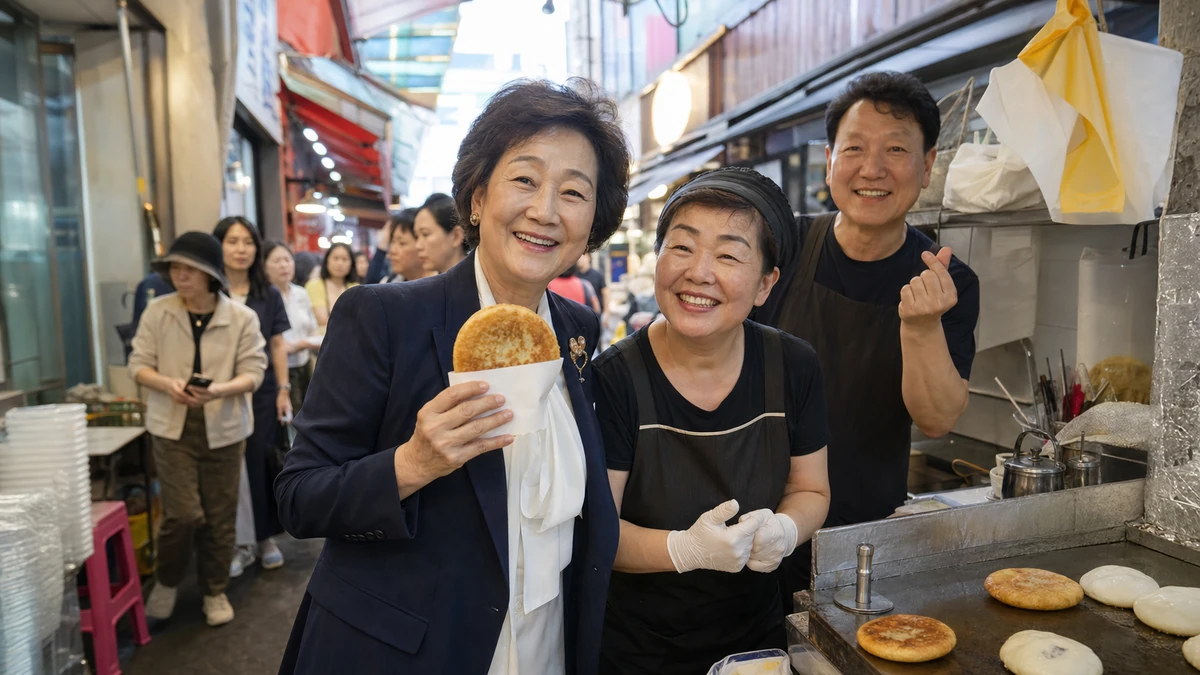
When a newly arrived U.S. ambassador begins public life in a foreign capital, the expected backdrop is usually formal: a government ministry, a ceremonial guard, a polished conference room lined with flags. Michelle Steel, the new U.S. ambassador to South Korea, chose something else. According to SBS, shortly after arriving in Seoul last month, Steel visited Namdaemun Market, one of the city’s oldest and busiest traditional markets, where she posed smiling with vendors while holding a hotteok, the sweet, pan-fried Korean street snack that for many Koreans instantly evokes winter streets, paper cups of coffee and the everyday warmth of the city.
For American readers who may not know the dish, hotteok is often compared loosely to a stuffed pancake or griddled pastry. The most familiar version is filled with brown sugar, cinnamon and chopped nuts or seeds, which melt into a syrupy center when cooked. It is inexpensive, handheld and sold in places where the atmosphere matters as much as the food itself: market alleys, subway exits and neighborhood street corners. It is not a tasting-menu item or a prestige export in the way Korean barbecue, kimchi or even trendy Seoul-style bakeries have become abroad. That is precisely why the image landed with unusual force.
Steel, who was born in Seoul in 1955 and immigrated to the United States in 1975, said the visit brought back old memories, SBS reported. That comment, simple as it was, gave the outing a dual meaning. On one level, it was a personal return for someone revisiting the city of her birth after decades spent building a life and political career in the United States. On another, it was a carefully legible public moment: the first Korean American woman to serve as U.S. ambassador to South Korea signaling that her relationship to the country will not be expressed only through treaty language, military coordination or summit symbolism, but through places where ordinary people shop, eat and talk.
There is a long tradition in American politics of using food to communicate accessibility. Candidates flip pancakes in Iowa diners, share cheesesteaks in Philadelphia or stop for tacos in border states. The symbolism is often obvious, sometimes awkward, but rarely accidental. Steel’s hotteok moment belongs to that same political grammar, though filtered through Korean cultural context. In Seoul, a market visit can signal less about populist campaigning than about reconnecting with what Koreans often describe as everyday life: routine commerce, familiar snacks and the social texture of a city that is experienced not only through landmarks but through repeated small interactions.
That matters because South Korea is a country Americans often encounter through extremes. News coverage tends to focus on North Korea’s nuclear threats, U.S.-South Korea military cooperation, semiconductor supply chains or the global spread of K-pop and Korean dramas. Those are real and important parts of the story. But they can flatten a place into geopolitics and spectacle. A hotteok in Namdaemun does the opposite. It points to the middle ground of lived culture: the crowded lane, the vendor’s practiced hands, the steam rising off the griddle, the short exchange between buyer and seller that makes a city legible to itself.
Why Michelle Steel’s Background Changes the Meaning of the Visit
Steel’s biography is central to why this scene resonated. She is not simply an American diplomat arriving in a strategically vital U.S. ally. She is Seoul-born, Korean American and, as the summary notes, the first Korean American woman to hold the post. That alone would have made her arrival notable. But symbolism in diplomacy works best when it is attached to a recognizable story, and Steel’s opening schedule appears to have done exactly that.
Before her market visit, she also shared images from Gwanghwamun, the grand central Seoul avenue anchored by the statue of King Sejong, the 15th-century monarch credited with creating Hangul, the Korean writing system. She reportedly described the site as a reminder of Korea’s history of innovation and leadership. She also visited Youngnak Church, the church associated with memories of her parents, who were displaced by war. Put together, those stops create a map more intimate than an official itinerary and more layered than a simple nostalgia tour. One site points to family history, another to national identity, another to the sensory life of the present city.
For American audiences, a rough analogy would be an ambassador returning to the city of her birth and making early stops at a family church, a monument as nationally symbolic as the Lincoln Memorial and then a food hall or old public market that still carries the smell and rhythm of an earlier era. Each stop says something slightly different. Together, they say: I know this place not just as a posting, but as a lived landscape.
That can be a diplomatic advantage, though it also carries expectations. Ethnic, cultural or family ties never automatically translate into political ease. In fact, they can heighten scrutiny. Observers may expect deeper cultural fluency, more intuitive communication or a special capacity to bridge differences between allies that remain close but not always frictionless. South Korea and the United States cooperate closely on security, but like any long alliance, theirs includes periodic tensions over trade, military burden-sharing, industrial policy and regional strategy. An ambassador with Korean roots cannot solve those structural issues through biography alone.
Still, biography shapes tone, and tone matters in diplomacy. There is a difference between saying a relationship is important and showing that you understand how people in the host country narrate their own lives. Steel’s choice to begin publicly in spaces associated with memory, language and food suggests an awareness that diplomacy in South Korea unfolds in a society highly attuned to symbolism, historical continuity and signs of respect.
That is particularly true in a country where personal history and national history often intersect sharply. Many older Korean families carry memories shaped by Japanese colonial rule, the Korean War, division of the peninsula and rapid industrialization. For younger generations, the reference points may be different: democratic activism, digital culture, crushing housing costs, intense work and school pressures and a globalized pop culture economy. A market like Namdaemun, which is both historic and stubbornly alive in the present, is one of the few spaces where those timelines can feel compressed into a single walk.
What Namdaemun Market Represents in Seoul
Namdaemun Market is not a quaint reconstruction for tourists. It is a real, sprawling commercial district near one of Seoul’s old city gates, with roots going back centuries and a reputation built on practical commerce rather than polished branding. Americans unfamiliar with Seoul may best think of it as something between an old public market, a discount district and a neighborhood institution that has survived wave after wave of urban reinvention. It is crowded, layered and sometimes chaotic in the way living markets often are. People go there not just to sightsee, but to buy clothes, household goods, kitchenware, accessories and, of course, food.
Traditional markets in South Korea occupy a culturally significant place beyond economics. They are often treated as repositories of a more tactile social life in a country where hypermodern retail, delivery apps and sleek department stores coexist with older commercial forms. When Korean officials or public figures visit such markets, the gesture can imply support for small merchants, interest in local life or solidarity with spaces that embody community memory. During holidays, election seasons or periods of economic anxiety, these visits can take on additional political meaning.
For a foreign diplomat, then, Namdaemun offers a stage that is informal but far from trivial. Unlike a museum or palace, it does not put the visitor at a ceremonial distance from the public. The interaction is immediate and transactional in the best sense: choosing food, waiting, receiving it by hand, exchanging a few words, maybe taking a photo. Those moments are small, but they are legible across language barriers. A smiling photo with a vendor says, without a speech, that the city is not only a policy environment but a social world.
The SBS summary highlighted that Steel posted pictures making a heart gesture with her husband, attorney Shawn Steel, outside the market and smiling with a vendor while holding the hotteok. That detail matters because it softens the stiffness that can surround official arrivals. Korean public life, especially online, is highly visual, and gestures that read as warm or playful can travel quickly. The now-familiar finger-heart and hand-heart poses are part of everyday Korean visual culture, embraced by celebrities, athletes and ordinary families alike. For Americans, it may resemble the way a local politician might roll up sleeves at a county fair or post an unguarded photo at a neighborhood festival. The point is not deep policy content; it is approachability.
Yet the power of the image also lies in what it does not overstate. Steel was not shown delivering a speech about market economics or turning the visit into a heavy-handed lesson on Korean identity. The appeal was simpler. A returning Seoul-born American official found a familiar street food in a familiar kind of place and treated it as a bridge between then and now. That is exactly the sort of low-key scene that can feel more persuasive than a grand cultural proclamation.
Hotteok, Jeong and the Politics of Everyday Warmth
If there is a Korean cultural concept hovering around this story, it is jeong, a term often translated inadequately as affection, attachment or warmth. None of those English words fully captures it. Jeong refers to a feeling that grows through familiarity, repeated contact and human bonds that may be informal but still deeply felt. It can exist among relatives, neighbors, old friends, longtime customers and shopkeepers or even between people and places. Koreans invoke it when describing the emotional texture of ordinary life, especially in settings that resist anonymity.
That is one reason a traditional market carries symbolic weight beyond commerce. It is not just where goods exchange hands; it is where social memory accumulates. The same vendor might see the same customer over years. The same alley might smell the same every winter. The same snack might summon childhood, economic hardship, family outings or the comfort of continuity in a city that otherwise changes at breathtaking speed. Seoul is famous for relentless reinvention. Neighborhoods rise, disappear, rebrand and densify. Yet market culture can preserve a more stable emotional register.
In the summary, Steel reportedly said many things had changed since earlier days, but the warmth, energy and familiar atmosphere remained. That observation is striking because it touches precisely on what many Seoul residents say about the city’s older markets: the skyline transforms, consumer habits modernize, but certain sensory and social cues still anchor memory. The hotteok becomes more than a snack. It becomes a trigger for recognition.
Americans have their own versions of this emotional shorthand. A paper sack of roasted peanuts at a state fair, a slice of pizza from a family-owned counter in a changing neighborhood or a bowl of gumbo from a place that has outlived redevelopment plans can do similar work. The food is real and pleasurable, but what people are often consuming is continuity. It is a way of tasting time.
That may help explain why this particular image could resonate even with international audiences who know little about Korean cuisine. You do not need to understand the full history of Namdaemun or the precise ingredients of hotteok to read the scene. Someone returned to a city after a long absence, found a familiar market food and located memory in it. That story is globally intelligible. It is also effective soft diplomacy, not because it is engineered to sell anything explicitly, but because it lets curiosity emerge naturally. Viewers may ask: What is that pastry? Where is that market? What does Seoul feel like away from palaces and skyscrapers?
In an era when Korean culture is often exported through highly produced forms, from Netflix dramas to stadium concerts and beauty campaigns, the humility of a market snack can be powerful. K-food’s global rise has been substantial, but much of it has centered on restaurant dishes, packaged ramen, fried chicken chains or social-media-friendly cafe culture. Hotteok belongs to another category: the food of passing through, pausing, buying something warm with one hand and continuing down the street. It introduces Seoul not as a brand, but as a place.
More Than a Photo: Soft Diplomacy in the Age of Social Media
None of this means the visit was apolitical. In modern diplomacy, especially in allied countries with digitally sophisticated publics, even the most casual-seeming public appearance can function as messaging. Steel recently expressed in a media contribution her intention to work closely with South Korea to sustain the U.S.-South Korea alliance as a core pillar of regional peace and security, according to the summary. That is the language of formal statecraft. But alliances are not perceived by the public only through defense white papers and summit communiques. They are also felt through personality, familiarity and the symbols that officials choose to circulate.
Social media has intensified this dynamic. An ambassador’s visit to a market once might have been a minor local item, remembered only by the people who happened to be there. Now a single photo can move quickly across platforms, picked up by broadcasters, translated by users and reframed as a story about identity, diplomacy or culture. Images also travel better than policy nuance. A smiling ambassador with a recognizable street food can carry a message faster than a carefully worded statement about Indo-Pacific coordination.
That is not necessarily superficial. It reflects a broader truth about public diplomacy: people often form impressions of nations through cultural encounters before they ever engage with strategic arguments. The United States has long understood this, from jazz tours during the Cold War to student exchanges and culinary outreach. South Korea, too, has become highly adept at wielding cultural soft power, though usually through entertainment, beauty, technology and cuisine at a national scale. Steel’s Namdaemun stop sits in the overlap between those traditions. It is the image of an American representative using Korean everyday culture to communicate ease, affection and attentiveness.
There is also a subtler message in the contrast between her early Seoul stops. Gwanghwamun and the King Sejong statue represent national story, literacy, leadership and civilizational pride. Youngnak Church evokes migration, faith, memory and division-era family history. Namdaemun Market introduces a third register: ordinary urban life. Read together, the itinerary resists the flattening of Korea into either ancient heritage or glossy modern export culture. It suggests a country experienced through institutions, memory and the street.
For Americans, whose understanding of South Korea is often filtered through two dominant lenses, military alliance and pop culture fandom, that matters. South Korea is neither just a frontline democracy under threat nor just the home of K-pop sensations and Oscar-winning filmmakers. It is also a society of market vendors, church communities, commuters, apartment residents and workers moving through intensely local rhythms. A diplomat who can acknowledge those layers may not change the alliance overnight, but she may widen the frame through which the alliance is seen.
Why a Street Snack Can Tell a Bigger Story About Seoul and the Alliance
In the end, the significance of Steel’s hotteok photo lies less in novelty than in proportion. It is a small story, and small stories sometimes reveal what larger official narratives cannot. Here was a newly arrived ambassador, born in Seoul and returning in a role that places her at the center of one of Washington’s most important Asian alliances. She could have introduced herself first and foremost through the vocabulary of strategic urgency. Instead, at least in part, she introduced herself through an old market, a warm snack and a remark about memory.
That choice lands at a moment when the U.S.-South Korea relationship is both robust and evolving. The alliance remains anchored in deterrence against North Korea, but it now extends into advanced manufacturing, technology supply chains, energy, regional diplomacy and global cultural influence. South Korea is no longer merely a recipient of security guarantees in the American imagination. It is increasingly understood as a major economic partner, democratic peer and cultural powerhouse. Public diplomacy in that environment requires more than rehearsing old alliance formulas. It requires showing that the relationship is alive in human terms.
Food is especially well suited to that task because it compresses place, memory and sociability into a form that travels easily. A bowl, a skewer, a dumpling or, in this case, a hotteok can introduce outsiders to a city without demanding prior expertise. It can also give insiders a sense that the visitor understands something essential, not because she has mastered every historical or political debate, but because she recognizes the emotional architecture of the everyday.
For English-speaking readers curious about what this episode says about Seoul, the answer may be simple: the city is often best read not only through its monuments or global headlines, but through the ordinary experiences that residents still use to measure belonging. A market visit after an official arrival does not settle policy. It does not erase the hard strategic work ahead. But it can signal how a diplomat intends to inhabit the role.
Steel’s image with hotteok offered a version of Seoul that many visitors eventually discover and many residents never fully stop defending: a city whose speed and sophistication coexist with pockets of tactile warmth, where memory survives in flavor, where a vendor interaction can feel as representative as a formal reception and where food still functions as one of the most natural points of entry into understanding the culture.
That is why the photo did more than show an ambassador eating a snack. It suggested that the story of U.S.-South Korea ties, however often told through missiles, trade figures and summit choreography, also lives in humbler places. In a paper sleeve holding a sweet pancake. In the laughter of a market stall photo. In the recognition that for all the city’s changes, some forms of welcome remain immediately legible. And in diplomacy, as in journalism, those are often the details that make a larger relationship feel real.
Comments
Post a Comment