Before K-pop, Korea Exported Precision: Why Jang Yeong-sil’s 15th-Century Clock Still Matters in the U.S.
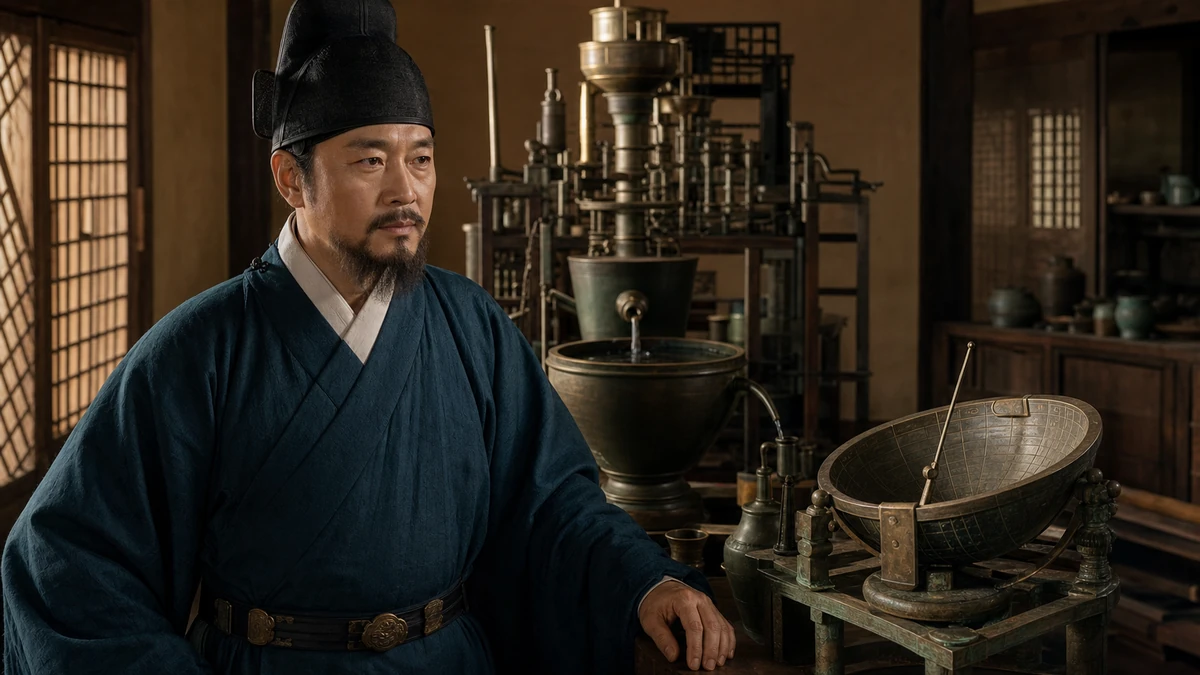
Image to help understand the article
A 15th-century inventor with a very modern story
Long before South Korea became globally associated with K-pop, Oscar-winning films, Samsung smartphones and blockbuster dramas, the Korean Peninsula was producing another kind of exportable idea: public technology built to standardize everyday life. At the center of that story stands Jang Yeong-sil, a scientist and inventor who worked during the reign of King Sejong in the Joseon Dynasty, the Korean kingdom that ruled from 1392 to 1897.
Jang is best known for helping create the jagyeokru, an automated water clock completed in 1434 that announced the time by itself. In practical terms, that made it more than a beautiful machine. It was a public timekeeping device, a state-backed effort to impose reliable, shared time on a society where time had to be measured, announced and trusted. For American readers, the closest comparison is not a decorative antique clock in a museum but an early piece of civic infrastructure, something closer in spirit to a town clock, a railroad timetable or, in the modern era, the federally coordinated systems that keep everything from financial markets to GPS networks synchronized.
The Korean account of Jang’s life also carries another layer that feels strikingly contemporary. He was born into a low social status and is recorded as having begun life as a government slave in Dongnae, in what is now the southeastern port region around Busan. In a rigidly stratified Confucian society, that origin should have sharply limited his future. Instead, his technical talent brought him to the attention first of King Taejong and then, more importantly, King Sejong, one of Korea’s most revered rulers. Sejong is widely remembered in Korea for promoting science, governance and literacy, including the later creation of the Korean alphabet, Hangul. Jang’s rise under Sejong has endured in Korean memory because it offers a rare case in premodern East Asia of merit, or at least useful expertise, partially breaking through inherited status.
That combination of scientific ingenuity, state ambition and social mobility helps explain why Jang remains a powerful figure in Korea today. His story is not just about one machine or one court inventor. It is about how a country imagines progress, who gets to contribute to it and why precision matters to national development. For American audiences trying to understand Korea beyond pop culture headlines, Jang offers an unusually revealing entry point.
Why the jagyeokru mattered more than a clock
The jagyeokru, often translated as a self-striking water clock, used the flow of water to trigger mechanisms that signaled the time automatically at set intervals. That detail matters. Earlier water clocks generally required someone to watch the device and announce the hour manually. The jagyeokru reduced dependence on constant human monitoring by making the machine itself perform the announcement. In the language of modern technology, it automated a repetitive public function.
That may sound incremental until it is placed in historical context. In the 15th century, standard time was not an abstract convenience. It was closely tied to governance, astronomy, ritual and agriculture. Courts needed to coordinate official duties. Astronomers needed regularized measurements. Agricultural societies depended on accurate calendars and seasonal awareness. In a monarchy like Joseon, which drew political legitimacy in part from orderly rule and attention to celestial patterns, timekeeping was a state concern.
American readers can think of this as part of a long global history in which governments and institutions tried to turn nature into an administrable schedule. In the United States, standard time became essential in the 19th century with the rise of the railroads, when local solar time gave way to coordinated time zones because modern commerce could no longer function town by town. The jagyeokru belongs to an earlier phase of that same broad human story: the effort to make time public, uniform and authoritative.
Its significance also extends beyond timekeeping. The device points to a culture of engineering that combined observation, metalwork, hydraulics and mechanical design. According to the Korean account, Jang’s earlier assignment from Sejong included building a night timekeeping device, and his experience with water-powered clocks later fed into more ambitious instruments. In that sense, the jagyeokru was both a finished achievement and a platform technology, part of a wider ecosystem of scientific tools.
That is an important distinction because modern audiences often romanticize premodern inventions as isolated strokes of genius. The Korean record suggests something more recognizable to contemporary readers: a state-funded research effort, involving multiple technicians and officials, in which one gifted engineer worked within a broader project. Jang collaborated with figures including Kim Jo and Yi Cheon, and he was part of larger astronomical and instrument-making programs. If Silicon Valley has conditioned Americans to think in terms of visionary founders, the jagyeokru is a reminder that many breakthroughs come from teams working under institutional sponsorship.
How Jang crossed a rigid social barrier
Just as compelling as the machine is the life behind it. The historical record on Jang’s birth and death is incomplete, but Korean chronicles indicate that his father was associated with migrants from the former Yuan dynasty in China, while his mother is described in ways that underscore her low social position. The clearest point is that Jang himself was originally attached to Dongnae as a government slave. In early Joseon society, status was not merely social background; it was a legal and political framework that shaped what kind of life a person could live.
That makes his rise all the more extraordinary. King Taejong reportedly recognized his technical talent first, and Sejong later elevated him further, valuing ability over birth to a degree unusual for the time. In 1421, Sejong sent Jang and other officials to China to study astronomical instruments and manufacturing methods. On his return, his contribution to instrument-making was rewarded. By 1423, he had been emancipated from slave status, and he was appointed to an official post connected to royal supplies and technical work. He was promoted again the following year.
In American terms, Jang’s life has shades of several familiar narratives at once. It is part Horatio Alger myth, part national-laboratory story and part reminder that institutions sometimes become more dynamic when leaders are willing to recruit talent from outside elite pipelines. That does not mean Joseon turned into a meritocracy; it did not. The very reason Jang’s case is memorable is that it was exceptional. But exceptions reveal values too. Sejong’s willingness to use technical skill in the service of statecraft helped build a lasting image of his reign as one of Korea’s greatest eras of practical innovation.
There is also a cautionary edge to the story. Jang’s career advanced rapidly because his abilities met the needs of the state, but his position also remained precarious. His rise depended on royal favor and institutional utility, not on equal standing in society. That dynamic is hardly unique to premodern Korea. Modern industries, including those in the United States, still celebrate innovators while leaving them vulnerable to politics, hierarchy or sudden reputational collapse. Jang’s story resonates because it is both uplifting and unsparing about how power works.
More than one invention: astronomy, public science and metal type
The jagyeokru is the headline achievement, but it was not the only one. Jang participated in a larger burst of instrument-making between 1432 and 1438, a period in which Joseon developed or refined astronomical observation tools, sundials and other clocks. Among them was the okru, a celestial clock completed in 1438 and installed in a royal pavilion at Gyeongbok Palace. The device reportedly represented the movement of heavenly bodies and indicated time and seasons, combining clockwork with a model of the cosmos.
For readers in the United States, a useful analogy might be the great mechanical astronomical clocks of Europe, which were not merely practical devices but visual statements about order, authority and knowledge. The okru appears to have served a similar function in Korea, though in a distinct cultural and political setting. It showed that timekeeping and astronomy were inseparable from how the state understood heaven, calendar-making and royal legitimacy.
Jang also contributed to sundials, including the angbuilgu, a bowl-shaped instrument placed in public locations so ordinary people could check the time. That detail is easy to overlook, but it suggests an important evolution: scientific tools were not only court curiosities. They could also function as public interfaces between state knowledge and daily life. In modern language, this was a form of civic technology.
His technical range extended beyond clocks and astronomy. The Korean summary also notes his participation in the casting of gabinja metal type in 1434, part of a state printing project overseen by Yi Cheon. Korea already had a long history with movable metal type predating Gutenberg, though that fact is still less widely recognized in the United States than it should be. The reported improvement in printing durability and output under gabinja reinforces the point that Jang was not simply a clockmaker. He was a metallurgist and engineer whose work touched information technology in the premodern sense: the systems by which knowledge was physically reproduced and distributed.
If all of this sounds unexpectedly sophisticated to Western ears, that says less about 15th-century Korea than about the limits of what many Americans are taught. East Asian scientific history is still too often filtered through a simplistic narrative in which innovation appears to move from China to Europe to the modern West, with Korea barely visible in between. Jang’s career complicates that story. It shows Joseon as an active site of adaptation, experimentation and state-directed technical development.
What this means for the United States
For Americans, the growing attention to figures like Jang Yeong-sil comes at a moment when South Korea is becoming more legible in U.S. public life, not just as a strategic ally facing North Korea but as a cultural and technological power. That shift matters because the Korean Wave, or hallyu, has changed what kinds of Korean stories can travel. U.S. audiences who first encountered Korea through BTS, “Parasite” or Netflix dramas are now more likely to be curious about deeper historical narratives. Jang’s story fits squarely into that broader expansion.
There is an economic angle as well. American companies have spent years treating South Korea as a critical market, manufacturing partner and innovation competitor. Korea’s modern reputation in semiconductors, consumer electronics, shipbuilding and advanced manufacturing did not spring from nowhere. It emerged from 20th- and 21st-century industrial policy, education and global trade, but it also draws symbolic strength from a longer national story that celebrates practical invention and technical mastery. Figures like Jang help Korea tell that story to itself and to the world.
That has implications for U.S.-Korea ties. Washington often frames the alliance through security, especially missile defense, North Korea and regional competition with China. But the relationship has become much broader. It now includes chip investment, electric vehicle batteries, scientific research, student exchange and a dense cultural economy connecting Korean creators to American audiences and platforms. Historical stories about Korean science may not move stock prices, but they do shape soft power. They influence which museums mount exhibits, which schools update curricula, which streaming services commission period dramas and which Americans come to see Korea as a country with a deep scientific heritage rather than only contemporary pop appeal.
There are parallels in the American imagination too. The United States likes stories about practical inventors who solved public problems, especially those who rose from modest beginnings. Benjamin Franklin, though vastly different in context, is remembered not only as a statesman but as a tinkerer whose experiments and devices symbolized useful intelligence in the service of society. Jang occupies a somewhat analogous place in Korean memory: the clever engineer whose work helped organize the nation’s time, tools and knowledge.
For U.S. audiences, recognizing that parallel can improve the quality of cultural exchange. It discourages the flattening of Korea into a set of current trends and encourages a fuller understanding of how historical identity informs present-day policy, branding and innovation. In practical terms, that matters for everyone from American educators to streaming executives to tech companies seeking long-term partnerships in Korea.
Why this story fits a larger trend in Korea now
The renewed interest in Jang is not only about honoring a historical genius. It reflects a larger pattern in South Korea: the effort to reclaim and popularize Korean intellectual history as part of national identity in a global age. As Korea’s cultural products travel more widely, there is growing incentive to surface historical figures who can anchor narratives of Korean achievement beyond entertainment. Sejong, Admiral Yi Sun-sin and other iconic figures already play that role. Jang belongs in that company because he represents science, engineering and social mobility.
This is also partly a response to history itself. Korea’s cultural record was damaged by war, colonization and division. The jagyeokru built in Sejong’s time did not survive intact; later versions and surviving fragments carry the material legacy forward. The fact that relics were preserved only in part through the Japanese colonial period and the Korean War underscores how much of Korea’s premodern scientific heritage has had to be reconstructed, interpreted and reintroduced. In that sense, retelling Jang’s story is an act of historical restoration as much as celebration.
There is another reason the story lands now: modern audiences are unusually receptive to themes of systems, standards and infrastructure. After the pandemic, supply chain disruptions, battles over semiconductor production and growing anxiety about artificial intelligence, Americans are paying closer attention to the invisible architectures that make societies run. Timekeeping, calibration and public trust in technical systems no longer feel like abstract historical topics. They feel contemporary. A 15th-century state project to standardize time suddenly looks less quaint and more foundational.
In Korea, where technology companies are central to national identity and economic strategy, that historical framing can be especially potent. Jang becomes a symbolic ancestor for a country that still prizes engineering education, manufacturing precision and export competitiveness. That does not mean a straight line runs from a water clock to a memory chip. History is never that tidy. But national narratives do not need to be literally continuous to be politically and culturally powerful. They need to feel plausible, useful and resonant. Jang’s story checks all three boxes.
The unfinished ending and what it says about power
Like many historical figures who later become legends, Jang’s public life ends abruptly. According to the Korean account, after his major technical achievements he continued to serve as a metalworking specialist until a royal carriage broke. The court treated the incident as a grave offense involving the king’s dignity, and Jang was punished, though Sejong reportedly reduced the severity of the sentence. After that, he disappears from the historical record.
That ending matters because it interrupts the temptation to turn him into a simple hero of progress. Jang’s career demonstrates both the possibility and the limits of talent under monarchy. His abilities allowed him to cross one of the hardest barriers in Joseon society, but they did not free him from dependence on the state’s favor. The same court that elevated him could erase him.
There is something familiar in that dynamic for modern readers. Technologists today are often celebrated as visionaries, especially when they help institutions achieve prestige or efficiency. But their status can prove fragile when politics change, failures occur or power decides it needs a scapegoat. In that sense, Jang’s disappearance is not just a historical curiosity. It is a reminder that innovation stories are also labor stories and power stories.
For journalists and historians alike, that complexity is part of what makes Jang worth revisiting. He was neither an isolated genius detached from his era nor merely a functionary in a royal machine. He was a gifted technician navigating hierarchy, ambition and risk. The machines he helped build brought order to time, but his own life remained vulnerable to disorder. That tension is one reason his story endures.
What to watch next as Korean history travels globally
The bigger question is not whether Jang Yeong-sil deserves recognition in Korea. He already has it. The question is how stories like his will be translated, adapted and understood abroad, especially in the United States. As Korean cultural exports broaden, American audiences are likely to see more historical content that reaches beyond war, division and contemporary celebrity. That could mean museum exhibitions on Korean science, English-language documentaries, school materials on East Asian technological history or prestige television dramas that present premodern Korean court life with the same confidence that British productions bring to the Tudors or the Victorians.
If that happens, Jang’s story is especially well positioned to travel. It has the elements American audiences respond to: a brilliant outsider, state ambition, elegant machines, social barriers, sudden downfall and a lasting legacy visible in surviving artifacts and national memory. It also has analytical value. It helps explain why Korea places such importance on education, engineering and public prestige through technology.
For the United States, engaging seriously with that history would do more than diversify cultural consumption. It would improve how Americans understand an ally whose importance continues to grow across technology, trade, security and entertainment. Too often, U.S. discussion of Korea swings between military crisis and cultural fandom. Jang Yeong-sil points toward a richer middle ground: Korea as a society with a long and self-conscious tradition of using science and craftsmanship to build public order.
That is why a 15th-century water clock still matters. Not because it can outdo a smartphone or surprise engineers with anachronistic brilliance, but because it captures a question every modern country still faces: who gets to design the systems that everyone else lives by? In Sejong’s Korea, Jang helped answer that question with water, metal and mechanical ingenuity. In today’s America, where debates over technology and public trust are only intensifying, that feels less like ancient history than a familiar challenge told in a different language and a different age.
Comments
Post a Comment