Image to help understand the article
A scholar-official who became a diplomat in exile
Long before K-pop, Korean dramas and Oscar-winning films made South Korea a familiar cultural presence in American life, Korea was fighting a very different battle for global attention: persuading the outside world that it existed as a sovereign nation at all. One of the men who took up that fight was Yi Sang-seol, a Korean scholar-official turned independence activist who tried to bring his country’s case before the international community in 1907 at The Hague.
Yi is not a household name in the United States, even among people who know something about Korea’s modern history. Americans are more likely to recognize later figures such as Syngman Rhee, who would become South Korea’s first president, or to associate Korea’s early 20th-century anti-colonial struggle with the March 1 Movement of 1919. But for many Korean historians, Yi belongs to an earlier generation of patriots who understood, sooner than most, that Japan’s growing control over the Korean Peninsula was not merely a diplomatic inconvenience or economic pressure campaign. It was an existential threat to Korean statehood.
Born in 1870 in what is now North Chungcheong Province, Yi came of age during the collapse of Korea’s old order. He began as a product of the classical Confucian system that had governed the Joseon dynasty for centuries. In that world, intellectual prestige and political advancement flowed through civil service examinations rooted in Chinese classics and moral philosophy. Passing those exams was not unlike winning admission to an Ivy League, securing a top federal appointment and joining the intellectual establishment all at once.
Yi succeeded in that system. He passed the highest level of the state examination in 1894, entered government service and held a series of official posts. Yet he was not simply a traditional literatus clinging to a fading world. In the late 1890s, as Korea struggled to respond to Western imperialism, Japanese expansion and internal reform pressures, Yi also encountered newer forms of learning, including Western-style mathematics, law and international thought. That combination — deep grounding in the old order and unusual openness to new knowledge — helps explain why he would eventually emerge as one of the Korean Empire’s most determined voices abroad.
To American readers, Yi’s story may sound familiar in a broad sense: a classically educated establishment figure who, confronted by national crisis, becomes radicalized and reorients his life toward resistance. But the specific setting matters. Korea at the turn of the 20th century was not a rising power or even a stable small state. It was a country trapped in the geopolitical space between empires, pressured by Qing China, imperial Russia, Japan and Western powers that all claimed to value international law while often bending it to serve power.
Yi saw that contradiction up close. He spent the early part of his career mastering the language of modern statecraft, only to learn that for weak nations, law and diplomacy often depended on whether stronger nations were willing to listen.
Why modern learning mattered to a Korean patriot
Part of what makes Yi’s life notable is that he did not become an activist by rejecting scholarship. He became one through scholarship. In Korea’s late Joseon and early Korean Empire period, many reform-minded officials believed their country had to absorb new knowledge quickly if it hoped to survive in a world increasingly governed by industrial power, bureaucratic efficiency and international law.
Yi fit squarely within that generation. He served as a professor at Sungkyunkwan, Korea’s historic top educational institution, and also held financial and administrative posts in government. Around that time, he is known to have formed ties with Homer Hulbert, an American educator and missionary who became one of the better-known foreign advocates for Korean sovereignty. Hulbert is a useful bridge for American readers because he represents a recurring feature of this period: some Western missionaries and educators in Korea became unusually sympathetic observers of Korean efforts to modernize and defend their independence.
Yi’s intellectual interests expanded beyond the Confucian canon into mathematics and legal studies. He helped compile a mathematics text, “Sansul Sinseo,” drawing on a Japanese work that itself reflected the circulation of modern technical knowledge across East Asia. He also studied and translated material related to international law. That may sound dry, but in the early 1900s it had immediate political meaning. International law was not merely an academic field. For officials in vulnerable countries, it was a possible shield — perhaps a fragile one — against outright annexation or coercion by stronger states.
In the United States, there is a tendency to think of legal argument and patriotic resistance as separate tracks: lawyers make cases, while activists take to the streets or the battlefield. Yi’s life complicates that distinction. He seems to have believed that if Korea could state its claims clearly — in the language of modern diplomacy, treaty rights and sovereign equality — the international community might be compelled to acknowledge Japan’s conduct as illegitimate.
It was a rational belief on paper. Korea had diplomatic relations with foreign powers. Its sovereignty had been recognized in prior international arrangements. It had an emperor. It had treaties. From a strictly formal standpoint, Korea was not an empty territory waiting to be claimed. Yet modern imperialism often worked by hollowing out sovereignty before destroying it outright. A country could retain ceremonies, titles and offices while losing control over its military, foreign policy and internal administration.
Yi understood that danger early. His study of math and law was not a side note to his political life. It was training for a new kind of struggle — one in which survival depended on being able to argue, in terms the world’s powers recognized, that Korea’s rights had been violated.
From palace official to outspoken opponent of Japanese encroachment
By the early 1900s, Japan’s influence in Korea was tightening dramatically. After its victory in the First Sino-Japanese War and later the Russo-Japanese War, Japan emerged as the dominant outside power on the peninsula. Korean officials who still hoped to defend national autonomy faced narrowing choices: cooperate, remain silent, pursue reform within shrinking boundaries, or openly resist.
Yi chose resistance.
In 1904, when Japan sought rights related to undeveloped land in Korea, Yi opposed the move through a formal memorial to the throne. To an American audience, the dispute might at first glance sound like a technical issue involving land use or economic development. But in colonial settings, such “concessions” were often a foot in the door. Infrastructure rights, resource access, advisory roles and land claims could all become mechanisms for stripping a weaker country of actual control. Yi and others saw the request not as a business matter but as part of a larger project of domination.
He also participated in organized public activity, serving in leadership roles in associations that pushed back against foreign pressure. This is another important piece of context. Korea in this period was not simply a passive victim moving helplessly toward colonization. Officials, intellectuals, educators, guerrilla fighters, religious activists and overseas migrants all experimented with different methods of resistance. Some pursued reform. Some appealed to the emperor. Some built schools. Some organized militias. Some turned outward and tried to internationalize Korea’s plight.
Yi did all of those in sequence or in overlap.
His break with the state reached a crisis point in 1905, when Japan imposed the Eulsa Treaty, known in Korea as a coerced agreement that stripped the Korean Empire of diplomatic sovereignty and made it a Japanese protectorate. In Korean historical memory, the treaty occupies a place not unlike other infamous acts of forced subordination around the world: a document signed under overwhelming pressure and later remembered less as a treaty than as an instrument of national humiliation.
Yi reportedly petitioned Emperor Gojong five times in protest and demanded punishment for the officials who had helped enable the agreement. He eventually left office. At one point, he attempted suicide but did not die. That detail, stark as it is, helps convey the depth of the crisis as men like Yi understood it. For them, the issue was not simply policy disagreement. It was the collapse of the state they had served and the dishonoring of their duty to protect it.
After leaving office, Yi’s path changed decisively. No longer operating mainly as a court official trying to persuade a monarch from within the system, he moved into the broader world of anti-colonial activism. He would focus on education, overseas organizing and diplomacy beyond Korea’s borders.
Building schools and exile communities beyond Korea’s borders
As political space inside Korea narrowed, many activists looked abroad. This is a recurring theme in the histories of colonized peoples: when repression closes domestic avenues, exile communities often become incubators for political strategy. For Koreans in the early 20th century, parts of China, Russia’s Far East and, later, the United States became crucial centers of organizing.
Yi left Korea in 1906 and traveled through Shanghai and Vladivostok before moving into areas with growing ethnic Korean populations near the Russian and Manchurian borderlands. There, he helped establish Seojeon Seosuk, an educational institution in Yongjeong, in what is now China’s Yanbian Korean Autonomous Prefecture. The school promoted modern learning alongside anti-Japanese national education.
That kind of institution may be easiest for Americans to understand if imagined as part boarding school, part civic academy and part nationalist training ground. It was not simply about textbooks. It was about preserving a sense of peoplehood under pressure, creating informed future leaders and giving displaced Koreans a framework for collective purpose. The school did not last long; Japanese pressure forced its closure. But the idea behind it proved durable.
Yi also worked to help Korean migrants settle in organized communities, including a place described in Korean accounts as one of the earliest bases of the independence movement. These communities mattered because anti-colonial politics needs infrastructure: housing, schools, newspapers, donors, meeting places, trusted networks and some degree of economic self-sufficiency. National movements are not sustained by sentiment alone.
He was also involved in attempts to unify armed resistance. In 1910, as Japan formally annexed Korea, Yi worked with other leaders to bring together scattered righteous armies, or “uibyeong” — irregular anti-Japanese militias often drawn from local fighters, former soldiers and patriotic civilians. He supported a vision in which military struggle, exile leadership and a continuing claim to legitimate Korean statehood could reinforce one another.
In one particularly striking effort, activists sought to persuade the former Emperor Gojong to go into exile in Russia and serve as a symbolic center for a government abroad. For American readers, that might call to mind European governments-in-exile during World War II, though Korea’s situation came decades earlier and under far less favorable international circumstances. The logic was similar: if the homeland is occupied and formal institutions are compromised, legitimacy may need to survive elsewhere.
These plans largely failed. Japanese power was too strong, foreign governments were unwilling to confront it and Korean activists lacked the military backing to reverse annexation. Still, the attempts show that Yi and his colleagues were not merely lamenting national decline. They were experimenting with multiple strategies — education, diplomacy, exile governance and military organization — in a rapidly closing window of time.
The Hague mission and Korea’s appeal to the world
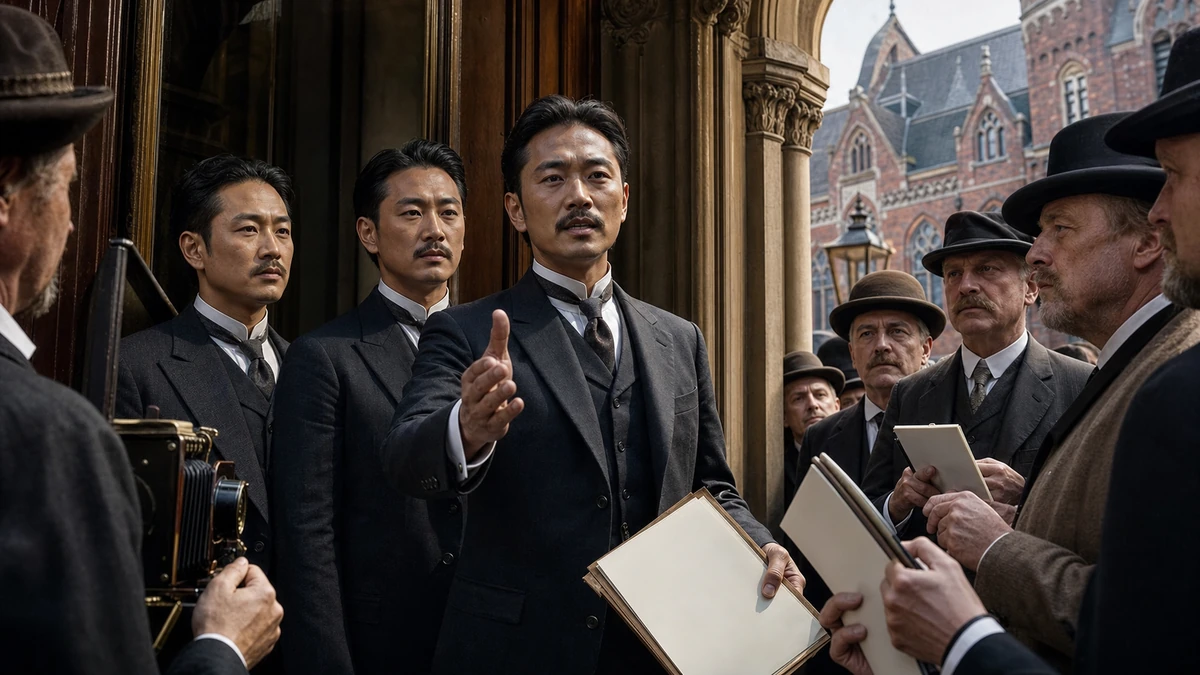
The episode for which Yi is best known came in 1907, when Emperor Gojong secretly dispatched him to The Hague for the Second Hague Peace Conference. Also sent were Yi Jun and Yi Wi-jong. Their task was audacious: to tell the assembled powers that Japan had illegally deprived Korea of its diplomatic rights and to ask that Korea’s case be heard before the international community.
To modern readers, the setting itself carries a kind of painful irony. The Hague, now widely associated with international law and global justice, was then already a symbolic center for the hope that disputes between nations might be regulated by rules rather than raw force. For Korean envoys, it represented perhaps the best available stage on which to insist that their country had been wronged.
But they were blocked from participating formally, in large part because Japan, having already asserted control over Korea’s foreign affairs, denied their legitimacy. In other words, the very power accused of stripping Korea of its diplomatic voice then used that stripped voice as proof that Korea could not speak for itself.
Yi did not simply go home.
According to Korean historical accounts, he continued pressing the issue and publicly appealed in fluent French, the language of diplomacy at the time. He argued that Korea was a sovereign state, that it had long maintained diplomatic relations with foreign powers and that Japan had used force to rob it of the right to conduct those relations. He accused Japan of interfering in Korean governance without proper imperial consent and of destroying Korean laws and customs. He appealed to justice and asked why Korea’s official envoys, sent under imperial authority, were being excluded.
For Americans used to thinking of anti-colonial nationalism mainly through mass protest movements or later decolonization struggles after World War II, the Hague mission is a reminder that colonized and threatened peoples were already using the language of international norms decades earlier. Yi’s appeal was not a nationalist outburst detached from global principles. It was an attempt to hold the international system accountable on its own stated terms.
The effort failed in its immediate goal. The conference did not intervene on Korea’s behalf. No coalition of powers forced Japan to restore Korean diplomatic rights. Realpolitik prevailed. Japan had emerged from the Russo-Japanese War with enhanced status, including significant respect in the West, where some leaders viewed it as a modernizing power and a stabilizing force in East Asia rather than as an imperial aggressor.
Yet failure does not mean insignificance. The Hague mission became one of the clearest early examples of Korea trying to internationalize its cause before full annexation. It also exposed the limits of the world order that claimed to prize peace, legality and the rights of nations while leaving a weaker country effectively unheard. In that sense, Yi’s appearance at The Hague belongs to a much larger global history: colonized or vulnerable peoples learning that international law could inspire hope, but also discovering how selectively it was enforced.
Exile, death sentence and the long shadow of independence activism
The consequences for Yi were severe. After the Hague mission, Japan sentenced him to death in absentia. He never returned to his homeland. Like many independence activists across the world, he became a political figure defined by movement across borders, by organizing among expatriates and by the painful fact that the nation he claimed to represent no longer controlled its own territory.
He remained active in overseas Korean communities, including efforts that reached across Russia’s Far East, Manchuria and even Korean immigrant circles in the United States. Korean diasporic politics in America at that time centered especially on places like Hawaii and the West Coast, where migrants raised funds, published newspapers and debated strategy. Yi’s participation in meetings involving overseas Koreans, including a gathering in Colorado, underscores how transnational the Korean independence movement had already become before it gained wider Western notice.
Back in Vladivostok, he helped build organizations such as the Kwonuphoe, which promoted education, community development and anti-Japanese activism. It also published a newspaper. That combination — media, schooling, economic advancement and political organization — reveals a sophisticated understanding of movement-building. If a stateless people hoped to survive politically, it had to preserve literacy, memory, morale and material resources all at once.
Later, Yi took part in establishing a government-oriented body often referred to as the Korean Restoration Army Government, another effort to create political structure for a nation under colonial rule. These organizations did not achieve sovereignty in Yi’s lifetime. But they laid groundwork for later independence activism, including the Provisional Government of the Republic of Korea established in Shanghai in 1919 after the March 1 Movement.
Yi died in exile in 1917, two years before that watershed uprising. He therefore occupies a somewhat difficult place in broader public memory: crucial, but overshadowed by later moments that produced larger demonstrations, clearer political institutions and, eventually, liberation in 1945. His career spanned the hinge years when Korea was moving from embattled sovereignty to full colonization, and when the men trying to stop that process had not yet found a strategy powerful enough to succeed.
Still, his life offers a sharp lens on the era. He was not only a patriot in the emotional sense but also a thinker who understood that national survival in the modern age required fluency in education, law, media, organization and diplomacy. He fought inside the state, then outside it. He petitioned the throne, founded schools, helped build exile communities, backed armed organizing and tried to take Korea’s case before the world.
Why Yi Sang-seol still matters now
For contemporary Americans, Yi’s story resonates beyond Korean history. It raises enduring questions about how small nations appeal to international institutions, what happens when legal recognition collides with geopolitical power and how exile communities sustain political causes that seem impossible in the moment. It also complicates simplistic narratives about Korea as merely a victim of great-power rivalry. Figures like Yi show that Koreans were active political agents, making strategic choices under extraordinary constraints.
His life also helps explain why sovereignty remains such a powerful theme in Korean political culture. Modern Koreans inherited not just memories of occupation, but also memories of being ignored by the very international order that claimed to regulate relations among states. That history helps illuminate later Korean suspicion of external domination, whether from imperial Japan, Cold War superpowers or other outside forces. It also helps explain why historical disputes with Japan still carry emotional and political weight in both South Korea and the broader Korean diaspora.
In American discourse, Asian history is often flattened into a few better-known chapters — China’s rise, Japan’s modernization, the Pacific War, the Korean War and, more recently, the global spread of Korean pop culture. Yi’s story belongs to an earlier chapter that deserves more attention. It is the story of Koreans arguing, before much of the world was prepared to listen, that their country had a right to exist on its own terms.
That argument did not prevail at The Hague in 1907. It did not prevent annexation in 1910. It did not spare Yi a life of exile. But it became part of a longer moral and political record, one later generations could point to in claiming that Korea had never consented to imperial rule. In that sense, Yi’s mission was not only about immediate diplomatic success. It was about putting Korea’s protest into the archive of the modern world.
And that may be the clearest way to understand his legacy. Yi Sang-seol was not just a failed envoy from a doomed court. He was an early architect of Korea’s international argument for self-determination — a scholar who grasped that if his country was being erased in practice, someone had to insist, publicly and before the world, that it still existed.
Comments
Post a Comment