
Image to help understand the article
A K-pop milestone turns Seoul itself into the stage
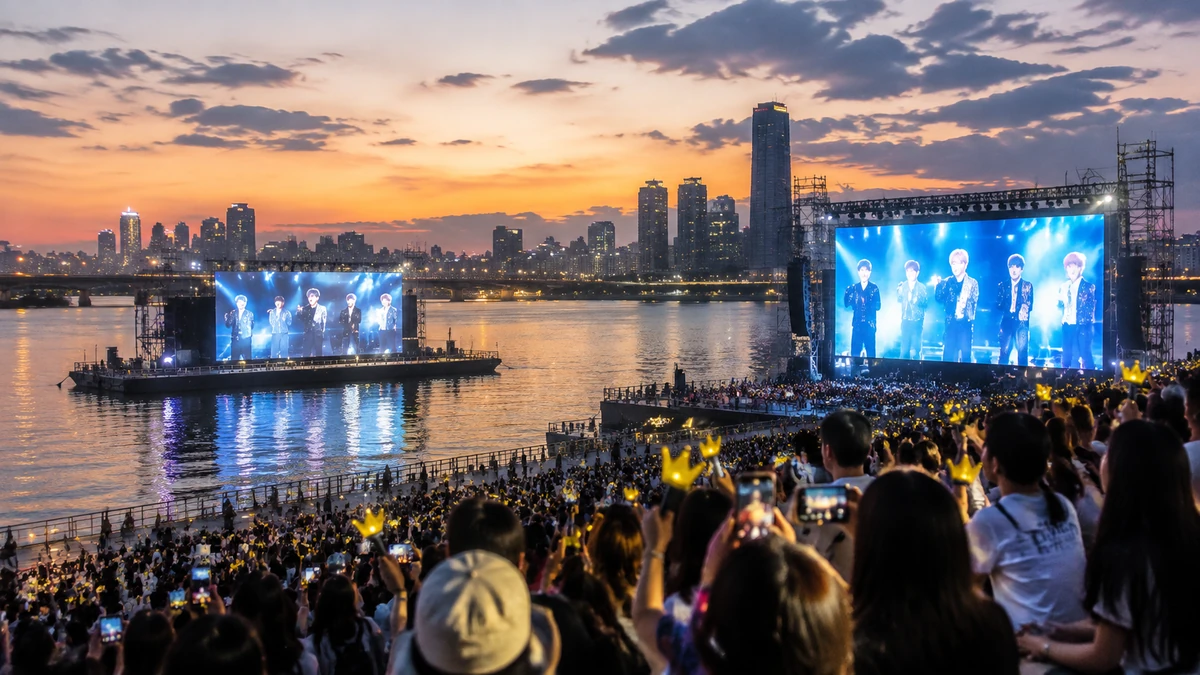
Seoul is preparing to celebrate the 20th anniversary of BigBang, one of the most influential groups in modern Korean pop history, with an event that says as much about the future of K-pop as it does about the band’s past. On July 19 at 8 p.m., city officials plan to support a large public anniversary event at Yeouido Hangang Park’s Mulbit Stage area, adding giant screens and related displays so crowds can watch from multiple vantage points along the Han River.
On the surface, that may sound like a straightforward fan celebration. But the setting matters. Rather than keeping the commemoration inside a concert hall or sports arena, Seoul is effectively using one of its most recognizable public spaces as a cultural platform. Large LED screens will be installed not only near the venue but also on a vessel on the water, according to city officials, turning the riverfront into a shared viewing space. Teaser videos are also expected to run at other Han River locations, including outdoor screens and transit-adjacent sites, extending the mood of the event beyond a single stage.
For American readers, a useful comparison might be the way major U.S. cities transform public landmarks for big civic spectacles — think New Year’s Eve in Times Square, Lollapalooza spilling into downtown Chicago, or a championship parade that temporarily turns streets and parks into ceremonial ground. What is notable in Seoul is that the event is tied not to a sports victory or a national holiday, but to the legacy of a pop group. That reflects how deeply K-pop is woven into South Korea’s cultural identity and export strategy.
BigBang, which debuted in 2006, helped define a period when K-pop was beginning to move from a regional phenomenon to a global one. Their hit songs, including “Lies,” “Last Farewell” and “Haru Haru,” became touchstones for a generation of listeners in South Korea and beyond. The anniversary event is therefore being framed not only as a celebration of fandom, but as a marker in the longer story of how Korean pop music grew into one of the country’s most visible forms of soft power.
That is why this riverfront celebration deserves attention outside South Korea. It offers a window into how Seoul is packaging music, tourism, public space and city branding into a single experience — and how the K-pop industry, now familiar to millions of Americans, increasingly operates far beyond the album release or the arena tour.
Why BigBang still matters in K-pop’s long arc
To understand the significance of a 20th anniversary event for BigBang, it helps to place the group in the timeline of K-pop’s global rise. In the U.S., many casual listeners first encountered Korean pop through later acts such as BTS, Blackpink or NewJeans. But BigBang belongs to an earlier generation that helped prove K-pop could travel. Long before Korean acts were headlining Coachella or topping Billboard charts, BigBang was helping reshape the idea of what an idol group could sound and look like.
The group’s importance lies partly in music and partly in image. BigBang mixed pop, hip-hop, dance music and ballad elements in a way that felt more flexible than the tightly standardized idol formulas that many outsiders associated with Korean entertainment in the 2000s. The members were also known for distinctive personal styles, stage presence and solo identities, characteristics that later became central to how K-pop companies marketed artists globally. Their approach influenced not just fans but the broader industry, including how labels developed acts that could appeal across national and generational lines.
In South Korea, a 20th anniversary is especially striking in the idol business, where careers are often shaped by short, intense promotional cycles, mandatory military service for male artists, and constant turnover driven by the next debut. Longevity carries symbolic value. It suggests that an act has moved from trend to institution. BigBang’s two-decade mark is therefore about more than nostalgia. It points to K-pop’s maturation into a legacy industry with its own canon, heritage acts and anniversary economy, much as American pop has long treated milestones for artists from Madonna to Backstreet Boys to Beyoncé as cultural events in their own right.
There is also a generational dimension here. BigBang’s music connects older millennial listeners who grew up with second-generation K-pop to younger fans who know the group as part of the genre’s history. That intergenerational reach matters because K-pop is no longer just youth culture. It has become a durable entertainment ecosystem with older consumers, family travel patterns, streaming habits and collector markets that stretch across age groups. A public event built around that kind of legacy is a reminder that K-pop’s audience is aging with the genre rather than simply cycling out of it.
In that sense, the Seoul celebration functions like both a fan festival and a museum piece come alive. It honors a group, but it also quietly tells the story of the industry that group helped build.
The Han River becomes a cultural product, not just a backdrop
The choice of the Han River is not incidental. For Seoul, the river is more than a scenic landmark. It is one of the city’s central public spaces, lined with parks, bike paths, performance areas and seasonal attractions. To Koreans, “Hangang” often evokes not only geography but everyday urban life: picnics, night walks, convenience-store snacks by the water, festivals and views of the city skyline. For visitors, it has become one of the easiest places to experience Seoul as both a modern capital and a livable city.
By staging a major K-pop anniversary event there, Seoul is merging entertainment with urban identity. That is increasingly common in global cities trying to differentiate themselves in a crowded tourism market. In the U.S., cities routinely tie music to place — Nashville to country, Austin to live music, New Orleans to jazz, Los Angeles to the entertainment industry itself. What Seoul is doing with K-pop is somewhat similar, but with a contemporary twist: the city is using a globally recognized genre as a way to activate public space and invite both residents and tourists into a branded, shareable experience.
The practical details reinforce that strategy. Officials say they will install large screens near the riverfront and on a vessel in the water so more people can watch from different areas. Teaser footage will appear at other Han River sites as well, allowing the event’s imagery to circulate across the city before and during the celebration. That matters because the event is designed not merely to host a crowd, but to create an atmosphere. The fan experience begins before the performance and extends beyond those who secure the closest view.
This is where K-pop differs from older models of music spectacle. In the streaming and social media era, the event is not confined to the people physically present. Public screens, scenic city shots and fan-generated content all become part of the product. A riverside concert setup produces visuals that can travel instantly on TikTok, Instagram, YouTube and fan platforms. The cityscape itself becomes content, and content becomes promotion for the city.
Seoul officials appear aware of the crowd-management implications as well. The city expects heavy attendance and plans to temporarily suspend access to some nearby spaces, including a plaza area and an overnight camping program. That is a practical reminder that K-pop fandom, often discussed online in terms of streaming campaigns and social media trends, has very real physical scale. When activated in the right location, it can reshape traffic patterns, public safety planning and urban operations much like any major civic event.
What this means for the United States
For American audiences and companies, the BigBang anniversary event is worth watching because it illustrates a broader shift in how Korean entertainment is being packaged and monetized. K-pop is no longer just about songs crossing into the U.S. market. It is about ecosystems: travel, sponsorships, streaming rights, platform partnerships, merchandise, urban tourism and cultural prestige. The reported collaboration tied to Coupang Play, a major Korean streaming platform, is one example of how tech and media companies are now central to the fan experience around music, not just the distribution of the music itself.
That has direct relevance in the United States, where entertainment companies are increasingly searching for ways to turn fandom into place-based experiences. American firms already know how to sell live music, fan conventions and branded events. What K-pop has done especially well is connect those pieces with narrative loyalty and digital participation. U.S. promoters, streamers and consumer brands have taken notice. Korean acts now routinely sell out arena and stadium dates in the U.S., appear at major festivals, collaborate with American labels, and drive social engagement that many domestic artists would envy.
There is also a tourism angle. For years, Americans interested in Korean culture may have traveled for food, shopping, television filming locations or beauty products. Increasingly, they travel for K-pop itself. An anniversary event on the Han River gives overseas fans a reason to experience Seoul not just as a destination where K-pop happens, but as a place designed to be consumed through K-pop. That mirrors the way U.S. fans visit Graceland, Broadway, the Country Music Hall of Fame or festival cities to get closer to the culture they follow from afar.
For American music executives, the lesson is not that every artist needs a riverfront spectacle. It is that music IP — intellectual property — now has greater value when it is embedded in a broader experience economy. The artist’s history, the city’s visual identity, the sponsor’s platform and the fan’s online behavior can all be fused into one event. South Korea’s entertainment sector has become unusually effective at that kind of integration.
There is a deeper diplomatic layer, too. U.S.-South Korea ties are usually discussed in terms of security, trade and semiconductor supply chains. But culture has become one of the most visible and emotionally resonant dimensions of the alliance. American audiences may first encounter Korea through a Netflix drama, a skincare brand, an Oscar-winning film or a K-pop group before they ever read about defense policy. Events like this reinforce South Korea’s image not only as an ally, but as a cultural powerhouse with global influence. That matters because cultural familiarity often shapes market behavior, travel choices and broader public attitudes.
In practical terms, the American stake is simple: U.S. consumers are already participating in the K-pop economy, and U.S. companies are already competing to serve them. A public celebration of BigBang’s legacy in Seoul is therefore not a distant local event. It is part of the same transpacific entertainment ecosystem that includes American tours, streaming subscriptions, brand endorsements and fan communities from Los Angeles to Atlanta to New York.
From fandom event to city strategy
One reason this story feels larger than a one-night celebration is that it reflects an evolution in how cities use pop culture. The old model treated entertainment as something that happened in designated venues. The newer model treats entertainment as a citywide layer, capable of animating parks, transit nodes, waterfronts and public screens. Seoul has been moving in that direction for years, and K-pop gives it a powerful global language for doing so.
This is part of a wider trend in which municipal governments do not simply permit cultural events; they actively shape them to support tourism, branding and economic activity. The BigBang anniversary event is a strong fit for that strategy because it joins a globally recognizable music act to one of Seoul’s most iconic public settings. The symbolism is clear: K-pop is not separate from the city’s identity. It is one of the ways the city introduces itself to the world.
That may sound obvious to Korean observers, but it carries implications for how the global entertainment business develops. If public spaces become more central to music branding, then local governments, tourism offices, streamers and event organizers all gain influence alongside record labels. The result is a more networked cultural economy in which a fan celebration doubles as destination marketing and where a skyline shot can be as important as a stage design.
American cities may study that model with interest. Many already host music festivals and civic arts programming, but fewer have a pop-cultural export as concentrated and internationally mobilized as K-pop. Still, the broader concept is transferable. Cities with strong entertainment identities may look for ways to convert fandom into urban foot traffic and social media visibility, particularly as tourism boards compete for younger travelers who value experiences that feel participatory, photogenic and tied to communities they follow online.
In that context, Seoul’s BigBang event looks less like a standalone tribute and more like a case study in cultural infrastructure. It shows how a city can use a milestone in pop history to animate public life, reinforce brand identity and invite the world to watch.
What to watch next in the global K-pop economy
The immediate event is a celebration of BigBang’s 20 years. The bigger story is what it reveals about where K-pop is heading. First, legacy matters more than it used to. As the genre enters a more mature phase internationally, older acts are likely to be revisited not just as nostalgia plays, but as valuable catalog brands with tourism and event potential. That mirrors patterns long familiar in the United States, where anniversary tours, documentary revivals and archival releases can be major business.
Second, physical space is becoming more important even in a digital-first entertainment industry. Streaming made music borderless, but fandom still craves place. Fans want to gather, document, travel and feel proximity to a scene. Seoul’s use of the Han River suggests that K-pop’s next chapter may rely as much on geography and public ritual as on algorithms.
Third, the platform economy around K-pop is widening. When a city government, a streaming service, outdoor screens and tourism messaging all align around one music event, it becomes clear that the business is no longer limited to labels and broadcasters. That will likely create more opportunities for partnerships — and more competition for the right to host, stream, sponsor or amplify major fan moments.
For American readers, perhaps the most important takeaway is that K-pop has reached a stage of institutional confidence. It is now capable of celebrating its own history at scale, in public, with city backing, and with an eye toward international audiences. That is what mature global industries do. They do not merely produce hits; they build memory, ritual and place around those hits.
BigBang’s 20th anniversary on the Han River is, in that sense, a marker of how far Korean pop has come. A group that once represented the cutting edge of a rising genre is now being honored as part of a national cultural story. And Seoul, by turning a riverfront into a fan festival and visual spectacle, is making a larger argument: K-pop is no longer just entertainment from Korea. It is one of the main ways Korea presents itself to the world — including to the United States, where the appetite for that story shows no sign of fading.


0 Comments