Image to help understand the article
Unitree's Market Debut Highlights the Global Race for Human-Like Robots
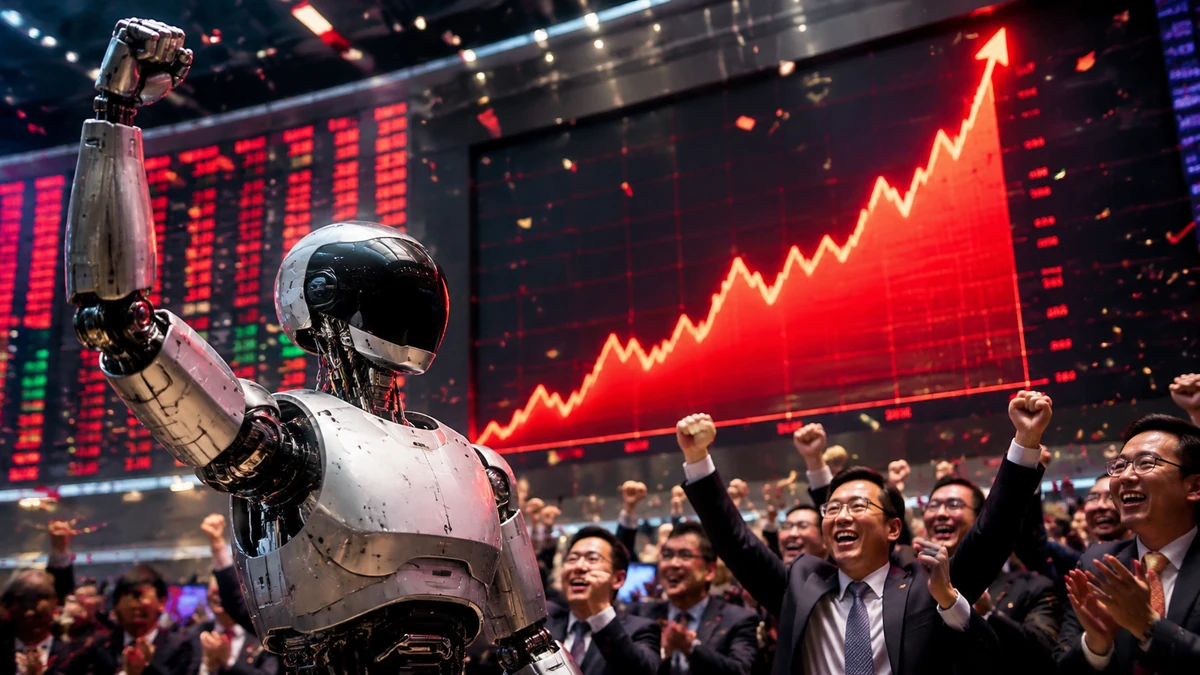
China's humanoid robot industry received a major financial spotlight on Aug. 19, 2026, when Unitree Robotics, one of the country's best-known robot manufacturers, saw its shares surge more than 400% on the first day of trading in Shanghai. The dramatic market debut pushed the company into the center of a global conversation about artificial intelligence, advanced manufacturing and the future of human-machine cooperation.
Unitree, also known by its Chinese name Yushu Technology, began trading on the Shanghai Stock Exchange's STAR Market, a technology-focused exchange designed to support high-growth companies. Shares climbed from an initial public offering price of 150.8 yuan to around 1,100 yuan shortly after trading began, giving the company a market capitalization of about 444.9 billion yuan.
For American readers, the scale of investor enthusiasm is comparable to the excitement that surrounded major U.S. technology listings during earlier waves of innovation, from internet companies in the late 1990s to electric vehicle and artificial intelligence firms in recent years. The difference is that Unitree's appeal is built around a technology that combines physical machines with AI systems: robots designed not only to perform repetitive industrial tasks but also to move and interact in ways closer to humans.
The surge does not guarantee long-term commercial success. Like many emerging technology companies, Unitree now faces the challenge of proving that investor expectations can translate into sustainable business growth.
From Lunar New Year Television to Global Technology Ambitions
Unitree's rise reflects a broader Chinese strategy of promoting robotics and artificial intelligence as key industries for future economic growth. Founded in 2016, the company has become recognized as one of China's leading humanoid robot developers.
The company gained wider public attention earlier in 2026 after its robots appeared in a Lunar New Year television program, performing martial arts-inspired movements. In China, the annual Lunar New Year broadcast is one of the country's most watched cultural events, similar in cultural importance to major holiday broadcasts or national sporting events in the United States. A technology appearance on such a stage can introduce emerging industries to millions of households.
The moment demonstrated how China has connected technology development with popular culture and national industrial ambitions. Robots were not presented only as laboratory experiments but as symbols of future manufacturing, innovation and technological independence.
China has invested heavily in advanced manufacturing, artificial intelligence, semiconductors and automation as part of a broader effort to strengthen its position in high-value industries. Unitree's listing shows how companies in these fields are increasingly connecting technological development with global capital markets.
However, analysts note that humanoid robotics remains a difficult field. A successful robot requires breakthroughs across multiple areas, including artificial intelligence software, sensors, mechanical engineering, battery technology and motion control. Building a robot that can move in a controlled environment is one challenge; creating machines that can reliably operate in unpredictable real-world settings is another.
Why Investors Are Betting on Humanoid Robots
The excitement surrounding Unitree is part of a larger global shift in how investors view robotics. For decades, industrial robots were mainly associated with factories, where machines performed highly repetitive tasks such as welding, assembly and packaging. Humanoid robots represent a different vision: machines that could potentially work alongside people in environments designed for humans.
Supporters of humanoid robotics argue that a human-like form could allow robots to operate in existing workplaces without requiring companies to redesign entire facilities. Potential applications include manufacturing, logistics, healthcare support, customer service and other industries facing labor shortages or dangerous working conditions.
Artificial intelligence has accelerated interest in the sector. Advances in AI models have improved robots' ability to understand instructions, recognize objects and adapt to changing situations. The combination of AI software and physical robotics has created a new investment theme similar to the recent global enthusiasm around generative AI.
Still, the industry faces significant questions. Investors must determine whether today's high valuations reflect realistic future demand or whether expectations have moved faster than technology. Many emerging technology sectors have experienced similar cycles, where excitement arrives before widespread commercial adoption.
Unitree's stock performance therefore represents both confidence and pressure. The company has gained a powerful market signal, but it must now demonstrate that its technology can move beyond demonstrations and become a commercially valuable platform.
What Unitree's Rise Means for the United States
The United States is also deeply involved in the global competition over AI-powered robotics. American technology companies, research institutions and startups are developing their own approaches to combining artificial intelligence with physical machines. The competition is not simply about building better robots; it is about controlling the technologies that could shape future workplaces and industries.
For American companies, Unitree's market debut is a reminder that China is moving aggressively to commercialize robotics. The United States has historically maintained strengths in software, artificial intelligence research and venture investment, while China has developed major advantages in manufacturing scale and supply chains. Humanoid robotics brings these strengths into direct competition.
The development of advanced robots could also affect U.S. industries that rely heavily on manufacturing, logistics and healthcare services. American companies are exploring automation as they face challenges including labor costs, workforce shortages and the need for greater productivity. If humanoid robots become practical at scale, businesses in the United States could become major customers as well as competitors.
The U.S.-China technology relationship adds another layer of complexity. Competition over semiconductors, AI capabilities and advanced manufacturing has already become a major issue in economic and national security discussions. Robotics represents another area where technological leadership may influence future industrial power.
At the same time, the global robotics market is unlikely to be defined by a single country. Collaboration between researchers, competition among companies and international demand will all influence how the industry develops. American consumers and businesses may ultimately benefit from faster innovation, regardless of where individual breakthroughs occur.
Humanoid Robots Move From Research Labs Toward Commercial Reality
Unitree's first trading day was more than a financial event. It reflected a changing perception of humanoid robots, which are increasingly viewed as potential commercial products rather than distant science fiction concepts.
The company's dramatic stock increase shows that investors believe robotics could become one of the defining technology sectors of the coming years. Similar to previous transformations in computing, smartphones and cloud services, the biggest opportunities may emerge when technology becomes integrated into everyday economic activity.
But the path forward will depend on execution. Companies must prove that robots can perform useful tasks safely, efficiently and at a cost businesses can justify. Technical demonstrations can attract attention, but long-term success will require reliable products, strong customer adoption and profitable operations.
For global audiences, Unitree's rise offers a glimpse into the next stage of the artificial intelligence competition. The future of AI may not exist only on computer screens or inside data centers. It may also walk, work and interact in the physical world.
The race for humanoid robots is becoming a competition among nations, companies and researchers to determine how intelligent machines will become part of daily life. Unitree's market debut suggests that this future is moving closer, while also showing that the hardest challenges may still lie ahead.
Comments
Post a Comment