Image to help understand the article
A Medieval Korean Engineer Who Changed the Course of Naval Defense
Long before modern Korea became known for advanced technology companies and cutting-edge industries, the Korean Peninsula produced innovators who reshaped the technology of their own era. One of the most important was Choe Museon (1325-1395), a late Goryeo Dynasty military official and weapons engineer who developed Korea’s first successful gunpowder production methods and introduced cannon-based warfare to the kingdom.
For American readers, Choe Museon’s story can be compared to the way early firearms transformed European warfare or how new military technologies changed naval strategy during later periods of history. His achievement was not simply the creation of a new weapon. He helped build an entire system around a new technology: manufacturing, military organization, training and battlefield use.
Choe lived during the final decades of the Goryeo Dynasty (918-1392), a period when Korea faced serious internal instability and repeated attacks from Japanese pirates, known in Korean historical records as Waegu. These pirate groups frequently raided coastal communities, damaging villages and disrupting trade. Traditional defensive methods were proving insufficient, and Choe recognized that Korea needed a technological solution.
His response was a long-term effort to develop gunpowder weapons domestically. At a time when gunpowder manufacturing techniques were closely guarded secrets in East Asia, Choe pursued knowledge that many considered impossible to obtain. His work eventually gave Goryeo a new military capability and influenced weapons development during the early Joseon Dynasty that followed.
The Challenge of Creating Gunpowder in a Secretive Technology Era
Choe Museon was born in Yeongju, an area corresponding to modern Yeongcheon in South Korea’s North Gyeongsang Province. His father, Choe Dong-sun, served as an official in charge of state finances. From an early age, Choe demonstrated strong technical curiosity and an interest in military strategy.
Unlike many officials of his time who focused primarily on classical studies and government administration, Choe devoted significant attention to engineering and weapons technology. He studied available texts, learned Chinese to access foreign information and investigated methods for producing military equipment.
The biggest obstacle was gunpowder itself. In medieval East Asia, gunpowder knowledge was considered a strategic asset. The materials, formulas and manufacturing processes required for reliable explosives were not openly shared. One essential ingredient, saltpeter, was particularly difficult to obtain and process.
China had developed advanced gunpowder technology earlier, but manufacturing details were tightly controlled. Goryeo had access to some foreign knowledge, but it lacked the ability to independently produce military-grade gunpowder on a national scale.
Choe refused to accept this limitation. Historical records describe his efforts to obtain technical information through contacts connected to the Yuan Dynasty. After learning parts of the manufacturing process, he conducted experiments and continued refining the formula.
His efforts were initially met with skepticism. Some officials doubted his claims and criticized him as someone making unrealistic promises. Like many innovators throughout history, Choe faced resistance because his ideas challenged existing assumptions about what was possible.
Eventually, his persistence convinced the government to support his research. In 1377, the Goryeo court established the Hwatongdogam, an official institution dedicated to producing gunpowder weapons. Choe became responsible for weapons manufacturing there, turning his personal research into a national defense program.
The Battle of Jinpo and the Arrival of Cannon Warfare in Korea
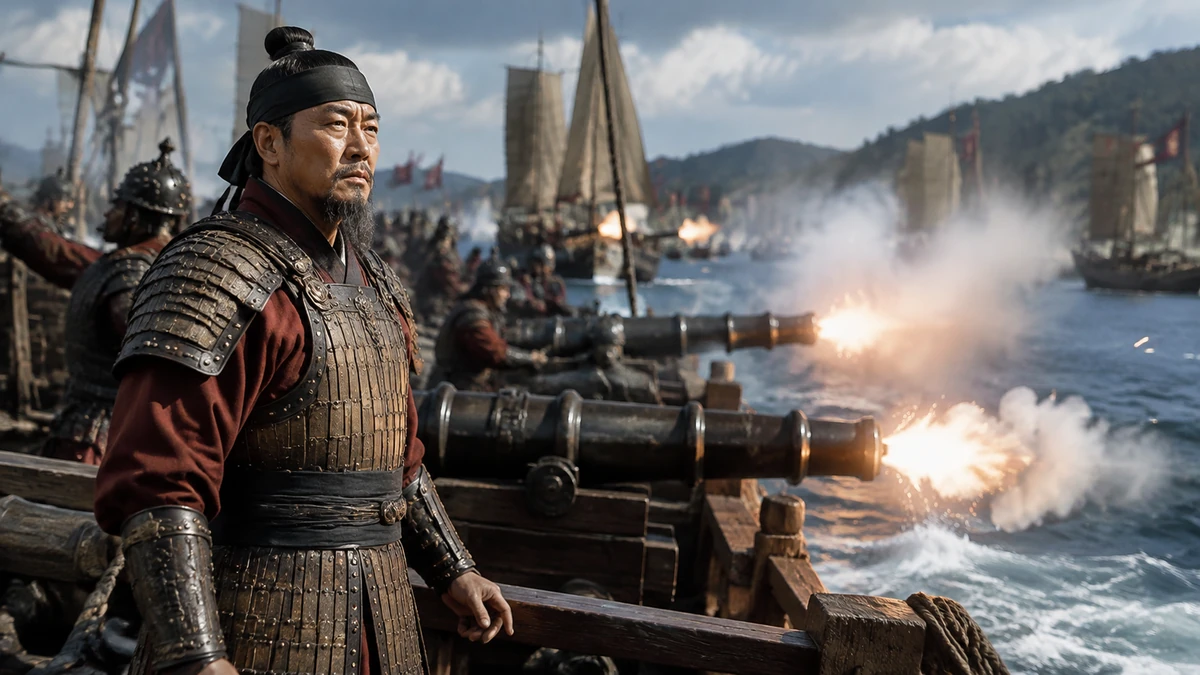
The true importance of Choe Museon’s work became clear on the battlefield. In 1380, Goryeo forces faced a major pirate invasion at the Battle of Jinpo, a naval conflict near the mouth of the Geum River. Historical accounts describe a large pirate fleet arriving with hundreds of ships and causing destruction along coastal areas.
Choe participated as a deputy commander and helped lead the use of gunpowder weapons in naval combat. Goryeo ships equipped with cannons and firearms attacked the invading fleet, marking one of the first major examples of gunpowder-based naval warfare in Korean history.
The battle demonstrated a fundamental change in military strategy. Previously, naval battles often depended heavily on boarding actions, archery and close combat. With cannon technology, ships could attack enemies from greater distances and destroy wooden vessels through explosive force.
The victory did not immediately eliminate pirate activity. Some surviving forces moved inland and continued attacks before later being defeated in additional campaigns. However, Jinpo became a symbolic turning point because it showed that technology could change the balance of power.
Historical records later credited Choe’s contribution with helping reduce pirate threats and allowing coastal communities to recover. His weapons technology also continued to be used in later battles, including conflicts against pirate forces near the southern coast.
Beyond Weapons: Building a Military Technology System
Choe Museon’s achievement was broader than inventing individual weapons. He understood that technology only becomes effective when supported by institutions and trained personnel.
At Hwatongdogam, Korean engineers produced various types of firearms and projectile weapons. Records mention weapons such as large cannons, smaller artillery pieces, fire arrows and other gunpowder devices. The exact design and operation of many weapons differed from modern firearms, but they represented a significant advancement for medieval Korea.
Choe also worked to adapt naval vessels for gunpowder warfare. Mounting weapons on ships required changes in construction, battlefield organization and crew training. The government created specialized units responsible for operating these weapons, showing that Korea was developing not only new equipment but also a new military doctrine.
This approach resembles later technological revolutions in military history. When aircraft, tanks or nuclear weapons appeared in the 20th century, countries did not gain advantages simply by possessing the technology. They needed manufacturing systems, trained specialists and strategic planning. Choe’s work followed a similar pattern centuries earlier.
What Choe Museon’s Legacy Means for the United States and Global Technology History
For American audiences, Choe Museon’s story offers a reminder that technological innovation has always been global. The history of science and engineering is often told through famous European or American examples, but breakthroughs also emerged from Asia’s medieval kingdoms.
The United States today maintains one of the world’s largest technology ecosystems, where defense technology, artificial intelligence, aerospace and advanced manufacturing are closely connected. Choe’s experience highlights a principle familiar to modern American industries: strategic technologies can influence national security, economic strength and international competition.
The Korea-U.S. relationship today is largely defined by cooperation in areas such as semiconductors, batteries, digital technology and defense industries. Modern Korean companies have become major players in global technology markets, but this technological identity has historical roots in earlier periods when Korean engineers sought solutions to national challenges.
For American historians and technology enthusiasts, Choe Museon provides another perspective on Korea beyond its contemporary cultural exports. The same country now recognized worldwide for electronics, automobiles and entertainment also has centuries of experience in engineering innovation.
His story may also resonate with discussions in the United States about the importance of research investment and technological independence. Choe’s success came from combining outside knowledge with domestic experimentation. He did not simply copy foreign technology; he adapted and developed it for Korea’s specific security needs.
A Medieval Innovator Remembered in Modern Korea
After Goryeo fell and the Joseon Dynasty was established in 1392, Choe Museon continued to be respected for his expertise. Although he was already elderly, the new government recognized the value of his experience and appointed him to important positions related to military administration.
Choe died in 1395. According to historical records, he left behind a written record containing knowledge about gunpowder production and saltpeter processing, which was later passed to his son Choe Haesan. This helped preserve Korea’s military technology after his death.
Today, Choe Museon is remembered in South Korea as a symbol of practical innovation and scientific determination. His life represents a period when technology became a critical factor in protecting a nation and shaping its future.
His legacy also reflects a broader lesson in world history: technological breakthroughs often emerge during moments of crisis. Faced with repeated coastal attacks and limited resources, Choe transformed a difficult challenge into an opportunity for innovation. More than six centuries later, his story remains an example of how knowledge, persistence and engineering can change the course of history.
Comments
Post a Comment