EXO’s Seoul Encore Signals How K-pop Turns a World Tour Into a Global Narrative — and Why That Matters in the U.S.
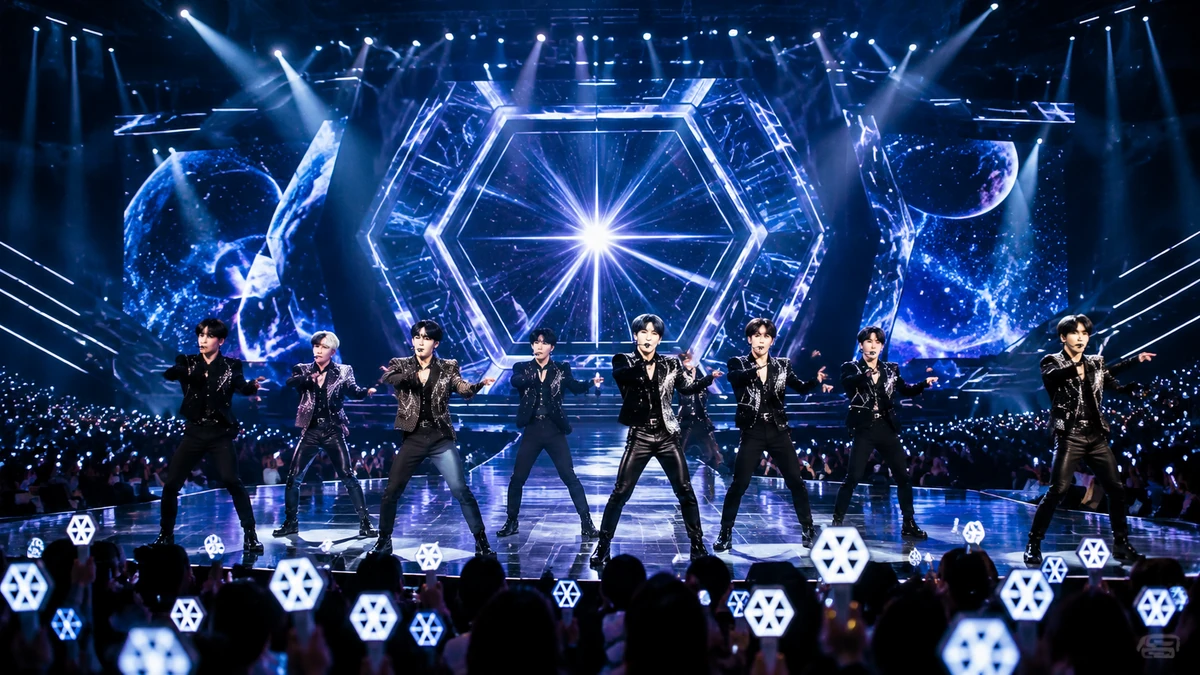
Image to help understand the article
EXO returns to Seoul to put a period on a world tour
EXO, one of K-pop’s defining boy bands of the past decade, is set to bring its sixth tour to a close with a three-night encore run Nov. 6-8 at KSPO Dome in Seoul, according to its agency, SM Entertainment. The concerts, billed as “EXO PLANET #6 - EXhOrizon ‘dot’ -,” are more than an extra set of dates tacked onto a successful tour. In the language of K-pop, they are meant to serve as a final chapter — a return to where the tour began in April, now reshaped by months of performances across 14 regions and 27 shows.
That framing matters. American concertgoers are familiar with the idea of a tour finale, a hometown show or a “last stop” designed to celebrate a long run. But K-pop often pushes that concept further, turning a concert series into a carefully branded narrative with its own visual identity, subtitle and mythology. In this case, the subtitle “dot” functions almost like punctuation. If the broader “EXhOrizon” tour represented expansion — a horizon line moving outward from Seoul to the wider world — the encore suggests closure, a deliberate return that gives the journey its ending.
For fans in South Korea, that means a chance to compare the April opening with the November conclusion and see how the production has evolved. For international fans, including a sizable audience in the United States, the Seoul dates carry a different but equally potent appeal: they offer a symbolic final look at a tour that has already passed through multiple markets and been shaped by audience response along the way. The concerts are being presented not as a replay of familiar material, but as a more developed version of what came before.
That distinction is subtle, but important. In the American pop industry, an encore can sometimes mean a second leg designed mostly to meet demand. In K-pop, especially at the arena and dome level, it can also mean a refined edition of the same artistic statement — a performance sharpened by repetition, scale and fan feedback. SM’s emphasis on a “more advanced” version of the show suggests the Seoul finale is intended to be the definitive form of the tour, not merely an encore in the colloquial sense.
It also underscores a broader reality of K-pop’s live business: the concert is no longer just a vehicle for songs. It is a narrative product, one that gains value not only from attendance, but from the sense that fans are watching an evolving story unfold across cities and months. EXO’s Seoul return fits squarely within that model.
Why the Seoul finale matters in K-pop’s performance culture
To American readers unfamiliar with the structure of the Korean pop business, the significance of a Seoul encore may not be immediately obvious. In South Korea, however, Seoul is not just another stop. It is the symbolic center of the industry — the place where agencies are headquartered, major music television appearances are staged, and many of the biggest acts begin and end their most important live cycles. Returning to Seoul can signal prestige, closure and a kind of artistic homecoming.
KSPO Dome, located in Seoul’s Olympic Park, is one of the country’s best-known large concert venues. For a major idol group, booking several nights there is a marker of enduring commercial strength. The three-day format also matters. Rather than a one-off add-on, it suggests a standalone final act substantial enough to be treated as its own event. In practical terms, that gives fans more opportunities to attend. In narrative terms, it tells audiences this is not an afterthought, but an ending with weight.
K-pop agencies have become particularly skilled at giving tours this kind of narrative architecture. A tour title is rarely just a title. It often ties into a group’s long-running concept, visual language or internal “worldview,” sometimes referred to by fans as a universe or lore. EXO has long leaned into that strategy. Even the “EXO PLANET” branding reflects the group’s identity-building beyond a conventional album cycle, inviting fans into a self-contained world rather than simply marketing a sequence of songs.
That helps explain why the word “dot” is doing so much work here. It is not just a decorative subtitle. It signals finality in a way that translates across languages. Fans who may not read Korean still understand the basic arc: a tour begins in Seoul, travels outward, and returns to Seoul to place a final mark on the journey. That is one reason K-pop’s touring narratives travel so well internationally. Even when specific cultural cues are local, the larger emotional structure — departure, expansion, return — is universally legible.
There is also a production logic behind the symbolism. After 27 shows in 14 regions, performers and creative teams have had time to test pacing, adjust set pieces, refine staging and gauge audience response. Anyone who has watched a Broadway show tighten after previews or seen a major U.S. touring act settle into a run understands the principle. Repetition can make a live production more polished. SM’s promise of an upgraded version of the show indicates that EXO’s encore is meant to reflect that accumulation of experience.
What this says about K-pop’s long shelf life
The EXO encore announcement landed alongside another datapoint from the Korean music business: SEVENTEEN’s 2022 song “HOT” has surpassed 300 million streams on Spotify, according to Pledis Entertainment. On the surface, one story is about concerts and the other is about streaming. Taken together, though, they illustrate a central truth about K-pop in 2025: the genre’s biggest acts are not operating on one-week hype alone. Their business increasingly depends on long-tail engagement, in which songs and performances keep generating value long after release day.
That is a crucial shift for understanding where K-pop sits now in the global music economy. For years, outside observers often reduced the genre to fan intensity, synchronized dance clips and social media trends. Those remain important ingredients. But they do not fully explain how older tracks continue to rack up streams or how a tour can gain new meaning at its endpoint rather than simply fading after opening night. The more durable story is one of sustained participation.
EXO’s encore is a case study in that durability. The group is not simply revisiting material because there is nothing new to say. The agency’s messaging suggests the opposite: that a tour itself can mature over time. By the time it reaches its final stop, it has been tested in front of different crowds and different local conditions. The encore becomes a summation of that process, a live equivalent of a deluxe edition or director’s cut.
In that sense, K-pop’s live strategy increasingly resembles what streaming has already done to recorded music. A song no longer lives or dies by its launch week. It can find new audiences months or years later through playlists, algorithms, fan edits and global discovery. Likewise, a tour no longer exists only in the city where it is performed on a given night. Its meaning accumulates across stops, through online clips, fan discussions and the shared knowledge that the production is changing as it moves.
That combination of constant circulation and constant refinement is one reason K-pop has proven more resilient than some early skeptics predicted. It is not just exportable because it is catchy. It is exportable because it is structurally built for repetition, adaptation and multi-platform fandom. EXO’s final Seoul shows are part of that larger pattern: a reminder that in K-pop, endings are often designed to generate one more wave of attention precisely because they feel like meaningful conclusions.
What it means for the United States
For the United States, EXO’s Seoul encore is relevant even though the concerts are taking place thousands of miles away. American fans have become an essential part of the K-pop audience, not only as consumers of albums and streams, but as participants in the broader ecosystem that keeps tours culturally alive long after a local date ends. U.S.-based fans follow Seoul concerts in real time through social media, fancams, translation accounts and livestream-related coverage, often treating a finale in Korea as a globally shared event rather than a geographically limited one.
That shift has major implications for the U.S. music business. It means that American companies — from ticketing and touring partners to streaming platforms and merchandising firms — are no longer dealing with K-pop as an occasional import. They are dealing with a transnational entertainment system whose center of gravity may remain in Seoul even while much of its revenue and attention comes from abroad. A concert at KSPO Dome can ripple into American fan communities instantly, influencing demand for future U.S. dates, merchandise sales and online engagement.
There is also a lesson here for the broader American concert industry. U.S. pop stars have long used deluxe albums, reunion runs and prestige finales to extend a project’s life. K-pop’s version is often more tightly integrated. The branding is consistent, the visual storytelling is planned from the start, and the ending is sold not merely as a final chance to attend but as the polished culmination of a monthslong arc. That is the kind of narrative discipline many American labels and promoters have been trying to recreate in an era when attention is fragmented and live entertainment has become one of the few dependable revenue engines.
For U.S.-Korea cultural ties, the significance is broader still. Every major K-pop tour helps normalize South Korea’s role as not just a source of viral songs, but a central player in global entertainment strategy. That matters in Washington as well as in Hollywood. The more Korean companies shape worldwide fandom habits, the more South Korea’s cultural exports become part of the everyday American consumer landscape — alongside U.S. films, British pop acts and Latin music. K-pop is no longer a niche cultural curiosity in the United States. It is part of the mainstream conversation about how music travels globally.
American fans also understand something especially well about the emotional power of the “final stop.” Think of the mythology around a final Madison Square Garden run, a farewell concert in Los Angeles, or a last-night performance on Broadway. The EXO encore taps into that same instinct. Even for fans who cannot attend in person, the Seoul finale becomes a communal milestone. It gives the fandom a date to gather around, discuss and document. That is how global fandom now works: a local event can function as international culture in real time.
From event coverage to industry trend
If there is a bigger takeaway from EXO’s encore, it is that K-pop’s mature phase is increasingly defined by how well acts manage continuity. The breakthrough era of the genre outside Asia was often framed around firsts: the first chart records, the first big festival appearances, the first arena tours that proved demand in the United States and Europe. Those milestones mattered, but they belonged to a period when K-pop was still being treated as a rising phenomenon.
Now the question is different. The issue is not whether K-pop can break through, but whether its biggest acts and companies can sustain attention across years, across markets and across changing fan habits. EXO’s encore suggests one answer: by turning the tour itself into a living product that evolves rather than merely repeats. The group’s route from April to November, across 14 regions and 27 shows, is not being framed as a completed obligation. It is being framed as a developmental process that reaches its fullest expression at the end.
That logic mirrors a wider shift in entertainment economics. In film and television, franchises are built around universe-building and serialized payoff. In sports, championships are consumed as narratives that gain meaning from the season’s long arc. In music, especially live music, artists increasingly need more than a strong opening weekend. They need a reason for audiences to stay invested. K-pop agencies have become adept at creating those reasons through packaging, symbolism and iterative performance design.
It is worth noting that none of this requires exaggerating what the Seoul encore is. At base, it is still a three-night concert run by a major Korean group finishing a world tour in its home market. But in the current media environment, that is enough to tell us something larger. It reveals how K-pop companies think about value creation: not as a one-time release, but as a chain of connected moments that can each be marketed as meaningful in their own right.
That is especially relevant for American observers because the U.S. industry is wrestling with similar questions. How do you keep fans engaged between releases? How do you make a tour feel culturally indispensable rather than merely expensive? How do you turn a final show into a global event? EXO’s encore does not answer all of those questions, but it offers a clear example of one model that is working.
What to watch next
The most immediate thing to watch is how clearly EXO differentiates this encore from earlier shows on the same tour. SM Entertainment has said the Seoul concerts will present a more developed version of the performance, but has not yet detailed what that means in practice. For industry watchers, the answer matters. Significant staging changes, revised sequencing or a reworked visual concept would reinforce the idea that K-pop encores are becoming a distinct premium product rather than a rerun.
Another question is how the finale circulates beyond the venue. In today’s fan economy, a concert’s impact is no longer limited to ticket buyers. It extends through clips, online discussion, media recap and fan translation. If the November shows generate strong digital afterlife — whether through viral moments, set-list changes or symbolic callbacks to the April opener — they will demonstrate again that a Seoul concert can function as worldwide content even without a Western venue attached.
There is also the broader competitive backdrop. K-pop is now crowded with established groups, rising acts and increasingly sophisticated agencies, all competing for global attention. That puts pressure on veteran acts to show not just relevance, but refinement. A well-received finale can help remind the market that longevity in K-pop is about more than nostalgia. It can be about craft, scale and the ability to keep giving fans a reason to care about the next version of the story.
For American audiences, the final measure may be simpler: whether a Seoul encore feels consequential even from afar. If it does, that says something important about where global pop is headed. The center of a music event no longer has to be in New York, Los Angeles or London for English-speaking audiences to treat it as major entertainment news. A three-night finale in Seoul can carry international weight because the fandom, the platforms and the business infrastructure already connect it to the rest of the world.
That may be the clearest lesson of all. EXO’s encore is not just a K-pop scheduling update. It is another sign that the global music map has changed. South Korea is not simply sending culture outward; it is hosting events that the world, including the United States, increasingly experiences as part of its own pop conversation.
Comments
Post a Comment