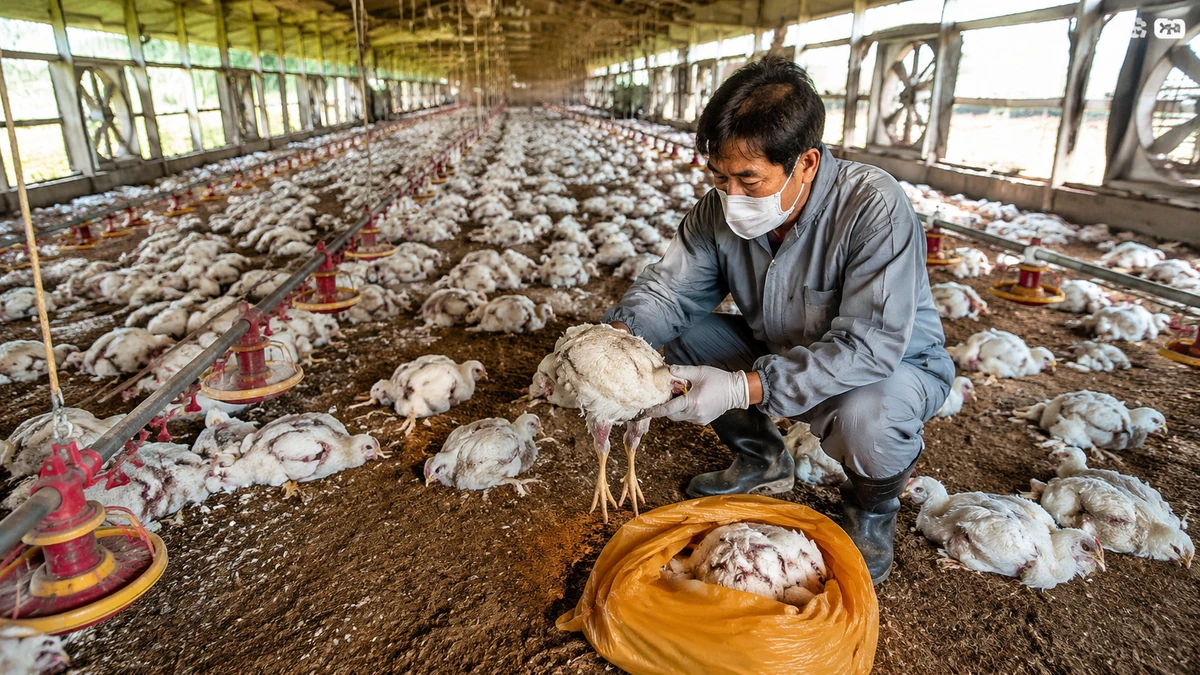
South Korean Region Reports More Than 10,000 Livestock Deaths Amid Historic Heat
A prolonged heatwave in South Korea has begun taking a serious toll on rural communities, with authorities reporting that more than 10,000 livestock animals have died across four farms in the southern region of Jeonnam-Gwangju. The regional government announced Aug. 4 that a total of 10,781 livestock deaths had been reported as temperatures remained unusually high for weeks.
The situation highlights a growing concern in South Korea and many other countries: extreme heat is no longer only a public health issue affecting people in cities. It is increasingly becoming a challenge for agriculture, fisheries and local economies that depend on stable environmental conditions.
For American readers, the situation is comparable to heat emergencies that have affected livestock operations in parts of the U.S. Southwest, Midwest and California, where prolonged high temperatures can create dangerous conditions for cattle, poultry and other farm animals. In South Korea, where agricultural communities often operate on smaller family-run farms, sudden climate pressures can have an immediate impact on household livelihoods.
A Heatwave Stretching Into Its Fourth Week
The Jeonnam-Gwangju region has been under heatwave advisories for 27 consecutive days since July 9, according to local authorities. Several areas, including parts of eastern Gwangju, Jangseong, Gwangyang and Suncheon, have been placed under the country’s highest-level heat emergency warnings, while many other cities and counties remain under heatwave alerts.
South Korea uses a national heat warning system that includes advisories and stronger emergency alerts based on temperature forecasts and potential risks to public safety. These warnings are commonly associated with recommendations to reduce outdoor activity, protect vulnerable people and prepare emergency responses.
But for farmers, avoiding the heat is often impossible. Livestock facilities must continue operating throughout extreme weather, requiring constant attention to ventilation, water supplies and temperature management. Unlike people who can move indoors, farm animals depend on their surroundings being carefully controlled.
The reported losses in Jeonnam-Gwangju demonstrate how a long period of extreme temperatures can transform a weather event into a broader economic issue. Authorities said the deaths were reported by four farms, although the available information did not provide a detailed breakdown of causes or the specific types of livestock affected.
Why Heat Creates Serious Risks for Farms and Fisheries
Animals raised for food production are particularly sensitive to prolonged heat because their bodies must maintain a stable internal temperature while exposed to changing outdoor conditions. High temperatures can reduce animals’ ability to eat, grow and reproduce, while increasing the risk of heat-related illness or death.
Poultry farms are especially vulnerable because birds have limited ways to release body heat compared with humans and some larger animals. During severe heat events, farmers often increase cooling measures, improve airflow and adjust feeding schedules to reduce stress on animals.
South Korea’s fisheries sector faces similar challenges. Warmer water temperatures can affect farmed fish by reducing oxygen levels in water and creating conditions that increase stress. Recent heatwaves have raised concerns among coastal communities that rely on aquaculture as an important source of income.
The Jeonnam-Gwangju case is therefore part of a wider pattern in which extreme weather events increasingly affect food production systems. A heatwave that begins as a temperature record can eventually influence farmers, markets, consumers and regional economies.
Rural Communities Face a New Climate Reality
South Korea has experienced rapid economic and technological development, but many rural areas still rely heavily on agriculture and fisheries. Regions such as Jeonnam, known for farming and coastal industries, remain closely connected to seasonal weather patterns.
Traditionally, farmers have planned their operations around predictable seasonal cycles. Summers were always hot, but many communities developed routines based on historical climate patterns. The challenge today is that extreme temperatures are becoming more frequent and lasting longer, making older approaches less reliable.
For rural producers, climate adaptation now involves more than responding after damage occurs. It requires investment in cooling equipment, improved farm designs, early warning systems and emergency planning. These changes can be especially difficult for smaller operators who may have limited financial resources.
The Korean government and local authorities have increasingly focused on helping communities prepare for climate-related risks. Their efforts include monitoring weather conditions, supporting emergency responses and encouraging preventive measures at farms and production sites.
Heatwaves Affect More Than Agriculture
Extreme heat has become a national concern in South Korea because it affects nearly every part of daily life. In urban areas such as Seoul and Busan, residents respond by changing commuting patterns, reducing outdoor activities and seeking cooler environments. In rural areas, the consequences are often more directly tied to work and survival.
Farmers, agricultural workers and outdoor laborers face higher risks because their jobs require exposure to weather conditions. At the same time, damage to livestock and crops can create financial pressure that extends beyond individual farms.
Food supply chains can also be affected. When production declines because of extreme weather, markets may experience changes in availability and prices. While the full economic impact of the Jeonnam-Gwangju livestock losses has not yet been determined, experts say repeated climate events could create increasing challenges for food producers.
The issue reflects a global trend. From wildfires in North America to droughts in Europe and record temperatures across Asia, communities worldwide are confronting the need to adapt to a changing climate.
South Korea’s Experience Reflects a Global Climate Challenge
The livestock losses reported in Jeonnam-Gwangju provide a local example of a much larger international issue. Extreme heat is becoming a test of how societies protect people, animals and industries that depend on natural conditions.
For South Korea, a country known internationally for its technology sector, entertainment industry and fast-growing cities, climate challenges are also reshaping rural communities that play an essential role in the national economy.
The response to events like this will likely focus not only on recovery but also on preparation. Farmers, governments and researchers are increasingly examining ways to make agricultural systems more resilient through technology, improved infrastructure and better climate forecasting.
The recent heatwave in Jeonnam-Gwangju serves as a reminder that climate change is experienced locally. A rise in temperature may appear as a simple weather statistic, but on farms it can mean lost animals, financial hardship and difficult decisions for families whose livelihoods depend on the land.
As South Korea continues to experience longer and more intense summer heat events, the country’s response may offer lessons for communities around the world facing similar pressures. The challenge is no longer simply surviving a hot summer, but adapting to a climate environment that is changing faster than many traditional systems were designed to handle.
Comments
Post a Comment