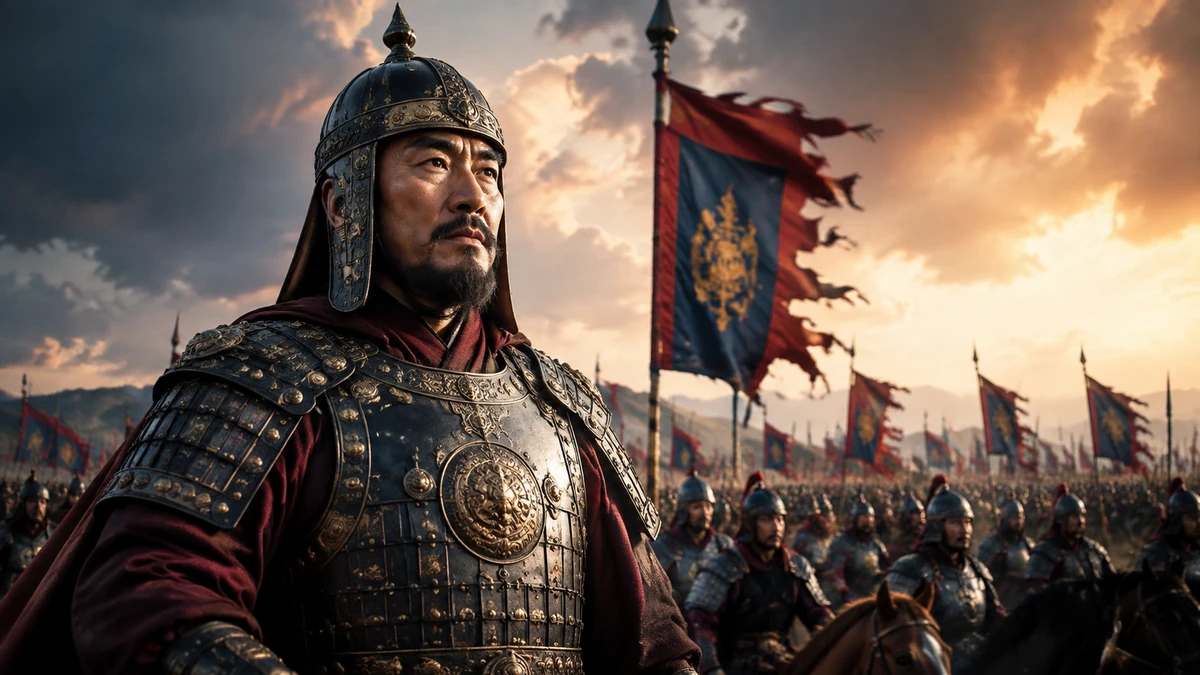
Image to help understand the article
A Medieval Korean Leader Whose Legacy Extends Beyond the Battlefield
More than a millennium ago, a Korean official who began his career as a scholar and civil administrator became the figure credited with one of the most important military victories in Korean history. Gang Gam-chan, a leading statesman of the Goryeo dynasty, is remembered not only as the commander who defeated a powerful invading force at the Battle of Gwiju, but also as an example of disciplined leadership, government service and public responsibility.
For many Americans, Korean history is often first encountered through modern stories: the Korean War, the rapid economic transformation known as the “Miracle on the Han River,” or the global popularity of K-pop, Korean films and television dramas. But Korea’s national identity has been shaped by centuries of earlier experiences, including the rise and survival of dynasties that navigated conflicts with neighboring powers. Gang Gam-chan’s story belongs to that longer historical narrative.
Gang lived during the Goryeo dynasty, which ruled the Korean Peninsula from 918 to 1392. The era was marked by sophisticated government institutions, active diplomacy and repeated challenges from surrounding states. Unlike many famous military figures who began as soldiers, Gang was originally a scholar-official. His career demonstrates a recurring theme in East Asian history: that political judgment, education and administrative skill could be as important as battlefield strength.
His greatest achievement came during the third invasion of Goryeo by the Khitan-led Liao dynasty in 1018. Facing a much larger invading army, Gang used careful strategy rather than simple force to defend his country. His victory at Gwiju became a defining moment in Korean history and established him as one of the peninsula’s most respected historical figures.
From Scholar-Official to Wartime Commander
Gang Gam-chan was born in 948 in Geumju, an area associated with modern-day Seoul. He entered government through the civil service examination system, an institution that rewarded knowledge of classical learning and administrative ability. In 983, he achieved the highest rank in the national examination, a major accomplishment in the Goryeo political system.
This background is important because Gang’s path differed from the image many people have of traditional military heroes. He was not a career warrior who rose through battlefield victories. Instead, he was a government official whose understanding of politics, diplomacy and national affairs later became essential during a military crisis.
Gang served in several important government positions, including roles connected with education, administration and the royal court. His experience gave him insight into how a state functioned during both peaceful and unstable periods. When foreign threats emerged, his ability to evaluate risks became one of his greatest strengths.
The Goryeo kingdom existed in a complicated regional environment. To the north was the powerful Liao dynasty, which controlled large territories and frequently sought influence over neighboring states. Relations between Goryeo and Liao involved both diplomacy and military confrontation. Korean rulers had to balance independence, trade relationships and security concerns, much like modern countries managing relationships with larger regional powers.
The Crisis of the Liao Invasions and Gang’s Strategic Vision
The early 11th century brought a major challenge for Goryeo. In 1010, the Liao dynasty launched a large invasion after political turmoil inside Goryeo provided a justification for military action. The invading army was reportedly enormous, and the Goryeo court faced pressure from officials who believed surrender might be the safest option.
Gang Gam-chan rejected that approach. Instead of accepting defeat, he argued for preserving the state through strategic withdrawal and continued resistance. His advice reflected a broader principle of national survival: a government could retreat temporarily without abandoning its legitimacy or future ability to fight back.
This decision allowed Goryeo’s leadership to survive the crisis. Although the country suffered severe damage, it avoided collapse. The experience also demonstrated Gang’s ability to think beyond a single battle and focus on the long-term survival of the state.
Several years later, the Liao dynasty launched another major campaign against Goryeo. In 1018, Liao general Xiao Baiya led an army into Goryeo territory. Gang Gam-chan, then serving as a senior official, was appointed commander of Goryeo forces. He worked with other generals to organize a defense against the invasion.
The conflict reached its decisive moment at the Battle of Gwiju. Gang’s forces used terrain, timing and tactical planning to overcome the invading army. One famous example involved the Battle of Heunghwajin, where Goryeo forces used a carefully prepared trap involving water control and hidden cavalry positions. When the Liao troops entered the area, Gang’s forces released the stored water and launched an attack, creating confusion among the enemy ranks.
After additional clashes, the retreating Liao army was confronted at Gwiju. Goryeo forces destroyed much of the invading army, creating one of the most significant military victories in the dynasty’s history. The defeat ended major Liao attempts to conquer Goryeo and helped establish a period of relative stability between the two states.
Why Gang Gam-chan Matters to American Audiences Today
Gang Gam-chan’s story offers an example of a historical figure whose importance is not limited to military achievement. In the United States, comparisons might be made to leaders who combined government service, strategic thinking and crisis management. Figures such as George Washington are often remembered not only for battlefield success but also for their role in building political institutions after conflict. While the historical contexts are very different, the broader idea of leadership during national emergencies is a familiar theme.
Gang’s reputation also reflects values that remain important in Korean society today: education, public service, preparation and responsibility. The Korean concept of a respected public official has deep historical roots. A leader was expected not only to achieve results but also to demonstrate personal discipline and integrity.
According to historical records, Gang was known for modest living and a reputation for honesty. He was not remembered as a wealthy or glamorous figure. Instead, accounts emphasized his seriousness, humility and dedication to government duties. This image continues to influence how Koreans view him as a model of ethical leadership.
These themes connect with current discussions in many countries, including the United States, about public trust, government accountability and the qualities expected from national leaders. Gang’s legacy is not simply about winning a war; it is about how leaders respond when institutions and societies face uncertainty.
What Gang Gam-chan’s Legacy Means for the United States and Global Interest in Korea
For American audiences, the story of Gang Gam-chan provides a window into a part of Korean history that is less visible than the country’s modern cultural exports. The United States and South Korea today maintain a close partnership built around security, technology, trade and cultural exchange. Understanding Korea’s historical experiences helps explain why national resilience and independence remain powerful themes in Korean society.
American interest in Korea has expanded dramatically in recent years. Korean entertainment, cuisine, technology brands and cultural products have reached audiences across the United States. However, the popularity of Korean culture has also increased curiosity about Korea’s deeper historical traditions. Stories like Gang Gam-chan’s help provide context for a country whose identity was shaped by centuries of interaction with neighboring powers.
For American educators, museums, historians and cultural organizations, Korean historical figures represent opportunities to broaden public understanding of East Asian history. While many Americans are familiar with modern Korean achievements in technology and entertainment, fewer may know about the political and military history that shaped the peninsula long before the modern era.
The connection is also relevant to the broader relationship between the United States and Korea. Both countries have experienced periods where strategic decisions made during moments of crisis had long-lasting consequences. Gang Gam-chan’s emphasis on preparation, diplomacy and national endurance reflects themes that continue to appear in international affairs today.
A Historical Figure Remembered as Both Warrior and Statesman
After the victory at Gwiju, Gang Gam-chan continued serving as a senior government official. His career did not end with military success. He returned to political leadership and eventually reached the highest levels of government, becoming one of Goryeo’s most influential ministers.
This second chapter of his life is central to his reputation. Korean historical memory does not define him only as a general who defeated an enemy army. Instead, he is remembered as a complete statesman who combined intellectual ability, administrative experience and military judgment.
His achievements have been preserved through monuments, historical sites and cultural references in Korea. A birthplace site associated with Gang exists in Seoul, and a Korean naval destroyer was later named after him, reflecting his continuing symbolic importance.
Today, Gang Gam-chan represents a bridge between Korea’s ancient past and its modern identity. His story shows that national history is not only shaped by kings and battles but also by officials who make difficult decisions during uncertain times.
For global audiences discovering Korea through contemporary culture, figures like Gang Gam-chan offer another perspective: Korea’s story is not only one of economic growth and cultural influence, but also of centuries of resilience, strategic thinking and leadership.
Comments
Post a Comment