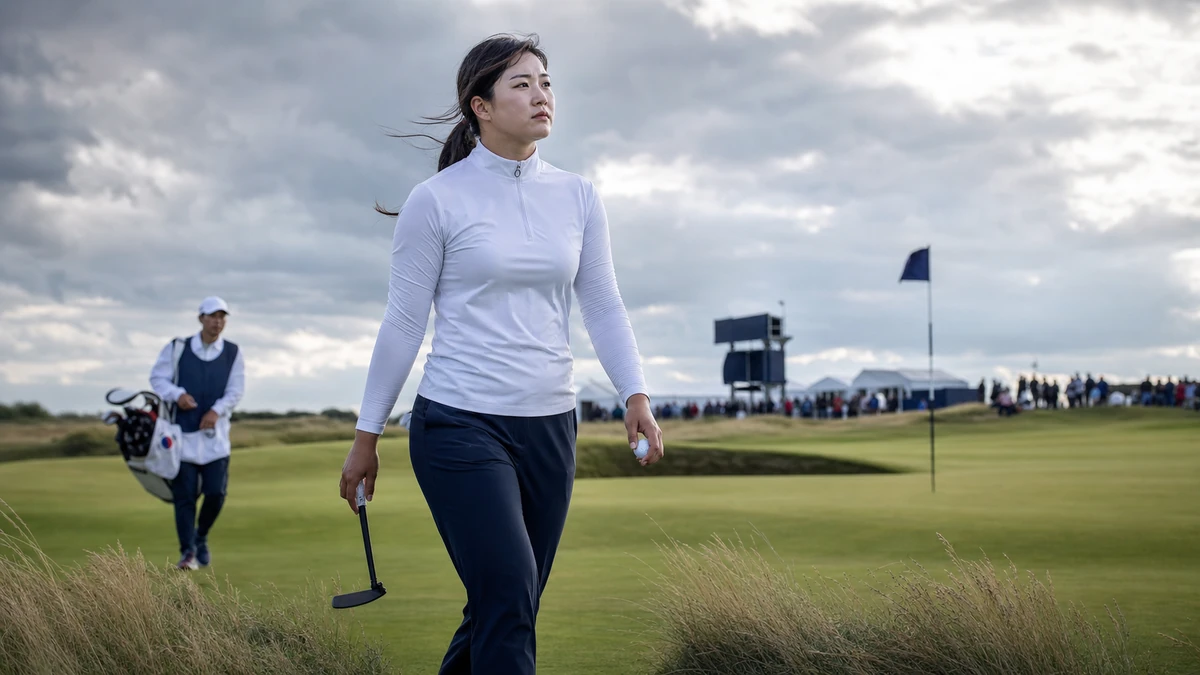
A bid for history ends, but a bigger picture comes into focus
Hae-ran Ryu did not leave England with the trophy she wanted, and she did not complete the kind of major championship streak that would have placed her in one of the smallest and most exclusive clubs in women’s golf. But even in disappointment, the South Korean star left the AIG Women’s Open having made something else unmistakably clear: she is no longer simply a promising international talent or a player on a hot run. She is now one of the central figures in the women’s game.
Ryu finished tied for sixth at the AIG Women’s Open at Royal Lytham & St. Annes in Lancashire, England, closing at 1-under 283 after a final-round 74. She made three birdies Sunday, but four bogeys and a double bogey kept her from mounting the late charge she needed. Japan’s Shiho Kuwaki won at 5-under 279, defeating Germany’s Esther Henseleit in a playoff after the two finished tied atop the leaderboard.
On paper, a tie for sixth at a major is a strong week almost anywhere, for almost anyone. In this case, though, it came wrapped in a very different set of expectations. Ryu entered the tournament having already won the KPMG Women’s PGA Championship in late June and the Amundi Evian Championship in July. That made the AIG Women’s Open more than just the season’s final major. It was the site of a chance at a three-major winning streak, a feat so rare that it has barely any modern precedent.
For American sports fans, the easiest comparison may be a tennis player arriving at the U.S. Open after winning both Wimbledon and the French Open, with history looming over every shot. In golf, where form can turn quickly and majors are separated by weeks of changing courses, weather and pressure, sustaining that level is arguably even harder. Ryu did not finish the job this time. But the fact that she arrived with a legitimate chance says almost as much about her standing as the record itself would have.
That is why this week in England will likely be remembered in Korea not as a collapse, but as a marker. Ryu took a serious run at a place in history, absorbed the pressure that comes with being everyone’s target and still finished in the top 10 of a major. That is not a consolation prize. It is what elite consistency looks like.
Why the missed milestone mattered so much
To understand why Ryu’s performance drew such intense attention, it helps to understand the rarity of the chase. Only four women have won three majors in a single year: Babe Zaharias in 1950, Mickey Wright in 1961, Pat Bradley in 1986 and South Korea’s Inbee Park in 2013. Even fewer have won three majors in a row. Zaharias did it. Park did it. That is the entire list.
So when Ryu arrived at Royal Lytham after back-to-back major victories, she was not just playing for another title. She was being discussed alongside some of the biggest names the sport has ever known. In the United States, fans may know Park as one of the defining LPGA players of the last generation, a Hall of Famer whose calm putting stroke and clinical temperament made her nearly untouchable at her peak. In South Korea, Park represents even more than that: a national standard-bearer who helped solidify the country’s status as a global powerhouse in women’s golf.
That matters because South Korean women’s golf carries a cultural weight that can be easy for non-Korean audiences to underestimate. In the U.S., women’s golf has star clusters, television windows and periodic spikes of mass attention. In South Korea, top female golfers often occupy a more consistently prominent place in the sports landscape. They are widely followed, heavily analyzed and frequently expected not just to contend, but to win. The pipeline is deep, the fan base is knowledgeable and the comparisons to previous greats come quickly.
Ryu stepped directly into that tradition this summer. By winning two straight majors, she went from being one of several high-level Korean contenders to the player carrying the biggest narrative in the sport. Every round at the AIG Women’s Open was now viewed not only through the lens of the leaderboard, but through the lens of history. That kind of scrutiny can be hard to describe to audiences who do not regularly watch women’s golf. Think of the way a player chasing a Grand Slam title in tennis gets discussed on every broadcast, or the way a Triple Crown contender in horse racing turns a niche sporting event into a mainstream storyline. That was the scale of the moment.
Ryu did not shrink from it. She simply could not finish it. And in golf, there is an important distinction between those two things.
A tournament that turned over the final 36 holes
For the first half of the championship, Ryu looked entirely capable of finishing the job. She opened with a 66, then followed with a 69 to reach 7 under and take the lead through two rounds. At that point, her bid no longer felt hypothetical. She was not merely hanging around the edges of contention, hoping for a Sunday run. She was out front, controlling the conversation and forcing everyone else to respond.
Those first two rounds were a continuation of the form that had made her the hottest player in women’s golf. She looked poised, in rhythm and comfortable in one of the sport’s most demanding settings. The AIG Women’s Open, often played on links-style courses in the United Kingdom, presents a very different test from many stops on the American schedule. The ground game matters more. Wind can change strategy hole to hole. Bounces are less predictable, and trouble can compound quickly. Players raised largely on parkland-style golf often need time to adjust. Ryu looked ready from the start.
Then came the back half of the tournament. She shot 74 in the third round and another 74 in the final round, dropping from 7 under to 1 under for the championship. The shift was not catastrophic in the sense of one giant implosion, but it was costly in the way majors often are: a collection of small errors, momentum changes and one bigger mistake that turn a lead into a chase.
Sunday’s card captured that pattern. Three birdies suggested she still had enough in her game to make something happen. But four bogeys and a double bogey kept pushing her backward whenever she tried to build any pressure. In regular tour events, there can be time to recover. In a major, especially one with a crowded international leaderboard, every dropped shot is magnified immediately.
Still, there is another way to read those final 36 holes. Ryu did not disappear. She did not tumble out of contention so badly that the week lost meaning. She held herself together well enough to secure a top-10 finish in the final major of the year. That matters because elite golf is not just about your winning ceiling; it is about your floor when your best is not there. Ryu’s floor, at least this week, was tied for sixth in a major.
That is the sort of result that tends to age well. A player chasing history inevitably gets judged against the history she did not make. But when the emotions settle, the record will still show a summer major run of win, win, tied for sixth. There are not many players in the world who can touch that.
“That’s golf”: the response that says as much as the score
After the round, Ryu did not indulge in dramatic self-criticism or search for excuses. She acknowledged the support she had received and the talk surrounding a third straight major title and the Annika Major Award, then offered a response that was both simple and revealing: “That’s golf.” She added that this is why people love sports and love golf, and that the result gave her one more reason to prepare even harder for the next tournament.
It was the kind of answer that can sound generic unless you understand the situation around it. Ryu had been carrying a rare kind of expectation, especially by the standards of Korean sports culture. South Korean athletes, particularly women in precision sports such as golf, figure skating and archery, are often asked to combine excellence with composure. Public disappointment can be intense, but so can admiration for those who absorb it gracefully. Ryu’s reaction fit that mold without feeling rehearsed.
American audiences may be most familiar with South Korean sports passion through events like the Olympics, the World Baseball Classic or global soccer tournaments. But golf occupies a special place, especially on the women’s side. South Korean fans track swings, putting numbers and amateur pedigrees with the kind of detail many U.S. fans reserve for quarterback depth charts or March Madness brackets. When a Korean player is chasing history at a major, every round becomes national material.
That makes Ryu’s calm especially notable. She was not speaking as a player who had simply had a bad week. She was speaking as a player who had just seen a once-in-a-career historical opening close. Some athletes respond to that moment by framing it as a missed opportunity too painful to process. Ryu instead treated it as evidence of where she now belongs: in the biggest tournaments, under the heaviest pressure, with more chances ahead.
There is maturity in that, but also realism. Golf careers are built on the management of near-misses. Even the greatest players spend most majors not winning. Tiger Woods lost far more majors than he won. So did Annika Sorenstam, Mickey Wright and every other legend in the game. The skill is not merely handling victory. It is converting heartbreak into momentum instead of scar tissue.
Ryu’s comments suggested she understands that. She did not act as though a tie for sixth was enough. But she also did not talk like someone shattered by the experience. In a sport where emotional overcorrection can be as damaging as technical flaws, that balance could prove valuable before the next major pressure cooker arrives.
The Korean context: why Ryu’s run resonated far beyond one leaderboard
In South Korea, Ryu’s chase was about more than one player’s résumé. It touched a larger story about continuity in Korean women’s golf. For more than two decades, South Korea has been one of the dominant forces on the LPGA Tour, producing major champions with striking regularity. The names vary by era — Se Ri Pak, Inbee Park, Jiyai Shin, So Yeon Ryu, Jin Young Ko and others — but the broader pattern has remained remarkably stable.
Se Ri Pak, in particular, remains the foundational reference point. Her breakthrough in the late 1990s helped ignite a surge of interest in women’s golf in South Korea, much the way a transformative star can change an entire sport’s future in the United States. If Americans think of how Tiger Woods expanded golf’s reach or how the 1999 U.S. Women’s National Team helped fuel girls’ soccer, Pak occupies a similarly catalytic place in Korean sports memory. Many of the Korean LPGA stars who followed have cited her as a direct inspiration.
Ryu is now part of that long arc, but she is also part of a newer phase. This is no longer just a story of South Korea dominating the LPGA through depth and technical polish. It is also a story of Korean players operating inside a genuinely global rivalry that includes major champions from the U.S., Japan, Thailand, Australia and Europe. Winning is harder because the field is broader. Sustaining a run like Ryu’s is harder still.
That is one reason her tie for sixth landed differently than a simple missed chance. Korean fans could see both the frustration and the significance at once. Yes, the three-peat was there to be had. Yes, the final two rounds left strokes on the course. But they also saw a player who had put herself in position to be compared with Inbee Park, who led a major at the halfway mark under the full glare of the sport’s attention, and who still posted a top-10 finish when her game was no longer at its sharpest.
In some sports cultures, second-order meaning like that gets dismissed as spin. In Korean golf, it often becomes part of how excellence is measured. A player’s standing is not just about the titles already won, but about whether she looks capable of carrying the country’s legacy on the biggest stages. Ryu looked like that player this summer.
That does not mean she will automatically become the next long-running face of Korean golf. The country’s system is too competitive, and careers are too unpredictable, for easy coronations. But it does mean this week likely reinforced her stature rather than diminished it. She no longer needs to be introduced as a player with potential. She is now firmly in the conversation whenever a major begins.
A new Japanese champion and a wider Asian surge in women’s golf
If Ryu’s story was about a missed historical milestone, Kuwaki’s was about arrival. The Japanese golfer, born in 2003, captured the biggest title of her career at 5 under, then sealed the win in a playoff against Henseleit. Before the event, she was ranked 46th in the world. By the end of the week, she had become the latest evidence that Japan’s women’s golf pipeline is producing champions ready for the sport’s biggest stages.
Kuwaki turned pro in 2021 and claimed her first professional victory in June 2024 at the Shiseido Ladies Open. She has since compiled five wins on the Japan LPGA Tour and entered this tournament leading that tour’s annual points race. Now she has a major title as well, and her victory means Japanese players have won the AIG Women’s Open in back-to-back years.
That trend is part of a broader shift that American fans should pay attention to. Women’s golf is increasingly defined by a dense, cross-Asian excellence that goes beyond any one flag. This week’s leaderboard offered a snapshot of that reality. Japan had the champion in Kuwaki and another top finisher in Rio Takeda. South Korea had Ryu. Thailand had Jeeno Thitikul near the top. Taiwan’s Hsu Wei-ling was tied with Ryu. Singapore’s Shannon Tan also finished in that cluster. And that list does not even include the American stars who were right there as well, including Noh Yealimi in third and Nelly Korda tied for fourth.
The result was not a story of one country steamrolling everyone else. It was a picture of women’s golf as one of the most internationally competitive sports in the world, and of Asia as the region supplying a huge share of that elite depth. In men’s golf, American audiences are accustomed to seeing global leaderboards and multinational stars. In women’s golf, that globalism is every bit as real, and arguably even more concentrated at the top.
For U.S. viewers, this presents both an opportunity and a challenge. The opportunity is obvious: the sport is rich with compelling international rivalries and different developmental systems. The challenge is that many of these players are still underintroduced to mainstream American audiences unless they win a major or contend opposite a well-known U.S. star. Stories like Ryu’s and Kuwaki’s show why that needs to change. These are not anonymous international names filling out leaderboards. They are the engine of the modern women’s game.
What comes next for Ryu, and why this week may still matter months from now
There is always a temptation after a missed record bid to focus on what slipped away. That is understandable. Ryu had the lead through two rounds. She had won the previous two majors. She had a chance to join a tiny circle of all-time greats. Those facts do not disappear just because the trophy went elsewhere.
But another set of facts deserves equal weight. Ryu is the world No. 3. She turned the final three majors of this stretch into a sequence of win, win, tied for sixth. She handled the pressure of being a front-runner rather than a chaser. She endured a difficult weekend and still remained in the top 10 of the season’s final major. And she emerged from it sounding like a player who expects to be back in the same position again.
That last part may be the most important. Elite athletes often reveal their future not only in how they play, but in what kind of disappointment they normalize. Ryu spoke as if contending for major titles is now part of her professional baseline. That may sound like a subtle distinction, but it separates established stars from one-off winners. One title can announce a player. Repeated contention changes her identity.
In that sense, this week may eventually look less like the end of something than the continuation of something much bigger. Ryu did not secure the record. But she deepened the impression that women’s golf has a durable new headliner from South Korea, one fully capable of shaping the next chapter of the sport’s international story.
For American readers who may be meeting her in earnest for the first time, that is the takeaway to hold onto. Hae-ran Ryu fell short of a historic three-peat. She also proved, once again, that when the biggest championships arrive, she is one of the players the entire golf world has to watch.
Comments
Post a Comment