How a 14th-Century Korean Thinker Helped Build a State — and Why His Ideas Still Matter Beyond Korea
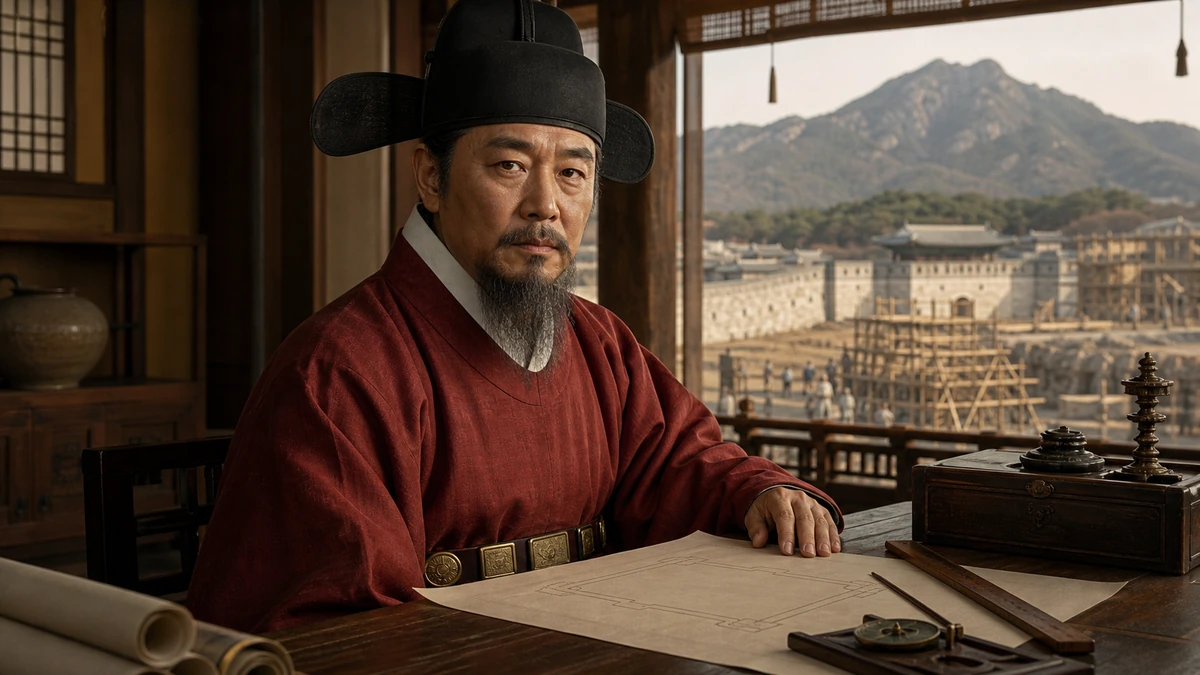
Image to help understand the article
A scholar who did more than advise a king
In the United States, the names most associated with state-building tend to be people like James Madison, Alexander Hamilton and Thomas Jefferson — men remembered not simply for holding office, but for designing the rules, institutions and political arguments that outlasted them. In Korean history, one comparable figure is Jeong Do-jeon, a 14th-century scholar-official and political strategist who helped lay the intellectual and administrative foundation for the Joseon dynasty, one of the longest-ruling dynasties in world history.
Jeong, who lived during the collapse of the Goryeo kingdom and the rise of Joseon, was not just a court intellectual in elegant robes. He was a reformer, ideologue and, in the plainest sense, a revolutionary. The Korean story summarized here presents him as a young thinker who turned to Neo-Confucianism — a moral and political philosophy that came to dominate East Asia for centuries — as a way to rethink society from the ground up. He saw the existing order as deeply compromised by aristocratic corruption, failing institutions and an economic structure that, in his view, no longer served ordinary people.
That matters because Jeong’s legacy is not merely about palace intrigue or dynastic turnover. It is about a recurring question in history, one that resonates far beyond Korea: What happens when intellectual critique becomes a blueprint for power? Jeong did not stop at saying the old order was broken. He tried to design a replacement — centralized, bureaucratic and rooted in a moral vision of government.
For American readers, that can sound distant at first. But the basic drama is familiar. A discredited elite. A struggle over ideology. Debates about whether reform from within is still possible. A coalition between thinkers and military power. And, ultimately, a new state claiming legitimacy not just through force, but through a new theory of how society should be governed. That is why Jeong remains one of the most consequential political minds in Korean history, and why his life offers more than a historical footnote. It offers a case study in how ideas become institutions.
He was born into a family connected to officialdom, studied in the intellectual center of Goryeo and distinguished himself early through scholarship. But the trajectory that made him historically significant was not simply academic success. It was his conviction that learning had to confront political reality. The Korean account portrays a young man who mastered classical learning, immersed himself in Neo-Confucian thought and then began asking why a society that spoke in the language of morality could tolerate so much disorder and suffering.
That shift — from scholarship as self-cultivation to scholarship as state reform — is the pivot of his life. It is also the key to understanding why he mattered. Jeong was not merely interpreting a philosophical tradition. He was weaponizing it for a political transformation.
What Neo-Confucianism meant in Korea
To understand Jeong Do-jeon, it helps to clarify a term many American readers may have heard but not fully place: Neo-Confucianism. Broadly speaking, Confucianism centers on ethics, education, social order, hierarchy, ritual and the moral duties that bind ruler and subject, parent and child, teacher and student. Neo-Confucianism, which developed over centuries and became especially influential in East Asia, sharpened those ideas into a more systematic philosophy of human nature, governance and moral cultivation.
In late Goryeo, this was not just an abstract school of thought. It was becoming a language for criticism. Jeong and his peers used it to judge whether institutions were living up to their obligations. In the Korean summary, Jeong appears especially focused on the gap between moral principle and social reality. He studied under major scholars, moved in circles that included some of the leading intellectuals of the time and shared a common scholarly world with figures who would later become allies and rivals.
What made his reading of Neo-Confucianism politically explosive was its practical edge. He believed government should be disciplined, centralized and staffed by capable officials rather than dominated by entrenched hereditary interests. He also believed the state had responsibilities to the public, especially when ordinary people were being crushed by corruption, bad administration and distorted economic arrangements.
This is where an American comparison may help. Think of Neo-Confucianism in this setting not as a private spirituality, but more like a fusion of moral philosophy, civic doctrine and governing framework. It shaped education, law, social norms and the theory of what a legitimate state should look like. In that sense, it functioned less like modern religion in the American understanding and more like a civil philosophy embedded in public life.
The Korean account also emphasizes Jeong’s critique of Buddhism, which deserves careful explanation. This was not simply a theological disagreement in the modern sense. He argued that the economic expansion and corruption of temple institutions were harming state finances and everyday livelihoods. In his view, religious establishments had become too entangled with wealth and privilege. He saw that as both an economic and political problem, not only an intellectual one.
For Americans, there is a recognizable pattern here too. Across history, reformers often attack institutions not just for what they believe, but for how they accumulate land, wealth and influence. Jeong’s criticism of Buddhist institutions was part of a broader argument: that a failing political order was being propped up by economic interests that weakened the state and burdened the public. His later writing systematized those arguments and helped set the ideological direction of the new dynasty.
In other words, Jeong was not choosing one set of ideas over another in a vacuum. He was deciding what moral vocabulary and institutional logic would define a new regime. That is one reason he still matters. He shows how a philosophical school can become the operating system of a state.
From classroom debate to political rupture
One of the most striking aspects of Jeong’s story is how closely intellectual history and political struggle were intertwined. He did not begin as an obvious kingmaker. He rose through study, official examinations and teaching. He built connections with scholars, mentored students and participated in the highly competitive world of elite learning. Yet the Korean account makes clear that he gradually concluded that scholarship alone could not solve the crisis around him.
That conclusion was shaped by personal experience. After periods in office, he withdrew, returned and then suffered exile. He lost his parents, observed customary mourning in a particularly rigorous way and spent years teaching and living in hardship. During exile and later wandering, he encountered the realities of hunger, rural poverty and exploitation more directly. The summary presents those years as formative: he came face to face with the people supposedly protected by the state but in practice abandoned by it.
This is the point at which Jeong’s ideas hardened into a reform program. He came to believe that elite privilege, especially the power of entrenched aristocratic families, was not a flaw at the edges of the system. It was the system. The problem could not be solved through cosmetic adjustment. It required structural change.
That analysis set him on a collision course not only with Goryeo’s ruling order but eventually with former allies. The summary notes his long intellectual and political relationship with Jeong Mong-ju, another major scholar of the era. They shared concern about corruption and initially cooperated around reform. But they split over the central question that often divides political movements: Should a broken order be repaired, or replaced?
That distinction matters. In modern terms, it is the line between institutional reform and regime change. Jeong Do-jeon moved toward the latter. He concluded that the old kingdom could not be redeemed on its own terms. To rescue the country, as he saw it, a new political foundation was needed.
This is also where foreign policy enters the story. The late Goryeo period was marked by regional instability and contested diplomacy, including arguments over relations with the Ming dynasty in China. Jeong backed stronger alignment with Ming and resisted policies he saw as strategically reckless or politically compromised. His exile after refusing a diplomatic demand underlines how closely ideological conviction, bureaucratic conflict and geopolitical positioning were connected.
For American readers, that detail is important because it undercuts any temptation to see this as a purely domestic philosophical dispute. State-building rarely happens in a vacuum. It usually unfolds under external pressure, with rival factions linking domestic legitimacy to foreign alignment. Late Goryeo was no exception. Jeong’s political thought developed in a world where diplomacy, military power and internal reform were inseparable.
The alliance with Yi Seong-gye and the making of Joseon
Ideas alone do not found states. They need institutions, allies and, in moments of rupture, force. Jeong’s meeting with Yi Seong-gye — the military leader who would go on to found Joseon — was therefore a turning point not just in his life, but in Korean history. The summary describes Jeong recognizing in Yi the disciplined military power needed to carry out change that scholars alone could not deliver.
That alliance is a familiar pattern in world history: the partnership between the theorist and the commander, the writer of political legitimacy and the wielder of military capacity. If Americans think of the country’s own founding, the exact comparison would be imperfect, but the broad dynamic is understandable. Military success by itself does not build durable order; it needs a governing rationale. Political philosophy by itself does not seize the state; it needs power behind it. Jeong and Yi supplied what the other lacked.
The Korean account emphasizes that Jeong became a close aide and strategist. He was not simply cheering from the sidelines. He was helping imagine what the new state would look like. After Yi took power, Jeong and other core figures moved on land and tax reform — a central issue in many premodern state transitions because land was the basis of wealth, political influence and fiscal capacity.
That is a crucial point. When historians say Jeong designed a state, they do not mean he wrote lofty essays and vanished. They mean he worked on the machinery of rule: taxation, land systems, bureaucracy, recruitment and the principles under which authority would be exercised. In modern language, he was involved in building the administrative architecture of government.
The Joseon state that emerged would become known for a strong bureaucratic order, deep investment in Confucian education and a centralized governing model that shaped Korean society for centuries. Not all of that can be credited to one man, of course. Dynasties are made by coalitions, contingencies and long institutional evolution. Still, Jeong’s role stands out because he helped supply the core logic of the transition. He gave revolutionary change a coherent language and a practical program.
This is part of why he is remembered not just as a scholar, but as a designer of political order. His significance lies in the combination of moral critique and administrative vision. Many people can describe what is wrong. Fewer can articulate what should replace it. Fewer still can help build it.
His story also carries an irony familiar to students of political history everywhere: founders often do not fully control the systems they help create. Political coalitions fracture. Success breeds rivalries. Revolutionary legitimacy gives way to contests over succession and power. Even when a thinker helps create a new order, that order may not honor his vision cleanly or for long. But that does not erase the fact that he was there at the constitutional moment, helping define the terms of a new era.
What this means for the United States
For American readers, the immediate temptation may be to file Jeong Do-jeon under “important Korean history” and move on. But there is a stronger reason to pay attention. As South Korea’s global cultural influence grows — through K-pop, streaming dramas, film, beauty, food and technology — Americans are encountering more Korean stories than ever before. Yet many of those stories circulate without the deeper historical frameworks that shaped modern Korea’s institutions, values and social debates.
Understanding a figure like Jeong helps fill that gap. South Korea is one of the United States’ closest allies in Asia, a major trading partner and a cultural force in the American market. U.S. audiences consume Korean storytelling on Netflix and other platforms; U.S. companies invest in Korean entertainment, semiconductors and manufacturing; and Korean companies have become major employers and brands in the United States. The relationship is no longer niche. It is mainstream.
That is why older Korean political and intellectual traditions matter more to Americans than they once did. They can illuminate why hierarchy, education, bureaucratic prestige and moral debates about public duty still carry distinctive weight in Korean society. They can also help Americans better understand why Korean historical dramas — a popular export in their own right — so often revolve around scholar-officials, court ethics, factional conflict and the struggle to align power with principle.
There is also a more direct U.S. parallel in the way Jeong’s legacy speaks to recurring American arguments about institutions. In the United States, there is constant debate over whether broken systems can be reformed internally or require more fundamental redesign. That debate surfaces in conversations about Congress, the courts, universities, policing, campaign finance and the administrative state. Jeong’s life is not an American template, and it should not be forced into one. But his story does offer a vivid historical example of a thinker deciding that moral criticism without institutional reconstruction was not enough.
For U.S. businesses and media companies, there is another lesson. As Korean intellectual history becomes more visible internationally, the commercial incentive to simplify it can be strong. Historical figures risk being flattened into archetypes — the good reformer, the loyal conservative, the brilliant schemer. But American audiences have shown increasing appetite for more textured global storytelling. A figure like Jeong rewards that complexity. He was a philosopher and political operator, idealist and tactician, product of elite education and critic of elite failure.
In a broader diplomatic sense, deeper literacy about Korean history also matters because the U.S.-South Korea relationship is often discussed mainly through security and economics: North Korea, troop deployments, chips, batteries, trade and China strategy. Those are essential issues. But alliances are also sustained by mutual understanding. Knowing how Korea remembers state formation, legitimacy and reform adds depth to how Americans engage one of their most important partners in Asia.
And for American fans of Korean culture, this is part of the maturation of the Korean Wave itself. The first phase of global enthusiasm often centers on music, fashion and viral entertainment. Later comes curiosity about language, history and political tradition. When that happens, figures like Jeong Do-jeon move from textbook names to live subjects of international interest.
Why his story feels current now
The reason Jeong Do-jeon’s story still feels alive is that it captures a political pattern that never quite disappears. Societies periodically reach moments when inherited institutions no longer seem credible to large parts of the public. Elites keep speaking the language of order, but the people beneath them experience disorder. Moral systems that once legitimized power begin to look like covers for privilege. At that point, the most important struggle is often not over whether change is needed, but over what kind of change will count as legitimate.
Jeong understood that legitimacy has at least three layers: ethical argument, administrative design and political force. Remove any one of those and a new order may fail. Ideas without implementation remain literature. Institutions without legitimacy become hollow. Power without theory becomes fear. His importance lies in trying to tie those strands together at a moment of upheaval.
That is also why the Korean summary frames him as more than a loyal official of one dynasty or another. He was a transitional figure — someone who prepared the ideology and institutions of a new state before that state fully existed. In American terms, he mattered at the founding level. He was helping answer questions like: Who should govern? By what moral authority? Through what system? For whose benefit?
Those questions are never purely historical. They return in different forms across eras and borders. In today’s world, where democratic confidence is shaky in many places, where public distrust of elites runs high and where culture wars often conceal deeper fights over institutions, Jeong’s life reads less like ancient history than like a reminder. Political transformation is not only about who wins power. It is about who defines the principles that make power seem justified afterward.
What to watch next, especially for English-speaking audiences, is how Korean history continues to travel globally. The more Korean culture becomes woven into mainstream American life, the more demand there will be for stories that explain the country beyond contemporary pop culture or geopolitical headlines. That includes the intellectual traditions that helped shape Korea long before the modern republic existed.
Jeong Do-jeon belongs in that conversation. He was not a celebrity in the modern sense, nor an easy hero. He was something more durable: a political thinker who believed that a corrupt system could be diagnosed, challenged and redesigned. For a 14th-century scholar, that was an audacious claim. For modern readers, it remains a timely one.
Comments
Post a Comment