How Disney+’s Korean Hit ‘Moving’ Turned the Superhero Story Into a Family Drama — and Why That Matters in America
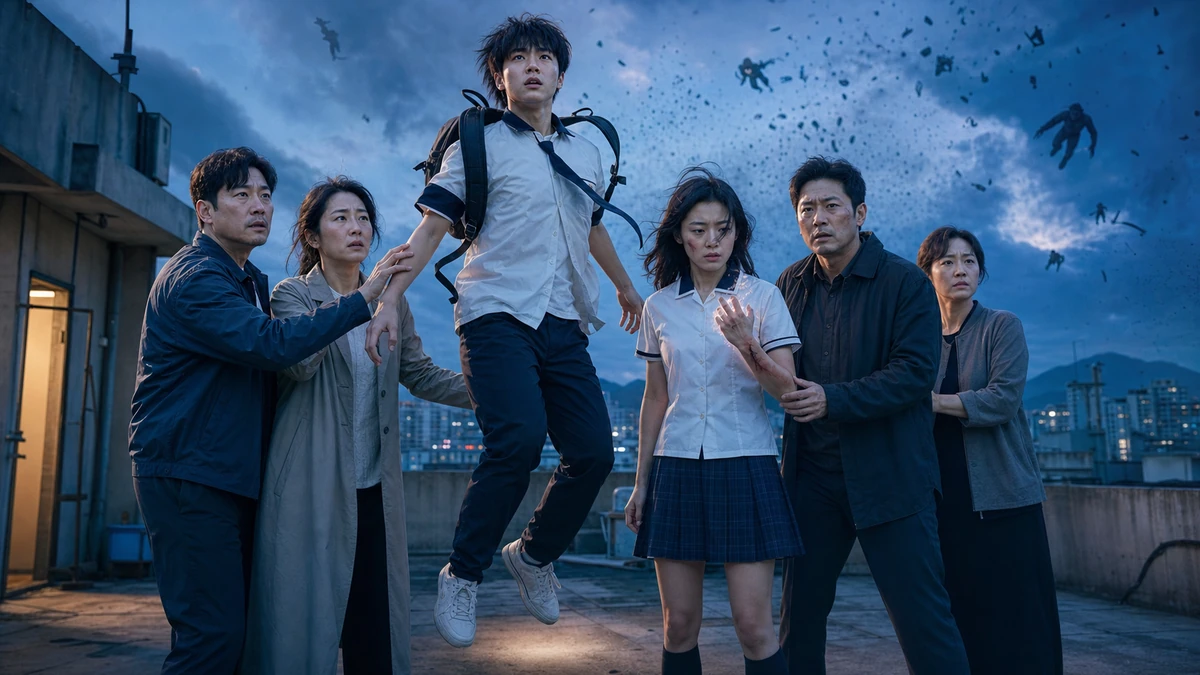
Image to help understand the article
A Korean superhero series that starts at home, not in the sky
At a moment when American audiences may feel both overwhelmed by superhero franchises and still hungry for something emotionally new, the South Korean series Moving offers a revealing answer: make the powers matter less than the people forced to live with them. The 20-episode drama, released on Disney+ in 2023 and later honored with the top TV prize at South Korea’s prestigious Baeksang Arts Awards, is built around a premise that sounds familiar to anyone raised on Marvel, DC or even Stranger Things. Teenagers discover they are not ordinary. Their parents know more than they have admitted. Governments want control. Violence follows.
But Moving is not really interested in the fantasy of becoming special. Its central question is what it costs to stay hidden. The series follows high school students with extraordinary abilities — including flight, rapid healing and unusual strength or speed — alongside parents who carry the emotional and political wreckage of earlier lives tied to South Korea’s intelligence world. The result is less a victory-lap superhero saga than a multigenerational drama about secrecy, surveillance, sacrifice and the burdens parents pass to children even when trying to protect them.
That distinction helps explain why the series landed so strongly in Korea, and why it deserves closer attention in the United States. In an era when global streaming platforms are no longer merely exporting American franchises but also building parallel mythologies from Seoul, Mumbai and Madrid, Moving shows how Korean television can take a globally recognizable genre and reshape it around local history, social space and family structure. The show is full of powers, chases and fights, yes. But its emotional engine is intensely domestic. Much of the drama unfolds in places that are strikingly ordinary: a classroom, a bus route, a restaurant, a shoe store, an aquarium, a family kitchen. The contrast is the point. These are not gods descending onto a city skyline. They are people trying to get through the school day, pay bills and keep old wounds from swallowing the next generation.
For American viewers, that makes Moving more than another foreign-language streaming success. It is part of a broader shift in how Korean storytelling is entering the U.S. mainstream: not as novelty, but as genre work sophisticated enough to stand next to Hollywood’s best while doing something Hollywood often avoids. It slows down long enough to ask what heroism looks like after the mission is over, after the state uses people up, and after the children inherit consequences they never chose.
Why ‘Moving’ feels different from an American superhero franchise
American audiences are trained to read superpowers as a path to identity. Think of Spider-Man learning responsibility, the X-Men turning mutation into political metaphor, or the Avengers treating extraordinary ability as public destiny. Even when those stories are tragic, they are still usually stories of emergence. A hero comes into view. The world reacts. The franchise expands.
Moving begins from the opposite end. Here, powers are not liberating. They are dangerous information. They invite state attention, exploitation and violence. The young characters do not dream of fame or even of moral duty in the comic-book sense. They are trying to survive adolescence under conditions of extraordinary secrecy, while their parents — many of whom have backgrounds in intelligence operations — are trying to hold together a normal life that was never really possible.
That is one reason the series’ family-centered structure matters. The children’s stories are interwoven with the parents’ pasts, and the show repeatedly cuts between present-day school life and earlier covert operations. Instead of treating adults as background figures, Moving makes them central to the emotional architecture. Their guilt, trauma and compromises shape the world the teenagers inhabit. In American TV terms, the show often feels less like a conventional origin story and more like a blend of Heroes, The Americans and a deeply felt family melodrama.
There is also a tonal confidence to the series that stands out in a crowded streaming market. It is willing to let teenage awkwardness, parental tenderness and state brutality occupy the same story without flattening any of them. The action sequences matter, but they are not there simply to deliver spectacle. They reveal character, memory and institutional violence. The powers themselves are familiar enough that an American viewer can quickly understand them. What feels fresh is the world around those powers: the social expectations of school life, the pressure of parental sacrifice, and the lingering shadow of South Korea’s national-security apparatus.
That grounding in the everyday is one of Korean drama’s great strengths. In many K-dramas, even heightened premises remain anchored in routine social life — commuting, eating, studying, working, caring for family. Moving uses that sensibility to reframe the superhero genre. If Marvel often asks how the extraordinary transforms the ordinary, Moving asks how the ordinary bears the weight of the extraordinary. That may sound like a subtle distinction, but it changes the emotional experience of the story.
The Korean history inside the fantasy
To understand why Moving resonates in Korea, American readers need some cultural and political context. The series draws on institutions and anxieties tied to South Korea’s modern history, especially the legacy of powerful intelligence agencies and a society shaped for decades by anti-communism, military tension and the unresolved division of the Korean Peninsula.
The parents’ generation in Moving is tied to organizations modeled on South Korea’s national security bureaucracy. For U.S. audiences, the closest comparison might be a fictional world in which former CIA operatives, military black-site personnel and domestic intelligence officials have tried to bury a morally compromised past, only to see it return through their children. But the Korean context is distinct. South Korea’s intelligence agencies, including predecessors to today’s National Intelligence Service, occupy a politically charged place in the country’s history. They have been associated not only with counterespionage and national security but also, at times, with domestic political control, surveillance and abuse.
That historical memory matters because Moving treats superhuman ability not simply as a scientific oddity but as a state-managed asset. There is a project in the story devoted to identifying and developing people with special abilities. This gives the show a bureaucratic and institutional logic that feels very Korean in its specifics even as it travels well internationally. The fear at the center of the series is not only that powerful enemies exist. It is that your own government may see your family less as citizens than as inventory.
The show also folds in references to tensions involving North Korea and to episodes from South Korea’s recent past. That does not make it a history lesson, nor is it a narrowly ideological drama. But it helps explain why the emotional stakes are so different from those of a standard American fantasy series. The danger is rooted not in some cosmic portal or billionaire villain but in systems of command, secrecy and coercion that echo real structures Koreans know from lived history, family memory and schoolbooks.
Even smaller details carry cultural meaning. The use of place-based codenames, for instance, may strike foreign viewers as an atmospheric flourish, but it reflects a recurring Korean habit of embedding geography into identity, memory and bureaucratic language. Likewise, the prominence of school life is not incidental. In South Korea, high school is a socially intense setting shaped by academic pressure, peer hierarchy and parental investment. By placing superpowered teenagers inside that environment, Moving makes adolescence itself feel like a form of containment. The students are not just hiding powers; they are navigating one of the most disciplined social spaces in Korean life.
This is where the series becomes especially effective for non-Korean audiences. It does not require viewers to know the full history of South Korean intelligence politics to feel the weight of the story. But for those who do look deeper, the show opens into something more than entertainment. It becomes a genre piece about how modern states classify human value and how families improvise forms of love under that pressure.
What the Baeksang win says about where Korean TV is heading
Moving did not merely draw streaming buzz. It won the grand prize in the TV category at the Baeksang Arts Awards, one of South Korea’s most respected honors across film, television and theater. For Americans unfamiliar with Baeksang, think of it as an institution with the prestige to signal industry consensus, not just fan enthusiasm. The recognition matters because it suggests that Korea’s establishment is rewarding not only traditional melodrama or auteur prestige TV, but also a large-scale genre series that blends commercial ambition with emotional and political depth.
The show’s writer, Kang Full, is a major part of that story. He is known in Korea as a webtoon creator, part of the generation of digital storytellers who helped turn online comics into one of the country’s most important intellectual-property pipelines. For U.S. audiences, the closest comparison may be the way comic books, graphic novels and speculative fiction have fed Hollywood for decades. But Korea’s webtoon ecosystem moves differently. It is more digitally native, more tightly linked to mobile consumption and increasingly central to the business strategies of streamers and studios.
That matters because Moving reflects the growing maturity of the Korean content machine at a time when global platforms are competing fiercely for adaptable IP with built-in audiences. It is also evidence that Korean creators are no longer confined to a few internationally legible categories such as romance, historical dramas or survival thrillers. Korea can now export a superhero-adjacent saga and still make it unmistakably local in rhythm and feeling.
The release strategy also deserves attention. Disney+ rolled out the series with a large initial batch of episodes and then weekly installments, a structure that allowed the story’s layered timeline to unfold in stages. That model sits somewhere between the binge era popularized by Netflix and the appointment viewing that companies now try to restore for buzz and retention. In a fragmented global streaming market, Moving shows how release design itself can become part of storytelling: families, histories and secrets are revealed not all at once, but with enough space for viewers to build attachment and speculation.
Its awards success also says something broader about Korean television’s confidence. This is not content engineered simply to travel; it is content rooted enough in its own culture that travel becomes a byproduct of quality rather than the only goal. That is a subtle but important difference. The most influential global hits increasingly do not sand down local specificity. They trust that audiences can come to them.
What this means in the United States
For the United States, Moving is significant on at least three levels: business, audience behavior and soft power. First, it is another sign that the U.S. market for Korean entertainment is no longer niche. Korean dramas once occupied a relatively limited space among dedicated fans, diaspora audiences and early adopters. That changed dramatically over the past decade as streaming lowered barriers, subtitles lost some of their stigma and South Korean culture became a larger force in American life through music, film, beauty products, food and fashion. After Parasite won best picture, after Squid Game became a streaming phenomenon, and after K-pop acts began filling U.S. stadiums, American executives no longer had the luxury of treating Korean content as peripheral.
Moving lands in that environment as a different kind of test case. Unlike survival thrillers or dark social satire, superhero storytelling is one of America’s core entertainment languages. If a Korean series can enter that space and win attention not by copying Marvel but by bending the genre toward family, memory and state critique, that has implications for U.S. companies and creators. It suggests American audiences are more open than executives sometimes assume to genre work that moves at a different emotional tempo and comes from outside the domestic franchise system.
Second, the show matters for Disney. In the United States, Disney is associated above all with an unrivaled franchise empire, from Marvel and Star Wars to Pixar and legacy animation. But globally, Disney+ also needs regional hits that deepen subscriber loyalty and prove the platform can produce more than extensions of American mega-brands. Moving is exactly the kind of title that helps make that case. It offers scale, recognizable genre hooks and international appeal, but it does so through Korean creative leadership. For U.S. media companies trying to navigate slowing subscriber growth and rising production costs, that is a meaningful model: not just importing finished content, but investing in local storytelling robust enough to travel back into the American conversation.
Third, there is the fan dimension. American viewers who came to Korean entertainment through romance dramas or K-pop may find in Moving a broader map of what Korean storytelling can do. At the same time, viewers who usually avoid K-dramas because they assume the category is limited in genre or tone may discover an accessible entry point through the superhero frame. That two-way movement matters in a country where global entertainment consumption increasingly shapes identity, community and even politics. Korean series are now discussed in U.S. group chats, college classrooms, fan conventions and entertainment media with a level of normalcy that would have seemed unlikely 15 years ago.
There is also a diplomatic undertone worth noting, even if the series itself is not propaganda and should not be reduced to policy symbolism. U.S.-South Korea ties are often described in military or economic terms: alliance management, semiconductor supply chains, China strategy, defense cooperation. Culture is sometimes treated as decoration around those harder interests. But a show like Moving is a reminder that cultural exchange can alter how Americans understand South Korea more effectively than any policy briefing. It presents Korea not as a geopolitical abstraction or breaking-news flashpoint but as a society with its own genres, traumas, humor, family codes and institutional critiques. That is a form of influence with real staying power.
From Marvel fatigue to global genre: what to watch next
The larger question raised by Moving is not whether one Korean series can break through internationally. That question has already been answered repeatedly. The better question is what happens when Korean creators begin competing directly in genres long dominated by Hollywood, while keeping enough local character to avoid becoming generic. That may be where the next phase of the Korean Wave — often called Hallyu — gets especially interesting for American observers.
For years, U.S. gatekeepers tended to sort Korean content into a handful of export categories: prestige cinema, emotional television dramas, horror-inflected thrillers, and of course music. But the Korean industry is now operating with greater range and industrial muscle. Webtoons generate adaptable IP. Streamers compete for series with franchise potential. Established film actors move fluidly into serialized television. Directors with movie credentials bring cinematic scale to long-form storytelling. The result is an ecosystem capable of making something like Moving: broad enough to attract mainstream attention, specific enough to feel authored.
American studios should pay attention not just to the fact of the show’s success, but to the method behind it. Moving does not seem embarrassed by emotion. It does not rush to irony as a shield. It trusts parents as protagonists. It allows action to coexist with melodrama, and it treats history as something that seeps into the present rather than serving as decorative backstory. Those are not uniquely Korean techniques, but Korean television often uses them with a sincerity and structural patience that Hollywood, especially in franchise mode, can struggle to sustain.
There are also business lessons. The future of global streaming may depend less on exporting one country’s cultural products everywhere than on creating strong local originals that become transnational events. That requires companies to think beyond dubbing and subtitles and toward long-term creative ecosystems. It means trusting regional storytellers not just to fill catalog space, but to define platform identity. In that sense, Moving is not only a successful show. It is evidence in an argument about how entertainment power is being redistributed.
As for viewers, the series points to a more hopeful possibility in the post-peak-superhero era. The genre may not be exhausted after all. It may simply need to be displaced, translated and made answerable to different histories. In the United States, superhero fatigue often reflects repetition: the same emotional arcs, the same visual grammar, the same industrial logic. Moving suggests that the form can feel alive again when it is rerouted through another country’s anxieties and values.
That does not mean every Korean genre series will become a U.S. sensation, nor should it. But it does mean Americans who care about the future of television — executives, critics, fans and creators alike — should watch more closely when Korean drama enters territory that Hollywood once treated as its private domain. Moving is a family story disguised as a superhero thriller, or perhaps a superhero thriller brave enough to admit it is really about family. Either way, its success marks something larger than an awards-season victory. It marks the continuing globalization of genre itself, and a reminder that some of the most interesting reinventions of familiar American forms may now be coming from Seoul.
Why it is worth watching now
Even for viewers who have never watched a Korean drama, Moving arrives with an unusually clear invitation. You do not need prior knowledge of Korean television conventions to understand a teenager hiding a dangerous secret, a parent protecting a child, or a government seeing people as instruments. Those are universal narrative engines. What the show adds is texture: a Korean high school setting, a distinctly Korean relationship to modern state power, and a grounded sense of how extraordinary lives still revolve around errands, jobs, meals and family obligation.
That everyday quality may be the series’ greatest achievement. In American superhero storytelling, normal life often exists only to be interrupted by destiny. In Moving, normal life is the battleground. The emotional suspense comes from whether a family can hold onto tenderness and routine when institutions keep trying to turn human ability into strategic property. For a U.S. audience living through its own arguments about surveillance, state power, parental fear and generational inheritance, that premise lands with more force than it might first appear to.
The Baeksang recognition confirms that South Korea did not view the show as merely a flashy streaming export. It saw a major work of television. American audiences would do well to treat it the same way. Moving is entertaining, but it is also diagnostic. It reveals how Korean creators are retooling global genres for a different moral and historical landscape. And it suggests that, in the next chapter of the Korean Wave, the question may no longer be whether Korean stories can cross over. The question may be which American assumptions about storytelling they will challenge next.
Comments
Post a Comment