How a Fried Chicken Stakeout Became a Korean Box Office Phenomenon — and What It Says About Comedy, Work and the U.S.-Korea Entertainment Pipeline
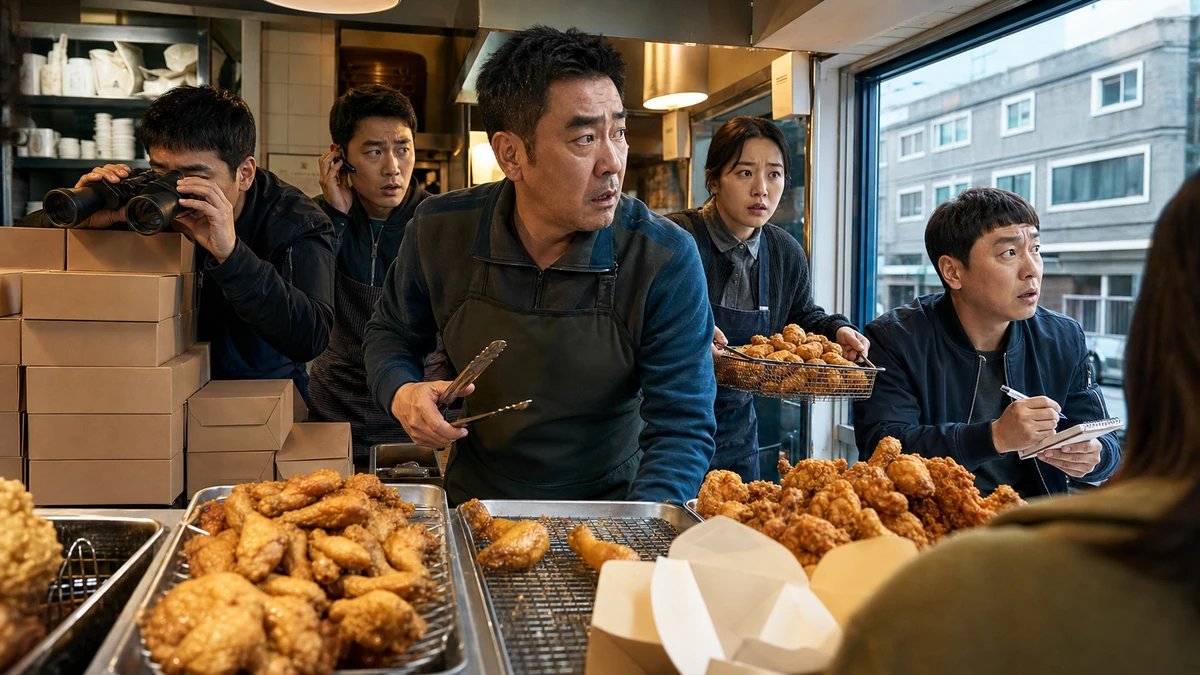
Image to help understand the article
A cop comedy built on fried chicken became one of South Korea’s biggest movie events
In the United States, a movie about a struggling narcotics squad taking over a failing fried chicken shop as part of an undercover operation might sound like the setup for a broad studio farce — something halfway between a police spoof, a workplace comedy and a food-business satire. In South Korea, that premise became “Extreme Job,” a 2019 film that did much more than score a few opening-week laughs. It turned into one of the biggest box office hits in Korean film history, drawing 16,266,337 admissions and cementing itself as a rare comedy that reached almost every layer of the mainstream audience.
That scale matters. South Korea has a population of about 51 million, so a film crossing the 10 million ticket mark — often called the “10 million movie” threshold in Korea — carries a cultural force somewhat comparable to a blockbuster in the U.S. becoming a genuine national conversation piece rather than simply a commercial success. “Extreme Job” got there in just 15 days. By the time its theatrical run was over, it had risen to No. 2 on the all-time admissions chart and No. 1 in box office revenue, according to the summary of the film’s performance. Those figures alone explain why the movie continues to be discussed years later.
But the real reason “Extreme Job” still resonates is not only that it sold a mountain of tickets. It is that the movie distilled several recognizable pressures of modern Korean life into a story that plays as pure entertainment: unstable work, relentless hierarchy, family strain, the grind of small business ownership and the absurdity of measuring people only by visible success. It wraps all of that inside a crowd-pleasing crime comedy in which bad cops become unexpectedly good restaurateurs — and then discover that being too good at the cover story threatens the actual mission.
For American audiences, the easiest comparison may be to a film that takes the ensemble energy of “Brooklyn Nine-Nine,” the underdog desperation of “The Other Guys” and the food obsession of a cult restaurant comedy, then roots it in a specifically Korean setting where fried chicken is not just a snack but a social institution. The result is accessible even across borders because the joke is universal: the side hustle becomes the real job. But the details of why that joke landed so powerfully in South Korea reveal something larger about the Korean Wave, or Hallyu, and why Korean commercial storytelling has become so exportable.
Why the premise works so well in Korea
At the center of “Extreme Job” is a narcotics team on the verge of being disbanded after repeated failures. Their leader, Go Sang-gi, is not presented as a glamorous supercop. He is seasoned, battered and professionally stalled — the kind of midcareer figure who has survived plenty but has little institutional reward to show for it. The summary notes that he has spent 20 years on violent cases, has been stabbed 12 times and earned the nickname “zombie,” yet remains stuck as a longtime team chief while a junior colleague has already been promoted ahead of him. That gap between endurance and advancement is a crucial part of the humor, and also part of the social commentary.
Korean workplace culture, especially in traditional hierarchies, often places enormous emphasis on seniority, rank and visible achievement. Titles matter. Promotions matter. The appearance of competence matters. In that environment, a team that keeps causing problems without producing results is not just ineffective; it is a public embarrassment. “Extreme Job” mines comedy from that anxiety. The narcotics unit is desperate enough to go all in on an absurd undercover plan, buying a struggling chicken restaurant near a criminal hideout so they can keep watch on a drug ring.
That restaurant, though, is not a random business choice. Fried chicken in South Korea occupies a place in the culture that Americans can understand only if they think of a blend of pizza delivery, neighborhood bar food and comfort ritual. Korean fried chicken is tied to late-night eating, sports watching, office gatherings and the hugely popular pairing known as “chimaek” — chicken and beer. A fried chicken shop is a deeply familiar everyday space. It is local, ordinary and intensely competitive. The film’s idea that police officers might temporarily become operators of one of these businesses lands because audiences immediately recognize both the plausibility and the desperation of the move.
The comedy gets sharper when the team accidentally succeeds. One detective, Ma Bong-pal, turns out to have real cooking talent thanks to his family’s background in a galbi restaurant. His chicken becomes so popular that the undercover location transforms into a hot restaurant. In American terms, imagine DEA agents opening a low-profile sandwich shop for surveillance and then going viral on TikTok because the sandwiches are incredible. The cover starts to overwhelm the case. Customers flood in. Orders pile up. The detectives spend more time frying chicken and making deliveries than tracking criminals.
That reversal is the film’s key comic engine, but it also taps into something more serious. In South Korea, as in the U.S., small business ownership is often portrayed as independence, but it can also be a sign of economic precarity. The film reportedly includes a failing shop owner, retirement money being invested into the business and later franchise expansion. Those details point to a social landscape in which entrepreneurship is not always a dream but sometimes a last stand. “Extreme Job” turns that reality into comedy without losing sight of the stress underneath it.
The movie’s biggest joke is about labor, not law enforcement
One reason “Extreme Job” traveled so well at home is that it understands something many hit comedies miss: people laugh hardest when the situation feels ridiculous but the pressure feels real. The police procedural elements are there, and the criminals across the street provide stakes, but the more durable theme is labor. Who is good at what? Which talents are rewarded? How do people end up trapped in jobs that do not fit them? What happens when the skills that make a person valuable are invisible inside the official system?
The five detectives are described not as naturally polished heroes but as a team of mismatched, flawed workers. One has cooking talent, one excels at surveillance, one is a former Muay Thai champion, one is physically tough but reckless, and Go Sang-gi has the kind of survival instincts only long field experience can produce. None of those traits has been effectively assembled into professional success. They look like a failure because the organization does not know how to combine their abilities. The chicken shop, absurdly, becomes the place where those hidden strengths finally click.
That structure feels familiar to American viewers living through an era of burnout, gig work and endless discussion about “transferable skills.” It also helps explain why the movie was not merely a collection of jokes. The film appears to ask whether institutions often misread their own people. The detectives are bad at producing the tidy numbers their bosses want, but they are not useless. Their gifts just emerge sideways. The workplace cannot see them until the market does.
That is a darkly modern idea. Across many economies, workers increasingly find themselves performing versions of this contradiction: the thing they are trained to do may not be the thing that creates immediate value, and the thing that earns attention may pull them away from their core purpose. In “Extreme Job,” that contradiction is dramatized literally. The better the detectives do at selling chicken, the worse they become at staying unnoticed. Their success sabotages the mission.
Even the family dimension, as described in the summary, reinforces this reading. Go Sang-gi’s wife has endured years of late nights, injuries and threats with little evidence of upward mobility. That is not just backstory; it is a portrait of professional devotion taking a toll at home. The idea that his retirement money ends up tied to a fried chicken shop deepens the pressure. The movie’s laughs are built on a foundation Americans would recognize well: a middle-aged worker who has sacrificed everything for a career that never pays off the way it promised.
What “Extreme Job” says about Korean commercial storytelling
The film’s runaway success also highlights an important feature of Korea’s entertainment industry: its strongest commercial hits often balance specificity with accessibility better than many Hollywood equivalents. “Extreme Job” is deeply Korean in its setting, rhythms and social references, yet the premise is instantly graspable anywhere. That is a hallmark of the Korean Wave at its best. Whether in film, television or music, Korean creators have repeatedly shown an ability to package local realities into globally legible stories.
This is not the same thing as making content feel generic. Quite the opposite. The neighborhood chicken shop matters because it is a highly recognizable Korean business. The workplace hierarchy matters because Korean office and policing culture shape the characters’ frustrations. The franchise angle matters because South Korea’s urban consumer economy is saturated with branded chains and intense competition. None of those details are diluted to appeal overseas. They are part of what makes the film feel vivid.
American audiences have seen this pattern in more internationally celebrated Korean titles, from the class stratification of “Parasite” to the institutional dread of “Squid Game.” “Extreme Job” operates on a lighter register, but it uses a similar method. It takes a local ecosystem and lets viewers understand it through genre. Instead of social thriller, the delivery system here is action comedy. The result is entertainment that can function domestically as a mass-market crowd pleaser and internationally as a window into daily Korean life.
The commercial numbers underscore another point: not every major Korean success has to be prestige cinema. Americans sometimes encounter Korean film through festival favorites, Oscar winners or dark thrillers that confirm the idea of Korea as a producer of edgy, high-concept work. “Extreme Job” is a reminder that ordinary populist comedy can be just as revealing. Its achievement suggests that Korean audiences were hungry not only for suspense or spectacle but for a film that reflected the absurdity of trying to survive in work and family systems that constantly threaten to overwhelm the individual.
That is one reason the movie remains useful to revisit. It captures a moment before Korean content became fully normalized in mainstream American streaming culture, yet it also anticipates the current era in which global audiences are more comfortable with subtitles, more curious about Korean storytelling and more aware that a local smash hit in Seoul may have lessons for viewers in Los Angeles, Dallas or Atlanta.
What this means for the United States
For the U.S., “Extreme Job” is more than an interesting Korean box office fact. It is a case study in how Korean commercial storytelling can travel, influence American viewing habits and challenge old assumptions about what kinds of foreign-language entertainment can connect here. Even when a title does not become a household name in the U.S. on the scale of “Parasite” or “Squid Game,” it can still help expand the pipeline through which Korean stories enter the American market.
First, the film fits a genre Americans understand immediately: the cop comedy. Hollywood has made decades of stories about dysfunctional law enforcement teams, undercover mishaps and workplace incompetence turned heroic. That familiarity lowers the barrier to entry. At the same time, the Korean setting gives the formula a fresh frame. For U.S. studios, streamers and distributors, that is valuable evidence that Korean content does not need to be remade into an American idiom before it is legible to Americans. The original can often do the work.
Second, the movie’s success reinforces the business logic behind U.S.-Korea entertainment ties that have deepened over the last several years. American streamers, talent agencies and production companies have invested heavily in Korean film and television not just because of critical acclaim but because Korean creators have demonstrated repeatable strength in genre storytelling. A hit like “Extreme Job” shows that Korea’s commercial engine is not limited to prestige exports. It can generate high-concept, audience-friendly material with obvious crossover potential.
Third, the themes are likely to resonate with American audiences living through similar economic anxieties. The side hustle replacing the main job, the worker whose institutional value goes unrecognized, the family strain caused by professional stagnation, the transformation of a modest food business into a brand-driven success story — these are not foreign ideas. They map cleanly onto American experiences with gig work, restaurant culture, franchising and career disillusionment. The Korean specifics remain essential, but the emotional logic is broadly shared.
There is also a fan-culture dimension. American audiences who came to Korean entertainment through K-pop, K-dramas or Oscar-winning films increasingly want a fuller menu of Korean content, including mainstream comedies that reveal how Korea laughs at itself. “Extreme Job” offers exactly that. It gives U.S. viewers a look at Korean social codes without requiring prior expertise. It explains itself through action, workplace chaos and food. For an American audience, that combination can be one of the easiest entry points into Korean popular cinema.
Finally, the film illustrates a larger competitive lesson for Hollywood. At a time when many American studio comedies have shrunk in theatrical ambition or moved to streaming, Korea has shown it can still turn a big, broad ensemble comedy into a must-see event. That should matter to U.S. executives. “Extreme Job” suggests there is still a mass audience for sharply built comedies rooted in character, social observation and a simple but expandable premise. The appetite has not disappeared; the execution has.
Why the movie’s record still matters now
It is easy to dismiss admissions milestones as trivia, especially several years after release. But “Extreme Job” remains significant because its performance hinted at trends that are even clearer now. Korean entertainment is no longer a niche import in the U.S. It is part of the mainstream conversation. The films and series that break through internationally do not all look alike, but they often share certain traits: a clean hook, a strong command of genre, a willingness to blend tones and a sharp eye for how social systems shape personal life.
“Extreme Job” checks every one of those boxes. It is a crime comedy, but also a workplace satire, a family-pressure story and a small-business farce. Its premise is silly enough to be memorable and grounded enough to sustain two hours of escalating consequences. And unlike some comedies that live or die on cultural in-jokes, this one appears to organize its humor around structural irony. The detectives’ competencies and failures feed each other. Every success creates a new obstacle. The audience does not need a glossary to understand why that is funny.
That kind of construction is increasingly important in the streaming era, where viewers choose quickly and global competition is relentless. A film that can be pitched in one sentence, explained in a trailer and then deliver layers beyond the hook has a better chance of crossing borders. In that sense, “Extreme Job” can be read not just as a hit from 2019 but as part of the blueprint for how Korean content keeps traveling: be local in texture, universal in tension and precise in genre mechanics.
It also matters that the movie did not rely on fantasy lore, superheroes or a sprawling cinematic universe to become enormous. Its world is recognizable. Its central location is a chicken restaurant. Its protagonists are not elite in the glamorous sense; they are overworked, underappreciated and a little ridiculous. That may be the most contemporary part of all. Around the world, audiences often respond most strongly not to idealized power but to capable messes — people who look like they are barely holding it together and somehow find a way through.
What to watch next in the Korea-to-America story
If “Extreme Job” offers a lesson for American observers, it is that Korean entertainment’s global impact should not be measured only by the most obvious breakout titles. The next meaningful crossover may not be a dystopian thriller or a prestige drama. It may come from a mainstream comedy, a procedural, a family melodrama or another genre that has long been treated as domestic fare first and export material second. That is where market watchers in the U.S. should pay attention.
American distributors and streamers are likely to keep looking for Korean stories that combine a clear commercial premise with specific social insight. The attraction is straightforward: these titles can serve multiple audiences at once. Korean viewers see lived reality refracted through entertainment. U.S. viewers see a fresh version of familiar genres. Companies on both sides of the Pacific see a growing business case for deeper collaboration.
For journalists, critics and audiences in the U.S., the challenge is to resist flattening Korean hits into easy labels like “the next Parasite” or “the next Squid Game.” “Extreme Job” shows why that approach misses the point. Korea’s entertainment strength lies not in repeating one global sensation but in sustaining an ecosystem capable of producing different kinds of blockbusters. Some travel through awards. Some travel through memes. Some travel through fan communities. Some, like this one, travel by proving that a story about exhausted cops accidentally building a fried chicken empire can say as much about a society as any solemn drama can.
That is ultimately why the film still matters. It is not just a record-setting comedy about a narcotics team whose surveillance post turns into a sensation. It is a snapshot of contemporary Korean life told in a form broad enough for the masses and sharp enough to endure. And for American audiences trying to understand why Korean popular culture continues to command attention far beyond the peninsula, “Extreme Job” offers a simple answer: the industry is exceptionally good at turning local pressure points into crowd-pleasing stories that feel, in all the ways that count, instantly human.
Comments
Post a Comment