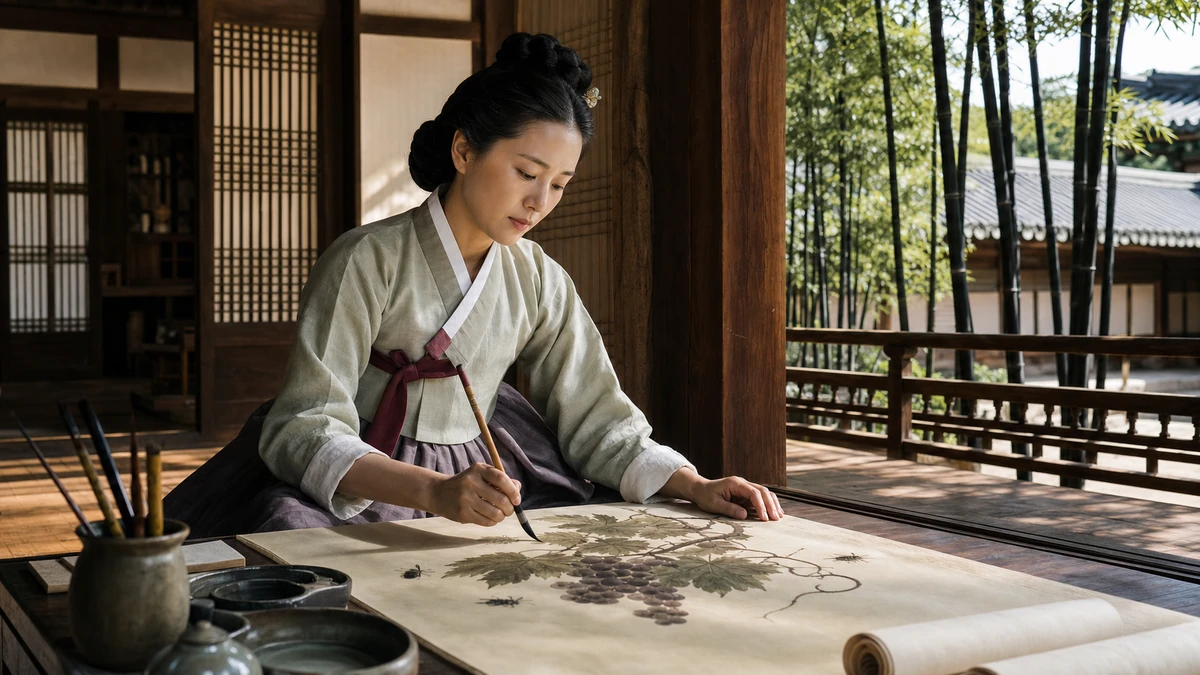
Image to help understand the article
A household name in South Korea, but little known in the United States
For many Americans, the face on a nation’s currency usually belongs to a president, a founding father or a wartime leader. South Korea made a different choice. Since 2009, the country’s 50,000-won note — one of its highest-denomination bills — has carried the portrait of Shin Saimdang, a 16th-century painter, poet, calligrapher and scholar. That decision says as much about modern Korea’s cultural memory as it does about Shin herself.
Shin Saimdang, born in 1504 in the eastern coastal city of Gangneung during the Joseon Dynasty, occupies an unusual place in Korean history. She is celebrated not only as the mother of Yi I, one of Korea’s most influential Neo-Confucian philosophers, but also as a major artist in her own right. Her paintings of grapes, plants, insects and landscapes became so admired that contemporaries compared her to leading painters of the age. Her poetry and calligraphy were also highly regarded. In a society where women’s public recognition was sharply limited, that was remarkable.
To Americans encountering her story for the first time, Shin can seem difficult to classify. She was not a court celebrity in the modern sense, nor an activist in the contemporary feminist mold. She did not challenge the social order by openly rejecting it. Instead, she carved out a space for artistic and intellectual accomplishment within one of East Asia’s most deeply Confucian societies. That may be one reason she still provokes debate in South Korea today: Was she primarily an idealized mother, elevated because she gave birth to a famous son? Or was she a groundbreaking creative figure whose own work deserves center stage?
The answer, historians increasingly suggest, is both — but the second part deserves much more attention. Long before she was memorialized as a model mother, Shin Saimdang was recognized as an artist whose talent stood on its own. Her life, beginning at Ojukheon, her maternal family home in Gangneung, offers a rare look at what female education, family life and artistic ambition could look like in Joseon Korea.
Born into learning at Ojukheon
Shin was born Shin In-seon on Dec. 5, 1504, in Bukpyeong Village, Jukheon-ri, in what was then Gangneung-bu, during the middle period of the Joseon Dynasty, which ruled the Korean Peninsula from 1392 to 1897. Today, her birthplace, Ojukheon, still stands and is one of South Korea’s most visited historic homes. For Korean visitors, it carries some of the aura that a preserved colonial house or founding-era site might hold for Americans — a place where national history is made legible through rooms, courtyards and family objects.
Her pen name, Saimdang, is the one by which she is now almost universally known. The name draws from Tairen, the revered mother of King Wen of Zhou in ancient China, who in Confucian tradition represented maternal virtue, discipline and moral cultivation. In later years, Koreans added “dang,” meaning hall or chamber, to identify her as a woman and to distinguish her literary identity. Pen names were common among scholars and artists across East Asia, but Shin’s choice was especially meaningful. It signaled not only learning, but aspiration — a self-conscious effort to place herself within a tradition of cultivated womanhood.
She was born into a family of pedigree and scholarship. Her lineage traced back to Shin Sung-gyeom, a founding contributor to the earlier Goryeo Dynasty who, according to Korean historical tradition, died in place of King Taejo. Her male ancestors had served in prominent government roles. Yet the political and educational fortunes of her immediate household were more complicated. Her father, Shin Myeong-hwa, spent years attempting to pass the state civil service examinations, the fiercely competitive tests that determined official advancement in Confucian Korea. He eventually passed a lower-level exam, but not the higher one that would have secured a major career in government.
That mattered, because the exam system shaped elite life much as admission to an Ivy League school or appointment to a federal judgeship might shape a high-achieving American family today — except with even greater moral and social weight. Scholar-official status was not just a profession. It was the governing ideal. Families organized education, marriage and household expectations around it.
Political turmoil also touched the family. During a wave of reform and backlash in the early 16th century, Shin’s father and relatives became entangled with emerging reformist scholar circles. After a purge in 1519, he abandoned hopes for office and moved to Gangneung, where he cared for his in-laws. The move had an unintended consequence for his daughter: It placed her in an environment where the maternal household became especially important in shaping her education.
A rare education for a Joseon girl
One reason Shin Saimdang continues to fascinate scholars is that her upbringing appears to have been unusually rich for a girl of her era. Joseon society was organized around Neo-Confucian values that emphasized hierarchy, filial duty and clearly defined gender roles. Elite women could be literate, but their education was generally expected to support domestic morality, family management and the raising of sons. Public intellectual life remained overwhelmingly male.
Yet Shin’s father reportedly did not sharply distinguish between sons and daughters in education, despite living in a patriarchal world. In fact, he had no sons, only five daughters, and Shin was the second. Accounts from later records say he taught not only his daughters but nieces as well. Her maternal grandfather, Yi Sa-on, also contributed to her early training. Through both sides of the family, Shin inherited a household culture in which books, moral philosophy and artistic practice were treated as part of daily life.
By age 7, according to traditional accounts, her abilities had already become clear. She learned classical Chinese texts early, developed a reputation for exceptional memory and began composing poetry that impressed adults around her. Her studies reportedly included introductory Confucian works such as the Thousand Character Classic, as well as more advanced canonical texts that formed the backbone of scholar education in East Asia. To a modern American reader, this might be compared to a child not only learning to read early, but moving quickly from primers into philosophy, history and literary composition — and doing so within a home where intellectual seriousness was expected.
That education was not limited to books. Shin also began formal training in painting at a young age after her family recognized her talent while she watched her mother do embroidery and tried to imitate visual forms. She studied from landscape paintings associated with the celebrated Joseon court painter An Gyeon, one of the towering names in Korean art history. Copying masters as a method of artistic training would be familiar to Western art historians as well; it was a disciplined way of learning technique, composition and visual language.
What makes Shin stand out is the breadth of her accomplishments. She excelled in poetry, painting and calligraphy — the classical triad of literati culture — but also in embroidery, sewing, cloth production and household skills. In Joseon terms, those were not contradictory pursuits. They formed a continuum of cultivated life. Intellectual refinement, visual sensibility and domestic competence were understood as interconnected, especially for women. Rather than dividing “fine art” from “women’s work” the way modern Western culture often does, her world linked them more closely.
Why her paintings mattered
It is easy, from a 21st-century distance, to flatten historical women into symbols. Shin Saimdang’s art resists that simplification. Contemporary and near-contemporary commentary suggests that her work was admired not merely as a genteel pastime but as serious painting.
She became especially known for landscapes, grapes, grasses and insects. Those subjects may sound modest to American readers more accustomed to ranking history painting or large oil portraits as the highest forms of art. But in East Asian painting traditions, such subjects carried technical and philosophical weight. A cluster of grapes, a stalk of grass or a carefully rendered insect could demonstrate brush control, compositional intelligence and close observation of the natural world. The point was not size or spectacle. It was distilled mastery.
One literary figure from the Joseon period, Eo Suk-gwon, praised Shin’s paintings in writing and rejected the idea that her art should be dismissed simply because she was a woman. He reportedly wrote that her grape and landscape paintings were so exquisite that viewers ranked them just after those of An Gyeon, and asked why such work should be slighted as “a woman’s painting” or criticized as somehow unfitting for a woman. That judgment is striking. It suggests that in or near her own lifetime, critics were evaluating her within the broader artistic standards of the day, not merely tucking her into a separate category of female accomplishment.
That matters for how her legacy is understood now. In modern South Korea, Shin has often been packaged in schoolbooks and popular culture as an icon of wise motherhood and womanly virtue. Those themes are certainly part of the historical record. But the older praise aimed at her paintings indicates that her reputation was never only domestic. She was known as a creator.
For an American parallel, imagine if a woman from the colonial era had long been remembered mostly as the mother of a famous statesman, only for art historians to remind the public that she also belonged in the same conversation as the leading painters or writers of her generation. That is, in some respects, what scholars and curators have been doing with Shin Saimdang.
A marriage shaped around the possibility of art
Another revealing part of Shin’s story is her marriage. According to traditional accounts, her father considered not simply rank or wealth when choosing a husband for her, but whether a marriage would allow her to continue painting and calligraphy. That detail, if read cautiously through historical sources, is extraordinary. It suggests that those around her understood her artistic work as something worth protecting.
She married Yi Won-su in 1522. He came from a respectable lineage but not a particularly prosperous branch of it, and he had lost his father early. In the calculations of elite Joseon families, that may actually have worked to Shin’s advantage. A wealthier, more rigidly status-conscious household might have imposed heavier demands on a new daughter-in-law. An extremely poor household might have consumed all her time with labor and survival. The chosen match seems to have offered a middle path.
Just as important, Shin appears to have benefited from a residence pattern less familiar to modern Americans who assume traditional East Asian marriages always brought women permanently into the husband’s household. In parts of early Joseon society, sons-in-law could spend extended periods residing with the wife’s family. That arrangement helped Shin remain connected to her natal home in Gangneung, where the educational and artistic environment that shaped her was still intact. In effect, geography, family structure and marital negotiation combined to create room for her work.
That does not mean her life was free of conflict. Historical anecdotes portray a woman with a strong will, not a passive ornament of Confucian domesticity. In one oft-retold story, she urged her husband to commit himself seriously to exam study, even pressing him with stern determination when he wavered. Whether every anecdote is literally exact is less important than what the tradition communicates: Korean memory did not preserve her merely as obedient and mild. It also remembered force, discipline and intellectual authority.
For American readers, the dynamic may call to mind the difference between a sentimentalized “good wife” image and the far more complicated reality historians often recover from diaries and family correspondence. Shin’s marriage appears to have been a partnership shaped by convention, affection, frustration and ambition all at once.
Between daughter, wife and mother
If one thread runs through Shin Saimdang’s life, it is movement — not social mobility in the modern sense, but physical and emotional movement between obligations. After her marriage, her father died without leaving a son. She observed mourning for him and later moved between Seoul, Paju and Gangneung while caring devotedly for her widowed mother. The journey between the capital region and Korea’s eastern coast was no small matter in the 16th century. To reduce the burden, the family is said to have maintained a residence in what is now Pyeongchang, roughly between the two areas.
That back-and-forth life shaped her poetry. Some of her best-known verses are suffused with longing for her mother and homesickness for Gangneung. Those emotions would be recognizable across cultures: the ache of leaving one’s childhood home, the guilt of distance, the split identity of someone trying to belong fully in two places at once. In that sense, her poems feel less like remote artifacts than intimate documents of family strain and attachment.
She also raised seven children, including four sons and three daughters. Among them was Yi I, later known by his pen name Yulgok, who became one of the central thinkers of Korean Neo-Confucianism and an important political figure. Another son, Yi U, developed a reputation in poetry and painting, while her eldest daughter, Yi Mae-chang, was praised enough to be called “Little Saimdang.” For later generations, the intellectual and artistic accomplishments of her children became evidence of her power as an educator inside the household.
That legacy has been double-edged. In South Korea, Shin Saimdang has long been upheld as the archetype of the wise mother who raises brilliant children, a role somewhat akin to how some cultures mythologize the self-sacrificing “founding mother” behind great men. But that framing can obscure as much as it reveals. It risks suggesting that her importance lies chiefly in what she produced through others rather than what she created herself.
A fuller reading is more interesting. Shin was a daughter caring for aging parents, a wife navigating an imperfect marriage, a mother managing a large household and an artist-scholar trying to sustain intellectual work amid all of it. That complexity makes her feel modern, even if the terms of her life were deeply premodern.
How modern Korea remembers her
Few historical women in Korea have been as publicly memorialized as Shin Saimdang. Her image appears in textbooks, museums, television dramas, tourism campaigns and currency. Ojukheon in Gangneung remains a major heritage site, drawing school groups, domestic tourists and foreign visitors curious about one of the country’s most recognizable historical figures. In the Korean imagination, she is at once local and national: a daughter of Gangneung and a symbol of the civilization of Joseon.
Yet she is not remembered without controversy. Some feminists and cultural critics in South Korea have questioned whether the state’s embrace of Shin reinforces a conservative ideal of womanhood — one rooted in maternal sacrifice, domestic virtue and support for male achievement. Why, they ask, should one of the country’s most visible female icons be someone so often presented first as the mother of a great man? Why not foreground women who challenged the system more directly?
Those are fair questions, but they do not require dismissing Shin herself. In fact, her life can complicate simple categories. She was undeniably formed by Confucian family ideals. She adopted a pen name referencing exemplary motherhood. She invested heavily in educating her children. But she also pursued advanced learning, cultivated major artistic skill and commanded recognition from male contemporaries in a culture that did not easily grant women such authority.
In that way, Shin resembles many women in history who made space for themselves not by standing outside their societies altogether, but by pushing the boundaries from within. Americans have their own versions of such figures — women whose talents were long filtered through domestic narratives before later generations recovered their intellectual or artistic power. Seen from that angle, Shin Saimdang is not simply a Korean curiosity or a moral emblem on a banknote. She is part of a broader global story about how women create under constraint and how nations remember them afterward.
Why her story still resonates beyond Korea
At a time when the Korean Wave, or Hallyu, has made Korean culture more visible in the United States than ever before, Shin Saimdang offers a useful corrective to the idea that Korean cultural achievement is only a contemporary phenomenon. Long before K-pop, Oscar-winning films or streaming dramas, Korea produced sophisticated traditions of painting, poetry, philosophy and family ritual. Shin stood near the intersection of all of them.
Her life also helps explain a tension that still runs through Korean society: the immense prestige attached to education and accomplishment, and the equally powerful expectations placed on family roles. Those pressures did not begin in the modern era. They have deep historical roots. Shin’s story shows an early version of the balancing act that many Korean women, and increasingly women everywhere, continue to navigate — how to excel intellectually and creatively while shouldering expectations tied to caregiving, family reputation and social norms.
For American readers, the temptation may be to ask whether Shin Saimdang was a feminist. That is probably the wrong question, or at least too narrow a one. Better to ask what forms of agency were available to her, how she used them and why her work endured. She appears not as a rebel in the modern political sense, but as a formidable cultural actor: a woman educated beyond the ordinary limits of her era, determined enough to preserve her artistic life through marriage and domestic duty, and talented enough that even male critics of her time could not ignore her.
She died in 1551 at age 47, leaving children still young and a body of work that later centuries would alternately admire, idealize and simplify. But the strongest version of her legacy may be the least reductive one. Shin Saimdang opened a path for recognition of female artistry in Joseon Korea not through a single dramatic act, but through sustained excellence in literature, painting and scholarship. She proved that a woman in a Confucian dynasty could be more than an ornament, more than a symbol and more than a mother of sons.
She could be an artist whose name still matters five centuries later.
Comments
Post a Comment