Hyundai’s Planned Factory Hiring in South Korea Signals a Bigger Bet on Manufacturing — and Matters in the U.S., Too
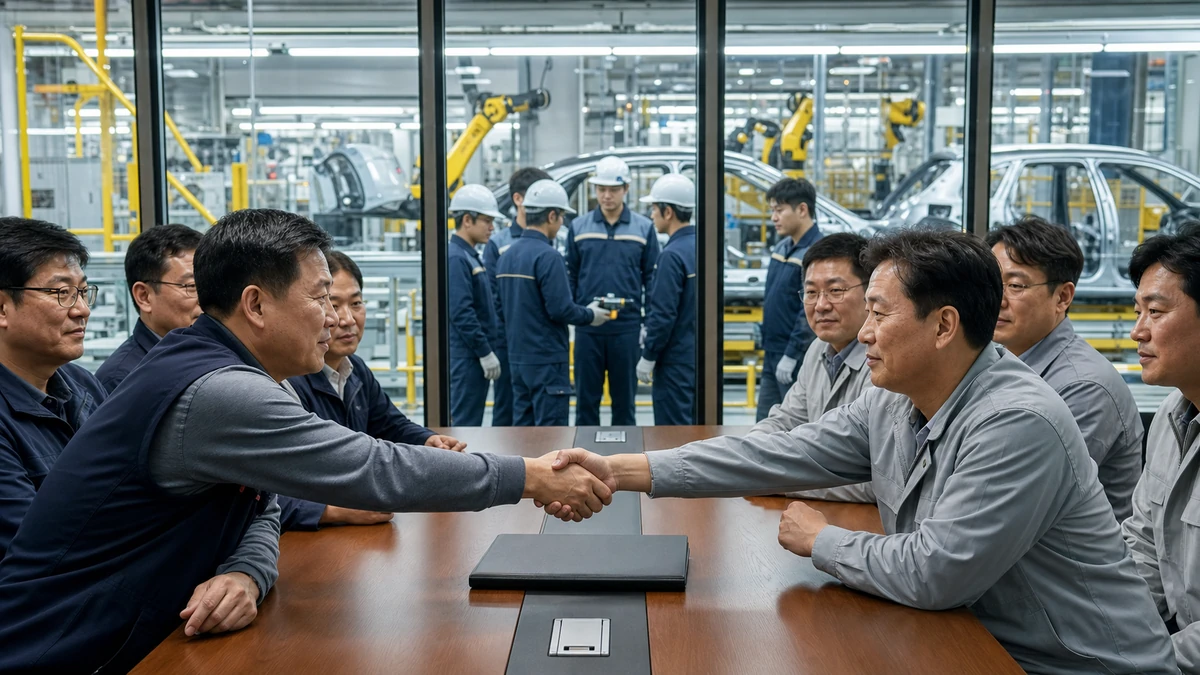
Image to help understand the article
More than a headcount, Hyundai’s plan is a manufacturing signal
Hyundai Motor’s expected plan to hire 500 entry-level technical workers in South Korea beginning in the second half of 2027 and continuing through 2028 may sound, at first glance, like a straightforward labor story. It is that, but it is also more than that. For one of South Korea’s signature industrial companies to move toward adding hundreds of new factory-floor workers is a notable marker in an era when global automakers are under pressure to automate, restructure and contain labor costs.
According to the reported outline, Hyundai and its labor union reached a broad convergence during this year’s wage negotiations on bringing in 200 new technical hires in the latter half of 2027 and another 300 in 2028. That distinction matters. This is not being presented as an immediate one-time hiring spree. It is a phased staffing plan, tied to future production needs and still short of a final, fully formalized recruitment announcement.
In the context of South Korea, where Hyundai is more than just another car company, that kind of labor planning carries economic and symbolic weight. Hyundai is one of the country’s flagship manufacturers, and its factory employment decisions are often read as a proxy for broader confidence in industrial production. When a company like Hyundai indicates that it sees long-term value in replenishing its shop-floor workforce, it suggests management is thinking beyond quarterly uncertainty and toward maintaining the kind of production base that keeps an industrial brand competitive over time.
That is especially important in manufacturing, where the most glamorous parts of the business — electric vehicle platforms, autonomous driving software, global branding campaigns — can overshadow the workers who actually assemble the product. Factories do not run on strategy decks alone. They depend on technicians, line workers, maintenance staff and production teams who can keep output steady and quality consistent. Hyundai’s emerging plan underscores a basic industrial truth: Even in a high-tech auto business, people remain essential infrastructure.
There is also a timing story here. The planned hires are years away, which makes the move less about plugging an immediate labor gap and more about pipeline-building. Bringing in entry-level technical workers means betting on training, adaptation and institutional continuity. That is different from poaching already seasoned workers from elsewhere. It suggests Hyundai is thinking about how manufacturing know-how is transferred from one generation of employees to the next — a quiet but crucial issue in every mature industrial economy.
Why the phased approach matters in South Korea
South Korean readers would immediately understand why this kind of announcement resonates, but international audiences may need a bit of context. In Korea, major manufacturing employers like Hyundai sit at the center of the country’s export-driven development model. Since the late 20th century, South Korea’s rise from war-torn poverty to advanced industrial power has been tied closely to conglomerates known as chaebol — large family-controlled business groups such as Hyundai, Samsung and LG. Hyundai’s factories are not just workplaces; they are part of the architecture of modern Korean economic success.
That is why technical hiring at Hyundai carries significance beyond the 500 positions themselves. In Korea, stable manufacturing jobs at top-tier firms have long been viewed as among the most desirable blue-collar careers in the country, offering wages, benefits and social status that can compare favorably with many white-collar jobs. The prospect of new entry-level slots can therefore be read as evidence that industrial work remains viable and valued, even as younger workers in many advanced economies increasingly gravitate toward service or technology sectors.
The phased structure — 200 hires in late 2027, then 300 in 2028 — also points to deliberate workforce management rather than political theater. If Hyundai were simply trying to create a splashy headline, it could have framed the move as one large number with an immediate start. Instead, the two-step rollout suggests the company may be trying to align recruiting with production schedules, training capacity and future staffing needs at specific plants or processes. The source material does not provide details on job categories, plant locations or recruitment criteria, so it would be premature to infer exactly where these workers will go. But the staged design alone implies planning, not improvisation.
That matters because manufacturing labor is not interchangeable. In auto production, even entry-level hires must be absorbed into workflows that depend on safety standards, quality control systems and plant-specific routines. A staggered intake can give supervisors and veteran workers time to train newcomers without overwhelming operations. It can also help management and labor assess whether the first wave of hiring supports productivity the way they expect before scaling up the second.
Just as importantly, the plan emerged from wage talks between management and labor. In the Korean industrial system, union-management negotiations often shape not just pay but also broader questions about workforce structure and job security. The fact that hiring levels were addressed during bargaining shows that labor replenishment is being treated as a strategic issue shared by both sides. That does not mean everything is settled. The key phrase here is that the two sides moved closer in their views, not that every procedural step is complete. Still, in industrial relations, agreement on direction can be almost as important as the final signature.
What this says about the future of auto manufacturing
The bigger story may be what Hyundai’s move says about the current phase of global auto manufacturing. For years, the industry conversation has often been dominated by automation and electrification. That has led to a recurring assumption: As factories become smarter and vehicles become more software-driven, fewer workers will be needed on assembly lines. There is some truth in that. But it can also oversimplify what modern manufacturing actually requires.
Building vehicles at scale still depends on labor-intensive coordination, especially when companies are balancing legacy internal combustion models, hybrids and newer electric vehicles within the same broader corporate system. Even with robotics, there is still a premium on people who can troubleshoot equipment, maintain production consistency and adapt to evolving processes. Automation changes jobs; it does not erase the need for a skilled human workforce.
That is why Hyundai’s planned intake of entry-level technical staff can be read as a sign that manufacturing capacity is not just about machines or capital expenditure. It is also about human depth. If a company believes its future production footprint requires a fresh bench of workers several years from now, that suggests it sees continued value in domestic industrial execution. In other words, Hyundai appears to be signaling that the factory floor remains a strategic asset, not merely a cost center to be minimized.
This fits a broader trend visible across advanced manufacturing economies. As supply chains have become more geopolitically sensitive and companies have reassessed the fragility exposed by the pandemic era, industrial resilience has become a boardroom buzzword. Resilience, however, cannot be purchased with equipment alone. A country or company that loses the ability to train, retain and renew frontline production workers can find itself with shiny facilities but diminished operational strength.
That is why the planned hiring deserves attention as a trend story rather than a one-day labor item. It reflects a recognition that manufacturing competitiveness is cumulative. You do not preserve an industrial base simply by announcing a new vehicle or opening a plant. You preserve it by maintaining the workforce systems that make mass production repeatable, adaptable and reliable over years. Hyundai’s approach suggests that, for all the talk of disruption, the core logic of manufacturing still rests on patient investment in people.
What it means for the United States
For American readers, this is not just a South Korean domestic labor story. It intersects directly with the United States in at least three ways: Hyundai’s growing footprint in the American market, the broader U.S.-South Korea economic relationship and the debate over the future of industrial jobs in the United States.
First, Hyundai is no peripheral player in America. Through the Hyundai and Kia brands, the South Korean auto group has become a major force in the U.S. market, competing head-to-head with Detroit automakers, Japanese rivals and Tesla in categories ranging from sedans and SUVs to electric vehicles. Americans know the company through cars in suburban driveways, Super Bowl commercials and dealer lots, but Hyundai’s relevance extends far beyond branding. Its manufacturing strategy in Korea can affect product pipelines, quality control, supply chain coordination and the company’s global ability to respond to demand.
Second, Hyundai’s labor planning in Korea is part of a larger U.S.-Korea industrial relationship that has deepened in the electric vehicle era. South Korean firms have become central players in America’s battery and auto investment boom, with Korean companies expanding in states such as Georgia and elsewhere in the Southeast. For U.S. policymakers, Korean manufacturing strength is no longer just an overseas phenomenon; it is intertwined with domestic job creation, technology partnerships and the politics of industrial policy.
That makes Hyundai’s hiring signal worth watching in Washington and in U.S. business circles. If Hyundai is reinforcing its production workforce at home while simultaneously expanding its manufacturing ecosystem abroad, it suggests the company is pursuing a both-and model rather than an either-or one: strengthening domestic industrial capabilities in Korea while also positioning itself more deeply inside the American market. That approach resembles how some multinational manufacturers now think about resilience — not by abandoning the home base, but by pairing it with strategic overseas capacity.
Third, the story lands at a moment when the United States is rethinking the value of factory jobs. For decades, American political rhetoric has treated manufacturing employment as both an economic necessity and a cultural symbol. From Michigan to Ohio to Georgia, politicians routinely promise to bring back or preserve industrial work. What Hyundai’s Korean hiring plan highlights is that sustaining manufacturing is not only about ribbon-cutting announcements for new plants. It also requires steady investment in entry-level workers, training pipelines and labor-management arrangements that support continuity.
There is a useful American comparison here. In the U.S., automakers and political leaders often celebrate multibillion-dollar facilities because capital spending is visible and photogenic. But long-term industrial strength depends just as much on whether companies cultivate the next generation of production workers. Hyundai’s signal from Korea is a reminder that durable manufacturing ecosystems are built person by person, not just plant by plant.
Lessons for U.S. companies and workers
American companies and workers can take several lessons from this development, even if the specific institutional context differs. One is that blue-collar industrial hiring is still a strategic decision in advanced economies, not an outdated relic. In the United States, manufacturing jobs have been politically romanticized and economically hollowed out in uneven ways over the past several decades. Wages, union strength and career stability vary sharply by company and region. Yet the basic challenge is familiar on both sides of the Pacific: How do companies maintain an experienced, adaptable workforce as older workers retire and newer technologies reshape production?
Hyundai’s reported plan does not answer that question for America, but it does offer a contrast. Rather than treating factory staffing as a last-minute operational issue, the company appears to be discussing future workforce needs years in advance and in connection with labor negotiations. That is notable in an industry where management and labor are often portrayed as locked in zero-sum conflict. In the United States, especially after the recent visibility of labor disputes in the auto sector, there is growing recognition that workforce stability, training and retention are not side issues. They are central to competitiveness.
There is also a message here for American communities that hope to attract foreign manufacturers. The value of companies like Hyundai is not only that they bring capital or logos; it is that they carry manufacturing systems that include long-range thinking about workforce development. U.S. states competing for investment increasingly talk about workforce readiness, technical colleges and training incentives. Hyundai’s move reinforces why those factors matter. Industrial employers want places where production talent can be built, not just recruited on the fly.
For workers, the symbolism is equally important. In both Korea and the United States, younger generations often hear mixed signals about manufacturing — that it is essential, but shrinking; that it is skilled, but vulnerable; that it is well-paid, but unstable. A plan to bring in hundreds of new technical workers at a major automaker sends a different message: that shop-floor expertise still has a future. The details of pay, duties and plant placement are not yet public, and those specifics will matter enormously. But at the level of industrial narrative, the move pushes back against the assumption that factory work has no next chapter.
What to watch next
The most important caveat is that Hyundai’s hiring plan, as reported so far, is not yet the same thing as a final, fully detailed recruitment launch. The source material makes that distinction clear. Management and labor have moved toward agreement on scale and timing, but the practical mechanics — formal announcements, eligibility requirements, application schedules, plant assignments and job descriptions — remain to be spelled out later.
That means the next phase matters more than the headline number alone. The first thing to watch is whether the framework survives the rest of the bargaining and internal approval process. Labor negotiations can produce momentum, but implementation is where intention becomes policy. The second is how Hyundai explains the jobs themselves. If the company frames the roles around long-term production capability and training, that will strengthen the interpretation that this is a strategic workforce investment rather than a short-term concession.
A third question is what the hiring says about Hyundai’s expectations for future production demand and operational structure. The source summary does not tie the planned recruitment to specific vehicle lines, export plans or technology transitions, so any attempt to do so now would be speculative. Still, when a global automaker prepares to add technical workers over multiple years, observers will naturally ask what that implies about capacity, model mix and domestic manufacturing priorities.
Finally, there is the larger trendline. If other major Korean manufacturers also begin signaling sustained investment in frontline industrial hiring, that would strengthen the case that South Korea is entering a period of renewed confidence in its manufacturing base, even amid global economic volatility. For American readers, that matters because South Korea is not just another export economy. It is a treaty ally, a major investor in the United States and an increasingly important partner in sectors that Washington views as strategically vital, from semiconductors to batteries to automobiles.
In that sense, Hyundai’s planned 500 hires are not merely an HR matter in one country. They are a small but telling window into how a globally relevant manufacturer is thinking about capacity, labor and resilience in the late 2020s. And for the United States — where leaders across the political spectrum say they want a manufacturing revival — the lesson is clear. Industrial strength still comes down to people, and companies willing to invest in people early are often the ones best positioned to compete later.
Comments
Post a Comment