
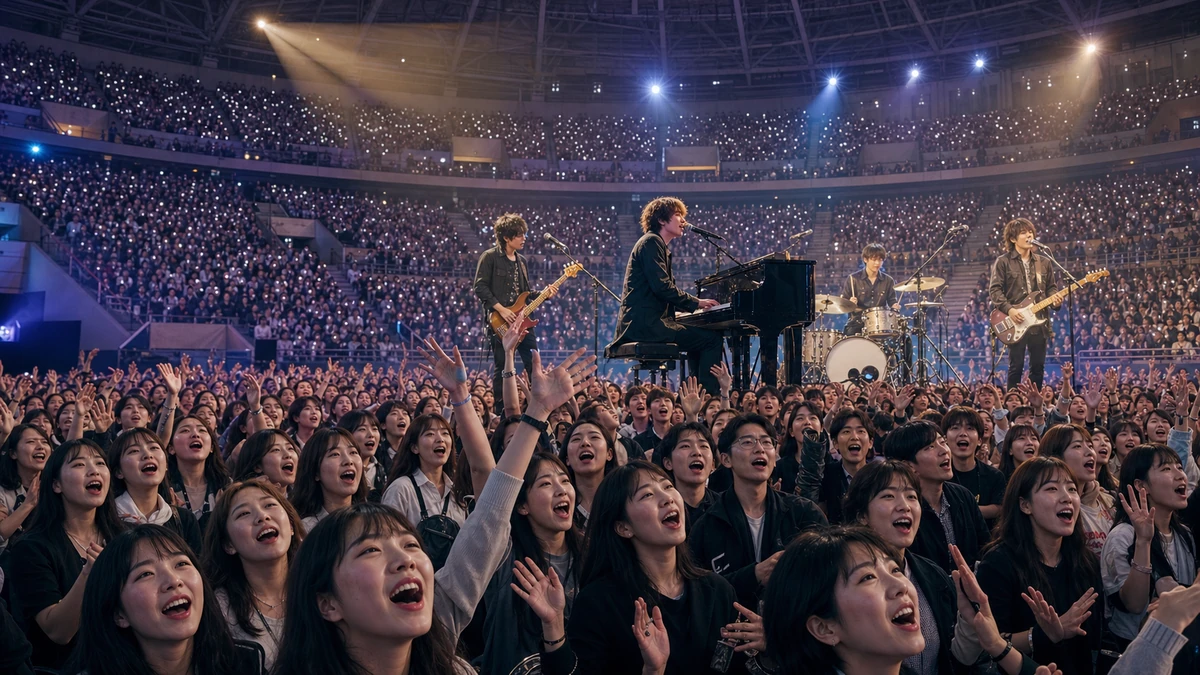
A Japanese band takes the stage at a Korean pop landmark
SEOUL — In a city better known globally as the beating heart of K-pop, a different kind of pop spectacle unfolded this week: about 13,000 concertgoers at Seoul’s KSPO Dome sang along in Japanese with Official Hige Dandism, the four-member Japanese band often shortened by fans to “Higedan.”
The moment that seemed to define the night came during the band’s hit “Pretender,” when the crowd joined in on the chorus — in Japanese, not Korean or English — turning one of South Korea’s most recognizable concert venues into a mass singalong that crossed both language and national boundaries. For American readers used to seeing fans belt out lyrics in English at arena shows, or perhaps in Korean at K-pop concerts in Los Angeles or New York, the scene in Seoul offered a revealing look at how pop culture now moves across Asia: fluidly, digitally and often with little regard for old assumptions about who listens to what.
KSPO Dome, inside Seoul’s Olympic Park, occupies a place in South Korea somewhat comparable to a storied arena in the United States where major pop acts prove their drawing power. It has long been associated with blockbuster K-pop performances and fandom rituals on a grand scale. Filling that space is no small feat, even for established Korean acts. That a Japanese band did so — and did it with an audience willing to memorize and sing lyrics in another language — says something important about where Asian pop culture stands in 2025.
This was not simply a foreign act making a tour stop in Seoul. It was a demonstration of how Korean audiences increasingly experience music beyond linguistic comfort zones, and how J-pop, once more niche in South Korea, is now claiming visible space inside a country whose own pop industry has become a global export machine.
More than a concert, it was a participatory fan event
One of the striking features of the show was not just that fans knew the songs, but that they participated with the kind of intensity American audiences might associate with a Taylor Swift crowd screaming every bridge or a stadium full of fans chanting along with Coldplay. In South Korea, there is even a word that helps explain this dynamic: “ttechang,” shorthand for a large-scale, full-throated singalong by the audience. It is a familiar feature of K-pop concerts, where fans often arrive prepared not merely to watch but to perform their role as an active part of the event.
That culture of participation was central to what happened at KSPO Dome. Fans did not remain passive listeners. They remembered Japanese lyrics, tracked the flow of each song and answered the band with cheers timed to the music. At points, the arena reportedly rang with shouts of “Hige yaho,” an affectionate cheer for the band. The result was that the usual boundary between artist and crowd felt unusually thin. The room operated less like a traditional concert hall and more like a collaborative performance space, with the audience functioning as a kind of unofficial fifth instrument.
For readers in the United States, where international acts often rely on spectacle, subtitles on screens or a handful of globally recognized hits to bridge the language gap, the Seoul show suggested a different equation. Here, unfamiliar language did not create distance. It became evidence of fan commitment. Knowing the Japanese words — or at least their sounds and rhythm — served as a public display of devotion, much like learning fan chants in K-pop or phonetic lyrics for Latin pop songs in places where Spanish is not the dominant language.
That distinction matters because it shows how fandom increasingly works in an era of streaming and social media. Listeners do not need full fluency to feel ownership of a song. Emotional familiarity can come first. Meaning, pronunciation and context are often learned later, or alongside the music itself. In Seoul, that process was audible.
How anime helped build a bridge from Japan to South Korea
Official Hige Dandism’s popularity in South Korea did not emerge out of nowhere. One major reason is the way music now travels through visual storytelling, especially anime, which has become one of the most powerful cultural pipelines in Asia and far beyond. For many younger listeners, songs are no longer discovered primarily on radio or through album promotion. They arrive attached to characters, narratives and emotionally charged scenes from TV series and films.
Higedan has benefited from exactly that dynamic. The group has performed theme songs tied to Japanese animated content known to Korean audiences, including titles such as “Tokyo Revengers” and “Spy x Family.” In the United States, anime has likewise evolved from subculture to mainstream entertainment; it now shapes not only viewing habits but also music discovery, merch sales and concert demand. A generation of fans who might first hear a song over an opening sequence or a climactic episode often goes on to seek out the artist’s broader catalog.
That pattern appears to have taken hold in South Korea as well. A fan may first encounter a Higedan song through a series streaming on a platform, then move to repeat listens on a music service, then finally decide that a live concert is worth the ticket. By the time that fan reaches the arena, the song is no longer just a soundtrack cue from an animated show. It is part of a personal emotional archive.
This helps explain why the crowd’s response at KSPO Dome felt so organic. The audience was not treating the band as an exotic novelty from Japan. Many had already formed attachments through stories and characters they knew well. In that sense, anime serves as a cultural translator. It carries not just language, but mood and memory, making a song feel familiar before listeners ever fully understand the lyrics.
For American audiences, there is a useful parallel in how movie soundtracks, streaming series and TikTok trends can propel songs far outside their original markets. A track featured prominently in a hit show can develop a second life internationally, untethered from traditional radio gatekeepers. In Asia, anime has become one of the clearest engines of that phenomenon, and Official Hige Dandism is among the acts reaping the benefits.
“Pretender” and the chart-to-arena pipeline
If anime opened one door, streaming charts opened another. “Pretender,” one of the band’s best-known songs, entered the Top 100 on Melon, one of South Korea’s leading music services. That may sound like a routine metric in an age of constant chart churn, but in context it mattered. A Japanese-language song gaining traction on a mainstream Korean platform signals more than curiosity; it points to repeated listening by a sizable audience.
The Seoul concert made clear that this was not a one-off streaming anomaly. There is a direct line from chart success to the roar of an arena crowd singing a chorus back to the stage. When thousands of people can join a Japanese refrain in unison, it suggests not just exposure, but sustained familiarity. They have lived with the song long enough to internalize it.
That journey from earbuds to arena is increasingly central to how pop fandom works across borders. An artist no longer needs heavy local media promotion or fluency in a market’s dominant language to break through. A song can circulate online, gather momentum through algorithmic recommendation and fan sharing, then translate into offline demand when enough listeners want the communal thrill of hearing it live.
American music executives have spent years studying how K-pop built such intensely mobilized global fandoms. What the Higedan show illustrates is that similar mechanisms now operate within Asia in multiple directions. South Korea is not only exporting music culture; it is also importing, adapting and amplifying it. The fans who helped make K-pop concert behavior famous around the world are applying that same energy to artists from elsewhere in the region.
“Pretender” became the clearest expression of that pipeline. Its singalong chorus turned chart data into something visible and bodily. It showed that streaming metrics can represent real attachment, not just fleeting clicks. And it underscored how language, rather than functioning as a barrier, can become part of the appeal when fans embrace the original sound of a song.
The bigger story: J-pop’s growing foothold in South Korea
Official Hige Dandism is not an isolated case. The band is part of a broader J-pop wave that has been gaining traction in South Korea, alongside artists such as King Gnu, Aimyon, Mrs. Green Apple and Fujii Kaze. Taken together, their rise suggests that Korean listeners are widening their view of Japanese popular music beyond a small set of crossover hits.
That development carries cultural significance because South Korea and Japan share a complicated history shaped by colonialism, political disputes and periodic nationalist tension. Those issues have not disappeared, and they still surface in diplomatic and public debates. Yet consumer culture, especially among younger audiences, often moves along different tracks. People may hold strong views about history and politics while still eagerly consuming each other’s entertainment.
For decades, Japanese popular culture faced formal and informal barriers in South Korea. Many of those restrictions have eased over time, and younger consumers have grown up in a digital ecosystem where access is harder to police and global fandom habits are more normalized. Streaming platforms, YouTube, short-form video apps and fandom communities have accelerated that shift. The result is a generation for whom a Japanese artist showing up on a Korean playlist no longer feels especially unusual.
Higedan’s appeal fits neatly into that environment. The band occupies a sweet spot: polished but emotionally direct songs, strong melodic hooks, a mainstream pop-rock sensibility and connections to anime that function as a powerful discovery funnel. For Korean listeners, there is often an easy entry point — perhaps a theme song linked to a beloved series — followed by deeper exploration into the band’s catalog.
The Seoul show, then, was not merely proof that one Japanese group has fans in South Korea. It reflected a broader consumer shift in which Japanese music is becoming a more regular part of the Korean listening landscape. As in the United States, where listeners might move from one viral track to an artist’s full discography, South Korean audiences appear increasingly willing to turn a single familiar song into longer-term fandom.
What Seoul’s singalong says about K-pop’s influence — and its openness
There is a temptation to view any major non-Korean success in Seoul as a challenge to K-pop’s dominance. But that interpretation misses the more interesting point. The KSPO Dome concert does not suggest K-pop is weakening. If anything, it shows how influential South Korea’s concert culture has become — so influential that it now provides the template through which other Asian acts can thrive in the country.
K-pop has helped normalize a highly participatory form of fandom. Fans learn lyrics, organize chants, coordinate light sticks and treat concerts as shared rituals rather than one-way performances. That ecosystem has become one of South Korea’s great cultural exports. What happened at Higedan’s show was, in a sense, that model being turned outward. Korean fans applied the habits honed at domestic idol concerts to a Japanese band’s performance.
That creates a striking reversal of the scenes American audiences have come to recognize abroad: international K-pop fans singing in Korean in Chicago, London or Paris. In Seoul, the pattern flipped. Korean fans sang in Japanese, demonstrating that cultural exchange in Asian pop music is not a one-way flow from Seoul to the world. It also moves sideways, across neighboring countries, through mutually influential fan practices.
The venue itself amplified the symbolism. KSPO Dome is deeply associated with K-pop memory-making, the sort of place where milestones are measured in ticket sales, screaming choruses and social media clips that circulate for days. To hear it filled by a Japanese-language singalong is to witness South Korea’s music scene acting not just as a national industry hub, but as a regional crossroads.
For U.S. readers, perhaps the easiest comparison is to think of a major American venue historically tied to domestic stars suddenly hosting a night that captures the cultural momentum of another country’s pop scene — and finding that the audience is completely ready for it. The significance lies not only in who is onstage, but in how quickly fans have adapted their listening habits to a more internationalized pop marketplace.
A glimpse of where Asian pop culture is headed
The 13,000 voices that rose inside KSPO Dome offered more than a memorable concert anecdote. They provided a concise illustration of how music fandom now works across borders: discovery through screen culture, reinforcement through streaming, emotional investment through repetition and communal validation in a live setting.
In that sequence, every stage matters. A theme song heard during an anime episode plants the seed. A streaming service turns it into routine listening. Social media clips help spread the chorus and fan enthusiasm. A concert then transforms solitary listening into collective experience. By the time the arena lights dim and the chorus arrives, the song belongs not only to the artist, but to the crowd that has carried it there.
That pattern is unlikely to remain confined to one band or one city. As younger listeners across Asia and beyond grow more comfortable moving among Korean, Japanese and English-language pop ecosystems, the categories that once separated them look increasingly outdated. Fans are building playlists — and identities — that reflect digital fluency more than national boundaries.
Official Hige Dandism’s night in Seoul may therefore be remembered as part of a larger transition. The story is not simply that a Japanese band drew a big crowd in South Korea. It is that the crowd met the band on shared cultural ground created by streaming, fandom and a willingness to engage music in its original form. In a region where history can still divide governments and publics, pop culture continues to create different kinds of contact: imperfect, commercial, emotional and very real.
For American audiences paying closer attention to the Korean Wave, that is the broader takeaway. K-pop remains the most globally visible piece of South Korea’s cultural influence, but the country is also becoming an increasingly important stage on which Asian pop culture interacts with itself. Seoul is not just exporting a music model; it is hosting the next phase of regional exchange.
And on this night, that exchange sounded like 13,000 people singing in Japanese at the center of K-pop’s home turf.




0 Comments