In South Korea’s Industrial Southeast, a Local Housing Partnership Focuses on the Basics That Can Change Daily Life
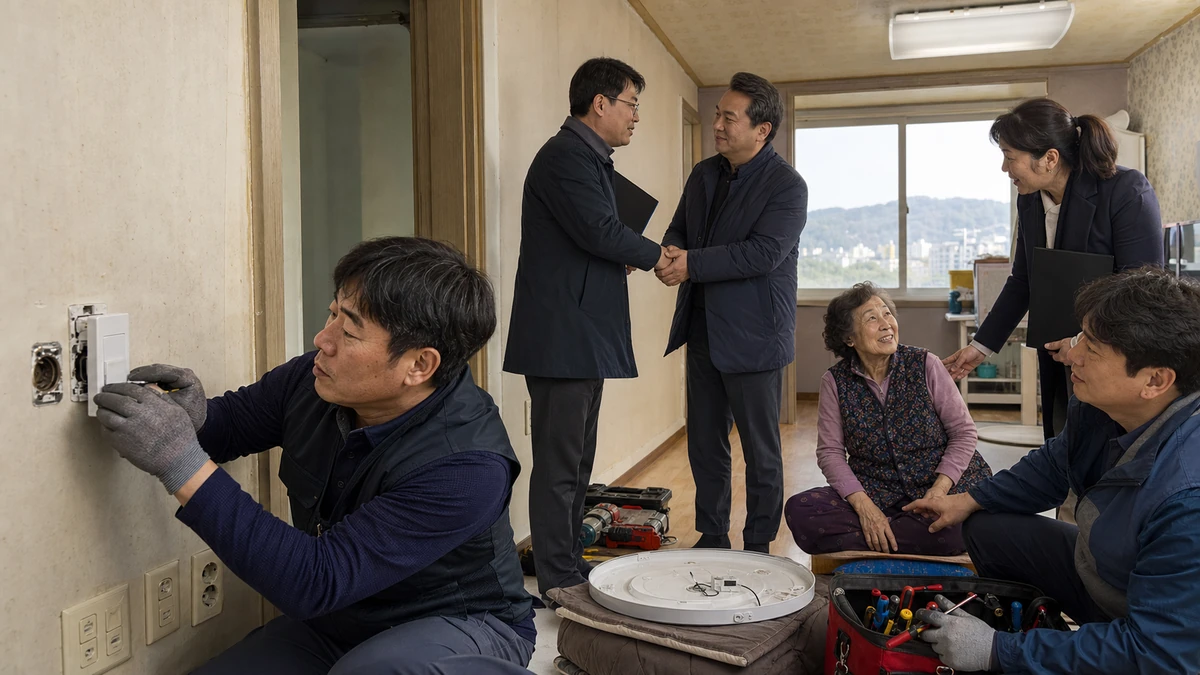
Image to help understand the article
A housing policy story told through light switches and front-line care
In the United States, conversations about housing policy often revolve around the big-ticket items: rising rents, affordable housing shortages, zoning fights, new apartment towers and mortgage rates. South Korea has its own version of that debate, especially in a country where real estate prices and redevelopment plans can dominate headlines. But a new agreement in Ulju County, a largely suburban and rural district in the southeastern city of Ulsan, highlights a different way of thinking about what makes housing livable.
Rather than focusing on new construction, two public-facing institutions in South Korea have agreed to work together on something far more basic and, for many residents, far more immediate: making the homes people already live in safer and easier to use. The Ulju Welfare Foundation, which handles welfare-related projects in Ulju, and the Busan-Ulsan branch of the Korea Housing Management Corp., a public housing management organization, signed a memorandum of understanding on June 12 aimed at improving living conditions for vulnerable residents and expanding social service efforts in the region.
On paper, the agreement includes practical measures that may sound modest: replacing old lights, switches and other worn household fixtures; using donated funds and goods; and sending both technical specialists and volunteers into the field. But for older adults, low-income households and residents living in aging homes, those fixes can matter more than the kind of flashy redevelopment projects that usually draw public attention.
The partnership also reflects a distinctly Korean policy instinct that may be unfamiliar to American readers. In South Korea, local welfare work, public housing administration and community volunteer networks often overlap more directly than they do in many parts of the United States. Housing is not treated only as a real estate asset or a physical structure. It is also understood as part of a broader support system that touches elder care, disaster response, seasonal labor needs and neighborhood well-being.
That broader approach is what makes this agreement notable. It suggests that in at least one corner of South Korea, improving a home can mean more than fixing a wall or changing a bulb. It can mean strengthening the web of care around the people who live there.
Why Ulju matters in understanding this story
To understand the significance of the agreement, it helps to understand where it is happening. Ulsan, on South Korea’s southeastern coast, is best known to international audiences as an industrial powerhouse. It is home to major shipbuilding, automotive and petrochemical operations, and for decades has been associated with the manufacturing engine that helped transform South Korea into one of the world’s leading economies.
Ulju County, or Ulju-gun in Korean administrative terms, sits within the broader Ulsan metropolitan area but has a different feel from the city’s heavy industrial zones. It includes communities that are more rural or semi-rural, places where older housing stock, aging residents and agricultural rhythms are part of everyday life. In practical terms, that means policymakers are often dealing with a mixed landscape: urban infrastructure in some places, countryside needs in others, and populations that may be more vulnerable to isolation, poor housing conditions or gaps in access to services.
That context helps explain why the agreement goes beyond conventional home repair. In addition to upgrading old residential facilities, the two organizations say they will cooperate on meal-sharing events for elderly villagers, volunteer support during the busy farming season and manpower during disasters. Those details point to a local reality Americans may recognize from rural counties back home: a house cannot be separated from the life around it. If an elderly resident is struggling with mobility, or if a farming household is stretched thin during harvest, a safe light fixture and a functioning switch are part of the same survival equation as food, transportation and neighbors willing to show up.
In that sense, the Ulju initiative resembles the kind of place-based social policy that some American nonprofits and local governments try to build through aging-in-place programs, weatherization grants or neighborhood response networks. The difference is that in this Korean case, the effort is being formalized through an agreement between a welfare foundation and a public-sector housing management body, giving it an institutional structure from the start.
Small repairs, big consequences
The most concrete details released so far are also the most revealing. One of the direct housing improvement measures in the agreement is the replacement of old lights, switches and similar fixtures in deteriorating homes. That may sound minor compared with a roof replacement or a full renovation, but it gets at a truth that housing advocates in many countries know well: the daily experience of a home is often shaped by the smallest things.
A flickering light in a hallway can become a fall risk for an older adult. A broken switch can make routine tasks harder for someone with limited mobility. Worn-out fixtures can also signal broader neglect, especially in homes where residents lack the money, physical ability or social support to keep up with even minor repairs. In that context, changing a light or replacing a switch is not cosmetic. It is a direct intervention in safety, dignity and quality of life.
American readers may think of similar programs that install grab bars in bathrooms, replace smoke alarms or weatherproof windows for seniors and low-income families. Those services rarely grab headlines, but they can be the difference between staying in one’s home and being forced into a more precarious situation. The same logic appears to be driving the Ulju effort.
What stands out in the Korean agreement is the execution model. The arrangement does not stop at providing donated goods. It also includes the deployment of professional personnel and on-site support staff who can actually carry out installations and replacements. That distinction matters. Anyone who has worked in social services knows that giving people supplies is only half the battle. If a recipient is elderly, disabled or living alone, a donated fixture is not much help unless someone can install it safely and correctly.
By dividing responsibilities between the organization that identifies need and the organization that can mobilize technical workers, the program appears designed to close that common gap between assistance promised and assistance delivered. In policy terms, that is often where good intentions fail. Here, local officials are at least trying to account for the mechanics of implementation.
A division of labor designed for follow-through
According to the agreement, the Ulju Welfare Foundation will oversee overall management and operations. Its role includes identifying villages and households in need, selecting recipients, administering donations and purchasing necessary supplies. It will also handle some field support and organize meal-sharing events for older residents in the community.
The Busan-Ulsan branch of the Korea Housing Management Corp. will contribute donated goods connected to its environmental, social and governance, or ESG, management efforts, as well as provide the professional and on-site personnel needed for housing improvements. It also plans to cooperate in meal-sharing events, volunteering during farming season and disasters, and public outreach connected to the initiative.
For American audiences, the ESG language may sound familiar from corporate boardrooms and investor presentations. In recent years, ESG has become shorthand for the idea that institutions should be evaluated not only on financial performance but also on environmental impact, social responsibility and governance practices. In the United States, the term has also become politically polarizing in some circles. In South Korea, however, ESG is frequently used in a more practical, administrative sense by corporations and public institutions that want to frame social contribution programs as part of broader management goals.
In this case, ESG seems less like branding and more like an organizing principle for converting institutional capacity into local service. The housing management body is not simply writing a check; it is putting its people and know-how into a program aimed at vulnerable residents. That is important because housing maintenance is a specialized field. Even relatively basic upgrades require technical judgment, scheduling and labor coordination.
Just as important is the role of the welfare foundation. A housing expert may know how to replace fixtures, but may not know which households are truly most in need. A local welfare agency, by contrast, is better positioned to understand community needs, social vulnerability and the realities of life in specific neighborhoods or villages. Bringing those two sets of expertise together is the central logic of the partnership.
The structure also suggests a longer process than a one-time giveaway. Officials described a sequence that runs from identifying households to selecting recipients, buying materials, supporting installation and continuing related social contribution work afterward. That kind of pipeline is often what separates a symbolic agreement from a functioning program. Whether it succeeds will depend on implementation, but the design itself shows an awareness that housing support is a chain, not a single act.
Housing as a community issue, not just a building issue
One of the most interesting aspects of the agreement is how explicitly it connects housing conditions with community care. The two institutions are not limiting their cooperation to indoor repairs. They also plan to work together on donated funds, meal-sharing programs for village elders, volunteer support during agricultural peak seasons and disaster response, as well as joint public messaging about social value.
That may strike some outsiders as an odd mix of responsibilities. Why put meal service and home fixture replacement under the same umbrella? In the Korean local welfare context, the answer is straightforward: because the same households often need both. An elderly person living in an old house may also face food insecurity, social isolation or limited mobility. A farming family under seasonal stress may need labor support and safer living conditions at the same time. A disaster, whether flood, heat wave or storm, can expose weaknesses in both housing stock and community support systems.
In other words, the agreement treats a home not as an isolated piece of real estate but as the base unit of daily life. That way of thinking is particularly relevant in a rapidly aging society like South Korea’s. The country has one of the world’s lowest birth rates and one of its fastest-aging populations, putting growing pressure on local governments to help older residents remain in place safely. For many of those residents, the issue is not buying a new home. It is making their current one workable.
This is where the Ulju model may resonate beyond South Korea. In the United States, policymakers increasingly talk about “aging in place,” a concept that emphasizes helping seniors stay in their homes and communities rather than moving into institutional settings. That approach requires more than medical care. It requires accessible housing, neighborhood support and local networks that can respond when problems arise. Ulju’s agreement, though shaped by Korean institutions and terminology, points in a similar direction.
It also quietly challenges the common assumption that housing value is defined mainly by size, location and market price. For residents who are elderly or vulnerable, the condition of a switch, the reliability of a light or the availability of local help can matter as much as the appraised value of the property. The quality of a housing market, in that sense, is also the quality of the support system surrounding it.
The limits of the announcement and the questions ahead
For all its promise, the agreement leaves important details unanswered. The available summary does not specify how many households will receive assistance, how much funding is involved or what the implementation timeline will be. Those gaps are significant. Without numbers, it is hard to judge whether the initiative is a pilot project affecting a small group of residents or a broader program with the capacity to alter living conditions across multiple communities.
That is not unusual in early-stage announcements. Memorandums of understanding often serve as frameworks rather than fully budgeted operational plans. Still, the real measure of success will come later: how households are chosen, how quickly repairs happen, whether the right materials and personnel are available, and whether residents experience the changes as meaningful.
There is also the question of continuity. Community-based support efforts often begin with strong public messaging but lose steam when staffing, budgets or institutional priorities change. Because this agreement includes everything from home repairs to disaster volunteerism, its durability may depend on how well the two organizations can maintain coordination across very different kinds of tasks.
Another question is replicability. If the Ulju model proves effective, it could offer a template for other Korean localities dealing with aging homes and aging populations. The underlying idea is simple enough to travel: let welfare agencies identify need, let housing professionals handle technical execution, and connect both to community volunteer work. But execution will always depend on local conditions, including the strength of civic organizations, the availability of skilled workers and the willingness of public institutions to commit resources over time.
For international observers, that may be the most important point. South Korea is often viewed through the lens of global pop culture, high-tech consumer brands and headline-grabbing real estate booms. Those stories are real, but they can obscure the quieter policy experiments happening at the local level. In places like Ulju, the challenge is not only how to build the next development project. It is how to make everyday life safer and more sustainable for people living in old homes right now.
A quieter vision of social value
There is a reason this story deserves attention beyond its immediate geography. It shows a version of public service that is easy to overlook precisely because it is so ordinary. No skyscrapers are being announced. No sweeping redevelopment map is being unveiled. Instead, a welfare foundation and a housing management agency are trying to solve problems that begin at the level of daily routine: lights that no longer work properly, older residents who need meals and contact, villages that may need extra hands in moments of strain.
That kind of work rarely becomes a national symbol. Yet it may say more about the health of a community than any ribbon-cutting ceremony for a new building. In both South Korea and the United States, policymakers often speak about resilience, social cohesion and quality of life in abstract terms. What those phrases mean on the ground is whether institutions can reach people where they are and improve the spaces they actually inhabit.
The Ulju agreement also reflects an evolving definition of social contribution. Rather than treating philanthropy as separate from core institutional expertise, it blends donated goods, administrative capacity and technical labor into a single program. That approach has practical advantages. It can make limited resources go further, reduce the disconnect between donors and recipients, and provide a clearer path from goodwill to visible results.
Whether the program ultimately succeeds remains to be seen. But the philosophy behind it is easy to understand, even for readers far from Korea: a decent home is not just about square footage or curb appeal. It is about whether the place where someone lives supports a stable life. In Ulju, local institutions are betting that the answer begins with careful maintenance, shared responsibility and a recognition that housing is inseparable from care.
For Americans accustomed to housing debates dominated by prices, permits and construction pipelines, that may be the most useful takeaway. Sometimes the most meaningful housing policy is not about building something new. It is about making sure the people already there can live a little more safely, a little more comfortably and a little less alone.
Comments
Post a Comment