Jennie’s Lollapalooza Headlining Set Marks a New Phase for K-pop on America’s Biggest Festival Stages
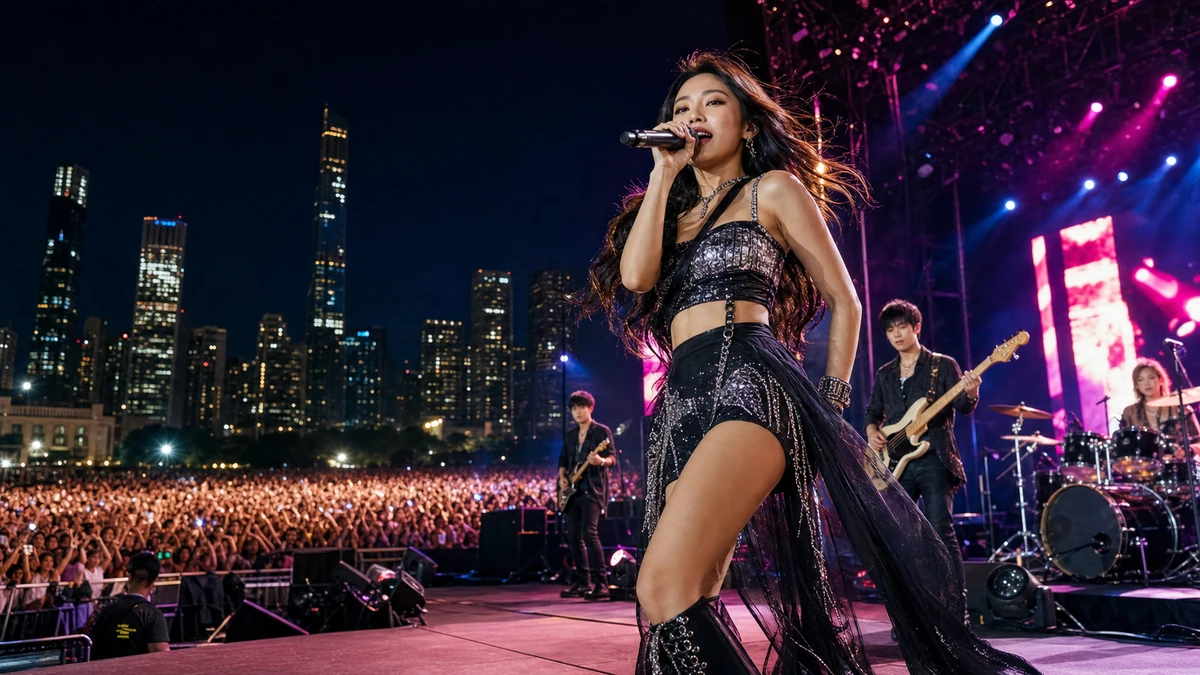
A K-pop star closes one of America’s biggest festivals
Jennie, the BLACKPINK member who has become one of the most recognizable faces in global pop, took a career-defining step in Chicago when she closed out the main stage at Lollapalooza with an 18-song solo set, a performance that underscored how far Korean pop music has moved from niche fascination to center-stage force in the United States.
According to her agency, OA Entertainment, Jennie performed for about an hour on Aug. 1 local time as the final act on Lollapalooza Chicago’s Bud Light stage, the festival’s marquee platform. Backed by a live band, she delivered the kind of full-length, carefully paced performance expected of a headliner, not the abbreviated guest appearance or crossover cameo that once defined many early K-pop festival bookings abroad.
That distinction matters. In the American festival ecosystem, headliner status is more than a billing line. It signals trust from organizers, a belief that the artist can command a massive, mixed audience at the most important time slot of the night. At an event like Lollapalooza, where fans move between multiple stages and where artists from different genres compete for attention, the closing main-stage slot is a test of staying power, cultural reach and performance control.
Jennie’s appearance also carried a milestone beyond her own celebrity. She became the first Korean female solo artist to headline Lollapalooza, placing her alongside internationally known names such as Charli XCX, Lorde and Olivia Dean on this year’s top line. For an American audience, that is the equivalent of moving from being a standout guest on a blockbuster soundtrack to being trusted to carry the final act of the movie itself.
The headline is not simply that a K-pop artist appeared at a major U.S. festival. That part is no longer unusual. The more consequential development is that Jennie was positioned as one of the artists responsible for defining the festival’s identity for the night. In other words, K-pop was not on the program as a specialty offering. It was the program.
Why headliner status means something different
To understand why this performance resonated so strongly, it helps to understand the hierarchy of major American music festivals. Lollapalooza, founded in 1991 and now one of North America’s largest festivals, is not simply a parade of famous acts. It is a sprawling live-music institution, with roughly 170 artists spread across eight stages and crowds that can top 400,000 over the course of the event. In that environment, being invited is one achievement. Being asked to headline is another entirely.
For many music fans in the United States, Lollapalooza occupies a place somewhere between Coachella’s pop-cultural spectacle and Bonnaroo’s marathon music immersion. It is a destination event with broad mainstream visibility, but it also remains a test of live credibility. Artists are expected not just to show up, but to own the space, win over casual listeners and justify why their performance should anchor a night in a city famous for live music.
The Bud Light stage, where Jennie performed, is especially symbolic. Over the years, versions of Lollapalooza’s main stage have hosted acts such as The Cure, Coldplay and The Weeknd — performers whose names are associated with arena-scale command and broad cross-demographic appeal. For Jennie to close that stage is to place her name in a lineage of artists who were asked to deliver not just a concert, but a festival-defining moment.
That is a notable shift in how K-pop artists are framed in the U.S. For years, Korean acts often arrived in American media narratives as curiosities, internet sensations or highly organized fan-driven phenomena. Even when they sold out arenas, the conversation frequently treated them as parallel to the U.S. mainstream rather than embedded within it. A headlining berth at a festival like Lollapalooza challenges that old framing. It suggests that an artist associated with K-pop can now be seen as central to the mainstream live-music conversation, not adjacent to it.
It also changes the audience equation. A solo arena concert is mostly filled with people who bought tickets specifically to see you. A festival headlining set includes that fan base, but it also includes casual attendees, genre tourists, curious onlookers and people waiting for the next stage transition. Winning that crowd requires a different skill set: pacing, charisma, musical adaptability and the ability to sustain energy over a long stretch. That is part of what made Jennie’s hour-long set significant.
More than a BLACKPINK member: the solo test
Jennie has long occupied a distinctive role in BLACKPINK, one of the most globally successful girl groups in pop music. For many listeners in the United States, BLACKPINK has served as a gateway into K-pop itself, thanks to the group’s Coachella appearances, chart success, fashion-world visibility and collaborations that helped bridge Korean and Western music markets. But group fame, however massive, does not automatically translate into solo headliner authority.
That is why this performance read as a meaningful test of artistic identity. In a group, star power is shared and multiplied; in a solo set, it is exposed. The artist alone must create momentum, shape the emotional arc of the show and keep a giant crowd engaged without the built-in chemistry of multiple members sharing the stage. In practical terms, that means song selection matters more, stagecraft matters more and the artist’s command of silence, transitions and crowd interaction matters more.
Jennie’s 18-song set list signaled that this was not a symbolic booking designed around a handful of viral moments. It was a full performance built to carry headliner expectations. Eighteen songs in about an hour is a brisk, demanding pace, especially in an outdoor festival setting where sound, heat, distance and audience movement can all work against intimacy. That scale suggests a show designed with flow in mind — peaks, resets, momentum and endurance — rather than a short spotlight package built around a couple of famous tracks.
The use of a live band is equally telling. K-pop is often associated in the U.S. with precision choreography, studio-polished production and tightly managed spectacle. Those qualities can be thrilling, but a large American festival often rewards something else, too: musical elasticity. A live band can enlarge the sound, deepen the groove and make songs feel more organic in a huge outdoor space. It also speaks to a different kind of performance confidence, one less dependent on exact replication of recorded material and more focused on making the music breathe in real time.
In that sense, Jennie’s set appears to have offered American audiences a version of K-pop performance that fits the festival format without abandoning the genre’s strengths. The polished visual identity remained important, but so did the dynamics of a band-driven show. It was a reminder that Korean pop’s global expansion is no longer just about export-ready hits. It is also about how those artists adapt to the rules of the world’s biggest live stages.
What this says about K-pop’s place in the United States
For more than a decade, K-pop’s rise in America has been measured through a familiar set of milestones: YouTube views, Billboard placements, sold-out tours, brand deals and first-of-their-kind achievements. Those markers mattered, especially in an industry where international acts have often struggled to receive equal attention from English-language media. But the next phase of globalization may look less like counting “firsts” and more like evaluating staying power in core institutions of the Western music business.
That is where a performance like this becomes especially revealing. Lollapalooza is not just a fan convention for one genre or one market. It is a mainstream U.S. festival with multiple competing sounds, from indie rock to rap to dance-pop. An artist who headlines there is not just speaking to a dedicated fandom. They are participating in a broader negotiation over what contemporary pop culture looks and sounds like in America.
Jennie’s set suggests that K-pop’s place in that conversation is becoming more secure and more complex. The genre’s presence is no longer defined solely by groups traveling as collective units. Instead, individual artists associated with K-pop can emerge as standalone live draws with their own performance language and audience command. That matters because it hints at a more durable ecosystem. If the genre can produce not only successful groups but also solo performers capable of holding major Western stages on their own, its influence becomes harder to dismiss as trend-driven or temporary.
There is also a gender dimension worth noting. The global music business has long created a narrow template for female pop stars: they must be commercially magnetic, visually compelling and somehow still prove, again and again, that they belong in spaces historically dominated by rock bands and male solo acts. For a Korean woman to close a major U.S. festival’s main stage speaks to both her own star power and the erosion of old assumptions about who gets to own those rooms — or, in this case, those fields.
For American readers less familiar with Korean entertainment culture, it is important to note that the road to a moment like this usually involves a highly demanding system of artist development. K-pop stars often train for years in singing, dance, media presentation and foreign-language communication before debuting. Critics of the system point to its pressures and rigid expectations, while supporters note the unusually high level of polish it can produce. Whatever one’s view, that background helps explain why performers like Jennie can move so fluidly between music, fashion, television and global branding while still meeting the physical and artistic demands of a set like this.
The symbolism of Chicago, and of closing the night
Chicago matters here, too. Lollapalooza is not just another concert stop; it is a civic event in one of America’s major cultural capitals. A performance in Chicago carries a different flavor than one in Los Angeles or New York, cities whose entertainment industries can sometimes blur the line between audience enthusiasm and industry self-congratulation. Chicago crowds have a reputation for responding to what works in front of them, not merely what arrives with hype.
Closing the main stage in that setting therefore carries a certain democratic symbolism. It means the artist is not being slotted into an early-evening novelty window or tucked into a side-stage experiment. They are being asked to deliver the festival’s final statement for the night. That is both a privilege and a burden. Audiences are tired, expectations are high and there is nowhere to hide if the pacing falters.
For Korean entertainment companies, which increasingly think globally from the outset, this kind of placement may become a new benchmark. The question is no longer whether a K-pop act can attract passionate fans in the United States. That has already been answered repeatedly. The question now is whether those artists can define the atmosphere of major Western events, carry mixed audiences for extended sets and be understood by organizers as anchors rather than additions.
Jennie’s performance points toward a yes. And while it would be easy to reduce the story to a record — first Korean female solo singer to headline Lollapalooza — the larger meaning lies in the type of work the booking required. She was not there simply to symbolize international diversity or capitalize on existing fandom energy. She was there to execute the responsibilities of a headliner, and by the available account, she did so through a long set, a live band and a performance structured to fill an hour at the center of one of America’s largest festivals.
That distinction may prove more important than any superlative. The music business is full of “firsts” that make headlines but do not change the underlying structure. What changes the structure is repeated evidence that artists from outside the traditional Anglo-American pipeline can headline, sell, sustain and shape the biggest stages. Every time that happens, the industry’s assumptions shift a little more.
What comes next for Jennie — and for K-pop festival strategy
The obvious implication of this set is that Jennie’s solo career has entered a new level of legitimacy in the global live market. For an artist already known in fashion circles, on social media and through one of the world’s biggest pop groups, festival headliner status adds another dimension: it frames her not just as a celebrity or brand magnet, but as a self-sufficient live performer capable of carrying a premium slot.
That can affect everything from future festival bookings to touring strategy to the way Western media covers her work. American entertainment coverage has often struggled to discuss K-pop artists as musicians without filtering them through fandom metrics or style narratives. A strong headlining performance creates a different journalistic frame. It invites critics and general-interest outlets alike to ask not just how large the fan base is, but what kind of performer stands at the center of it.
For K-pop more broadly, the lesson may be that global expansion is entering a more mature stage. Early breakthroughs often relied on shock value for Western audiences: the scale of online fandom, the synchronized performance style, the intensity of fan organization. Those elements still matter, but they are no longer enough on their own. As the genre becomes more normalized in the United States, its artists are increasingly judged by the same standards applied to other festival headliners: Can they build a set? Can they hold attention? Can they sound expansive outdoors? Can they turn recognition into command?
Jennie’s Lollapalooza appearance appears to answer those questions in a way that goes beyond symbolic inclusion. It suggests that the future of K-pop in America may depend less on simply getting invited into major spaces and more on demonstrating how effectively its stars can lead them. That is a subtle but major shift. Participation is one thing; authorship is another. A guest contributes to the atmosphere. A headliner defines it.
There is also something telling about the timing. As K-pop enters its second full decade of sustained relevance in the U.S. market, the conversation is moving past whether American listeners will accept Korean artists singing partly or mostly in Korean. Younger audiences, shaped by streaming culture and algorithm-driven discovery, are already more comfortable crossing language boundaries than earlier generations of radio listeners were. What matters increasingly is whether the artist can create a memorable event. Festival culture, with its emphasis on live impact over industry theory, is a natural place for that test to happen.
By closing out Lollapalooza’s main stage with an 18-song set backed by a live band, Jennie offered one of the clearest signs yet that K-pop’s relationship to the American mainstream is changing in substance, not just in optics. Her performance did not erase the importance of BLACKPINK in building the path that got her there. If anything, it showed how group success can evolve into individual authority. But it also made clear that she is now being asked to stand in spaces where the name on the marquee must carry the full weight of the night.
For American audiences, that is the real story. This was not simply a Korean star visiting a U.S. festival. It was a global pop artist taking responsibility for one of the most visible slots in American live music and turning that opportunity into a statement about where both her career and K-pop itself are headed. If the genre’s earlier chapter was about proving it could break into the room, moments like this suggest the next chapter is about deciding who gets to lead it.
Comments
Post a Comment