Image to help understand the article
A Korean thinker who asked what government is for
In the United States, the names most often associated with the Enlightenment and modern statecraft are people like Thomas Jefferson, Benjamin Franklin and Alexander Hamilton — men who wrote, argued, designed institutions and tried, however imperfectly, to connect ideas to public life. In Korea, one of the closest equivalents is Jeong Yak-yong, an 18th- and 19th-century scholar-official better known by his pen name, Dasan.
Born in 1762 and dead by 1836, Jeong lived during the late Joseon Dynasty, Korea’s last long-lived royal dynasty before the modern era. He was a civil servant, political thinker, prolific author, poet and reform-minded intellectual. But those titles do not fully capture why he still matters in South Korea today. Jeong is remembered not simply because he wrote elegant essays or passed difficult state exams. He is remembered because he tried to answer a question that still feels urgent in any democracy or bureaucracy: How should government actually improve ordinary people’s lives?
That question sat at the center of the Korean intellectual tradition known as silhak, often translated as “practical learning.” The phrase can sound dry in English, but the idea was anything but. Silhak scholars criticized empty formalism and argued that scholarship should address the real world — agriculture, taxation, administration, infrastructure, military systems, geography, medicine and the daily hardships of common people. In modern American terms, imagine a public intellectual who was at once part historian, part policy analyst, part engineer and part watchdog for rural communities.
Jeong became one of silhak’s most influential figures because he took that principle seriously. He did not see learning as something confined to elite debate, private virtue or literary accomplishment. He saw it as something that ought to shape bridges, fortresses, tax systems, local administration and public health. In a rigid monarchy defined by hierarchy, factional politics and strict social order, that was a consequential stance.
His life also carried a dramatic personal arc that helps explain his enduring appeal. He was born into a prestigious family with a deep tradition of scholarship and public service. He rose quickly through officialdom under a reform-minded king. He gained notice for his intellect and practical skill. And then, amid ideological suspicion and political upheaval, he faced investigation, demotion and exile. That combination — establishment pedigree, reformist energy and hard-earned moral authority — has made him one of Korea’s most studied historical figures.
Born where two rivers meet
Jeong was born in what is now Namyangju, east of Seoul, in an area known for Dumulmeori, the point where two rivers meet. The name literally means “head of two waters,” and the place remains one of the most picturesque landscapes in the greater Seoul region. The South Han River and North Han River converge there before flowing westward toward the capital area. For Korean readers, the location carries an almost symbolic charge: a meeting point of streams, regions and ideas.
Today, the area includes sites associated with Jeong’s life, including the location of his birthplace and a museum dedicated to silhak. That kind of historical preservation reflects the esteem in which he is held in South Korea. He is not a niche academic figure known only to specialists. He is part of the broader national story about how Korea understands reform, modernity and ethical government.
Jeong came from what the Korean summary describes as a “family of learning,” a lineage with generations of men who entered government service. In premodern Korea, this mattered enormously. Joseon society was shaped by Neo-Confucian values, and scholarly achievement was not just a private accomplishment; it was the main route to office, prestige and influence. Families built reputations over generations through mastery of the classics, success in state examinations and service in elite institutions.
Among those institutions was the Hongmungwan, or Office of Special Counselors, one of the most prestigious scholarly organs of the royal court. Service there signaled not just competence but intellectual distinction. Jeong took pride in his family’s long record of official service, seeing himself as heir to a household where scholarship was not ornamental but part of public duty.
Yet his early life was shaped by instability as much as privilege. The year he was born was also the year Crown Prince Sado died after being confined in a rice chest by order of his father, King Yeongjo — one of the most traumatic and infamous events in Korean royal history. The episode, still dramatized in Korean films and television, stands as a symbol of court brutality, dynastic anxiety and the dangerous volatility of factional politics. Jeong’s father, wary of the political world, reportedly stepped away from office and gave his son an early name that suggested returning to rural life rather than becoming consumed by status and factional struggle.
That tension — between public service and the moral danger of politics — would stay with Jeong for the rest of his life.
A self-taught prodigy shaped by books and hardship
Jeong did not follow the classic image of a young prodigy trained by one celebrated master. According to the Korean account, he learned largely through self-study and from his father while moving with him between official postings. That distinction matters because it helps explain Jeong’s intellectual temperament. He was deeply rooted in the Confucian scholarly tradition, but he was not merely reproducing a teacher’s orthodoxy. He developed through relentless reading, observation and independent synthesis.
Stories from his childhood reflect the almost mythic biographical style often attached to great scholars in East Asia. He is said to have learned basic Chinese characters at age 4 and written a poem called “The Sea” at age 7. Whether read literally or as part of the hagiographic tradition around famous thinkers, such anecdotes underscore how contemporaries and later admirers understood him: as someone marked early for intellectual distinction.
His childhood, however, was not untouched by suffering. He lost his mother at a young age and survived smallpox, one of the deadliest diseases of the premodern world. That experience would shape his later engagement with medicine. The summary notes that he was treated by a renowned physician of royal descent and that the memory of illness and recovery informed his later writings on measles treatment. This detail is revealing. Jeong did not compartmentalize knowledge. Personal experience became scholarship, and scholarship became practical guidance. In a society with limited medical infrastructure, a useful text on disease could quite literally save lives.
This practical orientation is one reason Jeong still resonates in modern Korea. He fits neatly into no single category. He was not just a philosopher in the abstract sense, nor merely a bureaucrat, nor only a literary figure. He moved across disciplines with a confidence that feels strikingly contemporary. In a 21st-century American frame, he might be described as the sort of thinker universities celebrate as “interdisciplinary,” except that for Jeong the point was not academic novelty. The point was social utility.
His intellectual development also brought him into contact with the lineage of Yi Ik, also known as Seongho, one of the most important earlier silhak thinkers. The Seongho school pushed scholarship toward concrete questions of reform and governance. Through family and scholarly networks, Jeong absorbed those ideas and eventually helped refine and extend them. If silhak was already a current within Korean thought, Jeong helped turn it into a more mature and influential vision.
From elite student to trusted official under King Jeongjo
Jeong’s rise came during the reign of King Jeongjo, one of the most intellectually ambitious and reform-minded rulers in Korean history. For many Koreans, Jeongjo occupies a role somewhat like a cross between an enlightened monarch and a political modernizer, though any comparison to Western figures can only go so far. His court became a center for scholarship, debate and selective reform, and Jeong flourished in that environment.
After marrying in his teens and spending more time in Seoul, Jeong deepened his contact with leading scholarly circles. He passed successive stages of the state examination system, the grueling merit-based process that served as the principal gateway into the bureaucracy. In theory, that exam system rewarded learning and talent; in practice, it also reflected family advantage, social hierarchy and court politics. Still, success in the exams was the defining credential of elite Joseon society, roughly combining the prestige of admission to a top university, a clerkship and entry into a federal leadership track.
Jeong excelled. At the national academy, Seonggyungwan, he repeatedly ranked highly in examinations and won recognition from the king. In 1789, at age 27, he passed the higher civil service examination and formally entered official life. He then served in and around the Gyujanggak, the royal library and research institution that functioned as one of Jeongjo’s key engines of reform.
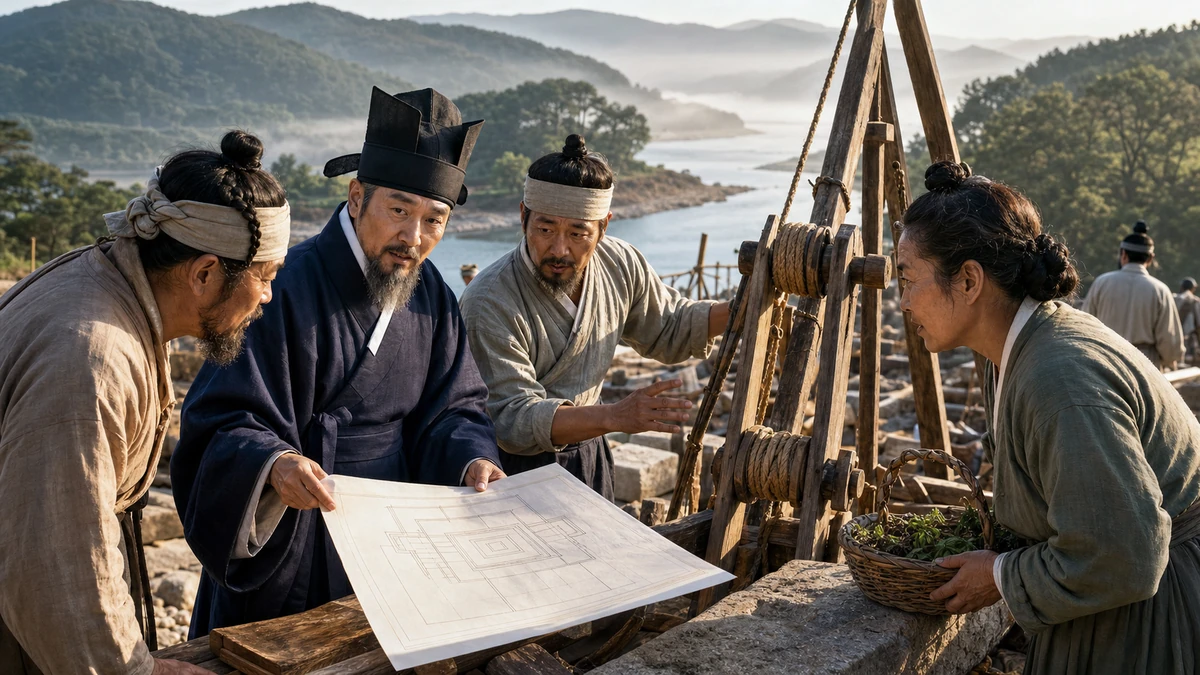
This is where Jeong’s career begins to look especially modern. He did not limit himself to writing memorials or interpreting classical texts. He helped with real-world state projects. The Korean summary notes that he participated in building a temporary bridge of boats and rafts across the Han River. He also took part in the design work associated with Hwaseong Fortress in Suwon, a UNESCO-listed site today and one of the best-known architectural achievements of the late Joseon era. There he was connected with the use of the geojunggi, a type of lifting device that helped move heavy materials more efficiently.
Those projects are not incidental footnotes. They illuminate the core of Jeong’s worldview. He treated administration, engineering and logistics as extensions of scholarship. To an American audience, that may sound obvious; public policy schools and engineering departments now often talk about applied knowledge in similar terms. But in Jeong’s time, the expectation that a scholar-official should also concern himself with the mechanics of transport, construction and efficient governance represented a meaningful push against more rigid notions of elite learning.
In other words, Jeong was not simply asking what a gentleman ought to know. He was asking what knowledge is for.
Listening to the people, not just ruling them
One of the most revealing episodes in Jeong’s career came through his service as an amhaengeosa, often translated as “royal secret inspector.” The office has become familiar to many modern Koreans through historical dramas, where disguised officials travel the countryside exposing corruption. The dramatized version can feel almost folkloric, but the role was real: inspectors were dispatched by the throne to quietly investigate abuses by local magistrates and report back.
That system existed because premodern states, like modern ones, often struggled to know what was happening outside the capital. Distance, patronage networks and information bottlenecks made local government especially vulnerable to misconduct. Jeong’s work in that role aligned naturally with his broader interests. He was concerned not only with orderly administration but with whether ordinary people were being squeezed by the officials who governed them.
Later, while serving as magistrate in Goksan, he encountered a tax protest led by an agricultural laborer named Yi Gye-sim, according to the Korean summary. The man reportedly presented more than 10 grievances describing how state demands threatened common people’s survival. Jeong did not simply punish him for insolence. Instead, he is said to have praised the courage of someone who spoke out against corruption and injustice.
That response is worth lingering on. In a stratified monarchy, a laborer challenging the system could easily be treated as a criminal or a threat to order. Jeong instead seems to have treated the complaint as evidence that government itself had failed in its purpose. That does not make him a democrat in the modern American sense; he remained a product of hierarchical Confucian statecraft. But it does place him in a reform tradition that insisted rulers and officials had moral obligations to the governed beyond mere control and tax collection.
For American readers, the closest analogy may be the best of the Progressive Era belief that government should be evaluated by whether it curbs abuse, serves the public and responds to conditions on the ground. Jeong’s outlook also anticipated a principle that modern policymakers now express in different language: people closest to a problem often understand it best.
That concern for public welfare helps explain why Jeong remains attractive across ideological lines in contemporary Korea. Conservatives can admire his seriousness, moral discipline and command of classical learning. Reformers can claim his concern for structural change and public accountability. Educators see a model of integrated knowledge. Public officials see a patron saint of ethical administration. He belongs to many narratives because his work touched so many parts of civic life.
Faith, faction and the cost of reform
Jeong’s life cannot be understood without the ideological tensions of late Joseon. The period was defined not only by debates over governance but also by factional conflict and growing interest in “Western Learning,” a Korean term that often included exposure to Western science, philosophy and Catholic thought. For some Korean intellectuals, such contact opened new ways of thinking about the cosmos, ethics and knowledge. For the court establishment, it could also look dangerous.
The summary indicates that Jeong moved within circles where Catholic ideas and Western scholarship circulated. That is significant because late 18th-century Korean Catholicism did not begin as a missionary-led mass conversion movement in the way many Americans might imagine Christianity spreading overseas. Instead, it initially grew through Korean scholars reading imported texts, discussing doctrine and exploring new intellectual frameworks. It was, at first, in part a bookish movement.
But what began as an intellectual encounter became politically explosive. Catholicism challenged core elements of the Joseon order, including the ritual system surrounding ancestor veneration, which was central not only to family life but to the moral and social architecture of Confucian society. Court authorities increasingly treated the faith as subversive. Waves of persecution followed.
Jeong was repeatedly entangled in those storms, whether through direct suspicion, association or factional attack. Even when briefly released or restored, he remained vulnerable in a political culture where reputation could be weaponized. The death of King Jeongjo in 1800 sharply changed the balance of power. Without the monarch who had recognized and protected him, Jeong’s position became far more precarious.
This pattern is familiar to students of reform across eras and nations. A talented official thrives under a patron committed to change, only to find that institutions are less flexible than the ruler seemed to be. Once court winds shift, the reformer becomes exposed. In Jeong’s case, that exposure would shape the rest of his life and ultimately deepen his legacy.
Why Jeong Yak-yong still matters in Korea — and beyond
Jeong’s long-term significance lies not only in the offices he held or the adversities he faced, but in the body of thought he left behind. He is remembered as one of the great system-builders of Korean intellectual history, someone who tried to connect moral philosophy to administrative design. That may sound abstract, but in practical terms it meant asking how laws should work, how officials should behave, how taxes should be structured, how local governance should be supervised and how knowledge should serve human needs.
For modern South Korea, which transformed itself within a century from a colonized and war-ravaged society into one of the world’s leading economies and democracies, Jeong offers a usable historical ancestor. He provides evidence that the Korean reform tradition did not begin only with 19th- or 20th-century encounters with the West. It also had indigenous roots — rigorous, critical and deeply concerned with lived reality.
That point matters because discussions of East Asian modernity are still too often framed as stories of passive reception: Western ideas arrive, Asian societies adapt. Jeong complicates that narrative. He shows that Korean thinkers were already wrestling, in their own language and traditions, with problems Americans would recognize immediately: bureaucratic inefficiency, abuse of office, regressive taxation, public works, social welfare and the gap between official ideals and daily life.
He also matters because he embodied an alternative ideal of elite education. In many countries today, including the United States, there is an increasingly familiar debate over whether academic institutions produce people who can actually solve public problems. Jeong’s life offers one answer from two centuries ago. Learning, in his view, should not be severed from reality. It should illuminate roads, granaries, courts, hospitals and village life. It should help a state govern more justly.
That does not mean he was a modern liberal hero in contemporary terms. He lived in a monarchy, accepted hierarchy and operated within assumptions very different from those of modern democratic citizenship. But historical importance does not require ideological sameness. It requires intellectual force and lasting relevance. By that standard, Jeong remains a giant.
Travelers to the Han River confluence where he was born can still visit the landscape that shaped his beginnings. Students still read his work. Museums still present him as a bridge between scholarship and reform. And in a country where public debates over fairness, merit, bureaucracy and social duty remain deeply alive, Jeong Yak-yong continues to speak with unusual clarity.
His message, stripped to its essentials, was simple enough to survive centuries: Ideas matter only if they can meet the people where they live.
Comments
Post a Comment