Netflix’s Korean Hits Hold Steady at Home as New Global Titles Surge, Highlighting a Split in Streaming Momentum
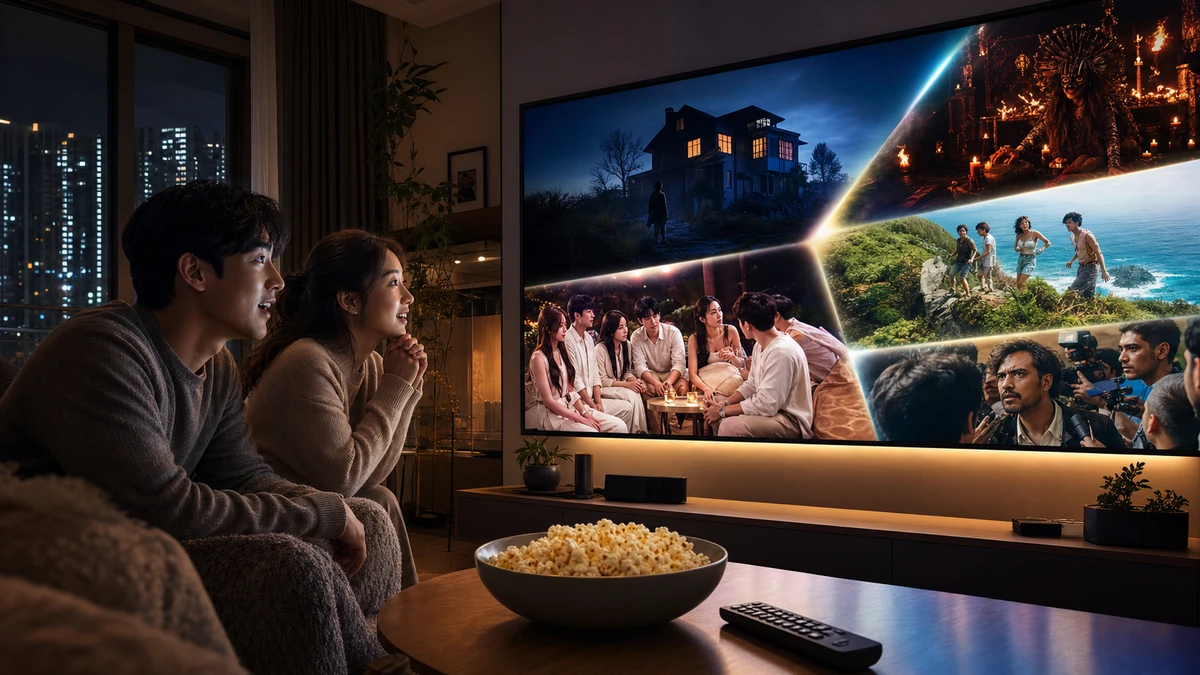
Image to help understand the article
A tale of two Netflix charts
Netflix’s latest weekly rankings offered a revealing snapshot of how streaming works in 2026: what lasts in one market is not always what breaks out worldwide. In South Korea, the platform’s top slots were dominated by familiar titles that have already spent multiple weeks near the top. The Korean film chart was led again by “The Last House,” while the Korean TV chart was topped by “I Am Solo” Part 33, extending a run that suggests viewers are sticking with established favorites rather than jumping immediately to every new release.
Globally, however, the mood looked different. New arrivals made a far more explosive first impression. The non-English TV chart was led by “Blood Sacrifice” in its debut week, the English TV chart was topped by “Outer Banks” right away, and the non-English film chart saw “Facing El Chapo” open at No. 1 with 18 million views. That contrast — durable incumbents in Korea, fast-opening newcomers worldwide — is more than a quirky one-week anomaly. It points to a broader split in how audiences consume streaming entertainment depending on local habits, franchise familiarity, release strategy and the sheer scale of global platform marketing.
For American readers, this is the kind of data point that helps explain why Netflix’s international business increasingly can’t be understood through a Hollywood lens alone. In the United States, the conversation around streaming often centers on splashy openings, opening-weekend equivalents and social media buzz. But the Korean rankings this week suggest a different kind of success: sustained loyalty, repeat discovery and long-tail viewing. That distinction matters not only for Korean content producers, but also for U.S. studios, streamers and advertisers trying to understand where the next big audience behaviors are coming from.
South Korea has become one of Netflix’s most closely watched content laboratories. The country is small compared with the United States in population, but oversized in cultural influence. K-dramas, Korean unscripted TV, Korean films and K-pop have become part of the mainstream entertainment diet for many Americans, especially younger viewers who move comfortably between subtitles, dubbed versions and social media fandom. When Korean charts show audiences rewarding staying power over novelty, it raises a useful question for the broader streaming industry: Is the future about instant worldwide hits, or about titles that can keep people watching for weeks?
This week’s answer appears to be both — depending on where you look.
Why Korean viewers are rewarding staying power
In South Korea, “The Last House” held the No. 1 film spot after three weeks on the chart, and the rest of the upper tier looked similarly stable. “Wild Sing” and “Demon Slayer: Kimetsu no Yaiba Infinity Castle I” each remained high after four weeks, while “Spider-Man: Homecoming” and “Spider-Man: Far from Home” kept their places after even longer runs. That kind of persistence suggests a chart shaped less by one-time launch excitement than by a broad and steady audience base.
The Korean TV side showed the same pattern. “I Am Solo” Part 33 stayed at No. 1 for a third week, with “Our Sticky Love” at No. 2 and “The Apartment Job” and “Spooky in Love” also holding firm after long runs. New shows did enter the rankings, including “Take a Hike!,” “Your Honor” and “My AI Partner: Strange Love,” but they did not immediately dislodge the top four. Instead, they landed lower in the Top 10, suggesting a market where word-of-mouth and habitual viewing still matter more than the instant churn that often defines global streaming culture.
That is especially notable in a country with one of the world’s most digitally connected populations. South Korea is often caricatured abroad as a place of relentless trend cycles, overnight fandom and hyper-accelerated online culture. There is some truth to that image. But these rankings show another side of Korean viewing behavior: audiences can also be highly loyal and methodical, sustaining programs over multiple weeks once they have entered the mainstream conversation.
“I Am Solo” is a useful example. For Americans unfamiliar with the format, it belongs to a South Korean reality and dating-show tradition that differs in tone from many U.S. counterparts. Rather than leaning entirely on spectacle, confrontation or lavish dating environments, many Korean unscripted romance programs build devoted followings by emphasizing emotional awkwardness, social observation and ongoing investment in the participants. In that sense, the show’s staying power is not unlike the way some American audiences keep returning to franchises like “Love Is Blind” or “The Bachelor,” even as those formats evolve. What differs is the specific social texture: Korean dating shows often become conversation starters about gender expectations, marriage pressure and changing family norms in a fast-modernizing society.
That deeper social resonance can help a series linger on the chart. The same is true for dramas with established fan communities, and even for imported U.S. studio titles such as the “Spider-Man” films, which continue to find second and third lives on streaming long after their theatrical releases. In other words, Korean viewers this week appeared to reward familiarity, comfort and accumulated buzz. New titles still mattered — they just did not dominate.
Global Netflix still runs on the power of the launch
The global rankings told a more familiar streaming story, one closer to the logic U.S. audiences already know well. Debuts hit hard. “Blood Sacrifice” opened atop the global non-English TV chart with 7 million views, while “Outer Banks” claimed the top spot on the English-language side with 9.4 million. On the film side, “Facing El Chapo” debuted at No. 1 in non-English film with 18 million views. These are the kinds of launches that reflect Netflix’s strongest platform advantage: the ability to turn a fresh title into an immediate multinational event.
That launch-driven model has become one of the defining features of global streaming. A title can be propelled by a combination of homepage placement, push notifications, algorithmic recommendations, dubbed and subtitled availability, social clips and a conversation that spills across TikTok, YouTube, Instagram and fan forums in multiple languages at once. A first week is no longer just a first week in one country; it is a synchronized international test of relevance.
But the numbers in the Korean-related titles also add nuance. “Our Sticky Love,” which ranked No. 2 in Korea, also reached No. 2 on the global non-English TV chart, drawing 3.7 million views and 43.3 million hours watched. Its total views were lower than “Blood Sacrifice,” but its watch time was significantly higher. That suggests a different audience pattern — perhaps a longer running time, perhaps stronger completion, perhaps viewers willing to spend more time with each episode. Meanwhile, “Spooky in Love” also showed parallel durability, ranking fourth in both Korea and the global non-English TV chart.
For Netflix executives and competitors alike, that split between launch power and endurance is not just an academic distinction. It affects marketing budgets, renewal decisions, release calendars and even how success is communicated to Wall Street. A flashy opening grabs headlines. A steady multiweek performer may be more valuable in keeping subscribers engaged over time. Hollywood has long obsessed over opening weekends, but the streaming era increasingly rewards a second metric too: how long a title remains part of the conversation after the opening push fades.
This week’s rankings suggest Netflix has room for both kinds of wins. The global chart is still a machine for instant breakout titles. The Korean chart, by contrast, shows the value of deeper audience attachment.
What this means in the United States
For the United States, the implications go beyond curiosity about what South Koreans are watching. Korea has become one of the most influential exporters of entertainment in the streaming age, and American companies are now tightly bound to that success. Netflix has invested heavily in Korean content. U.S.-based talent agencies, distributors and consumer brands increasingly view Korea not as a niche foreign market, but as a central engine of global pop culture. American viewers have embraced Korean dramas, Korean variety formats and Korean films to a degree that would have seemed improbable a decade ago outside cinephile circles.
That makes this week’s chart divergence especially meaningful for the American market. One lesson is that not every success has to look like a U.S.-style blockbuster. In Hollywood, there is a strong instinct to define victory by immediate scale: the biggest debut, the most talked-about premiere, the series everyone binges in one weekend. The Korean chart argues for a broader definition. A title that holds the top slot for three weeks or keeps multiple older entries circulating in the Top 10 may be building something more durable than a short burst of attention.
That matters for American streamers because they are under growing pressure to retain subscribers, not just attract them. A sticky library — one that gives viewers reasons to return week after week — may be just as important as a giant new launch. Korean content has repeatedly shown an ability to serve both functions in the U.S. market. Some titles break out explosively. Others accumulate audiences more quietly through recommendations, fandom communities and word-of-mouth among viewers who are increasingly comfortable crossing language barriers.
There is also a business lesson here for U.S. media companies. Korea’s entertainment ecosystem has become highly effective at producing formats and genres that travel. Romance dramas, workplace dramas, thrillers and unscripted dating shows can all find overseas viewers if packaged well. American studios have often looked to Korea for remake rights or adaptation ideas, just as they once looked heavily to Britain, Scandinavia or Japan. The continued resilience of Korean chart-toppers at home suggests that local authenticity remains part of the export strength. In other words, the goal is not necessarily to make Korean shows more American, but to make them compelling enough in their original form that Americans come to them.
That shift is already visible in U.S. viewing habits. Subtitled television is no longer seen as a fringe preference. Younger audiences in particular are willing to treat Korean content the way earlier generations treated prestige cable dramas or British imports: as part of the mainstream cultural conversation. If this trend continues, American companies will have to think differently about development, acquisition and marketing. They are no longer just competing with domestic studios. They are competing with the best global content, released on the same day into the same app.
And for U.S.-Korea relations more broadly, entertainment remains one of the soft-power success stories that often advances more smoothly than politics. Security ties between Washington and Seoul may dominate official diplomacy, but culture has become one of the most visible everyday connections between the two countries. When Americans watch Korean shows on Netflix, buy K-pop concert tickets or discuss Korean dating formats online, they are participating in a relationship that is increasingly commercial, cultural and mutual — not just strategic.
Korean content’s global footprint is getting more complicated
It would be easy to read the week’s data as a simple narrative of Korea holding steady at home while the world chases the newest thing. But the fuller picture is more complicated. Several Korean-linked titles still showed real global strength. “Our Sticky Love” and “Spooky in Love” both ranked prominently in the global non-English TV chart, while “The Apartment Job” also made the global list, even if at a lower rank than in Korea. On the film side, “The Last House” reached No. 2 in the global English-language film chart with 12 million views, showing that a title can be locally dominant and internationally competitive at the same time.
That kind of crossover reach is significant because it demonstrates how porous the categories have become. A Korean chart hit can remain primarily a domestic phenomenon. It can also become part of a broader global viewing wave. Sometimes it does both, though not always on the same timeline. This is increasingly common in the Korean Wave, or Hallyu — the term used to describe the international rise of South Korean popular culture. For Americans who know Hallyu mainly through K-pop groups or the global sensation of “Squid Game,” the current moment is less about a single breakout title and more about a mature pipeline of content that can travel in different ways.
Some shows become instant cross-border events. Others stay stronger in Asia than in North America. Some thrive in hours watched because audiences consume them deeply, even if the total number of viewers is smaller. That is why the distinction between views and watch time in Netflix reporting matters. A title with fewer viewers but longer engagement may indicate a more committed audience, the sort of audience that sustains fandom, spin-offs and future projects.
For the Korean industry, that means success can no longer be measured solely by whether a show becomes “the next” global sensation. The market is more diversified than that. A solid domestic run remains valuable. A reliable multi-market performer may be even more valuable. And a global No. 1 debut, while spectacular, is only one kind of achievement. This more layered picture is healthy for the industry because it reduces dependence on lightning-strike phenomena and increases the importance of catalog depth.
It also means international observers should resist oversimplifying Korea’s entertainment exports. Not every strong Korean result has to be framed as a race for total global domination. Sometimes the more important story is consistency, repeatability and audience segmentation — all signs of a market moving from trend status into structural importance.
What to watch next for Netflix, Korea and U.S. viewers
The immediate question is whether the Korean chart’s stability will hold. The lower half of the movie and TV Top 10s included several new entries, which means the rankings could still turn over quickly if one of those titles gains momentum. But the bigger issue is whether this week reflects a durable split in viewing behavior: Korea favoring established hits at home while the global chart keeps rewarding strong first-week launches.
If that pattern persists, Netflix may lean even harder into a two-track strategy. One track is the global event release, built for the largest possible opening. The other is sustained local programming that keeps audiences engaged over time and nourishes a market-specific viewing culture. That would be a smart approach in Korea, where local relevance matters and where viewers have shown they will continue supporting a title beyond its launch week.
American audiences should pay attention because this is increasingly how streaming competition is being decided. The winners are not just the companies that can create the biggest premieres. They are the ones that can operate globally while still understanding local habits. Korea has become one of the clearest test cases for that model. Its viewers are sophisticated, vocal and trend-setting, but they also appear willing to reward consistency and emotional investment.
There is a parallel here to broader changes in American entertainment. Even in the United States, where franchise culture and opening-weekend thinking remain deeply entrenched, viewers are showing renewed interest in comfort watches, library rediscovery and slower-burn word-of-mouth hits. The return of older studio films to streaming charts, whether in Korea or the U.S., is not accidental. In an overcrowded content environment, familiarity has value. So does trust. Audiences gravitate toward what feels worth their limited time.
That may be the clearest lesson from this week’s Netflix rankings. South Korea and the global market are not moving in opposite directions so much as revealing two sides of the same streaming economy. One side rewards novelty, scale and immediate impact. The other rewards endurance, loyalty and repeat engagement. The most successful companies, and the most exportable content industries, will need to master both.
For Korea, that is a sign of maturity. For Netflix, it is a reminder that the platform’s biggest strength is not just launching hits, but managing many kinds of audience behavior at once. And for the United States, where entertainment companies are still recalibrating after years of streaming disruption, the message is straightforward: Korea is no longer just a source of occasional breakout content. It is one of the markets helping define what global television and film success now look like.
Comments
Post a Comment