North Korea’s Latest Hard-Line Message Shows How Far Washington and Pyongyang Still Are From a Real Deal
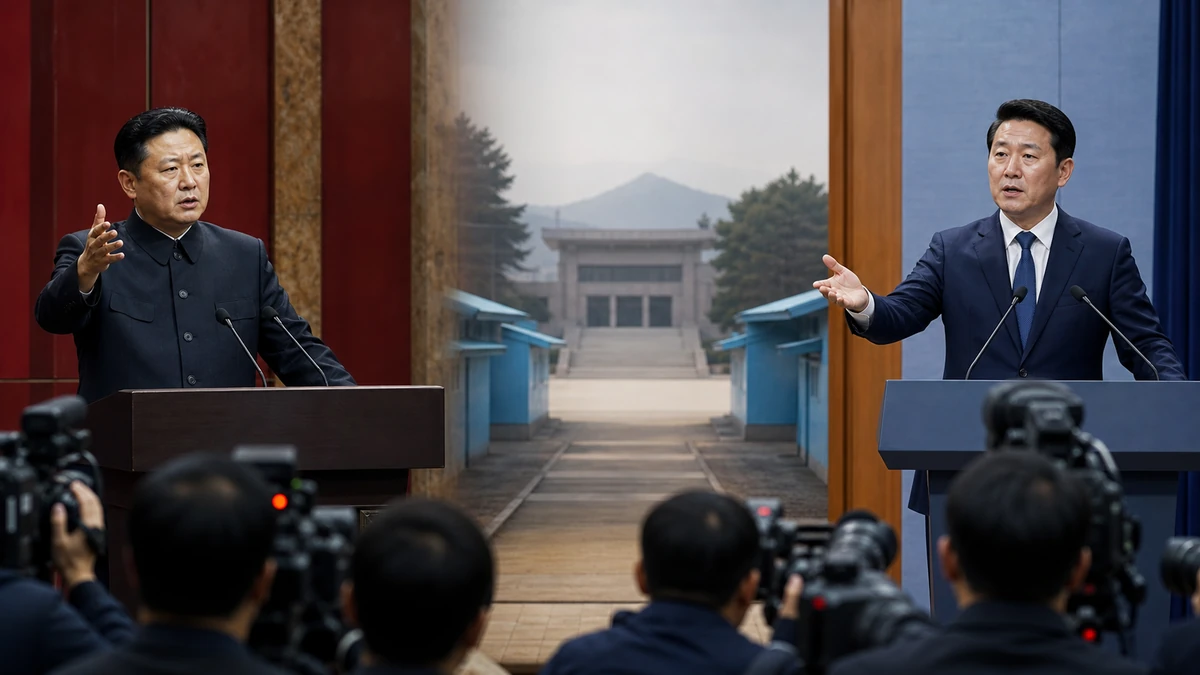
Image to help understand the article
North Korea’s message is less about one statement than the entire U.S. approach
North Korea’s latest declaration that there has been “not the slightest change” in its policy of responding to the United States with the toughest possible line is more than another burst of familiar rhetoric from Pyongyang. It is a reminder that, despite periodic talk of summit diplomacy and renewed engagement, the basic dispute at the center of the Korean Peninsula remains unresolved: Washington still says North Korea must give up its nuclear weapons, and North Korea now treats its nuclear status as permanent, nonnegotiable and tied to regime survival.
That standoff was thrown into sharper relief after North Korea’s Foreign Ministry said Aug. 31 that the United States continues to pursue a hostile policy. The statement pointed directly to Washington’s repeated commitment to the “complete denuclearization” of North Korea, as well as to growing security cooperation among the United States, South Korea and Japan. In effect, Pyongyang argued that U.S. words on denuclearization, pressure on human rights and allied military drills are not separate issues. They are, from North Korea’s perspective, parts of one larger strategy meant to weaken the state politically, militarily and ideologically.
That framing matters. For years, Americans have often heard the Korea issue in a simpler form: the United States wants North Korea to disarm, North Korea wants sanctions relief and security guarantees, and talks rise or fall on those points. What Pyongyang is signaling now is broader. It is saying the problem is not merely sanctions or one administration’s tone. It sees the entire structure of U.S. policy toward the North as unacceptable unless Washington changes the principles behind it.
South Korea, for its part, responded by urging North Korea to return to dialogue and by reaffirming that denuclearization of the Korean Peninsula remains the consistent goal of the international community, backed by multiple U.N. Security Council resolutions. Seoul also repeated its own vision of peaceful coexistence and shared growth, language meant to keep the door to diplomacy open even as tensions remain high.
Taken together, the exchange captures the unusual moment now taking shape on the peninsula as of Sept. 1, 2026: the United States continues to send signals that it is open to talks, North Korea is publicly hardening its conditions, and South Korea is trying to hold together deterrence and engagement at the same time. That is not a diplomatic breakthrough. But it is a useful map of where the next confrontation — or the next attempted negotiation — is likely to begin.
The real fault line is not tone, but the starting point for any future talks
The most important detail in North Korea’s latest statement is that it did not simply reject one American comment. It challenged the premise of U.S. policy itself. Pyongyang specifically objected to the State Department’s position that the United States remains committed to North Korea’s complete denuclearization and that there has been no change in U.S. policy. To American ears, that may sound like boilerplate, the sort of line administrations of both parties have repeated for decades. To North Korea, it is treated as evidence that Washington still refuses to accept what Pyongyang considers political reality.
North Korea has increasingly argued that its nuclear arsenal is not a bargaining chip but a constitutional and strategic fact. In recent years, that argument has become central to how the regime defines sovereignty and national security. In other words, Pyongyang is no longer merely demanding concessions before disarmament. It is questioning whether denuclearization should be on the table at all.
That creates a gap far wider than the one many Americans may remember from the diplomacy of 2018 and 2019, when meetings between President Donald Trump and North Korean leader Kim Jong Un briefly raised hopes that personal diplomacy might cut through decades of mistrust. Trump at the time took steps that were widely interpreted as conciliatory, including a softer approach to some joint military exercises with South Korea and a willingness to meet Kim directly. But North Korea’s latest position suggests that summit atmospherics were never enough to resolve the underlying dispute.
Pyongyang appears to be drawing a sharp distinction between a leader’s willingness to talk and a government’s official policy. From that perspective, even friendly gestures do not matter much if the United States continues to insist, formally and publicly, that North Korea must eventually give up its nuclear weapons. That helps explain why North Korea’s statement sounds less like a simple rejection of talks and more like an attempt to set the terms of any future talks before they begin.
For analysts, that is one reason this episode deserves attention. The language from Pyongyang suggests the North is not necessarily slamming every diplomatic door shut. It may instead be trying to redefine the agenda in advance, raising the price of reengagement and making clear that it wants recognition, or at least practical treatment, as a nuclear-armed state. That does not mean Washington or Seoul will accept that premise. It means the next round of diplomacy, if it comes, would likely be even more conceptually difficult than the last one.
Why military drills and trilateral ties matter so much to Pyongyang
North Korea also cited the upcoming “Freedom Edge 2026” multidomain exercise involving the United States, South Korea and Japan as proof that American policy has not changed in practice. That point is crucial because it shows how Pyongyang links diplomatic language to military behavior. In the North’s narrative, calls for denuclearization are reinforced by concrete security measures — allied drills, missile defense coordination, intelligence sharing and the broader tightening of trilateral cooperation among Washington, Seoul and Tokyo.
For American readers, it may help to compare this to how U.S. officials talk about “integrated deterrence,” the idea that alliances, joint operations and coordinated capabilities across multiple domains send a stronger signal than any one country acting alone. That framework has become increasingly important in U.S. strategy not only in Northeast Asia but also in Europe and the Indo-Pacific more broadly. The Freedom Edge exercise fits that logic: It is not simply about one training event but about demonstrating that U.S. allies are operating more closely together.
North Korea, unsurprisingly, sees the same development through the opposite lens. Rather than viewing trilateral cooperation as defensive stabilization, it treats it as encirclement. That perception is intensified by the history of the region. Relations among South Korea, Japan and the United States are never only about current security threats; they are also shaped by the unresolved legacies of Japanese colonial rule, the Korean War and decades of Cold War confrontation. When Washington, Seoul and Tokyo align more tightly, Pyongyang often uses that as evidence that pressure on the regime is becoming more systematic.
That does not mean North Korea’s interpretation is accepted internationally. South Korea and the United States have long argued that joint drills are lawful, defensive and necessary in the face of the North’s advancing weapons programs. But the practical point remains: from Pyongyang’s standpoint, military exercises are not background noise. They are central proof for its claim that the United States is hostile regardless of diplomatic messaging.
This is one reason rhetorical tensions can persist even when no missile launch, summit or major crisis dominates headlines. The military calendar itself shapes the diplomatic climate. So do alliance meetings, defense agreements and regional coordination efforts. If North Korea is signaling that these measures are inseparable from nuclear negotiations, then any future dialogue will likely have to contend not only with warheads and sanctions but with the broader architecture of U.S. alliances in Asia.
South Korea is trying to do two things at once — and that balancing act is getting harder
Seoul’s response underscores the complexity of South Korea’s position. The government reaffirmed the international goal of denuclearization while also urging North Korea to return to talks and stressing a vision of peaceful coexistence. That might sound contradictory to outside observers, but for South Korea it is standard and necessary statecraft. Seoul has to preserve deterrence with the United States while also keeping alive the possibility of inter-Korean or U.S.-North Korea diplomacy. It is both a frontline ally and, potentially, a diplomatic bridge.
This dual role is often underappreciated in the United States. Americans sometimes see Korea policy through the prism of Washington-Pyongyang relations, especially when U.S. presidents become personally involved. But for South Korea, the stakes are more immediate and existential. Any military escalation would unfold on or near its territory, under the shadow of a heavily armed border that remains one of the most fortified in the world. At the same time, South Korean governments have long known that there is no purely military solution to the North Korea problem.
That is why Seoul’s response avoided matching Pyongyang’s rhetoric point for point. Instead, it placed denuclearization and dialogue side by side. This is not weakness or indecision so much as an attempt to prevent the diplomatic ground from collapsing entirely. South Korea wants to maintain the international norm against accepting North Korea’s nuclear program as legitimate while also avoiding a spiral in which military readiness becomes the only visible policy tool left.
The challenge is that this balancing act grows harder as North Korea becomes more explicit about rejecting the old negotiating framework. If Pyongyang insists that its nuclear status is irreversible, then Seoul faces a narrowing set of options: continue pressing for denuclearization even as the North refuses the premise, push for risk-reduction talks that fall short of disarmament, or try to sequence discussions in a way that lowers tensions without rewarding nuclear expansion. None of those paths is easy politically, either at home or in coordination with Washington and Tokyo.
Still, South Korea’s response matters because it signals continuity. Even amid sharper rhetoric from the North and tighter U.S.-Japan-South Korea security cooperation, Seoul is still trying to preserve room for diplomacy. Whether that room is realistic is another question. But for now, the South Korean government is making clear that deterrence and dialogue remain linked, not mutually exclusive.
What this means for the United States
For the United States, North Korea’s latest statement is a warning that the old gap between American policy language and North Korean expectations may be growing wider, not narrower. Washington has long treated complete denuclearization as the nonnegotiable end state. That position is rooted in U.S. nonproliferation policy, alliance credibility and the fear that accepting North Korea as a permanent nuclear power would encourage similar behavior elsewhere. No American administration wants to be seen as legitimizing the nuclear ambitions of a state that has repeatedly violated international resolutions.
But the U.S. policy challenge is that repeating the denuclearization formula does not make the objective more attainable. If Pyongyang now considers that very formula proof of hostility, American officials may face a strategic dilemma familiar from other hard diplomatic files: how to preserve a principle without making talks impossible before they start. In Washington terms, this resembles debates over whether adversaries should be engaged on arms control, crisis management and de-escalation even when there is little chance of solving the fundamental dispute quickly.
That has implications for U.S. allies, U.S. businesses and U.S. audiences. For American allies in Asia, especially South Korea and Japan, the credibility of U.S. extended deterrence — the promise that America’s military umbrella helps protect them — remains central. Any sign of policy drift can unsettle domestic politics in both countries. For U.S. companies, the stakes are less direct but still real. Heightened tensions on the Korean Peninsula can affect markets, supply chains, investor confidence and the wider security environment in Northeast Asia, a region deeply connected to American technology, manufacturing and trade.
There is also a public dimension. American attention to North Korea tends to surge during missile tests, summits or dramatic insults traded by leaders, then fade. But the deeper story is about whether the United States can still shape the terms of security in a region where deterrence, diplomacy and industrial competition increasingly overlap. South Korea is not just a treaty ally; it is a major economic and cultural partner. It is home to globally important chipmakers, battery manufacturers and entertainment companies that matter to American consumers and corporations alike. Stability on the peninsula is therefore not an abstract foreign-policy goal. It has practical consequences for sectors Americans interact with every day.
There is a useful U.S. comparison here: Americans understand that in conflicts from Eastern Europe to the Taiwan Strait, official language, military posture and alliance signaling are deeply interconnected. The Korean Peninsula works much the same way. What North Korea has done is make explicit that it sees those linkages, too. For Washington, the next test is whether it responds with more of the same, or whether it finds a way to pursue deterrence and openness to talks without assuming the old formulas will still produce movement.
This is part of a larger trend in Korean Peninsula diplomacy, not just a one-day flare-up
The broader significance of this moment is that it reflects a structural shift in how the North Korea issue is being argued. In earlier periods, the central question was often whether talks could resume. Now the question is increasingly what kind of talks would even be imaginable. If the United States insists on complete denuclearization as the starting principle, and North Korea insists its nuclear status is settled, then diplomacy risks becoming a conversation in which both sides use familiar words but mean fundamentally incompatible things.
That is why this episode should be read less as a passing exchange and more as a snapshot of the post-summit era. The optimism that once surrounded leader-level diplomacy has largely given way to something colder and more bureaucratic: statements about principles, exercises that reinforce alliance structures, and increasingly explicit efforts by North Korea to frame every U.S. move as part of a larger hostile design. Seoul, meanwhile, continues trying to keep a peace process alive rhetorically even as the space for one appears to shrink.
For international readers, and especially for Americans, one of the clearest lessons is that the Korean Peninsula remains a place where global and local politics collide. The issue is not only North Korea’s weapons. It is also the future of U.S. alliances in Asia, the role of Japan in regional security, the diplomatic room available to South Korea and the credibility of the international nonproliferation system. That is a heavy burden for any single crisis to carry, which is why even a statement from a foreign ministry can have implications far beyond its immediate wording.
What should observers watch next? First, whether the United States adjusts its public language at all, even subtly, in describing the purpose of future contact with North Korea. Second, whether allied military cooperation continues to expand in ways that further harden Pyongyang’s position. Third, whether South Korea can translate its call for peaceful coexistence into any concrete channel for dialogue, however limited. And fourth, whether North Korea’s hard line remains rhetorical or is paired with additional military or political steps that raise the stakes.
None of that points to an easy breakthrough. But it does suggest the peninsula is entering another complicated phase in which the argument is not just over concessions, but over reality itself. Washington says denuclearization is still the goal. Pyongyang says that goal is itself the problem. Seoul says peace still requires talking. For now, those three positions coexist uneasily, and the distance between them may be the most important fact in Northeast Asia.
Comments
Post a Comment