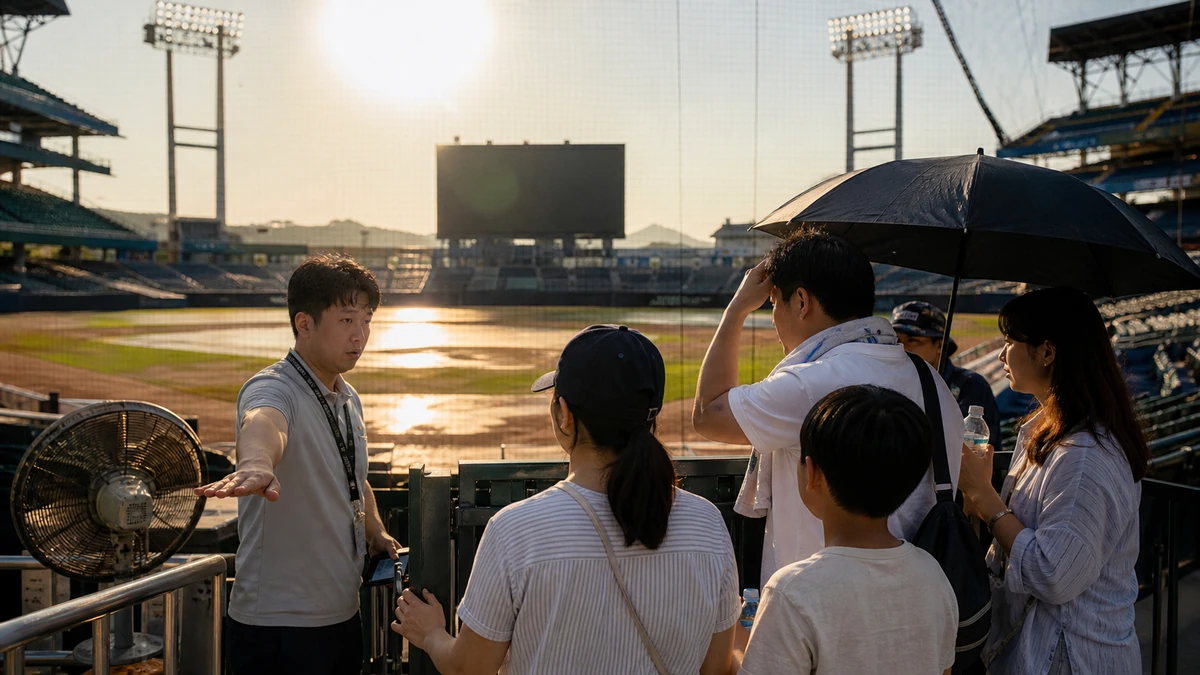
South Korea’s summer heat is now strong enough to stop baseball
In a country where summer baseball has long been part of the rhythm of daily life, South Korea’s latest heat wave is changing even the most familiar routines. A professional baseball game scheduled for 6 p.m. Saturday in Changwon, a major industrial city on the country’s southeastern coast, was canceled because of extreme heat, while another game in the port city of Busan was pushed back by 30 minutes. The moves may sound minor on paper, but together they offer a striking picture of how a punishing summer is beginning to reorder public life in South Korea.
The canceled game was between the KIA Tigers and the NC Dinos, two teams in the Korea Baseball Organization, or KBO, the country’s top professional league. According to South Korean media reports, the KBO called off the Changwon game after forecasts showed temperatures in the area were expected to remain above 100 degrees Fahrenheit, or about 38 degrees Celsius, even around game time. It was the second straight day that a game in Changwon had been scrubbed because of the heat.
On the same day, in Busan, the KBO took a more limited step, delaying the start of the game between the Samsung Lions and the Lotte Giants by 30 minutes rather than canceling it outright. The different responses in two cities underscore a broader reality of climate-era sports: there is no one-size-fits-all solution. Conditions vary by city, by time of day, by stadium design and by how much exposure players, staff and spectators face before a game even begins.
For American readers, the easiest comparison may be to weather disruptions that have increasingly affected sports from Little League to the major leagues in the United States. Just as NFL games are delayed for lightning or extreme storms, and just as youth leagues across the U.S. have adopted heat index rules to protect young athletes, South Korea’s baseball authorities are now treating extreme heat not simply as an inconvenience but as an operational hazard. The change matters because baseball in South Korea is not just a sporting event. It is a social outing, a family activity, a date-night destination and, in many cities, a defining part of local identity.
Saturday’s decisions suggest that in South Korea, the practical meaning of a heat wave is expanding. It is no longer only about uncomfortable commutes or higher electric bills. It is increasingly about whether a stadium can safely host thousands of people, whether outdoor tourist districts will empty out in the afternoon, and whether leisure itself must move indoors or later into the evening.
Why a baseball cancellation in Korea says more than a rainout ever did
Baseball occupies a distinctive place in South Korean culture. While soccer commands global attention and e-sports have a powerful following among younger audiences, KBO baseball remains one of the country’s most visible and communal spectator traditions. Games are known for organized cheering sections, fight songs, inflatable thundersticks and crowds that often treat the ballpark less like a quiet cathedral of sport and more like a festival. Fans do not simply watch. They sing, chant, eat and stay engaged for hours.
That atmosphere makes heat-related decisions especially consequential. In the United States, many sports fans are familiar with the discomfort of sitting through a sweltering afternoon game in places like Arlington, Texas, or Atlanta in August. But the Korean baseball experience can involve extended time outdoors before first pitch, from lining up to enter the stadium to traveling on public transit in the late afternoon heat to sitting in closely packed sections with limited shade. Even if the game itself starts after sunset, much of the exposure happens beforehand.
That helps explain why the KBO did not frame the Changwon cancellation solely around the players on the field. Reports indicated the league cited the health of both spectators and team personnel. That is an important detail. It reflects a broader understanding of risk, one that extends beyond the action between the foul lines to the entire chain of movement and waiting that makes live sports possible.
KBO rules already allow games to be canceled because of weather-related conditions including strong wind, extreme heat, fog, fine dust and yellow dust, the seasonal sand-laden air that can drift into Korea from the Asian continent. In other words, the league did not improvise a new policy on the spot. It acted within an existing framework that recognizes modern weather threats as serious enough to interrupt competition. But what feels new is the frequency and visibility of those choices.
A two-day run of heat cancellations in one city sends a stronger signal than a one-off decision. It suggests officials are no longer treating these episodes as rare anomalies. Instead, they are beginning to manage heat the way leagues once managed rain: as a condition that may force real schedule changes and demand flexibility from teams, fans and broadcasters.
Different cities, different decisions
The contrast between Changwon and Busan also reveals how South Korean officials are adapting in real time rather than relying on rigid rules. In Changwon, the forecast appears to have crossed a threshold where cancellation was considered the safer choice. In Busan, where conditions may have been somewhat less severe or expected to improve, a short delay was judged sufficient.
That kind of distinction matters. It shows that heat response is becoming more calibrated and situational. Rather than treating every hot day the same, organizers are weighing a mix of factors: not just the temperature at game time, but how long dangerous conditions will last, how quickly they may ease after sunset, and how much time people will still need to spend outdoors.
It is a reminder that extreme heat can be harder to manage than rain. A thunderstorm often moves through. Heat can linger for hours, especially in cities where concrete, traffic and dense development hold onto warmth late into the evening. A 30-minute delay does not sound like much, but in weather management terms it can mean the difference between staging an event at the peak of the day’s stored heat and waiting for at least a slight drop in temperature.
For Americans accustomed to debates over domed stadiums, retractable roofs and summer kickoff times in college football, South Korea’s choices will feel familiar in one sense. But Korea’s urban geography gives the issue a distinct shape. Many stadiums are deeply woven into city neighborhoods and accessible primarily by mass transit. Fans often arrive together in concentrated waves. The exposure is therefore collective and public, not just individual. A dangerous heat day becomes a city-management issue as much as a sports issue.
There is also a cultural dimension to schedule keeping in South Korea. Public events, transportation systems and group activities often operate with a high premium on punctuality and coordination. That makes even a 30-minute delay symbolically important. It signals that safety is beginning to outrank the expectation that planned events should proceed on time unless something dramatic, like heavy rain or a typhoon, makes that impossible.
This is bigger than baseball
The sports adjustments came as heat alerts were spreading well beyond the ballpark. In Seoul, the capital, authorities upgraded a heat advisory to a more serious heat warning in the city’s northwestern districts, placing the entire city under a heat warning status. Local officials responded by stepping up protections for vulnerable residents, including elderly people and those living in cramped, low-income housing often referred to in Korea as jjokbang, or tiny rooming units that can become dangerous in high heat.
Elsewhere, the heat was equally intense. In North Jeolla province, temperatures in several cities climbed well into the mid-90s Fahrenheit, part of a wider pattern affecting multiple regions at once. In the historic city of Gyeongju, famous for ancient tombs, temple heritage and outdoor walking districts, the daytime high reportedly reached 40.2 degrees Celsius, or more than 104 degrees Fahrenheit. Outdoor tourist areas that would typically be crowded thinned out, while the air-conditioned Gyeongju National Museum drew larger numbers of visitors.
Taken together, those snapshots tell a broader story about how daily life in South Korea is being reorganized around heat. The empty baseball diamond in Changwon, the delayed first pitch in Busan, the quieter outdoor tourism corridors in Gyeongju and the busier indoor attractions are all expressions of the same shift: people are not necessarily canceling leisure altogether, but they are moving it to safer places and safer hours.
That pattern will sound familiar to Americans living through longer and more intense summers at home. In cities across the U.S., families increasingly plan errands in the morning, youth sports begin after sunset, and public officials open cooling centers during dangerous heat spells. South Korea is seeing its own version of that adjustment, but compressed into a dense, highly urbanized society where public behavior can change quickly and visibly when weather alerts intensify.
The result is a subtle but important cultural transition. Summer in South Korea has traditionally been associated with packed festivals, night markets, baseball games, beach travel and sightseeing. Those habits are not disappearing. But they are being rearranged. The hottest hours of the day are becoming dead zones for outdoor activity, while air-conditioned museums, department stores, malls and indoor attractions gain new importance as refuges, not just conveniences.
How Korean summer culture is adjusting in real time
To understand why this story resonates beyond sports pages, it helps to appreciate how deeply weather shapes social patterns in South Korea. The country’s summers have always been hot and humid, and the monsoon season often adds another layer of discomfort. But extreme heat now appears to be changing not just what people do, but when and where they do it.
In many Korean cities, weekend leisure is highly structured. Families may head to a museum district, a shopping area, a baseball stadium or a well-known pedestrian zone with the expectation of spending several hours there. If extreme heat makes the journey itself feel dangerous, the entire outing can unravel. That is why weather alerts are increasingly becoming a central planning tool rather than a background detail.
The shift described by South Korean reports is especially visible in places like Gyeongju, often called a museum without walls because of its concentration of ancient sites from the Silla Kingdom. In normal summer conditions, its major attractions, including outdoor burial mounds and trendy walking streets, draw heavy foot traffic. But in triple-digit heat, history and aesthetics become secondary to air conditioning. The museum wins.
This does not mean public life comes to a halt. If anything, the adaptation is more creative than that. People move to indoor venues, wait until later in the day, or seek out nighttime activities. South Korea already has a robust evening culture, with shopping, dining and socializing often stretching late into the night. Heat waves may strengthen that tendency further, pushing more of summer life into after-dark hours.
Baseball is a perfect case study because it sits at the intersection of entertainment, civic identity and seasonal routine. When a game is canceled for heat, the message is visible and easy to grasp. But behind that message is a larger recalibration affecting tourism, transportation, retail and public health. One canceled game represents countless micro-decisions being made elsewhere: a parent deciding against an afternoon park visit, a tourist swapping an outdoor palace tour for an indoor exhibition, an older resident choosing to stay home until evening.
In that sense, the baseball cancellation in Changwon functions almost like a weather vane for society. It shows how a long-standing summer pastime can become a benchmark for what the season now demands. If even a baseball-first country in the middle of its season is willing to stop, delay or rework its schedule, it suggests the heat is not a passing discomfort. It is a structural fact shaping how cities operate.
What this means for Korean sports and for visitors watching the country change
There is an immediate practical question for South Korean sports organizers: how to make these decisions clearly and consistently as hot-weather disruptions become more common. Fans will want to know not only whether a game is canceled, but how far in advance those calls can be made, what benchmarks trigger a delay and how refunds, rescheduling and communication will be handled. Flexibility is useful, but flexibility without clarity can create confusion.
The KBO’s actions in Changwon and Busan suggest the league understands that a fixed approach may no longer work. Still, with fans traveling across cities and planning entire weekends around games, communication becomes part of safety management. If dangerous heat is expected well before first pitch, early notice can spare people from long, hot trips only to discover that plans have changed after arrival.
For international readers, particularly those interested in the Korean Wave, or Hallyu, this story offers a revealing window into contemporary South Korea beyond pop culture exports like K-dramas, K-pop and Oscar-winning films. It shows a country that is highly organized, intensely urban and deeply accustomed to shared public experiences now adapting those experiences to a harsher climate reality.
That matters because South Korea is often presented abroad through images of speed, efficiency and constant activity: crowded shopping districts in Seoul, festive baseball stadiums, bustling tourist sites and late-night restaurant scenes. Those images are still real. But increasingly, they coexist with a new rhythm in which climate conditions dictate when the city comes alive and which spaces remain usable in the hottest months.
Visitors to South Korea may notice this in practical ways. Afternoon outdoor plans can become unrealistic in high summer. Popular heritage areas may feel surprisingly quiet at midday. Museums, department stores and underground shopping corridors may be more crowded than expected. Evening becomes not just atmospheric, but strategic.
For sports leagues, the challenge is even sharper. Heat is unlike rain in one critical respect: it does not always announce itself with spectacle. There may be no dramatic clouds, no flooded field, no visible reason a game cannot begin. But when temperatures remain near or above 100 degrees, the danger is physiological and cumulative. It affects not only star athletes sprinting in uniform, but also stadium workers, older spectators, children and commuters standing on concrete platforms in the late afternoon sun.
That is why the canceled game in Changwon feels like more than a local sports brief. It is a marker of how climate pressure is filtering into the ordinary rituals that define summer. In South Korea, as in much of the world, people are not giving up those rituals entirely. They are editing them. They are shifting them indoors, pushing them later, shortening them, or, when necessary, calling them off.
The images from Saturday are easy to picture: an empty field in Changwon, a delayed start in Busan, quieter outdoor tourist routes in Gyeongju, fuller museum halls and a public increasingly planning around temperature the way previous generations planned around rain. For a country known for its fast-moving cities and highly choreographed public life, that may be the most notable change of all. Heat is no longer just part of summer in South Korea. It is becoming the force that sets the schedule.
Comments
Post a Comment