Seoul’s Fight Over Yongsan Park Is About More Than Housing. It’s a Test of How Korea Balances Growth, Memory and Green Space.
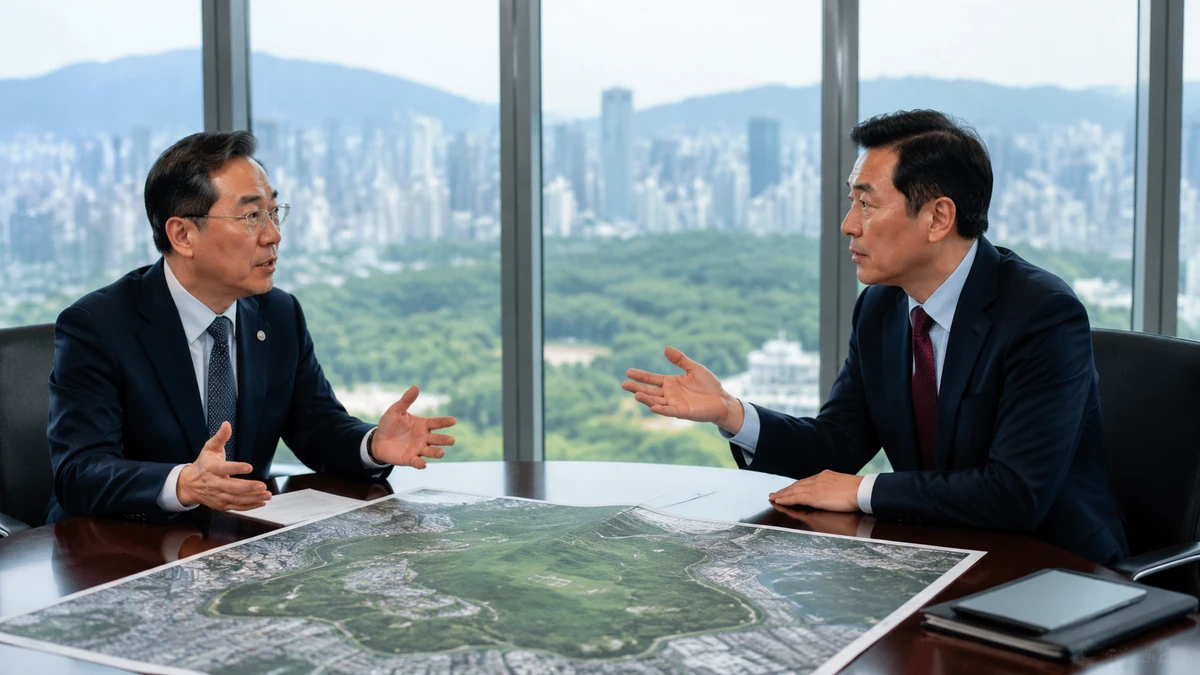
Image to help understand the article
A high-stakes land fight in the middle of Seoul
South Korea’s latest housing debate is unfolding on some of the most symbolically loaded land in the country: the area tied to Yongsan Park in central Seoul. In talks this week, Land Minister Kim Yoon-duk and Seoul Mayor Oh Se-hoon agreed on the basics of a problem familiar to residents of nearly every global city. Seoul needs more housing, especially for younger people, newly married couples and larger families. At the same time, the city wants to preserve scarce open space and protect the long-term identity of a major public park.
Where the two sides split is on a question that sounds technical but carries enormous political weight: exactly which parts of the Yongsan site can be used, and which must remain untouched as part of the park’s core. The national government has argued that some portions whose park or green-space function has already been damaged could be used for housing without abandoning the broader goal of park preservation. Seoul city officials have taken a firmer line, saying scattered parcels around the park may be reviewed, but the main body of the park should not be opened to residential development.
That disagreement matters because Yongsan is not just another redevelopment zone. It sits at the intersection of urban planning, national memory and social policy. The debate is not simply whether South Korea should build more homes. It is about whether a city that is under intense pressure to house its middle class and younger generations can do so without compromising one of its most important public spaces.
The meeting ended without a breakthrough, and both officials said they would continue discussions next week. That outcome may sound inconclusive, but it actually clarifies the real fault line. The shared principle is not in dispute: preserve the park, expand housing supply where possible. The unresolved issue is the boundary between preservation and use, and who gets to define it.
For readers outside Korea, this may resemble fights in major American cities over whether public land, underused government sites or former industrial tracts should be converted into housing. But Yongsan carries an added layer of national meaning that makes the politics even more sensitive.
Why Yongsan matters in South Korea
To understand why this dispute has become so charged, it helps to understand what Yongsan Park represents. The area has long occupied a central place in modern Korean history. For decades, the Yongsan site was associated with military use, including the former U.S. military garrison in Seoul. In South Korean public life, plans for Yongsan Park have often been discussed not just as an urban amenity, but as part of a larger project of reclaiming land, reshaping national space and creating a civic landmark in the heart of the capital.
That gives the word “preservation” unusual force here. In many cities, a park can be thought of mainly as a recreational asset or an environmental buffer. In Seoul, Yongsan Park has also been framed as a historic and symbolic landscape. For opponents of residential use in the park’s main section, building housing there is not merely a zoning choice. It risks changing the character of a place that many see as carrying national meaning beyond its market value.
At the same time, supporters of selective use are responding to another reality that is deeply felt in South Korea: the housing squeeze in Seoul. The capital region dominates the country economically and demographically. Jobs, education and opportunity are concentrated there, and housing costs have become a defining burden for younger Koreans. In that sense, the government’s argument is not hard to understand. If some parcels have already lost meaningful green or park function, why should they be treated as untouchable if they could help relieve pressure on households struggling to find homes in the city?
This is the tension at the center of the Yongsan debate. South Korea is trying to serve two public goods at once. One is housing access for groups that policymakers routinely identify as needing support: young adults, newlyweds and families with multiple children. The other is the preservation of a major civic asset in one of the densest and most expensive urban environments in the world.
Neither side is arguing against the existence of the other value. That is what makes the standoff more interesting than a typical pro-development versus anti-development clash. Both camps say housing matters. Both say the park matters. The disagreement is about which land can be reclassified without undermining the larger promise of the park itself.
This is really a debate over standards, not speed
One of the clearest takeaways from the latest talks is that the central issue is no longer whether housing should be supplied in Seoul, but what standards should govern where it goes. That may sound like bureaucratic nuance, yet it is often where the most consequential urban policy battles are decided.
The national government appears to be promoting a selective, parcel-by-parcel approach. Under that framework, land that is already degraded, fragmented or no longer functioning meaningfully as green space could be considered for housing while leaving the broader park concept intact. It is, in effect, an argument for managed compromise: preserve the whole idea of the park, but treat not every acre as equal if some parts are already compromised.
Seoul city government is drawing a clearer line. Its position suggests that once the main body of the park is opened to residential use, even partially, the logic of preservation begins to weaken. In that view, allowing housing inside the core is not just a limited adjustment; it changes what the park fundamentally is. That is why city officials appear more open to scattered adjacent parcels than to the principal site itself.
This difference in standards matters more than the pace of negotiations. Governments can meet again next week, next month or next quarter, but unless they agree on the categories of land involved, every subsequent discussion about housing targets, design, law changes or timeline will remain stuck. What counts as the “main body” of the park? What qualifies as a damaged parcel? Who determines whether a site’s green-space function has already been impaired? Are legal changes required, and if so, how much political appetite exists for them?
These are not side issues. They are the policy. In many housing fights, the public debate gets framed around urgency: build faster, act now, cut red tape. But the Yongsan case shows that speed can be secondary when the conflict is over definitions. Before South Korea decides how much housing could be created there, it first has to decide what kind of land Yongsan is.
That is why the most notable sign of movement from the meeting may be the narrow area of overlap: the two sides appear willing to review scattered parcels around the park. That does not resolve the central dispute, but it keeps negotiations alive and suggests a staged approach is possible. In practice, that could mean advancing projects in areas where conflict is lower while leaving the hardest question, the park core, for further negotiation.
What this says about South Korea’s housing model
The Yongsan dispute is also a window into a bigger shift in how South Korea is thinking about housing supply. For years, Seoul’s real estate debates have revolved around familiar tools: apartment construction, redevelopment, reconstruction and the release of new sites. But in a highly built-out capital, the easiest land has largely been spoken for. That pushes policymakers toward politically delicate spaces, including publicly owned or symbolically important land.
What makes this case especially revealing is the intended target for new housing. Officials have talked specifically about homes for young people, newlyweds and families with multiple children. That signals a policy rationale grounded less in abstract growth and more in social support. In other words, this is not being sold merely as another high-end redevelopment opportunity. It is tied to the state’s effort to address affordability, family formation and demographic strain.
That matters in South Korea, where low birth rates, delayed marriage and intergenerational inequality are major national concerns. Housing costs are often cited as one reason younger adults postpone marriage or parenthood. When policymakers mention newlyweds and larger families, they are not just naming a beneficiary group. They are tapping into one of the country’s deepest anxieties: whether younger generations can afford to build stable lives in the places where jobs and opportunity are concentrated.
Yet the Yongsan case also reveals the limits of using scarce central-city land to solve structural housing problems. Even if some parcels were opened, no single site is likely to transform the broader market. The symbolic stakes can easily exceed the numerical housing gain. That is one reason debates like this become so contentious. A relatively modest number of units may come at the cost of a much larger political and cultural fight over what a city values.
In that sense, Yongsan is less important as a one-off land dispute than as a test case. It asks whether South Korea can build a more layered urban policy, one that ranks land by function, symbolism, environmental value and housing need rather than treating development and preservation as binary opposites. If officials can establish credible standards here, those standards may influence future disputes elsewhere in Seoul. If they cannot, Yongsan may become a cautionary tale about how even shared goals can collapse without agreement on definitions.
What it means for the United States
For American readers, the Yongsan debate should feel strikingly familiar, even if the local history is different. The United States is wrestling with its own version of the same question: when housing shortages become severe, how far should cities go in repurposing public land, historic sites or open space? From California to New York, public officials have faced pressure to unlock land near transit, redevelop former government properties and increase density in expensive urban cores. The arguments are often the same as those now heard in Seoul: younger residents are priced out, family formation is getting harder, and cities cannot preserve affordability by protecting every parcel from change.
But there is also a counterargument that Americans know well. Once public space is lost, it rarely comes back. Parks, waterfronts and historically important sites tend to gain value over time, especially in dense cities where open land becomes increasingly scarce. That is why debates over Central Park-adjacent development in New York, waterfront access in Chicago or public land use in Los Angeles can become so emotional. The fight is not only about units and zoning. It is about whether leaders are sacrificing long-term civic value for short-term supply gains.
Yongsan adds another U.S. dimension because of the long American presence tied to the site’s history. Even without making the current dispute about Washington, the land’s connection to the former U.S. military garrison means American policymakers, urban historians and Korea watchers are likely to see this as more than a local planning issue. It touches a space shaped in part by the U.S.-Korea alliance and later reimagined by South Korea as a public asset.
The case also matters for American companies and investors who follow Korean real estate, infrastructure and urban policy. South Korea is a close treaty ally, a major economic partner and one of the world’s most watched urban markets. Decisions about land use in central Seoul can signal how the country intends to balance development pressure, environmental goals and public sentiment. That, in turn, can shape the climate for architecture, engineering, design and investment sectors that often operate across borders.
There is also a cultural angle for Americans who know South Korea mainly through K-pop, K-dramas and consumer brands. The global Korean Wave has made Seoul more legible to international audiences, but often through lifestyle imagery rather than policy realities. The Yongsan debate is a reminder that the capital behind those polished exports is dealing with the same urban contradictions found in San Francisco, Washington or Boston: too little affordable housing, too much pressure on prized land, and no easy consensus on how to reconcile growth with quality of life.
For U.S. readers, then, Yongsan is not just a Korean planning story. It is a mirror. It shows how another advanced, democratic and deeply urbanized society is trying to answer a question the United States has not solved either: how to build more homes without steadily hollowing out the public spaces and shared landmarks that make city life worth defending.
What to watch next in Seoul
The next round of talks will matter less for whether the two sides suddenly reach a grand bargain and more for whether they begin defining the categories that have kept this issue stuck. If there is progress, it is likely to come in incremental form. Officials may find a path forward on scattered parcels around the park before touching the most contested land. That would allow some movement on housing while avoiding an immediate showdown over the symbolic core of Yongsan Park.
Another point to watch is the legal question. The summary of the talks suggests that changing relevant laws is itself a live issue. In many land disputes, the politics become significantly harder once legal revisions are required, because lawmakers, civic groups and the broader public are drawn more directly into the process. If any proposal for residential use in part of Yongsan depends on statutory change, the debate is likely to widen beyond a negotiation between the land ministry and city hall.
Just as important is the language each side uses from here. If the national government continues emphasizing “damaged” or functionally compromised parcels, it will be trying to persuade the public that selective use is compatible with preservation. If Seoul continues stressing the sanctity of the park’s main body, it will be trying to establish a bright line that can rally public support against encroachment. The eventual outcome may depend as much on which framing resonates with voters as on any technical planning document.
In the longer run, the Yongsan dispute may help determine whether South Korea can develop a more trusted framework for balancing housing and public land. Trust is the scarce resource in many urban battles. Residents often suspect that small exceptions will become larger ones, while governments argue that inflexible rules make meaningful housing policy impossible. If Seoul and the central government can articulate transparent criteria for what land is protected, what land is eligible for limited use and why, the fight could produce a template for future decisions. If not, Yongsan may deepen public cynicism that every planning principle is negotiable under enough market pressure.
That is why this debate deserves attention beyond Korea. It captures a central policy dilemma of the 21st-century city: the same neighborhoods that are most desirable, best connected and richest in public meaning are often the places where housing demand is most intense. In Seoul, as in many American cities, leaders are discovering that the hard part is not choosing between growth and preservation in theory. It is deciding, parcel by parcel, how much of each a city can live with.
For now, the outcome remains uncertain. But the stakes are already clear. Yongsan has become more than a dispute over apartments in a park-adjacent area. It is a test of whether South Korea can turn a shared acknowledgment of two urgent needs, housing and public space, into rules that the public sees as legitimate. That is a challenge Seoul shares with some of America’s most powerful and most unequal cities. And it is one reason this local Korean fight has broader global relevance.
Comments
Post a Comment