Seoul’s Yongsan Park Debate Mirrors a Global Urban Dilemma — and Offers Lessons for the United States
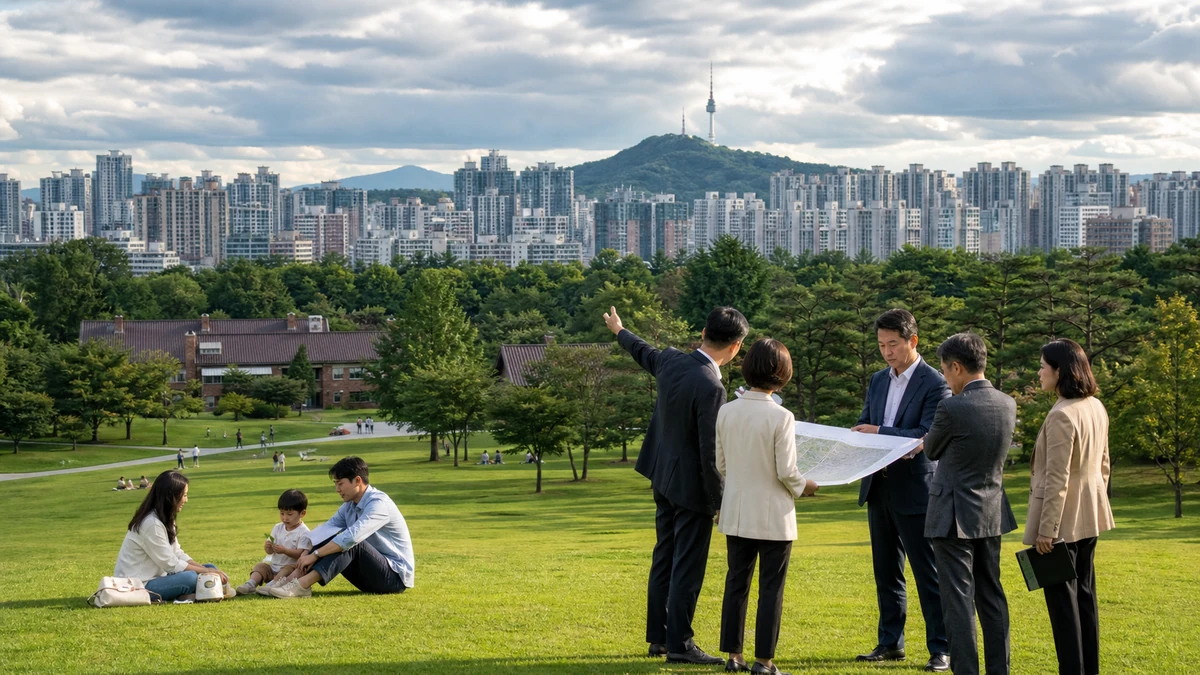
Image to help understand the article
A Fight Over One Park, and Over What a Global City Is For
South Korea is wrestling with a question that will sound familiar in Los Angeles, New York, Chicago and just about every other major American city: When land in the urban core is scarce and housing is expensive, should governments build more homes wherever they can — even on land many people see as irreplaceable public green space?
That debate has now converged on Yongsan Park, one of the most symbolically loaded pieces of land in Seoul. South Korea’s land ministry, according to local reporting, has said it is reviewing whether not only the Yongsan Children’s Garden but the broader Yongsan Park area could be considered for housing supply. Seoul city officials, by contrast, have pushed back, arguing the site should be preserved as a major urban green space for future generations.
At this stage, it is crucial to be precise about what has and has not happened. There is no finalized housing plan. No number of units has been announced. No housing type, development footprint or construction schedule has been publicly presented in the material summarized here. What exists now is a policy review on one side and an explicit preservation stance on the other. But even in this preliminary form, the disagreement matters well beyond one parcel of land, because it exposes a deeper argument about what Seoul should become.
In that sense, the Yongsan dispute is not just about whether apartments go up in one neighborhood. It is about the order of priorities in a dense, high-value metropolis: Should officials first ask where housing can be added and then determine what green space remains? Or should they first define which landscapes are off-limits because they serve a long-term public purpose that cannot easily be replaced elsewhere?
That tension is especially sharp in Seoul, one of the world’s most densely developed capitals, where land carries enormous economic pressure and public space has outsized civic importance. To American readers, the dispute may evoke the politics that surround urban waterfronts, former military bases, rail yards or old industrial land: places that seem to invite redevelopment because they are large and centrally located, but that also attract visions of parks, memorial landscapes and public commons.
Yongsan Park has become a test case because both sides are invoking public value. The national government is pointing to housing need in the city center, a familiar and powerful policy objective. Seoul city officials are pointing to the need to preserve a major urban green space, an equally powerful claim in an era of heat waves, density and public concern about quality of life. Neither argument can be dismissed as frivolous. The political difficulty comes from the fact that both speak to real urban needs.
Why Yongsan Matters More Than an Ordinary Development Site
Part of what makes this debate so consequential is that Yongsan Park is not being treated as just another vacant lot. In the Korean discussion, the site stands at the intersection of housing policy and city planning. When the land ministry says the wider park area should not be automatically excluded from housing review, it is signaling that no centrally located land should be taken off the table before supply options are examined. When Seoul city officials insist the park should be preserved, they are arguing that some places must be defined first by their civic and environmental role, not by their potential development yield.
That distinction may sound technical, but it reflects a major philosophical divide. One approach treats land in the city center as a finite resource that must be assessed for practical uses, especially housing. The other treats certain urban landscapes as assets whose public value grows precisely because they are not converted into conventional real estate. In practice, these two ways of seeing the same ground often collide in global cities.
For readers unfamiliar with Seoul, Yongsan is in the heart of the capital. That alone raises the stakes. Decisions about central districts shape not just local neighborhoods but the identity of the city itself. When an urban core becomes more residential, denser and more commercially integrated, that changes commuting patterns, family life, school demand, transit use and political expectations. When a major central site becomes or remains a park, it influences air quality, public recreation, resilience to heat and the symbolic image a city projects about what it values.
In South Korea’s framing, this is also a jurisdictional story. The Ministry of Land, Infrastructure and Transport is looking at national housing supply concerns. Seoul city government is emphasizing its role as steward of the capital’s urban environment. That split is not unusual in democratic systems. In the United States, Washington, state governments and city governments regularly clash over transportation corridors, public lands, environmental review and housing mandates. The institutions are different, but the pattern is recognizable: one level of government prioritizes macro supply or infrastructure goals, while another focuses on local land use character and long-horizon quality-of-life concerns.
The Korean reporting also underscores something important: the meaning of the word “use.” Reviewing “usable” land within a park area is not the same as announcing wholesale conversion of the park into housing. That may seem obvious, but it matters in public debate, where a broad review can quickly be interpreted as a settled development agenda. The current issue is not a fully designed project but a widening of the review boundary — from the children’s garden area to the park as a whole — and a clear refusal by Seoul city officials to accept that premise.
That leaves the debate at a foundational stage. Before unit counts, site plans or financing structures come the questions that are often harder to reverse: What kind of place is this? What purposes are legitimate here? And who gets to decide which value — shelter, access to nature, historical meaning, or some combination of them — should dominate?
Housing Pressure vs. Green Space: A Clash of Two Public Goods
The simplest way to misread the Yongsan dispute would be to frame it as housing versus scenery, as if one side were defending ordinary people and the other were defending a decorative amenity. That is not what the Korean debate, as summarized, suggests. Both sides are making public-interest arguments, and that is exactly why the case is so difficult.
The housing side rests on a logic familiar to policymakers from Seoul to San Francisco: if homes are needed, and if demand is strongest near jobs, transit and established infrastructure, then land in the urban core deserves careful consideration. Governments under pressure to address affordability are often reluctant to declare valuable central land permanently unavailable. Doing so can look like a luxury in a city where residents feel shut out of the housing market.
The green-space side rests on a different but equally contemporary logic. Large urban parks are not merely pleasant extras. They function as environmental infrastructure. They reduce heat, create breathing room in dense districts, improve mental health, offer public recreation regardless of income and shape how future generations experience the city. Once such land is substantially developed, it is extraordinarily difficult — and often impossible — to recreate the same civic asset elsewhere in the core.
Americans have watched versions of this debate play out for years. In some cities, vacant land has been recast as a moral imperative for housing production. In others, communities have fought to preserve open land against proposals that promise more units. The tension has only deepened as climate change has made urban tree cover, shade and open space more valuable, while affordability crises have made every central parcel look like a potential housing site.
Seoul’s argument is particularly revealing because it shows that the housing crisis and the climate-and-livability crisis are no longer separate policy lanes. They are competing on the same geography. A city can say it needs more homes. It can also say it needs more green space. In a land-constrained downtown, both statements can be true at once.
The Korean summary notes that neither side can easily discard the other’s concern. That is exactly right. Building homes is about making room for people to live in the city. Preserving a park is about shaping the environment in which those people live. One addresses quantity of urban life; the other addresses quality and long-term sustainability. The real policy challenge is not proving one value exists and the other does not. It is deciding what should happen when two legitimate public goods compete for the same finite ground.
That is why the next phase of the Yongsan discussion may be less about numbers than about principles. Before Seoul or the national government can persuasively argue for a particular outcome, they will need to make clear what assumptions come first. Is the park’s civic character the starting point, with only narrow exceptions considered afterward? Or is city-center housing supply the starting point, with park preservation negotiated around it? Those are not small procedural differences. They often determine the eventual answer.
What This Means for the United States
For American readers, the Yongsan debate offers more than an interesting foreign planning dispute. It is a useful lens on the same policy dilemmas now reshaping U.S. cities, where housing scarcity and environmental stress increasingly collide rather than operate in sequence.
The United States has spent years moving from a broad, bipartisan recognition that housing is too expensive in many metro areas to a more uncomfortable question: exactly where should new homes go? In theory, it is easy to support more supply. In practice, every urban parcel comes with trade-offs. Some are industrial lands with environmental cleanup issues. Some are parking lots tied to commercial activity. Some are low-rise neighborhoods whose residents fear displacement or loss of character. And some are open spaces or publicly held land that cities are deeply reluctant to give up.
That is why Yongsan may resonate with U.S. planners, developers, environmental groups and elected officials. The case distills a problem American cities know well: the most convenient land for solving one crisis may be the same land people want to preserve to solve another.
There is also a broader U.S.-Korea dimension. South Korea is one of America’s closest allies, and Seoul’s trajectory matters to Americans not only strategically but commercially and culturally. U.S. investors, architecture firms, engineering companies, climate-tech businesses and urban policy circles all pay attention to how major Asian cities balance density, livability and redevelopment. Seoul has long been studied in the United States for transit, digital infrastructure and high-density urban management. What happens at Yongsan will be watched as part of that larger conversation.
American audiences may also see a familiar pattern in the tug-of-war between central and local authorities. In California, for example, state leaders have increasingly pushed cities to allow more housing, sometimes over local resistance. In New York and Massachusetts, debates over zoning reform, public land and transit-oriented development carry similar themes. Local governments often argue that they understand neighborhood impacts better; higher levels of government argue that local veto points have made the broader housing shortage worse.
Yet the U.S. experience also offers a caution that applies to Seoul. Cities that underinvest in parks, trees and public space often discover that adding housing alone does not create urban neighborhoods people experience as healthy or durable. At the same time, cities that defend every major open tract without a serious housing plan can worsen exclusivity and affordability. Americans have learned, often painfully, that refusing trade-offs does not eliminate them. It simply pushes the costs elsewhere — into rents, commutes, unequal access to green space, or all three.
For U.S. companies and institutions working with Korea, from real estate advisers to climate resilience consultants, the Yongsan debate signals where future collaboration may deepen. The hard question is no longer whether dense global cities need both housing and environmental quality. It is how to measure those goals against each other on specific sites, under political pressure, with legal and public legitimacy. That challenge is not uniquely Korean. It is increasingly the default condition of big-city governance on both sides of the Pacific.
Why This Is About Urban Philosophy, Not Just One Policy Review
The Korean summary repeatedly returns to the idea that Yongsan is becoming a stage on which Seoul’s urban philosophy is being tested. That is the most important way to understand this story.
Every large city eventually confronts moments when it must declare what kind of urban future it believes in. Does it favor maximum flexibility in land use to respond to economic and demographic pressure? Does it protect certain public landscapes even when doing so appears costly in the short term? Does it seek compromise through partial development, or does that merely postpone a more painful reckoning over what should be nonnegotiable?
Those are philosophical questions, but they produce very practical outcomes. They shape how families live, how long commutes become, where children play, how seniors experience summer heat and whether public trust in planning institutions holds up. When officials fail to articulate those principles clearly, debates quickly devolve into slogans: build more, save the park, protect the future, solve the crisis. Those slogans carry truth, but not enough precision to govern by.
In Yongsan, the central disagreement appears to begin with sequence. The national government is emphasizing the importance of reviewing city-center supply potential before excluding land. Seoul city is emphasizing the need to define the park as a preserved green asset before considering any other use. Same site, different first principle.
That sequencing matters because urban planning is path dependent. Once a piece of land is categorized primarily as a development opportunity, the conversation tends to move toward efficiency, feasibility, infrastructure and yield. Once it is categorized primarily as protected public space, the conversation shifts toward stewardship, continuity, ecology and intergenerational obligation. Each framework creates its own burden of proof for anyone seeking to alter it.
To American observers, that may sound abstract, but it is deeply familiar in disputes over national monuments, city parks, public housing land, school sites and waterfront redevelopment. The hardest part is often not the engineering or financing. It is deciding which civic story a place belongs to.
That is why the absence of a finalized Yongsan housing plan is not a reason to dismiss the story as premature. On the contrary, this is the stage when the most consequential assumptions are still visible. Once a detailed project appears, debate often narrows to scale, design and mitigation. Right now, the more basic question is still open: Is Yongsan fundamentally a reserve for future housing options, or is it a green inheritance that should be preserved unless an overwhelming case can be made otherwise?
What to Watch Next
Because no concrete project details are yet established in the summary provided, the most important developments to watch are not floor plans or sales prices but signals about process and principle.
First, watch how broadly the national government defines “utilization.” If officials continue to describe the entire park area as within review, that suggests they want to preserve maximum policy flexibility. If the discussion narrows back toward specific subareas such as already activated sections like the children’s garden, that would indicate an attempt to lower the political temperature and distinguish between theoretical review and practical development scope.
Second, watch whether Seoul city frames its opposition in purely preservationist terms or develops an alternative answer to central-city housing demand. Green-space arguments are strongest when paired with a credible account of where the housing pressure should go instead. If city leaders insist Yongsan is untouchable, they may face pressure to show how the same public interest in housing will be served elsewhere.
Third, watch the language both sides use about future generations. That phrase appears prominently in the Korean framing of the park as an asset to be handed down. In urban politics, appeals to future residents and future generations can cut both ways. Housing advocates invoke the rights of people who need a place to live. Preservation advocates invoke the rights of people who will inherit the city’s environmental and civic assets. How Korean officials balance those claims will reveal much about the political narrative they think the public will accept.
Fourth, watch whether the issue becomes a proxy for a broader debate over Seoul’s identity. Many big planning fights stop being about a tract of land and become symbolic contests over whether a city is becoming too crowded, too expensive, too unequal, too concrete or too beholden to growth. Yongsan has the ingredients for that kind of symbolic escalation because it sits at the meeting point of national policy, local governance and a rare central green space.
Finally, for American readers and institutions that follow South Korea, the Yongsan story is worth watching because it captures a trend rather than a one-day event. Across advanced cities, the easy era of urban planning — if it ever existed — is over. The next generation of land-use politics is defined by overlap: housing goals overlap with climate goals, preservation overlaps with equity, and local control overlaps with national urgency. Seoul is now arguing in public about how to sort those overlapping claims on one of its most sensitive sites.
The outcome remains uncertain. But the importance of the dispute is already clear. Yongsan Park has become a visible test of whether one of the world’s densest capitals can reconcile two increasingly inseparable demands of modern city life: the need to house people and the need to preserve the kinds of shared spaces that make urban life bearable, healthy and worth sustaining.
Comments
Post a Comment