Image to help understand the article
Seoul faces a familiar question in an unfamiliar war
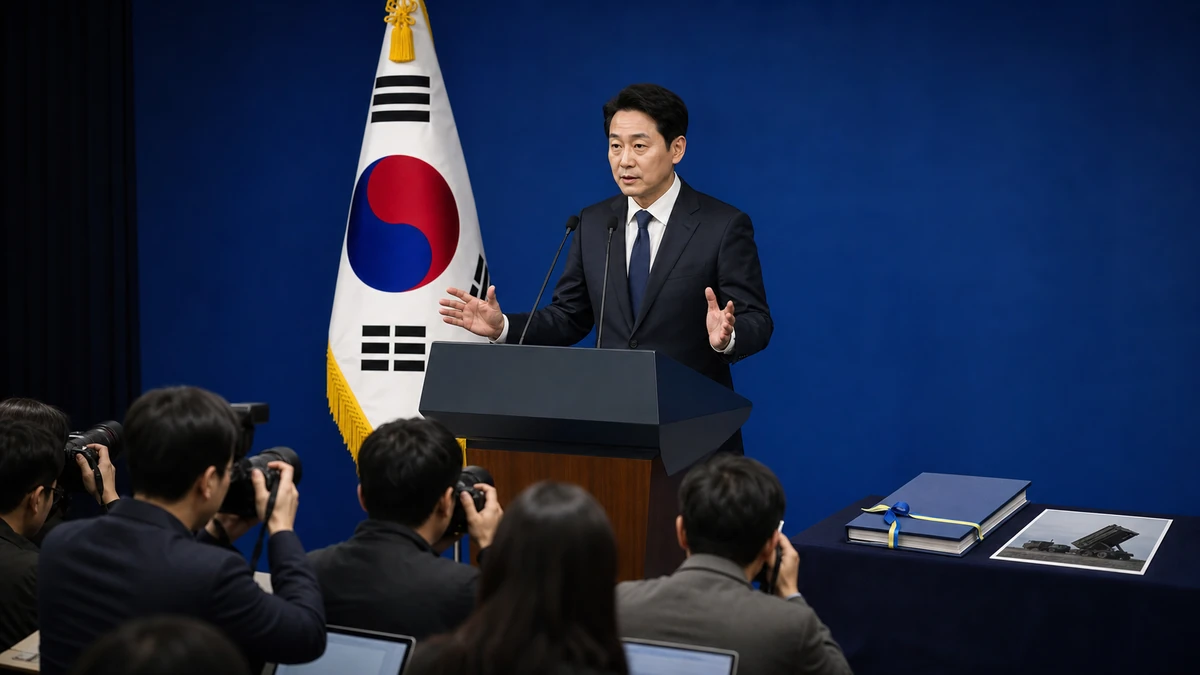
South Korea said Thursday it is maintaining its cautious position on Ukraine’s repeated requests for air defense support, even as Ukrainian President Volodymyr Zelenskyy has tried to sharpen Seoul’s sense of urgency by tying the war in Europe to the threat posed by North Korea.
The response from Seoul was notable less for what it promised than for what it declined to say. South Korean officials did not announce any new decision on whether to provide air defense systems or other military materiel to Ukraine. Instead, the government reiterated a line it has used before: any decision involving defense-related support must be reviewed under South Korea’s domestic laws and long-standing policy guidelines.
That may sound bureaucratic, but in South Korea, that language carries real weight. The country is a major arms producer and a treaty ally of the United States, yet it has also tried to calibrate its role in the Russia-Ukraine war with unusual care. Seoul has provided humanitarian aid and nonlethal assistance to Ukraine, but it has generally avoided publicly crossing the threshold into direct lethal weapons support. That position has been tested repeatedly as the war has dragged on and as South Korea’s own defense industry has become more prominent on the global stage.
The latest pressure point comes from Ukraine’s argument that growing military cooperation between Russia and North Korea is not simply a European problem. Kyiv has been urging South Korea to see the conflict through a more personal security lens, arguing that if North Korean troops gain modern battlefield experience or access to new military technologies through Russia, the consequences could eventually reach the Korean Peninsula.
For an American audience, the debate may resemble arguments heard in Washington over whether distant conflicts become harder, more dangerous and more expensive if allies wait too long to respond. But South Korea’s position is more complicated than that comparison alone suggests. Unlike the United States, South Korea lives under the immediate shadow of North Korea, sits within range of its artillery and missiles, and must weigh every foreign policy move against the risk of escalation in its own neighborhood.
So while Ukraine is making a strategic case for stronger support, Seoul is signaling that urgency alone will not override procedure, domestic constraints or the need for verified intelligence.
Ukraine’s pitch to Seoul is tailored to Korean anxieties
Ukraine’s argument is straightforward: what happens between Russia and North Korea on the battlefields linked to Ukraine may not stay there. If Pyongyang sends more personnel, ammunition or military support to Moscow, and if those forces gain practical knowledge from a modern war, South Korea could one day face a better prepared and potentially more capable adversary.
That is not an abstract concern in South Korea. The country has spent decades preparing for the possibility of conflict with North Korea, one of the world’s most heavily militarized states. The two Koreas are still technically at war because the 1950-53 Korean War ended in an armistice, not a peace treaty. In Seoul, security officials routinely think in terms of deterrence, readiness and alliance coordination with Washington. Any suggestion that North Korea could improve its combat effectiveness through cooperation with Russia is therefore bound to draw attention.
Ukrainian officials appear to understand that. By emphasizing the North Korea angle, they are not just asking South Korea for help as a wealthy democracy or advanced defense manufacturer. They are trying to cast South Korea as a country with a direct stake in the outcome, or at least in one of the war’s spillover effects.
That is a more sophisticated appeal than simply saying Ukraine needs more weapons. It reframes the war from a distant European conflict into part of a wider security chain that links Eastern Europe to Northeast Asia. In American terms, it is somewhat akin to warning that lessons learned by one adversarial state in one region can be transferred to another theater with very different geography but overlapping strategic consequences.
Still, there is a difference between a plausible security argument and a fully verified intelligence assessment. Zelenskyy has claimed that North Korea could deploy an additional 30,000 to 50,000 troops to Russia, but that figure had not been independently confirmed at the time of the reporting summarized here. That matters. Governments do not generally make major shifts in defense export policy based solely on claims from one wartime party, even when that party is an ally or partner with legitimate concerns.
South Korea’s response suggests it is deliberately separating two questions: whether the reported North Korean role is real and growing, and whether that automatically justifies a change in Seoul’s policy on defense support. For now, the answer to the second question appears to be no.
Why South Korea keeps talking about law and policy
When South Korean officials say they are reviewing such matters under domestic law and policy, they are doing more than offering a diplomatic placeholder. They are drawing a boundary around what can and cannot be inferred from diplomatic contacts, public requests and media speculation.
In South Korean politics, legal and policy frameworks often serve as a buffer between external pressure and immediate action. That is especially true on matters involving arms transfers, wartime assistance and relations with major powers. Seoul has to think not only about Ukraine and Russia, but also about its relationship with the United States, its economic ties across Eurasia and Asia, and its chronic security confrontation with North Korea.
There is also a domestic political dimension. South Korean governments of different ideological stripes have often debated how assertive the country should be internationally, particularly in conflicts where the direct Korean national interest is debated. Some conservatives favor a stronger strategic alignment with Western democracies and a more active global security role. Some progressives emphasize caution, regional stability and the risk of entanglement. Even when those categories oversimplify the political landscape, they help explain why a government might prefer institutional language over headline-grabbing declarations.
For U.S. readers, one useful comparison is the way American administrations often invoke congressional authority, alliance consultations or statutory limits when they want to slow a policy debate without shutting the door entirely. South Korea’s invocation of law and policy functions in a similar way. It says: we are listening, but a request alone does not equal a decision.
That distinction is especially important in this case because air defense systems, while commonly understood as defensive weapons, are not politically neutral objects. Whether a weapon is used to attack or defend, transferring it to a country at war carries diplomatic consequences. It can alter perceptions of alignment, affect relations with other states and raise questions about what comes next if the conflict intensifies.
In other words, even if an air defense system seems easier to justify than artillery shells or offensive missiles, Seoul still sees it as part of a broader foreign policy calculation, not merely a technical matter of helping intercept incoming attacks.
The North Korea-Russia factor changes the conversation, but not yet the outcome
What makes this moment different from earlier requests is the increasing salience of North Korea in the Ukraine war discussion. Over the past two years, concerns have grown in Washington, Seoul and elsewhere over military cooperation between Moscow and Pyongyang, including suspected arms transfers and the possibility of deeper strategic exchanges.
If North Korea is indeed contributing more directly to Russia’s war effort, that would complicate South Korea’s security environment in at least two ways. First, it could deepen a partnership between two countries that oppose key elements of the U.S.-led international order. Second, it could provide North Korea with experience, leverage or technology that enhances its own military posture back home.
That is why Ukraine’s message resonates, even if it has not yet produced a policy shift. It speaks to one of South Korea’s deepest strategic instincts: that the peninsula cannot be viewed in isolation. For decades, South Korean officials have had to interpret events in Washington, Beijing, Tokyo and Moscow through the lens of Korean security. Now they are being asked to connect those dots through Kyiv as well.
Yet resonance is not the same as proof. One of the striking features of Seoul’s current stance is its refusal to collapse uncertainty into action. Zelenskyy’s warning about possible additional North Korean troop deployments may or may not reflect a developing reality, but South Korea appears determined not to base a major public policy turn on unverified troop numbers.
That restraint is easy to criticize from the outside. To some observers, it may look like hesitation in the face of a mounting threat. But from the perspective of a government that shares a peninsula with North Korea and has to manage consequences long after media attention shifts elsewhere, caution can also look like discipline.
There is a practical reason for that. If Seoul were to move quickly on the basis of incomplete information and the underlying claims later proved exaggerated, the government could face diplomatic backlash at home and abroad. If, on the other hand, it dismisses Ukraine’s concerns too casually and later evidence shows a substantial North Korean role, it risks appearing strategically flat-footed. By sticking to principle and process, the government is trying to preserve room to maneuver.
South Korea’s global role is getting harder to define
This episode also highlights a bigger question that has followed South Korea’s rise as an economic and military power: What kind of international security actor does it want to be?
South Korea is no longer just a frontline state dependent on others for protection. It is a major democracy, a top-tier exporter, a technology heavyweight and an increasingly influential defense manufacturer. Its weapons systems have drawn interest from Europe, the Middle East and beyond. Its diplomatic profile has grown alongside its cultural one, with a country better known to many Americans through K-pop, Korean film and Korean food now also becoming more visible as a strategic player.
That visibility brings pressure. When wars break out or alliances are tested, countries with South Korea’s capabilities are expected to do more than issue statements. But South Korea’s leaders know that every move is viewed through multiple lenses at once: by Washington as an alliance question, by Moscow as a geopolitical signal, by Pyongyang as a potential provocation, and by South Korean voters as a test of judgment.
That tension explains why Seoul’s answer to Ukraine has remained measured. The government is not saying the war in Europe has nothing to do with Korea. In fact, the tone of its public messaging suggests the opposite: it recognizes the issue as serious enough to be evaluated through formal legal and policy criteria. What it is resisting is the idea that geopolitical logic alone should dictate the pace of its decision-making.
In that sense, South Korea’s current stance can be read as a form of middle-power statecraft. It is trying to signal seriousness without overcommitting, solidarity without impulsiveness and awareness without surrendering control of its own timetable. That may frustrate countries seeking immediate support, but it is consistent with how many states positioned between regional danger and global expectation tend to operate.
For Americans used to hearing foreign policy framed in stark yes-or-no terms, that ambiguity can seem unsatisfying. But in much of Asia, especially on security issues involving North Korea, ambiguity often serves a purpose. It preserves deterrence, avoids unnecessary public escalation and gives officials latitude as intelligence evolves.
What comes next will depend on facts, not just pressure
At this stage, there is no confirmed public decision that South Korea will provide air defense systems to Ukraine, and there is no confirmed public decision that it has definitively rejected the idea. The clearest reading of Seoul’s position is narrower: it acknowledges Ukraine’s request, understands the North Korea-centered security logic behind it, and is maintaining its existing cautious approach.
That means the next phase of the debate will likely hinge on two developments. The first is factual. Are claims of additional North Korean deployments to Russia substantiated by intelligence from South Korea, the United States or other partners? The second is procedural. If the threat picture becomes clearer, does South Korea conclude that its legal and policy standards allow for a different form of support than it has so far been willing to provide publicly?
The answers matter beyond Ukraine. They will help show how Seoul intends to navigate a world in which security theaters once treated as separate are increasingly connected. A war in Europe can influence deterrence on the Korean Peninsula. Military cooperation between Russia and North Korea can affect alliance planning in Washington and Seoul. Decisions about so-called defensive weapons can carry offensive diplomatic consequences.
For global audiences, that is the larger significance of this story. It is not just about whether one country sends one category of equipment to another. It is about how governments process overlapping threats when law, intelligence, diplomacy and domestic politics all pull in different directions.
South Korea’s answer, for now, is one of restraint. That should not be mistaken for indifference. If anything, the careful language coming out of Seoul suggests a government that understands the stakes very well and wants to avoid making a consequential security decision on momentum alone.
Whether that caution holds will depend on what can be verified in the days and weeks ahead. If evidence grows that North Korea is deepening its military role alongside Russia, the pressure on Seoul to revisit its position will almost certainly intensify. If the intelligence remains uncertain, South Korea may continue to do what it is doing now: emphasize rules, preserve flexibility and keep its options open in a conflict that increasingly touches its own security concerns, even from thousands of miles away.
Comments
Post a Comment