South Korean biotech giant Celltrion launches intensive training program for young adults sidelined from the job market
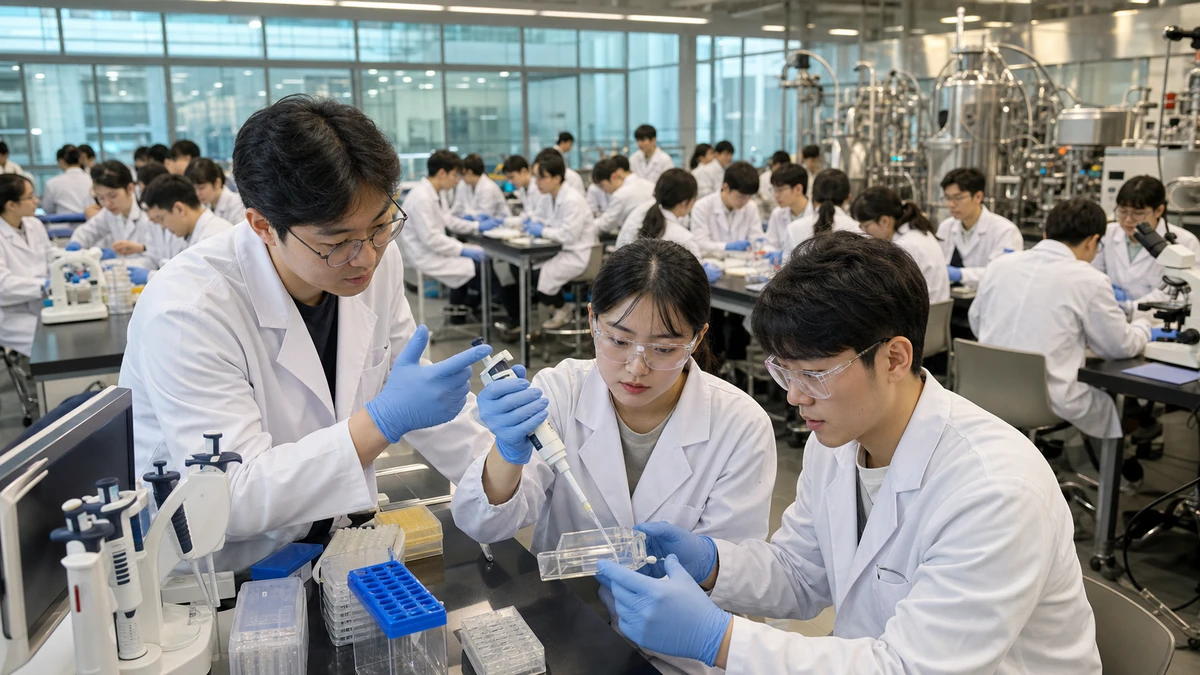
Image to help understand the article
A biotech company steps into a stubborn youth employment problem
South Korean biopharmaceutical company Celltrion has launched an intensive new training program aimed at 50 young adults who have been out of work for long stretches or have stopped actively searching for jobs, an effort that reflects both the promise of the country’s fast-growing biotech sector and the anxiety surrounding a generation that has struggled to find stable footing in the labor market.
The program, which began this week at a pharmaceutical and biotech research center in Songdo, Incheon, is notable not simply because a major company is offering technical education. What makes it stand out is the target group: people ages 18 to 34 who are not employed and are no longer fully engaged in job hunting. In South Korea, that group has become significant enough to have its own social shorthand, a phrase that roughly means “resting youth” — young people who are neither working nor actively pursuing employment.
For American readers, the concept may sound similar to the category often described in policy circles as young adults disconnected from work or school, though the Korean term carries its own social weight. It refers not to leisure in the carefree sense, but to a limbo state shaped by burnout, repeated rejection, economic pressure and, often, a quiet withdrawal from increasingly competitive systems.
Celltrion’s initiative, developed with South Korea’s Ministry of Employment and Labor and Ministry of Trade, Industry and Energy, attempts to address that gap with a structure closer to a full-time job than a one-off workshop. Participants are expected to attend five days a week, eight hours a day, in a sustained course designed to rebuild both technical skills and routine.
That schedule matters. In many countries, including the United States, debates about workforce development often focus on credentials, résumé gaps and hiring pipelines. But for people who have spent months or years outside formal employment, re-entering the work world can also mean relearning habits that are easy to take for granted: keeping a schedule, working alongside peers, interacting with supervisors and regaining the confidence to imagine a career path again. The Celltrion program appears built around that idea as much as around biotech itself.
Why this matters in South Korea
South Korea is often admired abroad for its technological sophistication, cultural exports and economic ascent. It is home to global brands in semiconductors, electronics, shipbuilding, batteries and increasingly biopharmaceuticals. But beneath that success story is an intense labor market that has left many young people frustrated, exhausted or discouraged.
The country’s youth unemployment rate does not always capture the full strain. As in the United States, headline numbers can miss those who have stepped away from the job search entirely. In South Korea, that hidden population has become an increasingly important concern for policymakers, educators and employers. The issue is tied to a broader social reality: a highly educated society where the pressure to secure a strong first job can feel overwhelming, especially in a culture where school pedigree, résumé sequencing and entrance into prestigious firms still carry outsized importance.
For many young Koreans, career setbacks are not experienced as temporary detours but as signs of falling behind in a race that never seems to slow down. The pressure can be especially intense because education and employment are so tightly linked to social status, housing prospects and long-term security. In a country with high housing costs, fierce competition and a work culture known for demanding standards, stepping outside the labor market can quickly become more than an economic problem. It can become a social and psychological one.
That helps explain why the phrase “resting youth” has resonated. It frames inactivity not as laziness, but as a condition that deserves explanation. The term has entered public conversation as South Korea grapples with how to reconnect young adults who have become detached from conventional employment pathways.
Celltrion’s program addresses that issue through a distinctly Korean blend of corporate involvement and state coordination. In the United States, workforce retraining might come through community colleges, state labor departments, nonprofit job centers or employer partnerships. South Korea’s version often leans more directly on coordination between central government ministries and large corporations, especially in strategic industries the country wants to strengthen.
A program designed around routine, not just lectures
The new initiative, called “Cell-in,” combines the English word “cell” with the idea of coming inside or entering in. It is a brand name with an obvious biotech connection, but it also signals the program’s deeper purpose: bringing young adults back into a professional setting after periods of detachment from the labor market.
That symbolism is important because the program is not being presented merely as a public-relations exercise or a motivational seminar. It is structured as a weekday, full-day commitment. According to the information released, participants will attend on a five-days-a-week, eight-hours-a-day basis, a design that mirrors the cadence of ordinary employment. Even without a guarantee of a job at the end, the program appears intended to serve as a bridge between isolation and re-entry.
There is also significance in where the training is taking place: Songdo, a meticulously planned district in Incheon built on reclaimed land west of Seoul, marketed for years as a futuristic business and research hub. To many Americans, Songdo might be compared to a master-planned innovation corridor, combining corporate offices, research facilities and state-backed development ambitions. It represents South Korea’s effort to position itself at the forefront of advanced industries, including biotech.
Holding the program at a pharmaceutical-bio convergence research center there gives participants more than classroom instruction. It places them in a physical environment associated with the industry they are being asked to imagine joining. That can matter for people who have spent extended periods outside professional spaces. Workforce specialists often note that re-entry is not just about information; it is about exposure, belonging and the ability to picture oneself in a field that may have once seemed remote.
Details about the curriculum have not yet been fully outlined publicly, and neither the company nor the government agencies involved have presented a specific hiring track tied to completion. That limitation is worth underscoring. It would be premature to frame the initiative as a direct job-placement pipeline. At this stage, what is clear is that 50 participants are beginning sustained biotech-related training under a joint company-government framework, with self-reliance and re-entry into society identified as explicit goals.
Still, the absence of a guaranteed job does not necessarily diminish the program’s importance. In labor-market interventions, especially for people who have withdrawn from active job seeking, the first step is not always placement. Sometimes it is rebuilding momentum.
The rise of biotech — and the search for talent beyond the usual résumé
The program also says something broader about where South Korea sees its economic future. Biotech has become one of the country’s key growth sectors, joining chips, batteries and clean-tech manufacturing as areas where Seoul wants to deepen global competitiveness. Celltrion is one of the sector’s most prominent names, known internationally for biopharmaceutical development and biosimilar products — medicines designed to be highly similar to existing biologic drugs, often at lower cost.
For readers in the United States, biosimilars occupy a policy space somewhat akin to generics, though the science and regulatory framework are more complex because biologic drugs are made from living systems. As American health care costs continue to drive debate, biosimilars have drawn attention for their potential to increase competition and improve access. South Korean firms like Celltrion have become influential players in that market.
That makes this training initiative more than a corporate social-responsibility footnote. It connects a strategic industry’s labor needs with a social challenge many developed economies face: how to bring discouraged young adults back into growth sectors before they drift further from economic opportunity.
Traditionally, companies recruit candidates who are already polished for the market — recent graduates with strong credentials, applicants with internship experience or workers who have kept an unbroken professional trajectory. Programs like this suggest a different logic. Instead of treating the detached job seeker as someone outside the talent pool, they treat that person as a potential worker who may need an intermediate runway.
That is an important shift. It moves the conversation away from a moralizing question — why aren’t these young adults trying harder? — toward a practical one: what kinds of institutional support make it possible for someone to return? For employers, that can mean looking beyond the finished product and participating in the rebuilding process itself.
In the United States, similar questions have surfaced in debates about so-called opportunity youth, apprenticeships, second-chance hiring and employer-led workforce development. The specifics differ by country, but the underlying challenge is familiar. Employers say they need talent. Young adults say existing pathways are too rigid, too expensive or too unforgiving. Programs like Celltrion’s sit at that tense intersection.
A collaboration between business and government
One of the most striking features of the program is the degree of coordination between a private company and two arms of the South Korean government. Rather than operating separate initiatives — one focused on job counseling, another on industrial policy, another on skills training — the parties are participating in a single program tied to a specific sector.
That kind of collaboration reflects how South Korea often approaches economic development. The country’s modern growth was shaped not only by market forces but also by deliberate state planning, export strategy and close engagement with major business groups. While the political and economic context has evolved considerably from the era of rapid industrialization, the instinct to link public policy and industrial goals remains strong.
In this case, the Ministry of Employment and Labor brings experience in youth employment support and vocational capability building. The Ministry of Trade, Industry and Energy represents the industrial-policy side, focused on strategic sectors and business competitiveness. Celltrion contributes what government alone cannot fully provide: access to industry know-how, research infrastructure and proximity to an actual biotech work environment.
Together, that combination creates a bridge that neither side could easily build alone. Governments can fund training and identify vulnerable populations, but they often struggle to make programs feel connected to real employers. Companies understand the workplace, but they may not have the reach or public mandate to identify and support young adults who have become disconnected. Coordinated well, the partnership can reduce that gap.
Of course, collaboration alone is not proof of success. Such programs can falter if responsibilities are vague, if curriculum does not match actual hiring needs or if participants are expected to solve structural problems through sheer perseverance. Whether this initiative becomes a meaningful model will depend on what happens after the launch ceremony: attendance, retention, participant confidence, skill gains and eventual movement back into education, training or work.
But even at the outset, the program represents a noteworthy policy signal. It suggests that South Korea’s youth-disconnection problem is being treated not solely as a welfare issue or a counseling issue, but as a talent-linkage problem — one that touches the future of strategic industries as well as the well-being of individuals.
The cultural weight of stepping away from work
To understand why an initiative like this draws attention in South Korea, it helps to appreciate the cultural significance of employment there. In the United States, career detours are common and often framed as personal reinvention. Americans may leave one field for another, go back to school later in life or spend periods freelancing between jobs. Stigma exists, especially around long-term unemployment, but there is also a strong cultural narrative around second chances.
South Korea has second chances too, but the social context is different. Educational achievement is deeply emphasized from an early age, and transition points — high school entrance exams, college admissions, first jobs — can feel unusually decisive. That does not mean every Korean career is rigidly predetermined, but it does mean that falling off the expected path can feel especially consequential.
The expression “resting youth” reflects a society trying to name a condition that is both personal and structural. It acknowledges that some young people are not simply between jobs; they are stalled in a more profound way, often after repeated attempts to compete in systems that have offered little traction. Some may be dealing with anxiety or depression. Others may be exhausted by exam culture, unpaid preparation periods or industries where entry requirements seem constantly to rise.
In that sense, the Celltrion initiative implicitly challenges a familiar stereotype: that people outside the labor market are disengaged because they lack discipline. The program’s very design suggests a more nuanced view. It assumes that with structure, peer interaction and access to a real industrial setting, some of those young adults can begin to reconnect.
That framing may also make the initiative more politically and socially resonant. Rather than portraying participants as charity cases, it positions them as future contributors in a high-value sector. That matters in a country where dignity, face and social perception can shape whether people feel able to re-enter public life after setbacks.
What success would look like — and what remains unknown
For now, the program’s scale is modest: 50 participants. In a country facing much larger questions about youth detachment, that number alone will not transform the labor market. But pilot programs often matter less for their immediate size than for the model they test.
If the training keeps participants engaged through completion, helps restore daily rhythm and increases confidence in navigating professional environments, that would already mark a meaningful outcome. If some participants then move into further training, internships or jobs in biotech or adjacent fields, the program could become a template for broader replication.
Its symbolism may be just as important. When a major biotech firm treats disconnected young adults as worth investing in, it sends a message to other employers about where talent can come from. It also suggests that economic inclusion does not have to sit apart from industrial growth. The same research infrastructure used to build globally competitive products can also be used to widen access to the industries producing them.
There are, however, unanswered questions. Publicly available information so far does not spell out the exact coursework, mentoring structure or assessment process. It is unclear what kind of credential participants will receive, whether there are wraparound supports for mental health or transportation, or how success will be measured after completion. There is also no public basis yet to conclude that the program leads directly to employment at Celltrion or elsewhere.
Those unknowns matter because workforce programs can look promising at launch and still fall short if they are not sustained, tailored or honestly evaluated. A full-time schedule can rebuild structure, but it can also be demanding for participants who are already vulnerable. Effective support may require more than technical instruction. It may require counseling, coaching and realistic pathways into next-step opportunities.
Even so, the launch speaks to a broader international trend. Across wealthy economies, governments and employers are grappling with a mismatch between sectors hungry for skilled workers and young adults who feel shut out of viable careers. South Korea’s answer, at least in this instance, is to bring the job market’s outsiders into one of its most future-oriented industries and see whether routine, exposure and institutional partnership can reopen the door.
That makes this more than a local corporate initiative. It is a small but revealing test of how a technologically ambitious society responds to the people left on its margins. In a global moment defined by rapid industrial change, aging populations and persistent youth uncertainty, the question is not just how countries create cutting-edge sectors. It is whether they can make room for more people to enter them.
Celltrion’s new training program does not answer that question yet. But it does suggest that in South Korea, one of Asia’s most closely watched innovation economies, the search for talent is beginning to extend beyond the usual shortlist — and toward young people who, until now, have mostly been waiting outside.
Comments
Post a Comment