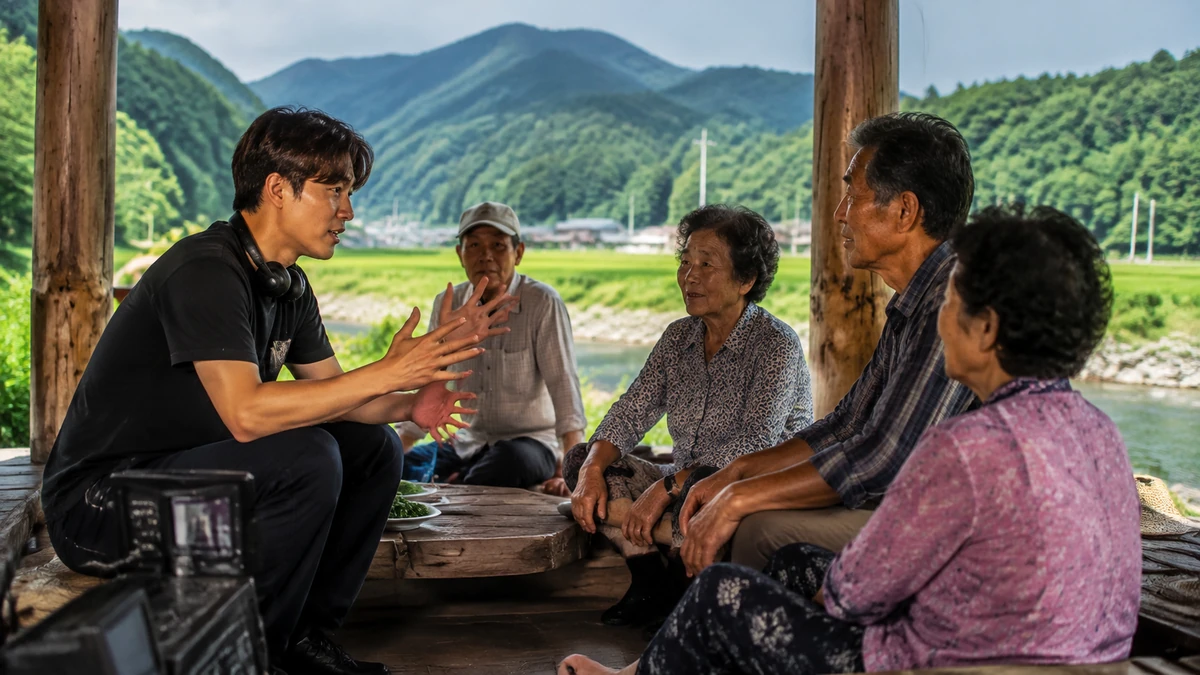
A Korean Film That Lets Reality Take Center Stage
South Korean director Choi Seung-woo is taking a different approach to storytelling with his new film ‘Last Summer,’ a work that explores how ordinary lives and familiar places can become the foundation of a powerful cinematic experience. Rather than building a fictional world from scratch, Choi focuses on observing and preserving the rhythms of real life, creating a film where everyday moments become the heart of the story.
According to Yonhap News Agency, Choi discussed his filmmaking philosophy during an interview held Aug. 5 at Sorigeurim in central Seoul. The director explained the creative process behind ‘Last Summer’ and why he chose to portray reality as honestly as possible. The conversation highlights a growing interest in Korean cinema toward films that capture human experiences through observation rather than relying only on dramatic plots or large-scale productions.
For American audiences familiar with independent cinema and documentary-style storytelling, ‘Last Summer’ represents a similar artistic question: How can filmmakers capture the truth of a place and its people while still creating a meaningful narrative? Choi’s answer is to approach filmmaking as an act of careful observation, allowing real communities and landscapes to shape the movie itself.
Hongcheon Becomes More Than a Setting
The film takes place in Hongcheon County, a rural area in South Korea’s Gangwon Province known for its mountains, agricultural communities and slower pace of life. In many films, rural locations function mainly as scenery, providing a backdrop for a character’s journey. In ‘Last Summer,’ however, Hongcheon is treated almost like a character of its own.
The movie includes scenes featuring actual residents going about their daily routines, including farming, resting under traditional village pavilions and sharing conversations with neighbors. These moments are not inserted simply to create a sense of realism. Instead, they form the emotional foundation of the film, showing how people build relationships and meaning through ordinary experiences.
This approach may feel familiar to viewers who appreciate American films centered on local communities, such as stories that focus on small towns and personal connections rather than major events. The difference is that ‘Last Summer’ places particular emphasis on preserving the identity of a specific Korean region. The film does not hide where it takes place; it openly shows details such as local road signs beginning with Seongsan-ro and the Hwacheon-myeon Community Service Center.
By revealing the exact location, Choi avoids turning Hongcheon into an imaginary countryside. Instead, he invites audiences to understand the area as a real place where real people live. The geography, architecture and daily routines become part of the storytelling language.
A Filmmaking Philosophy Built Around Observation
Traditional narrative filmmaking often begins with a filmmaker creating a fictional universe. Directors design characters, locations and events to support a planned story. Choi’s method begins with a different question: How can a filmmaker respectfully represent a world that already exists?
The director has said his focus was not on creating a world according to his own imagination, but on considering whether he had the right to recreate the reality of others. This perspective places responsibility and observation at the center of the creative process.
Rather than arranging residents as background figures for dramatic scenes, ‘Last Summer’ allows their presence to emerge naturally. A farmer working in a field, neighbors talking during a break or people spending quiet time together may appear simple, but the film treats these moments as meaningful expressions of human life.
This style reflects a broader conversation in global cinema about the relationship between fiction and reality. Many filmmakers today are exploring hybrid forms that combine elements of narrative film and documentary. These works often ask audiences to pay closer attention to small details and everyday emotions.
For Choi, the challenge was not deciding what kind of world to invent, but determining how to faithfully represent a world that already exists. His approach suggests that reality itself can provide enough drama, emotion and complexity without requiring artificial exaggeration.
The Balance Between Reality and Creative Storytelling
Although ‘Last Summer’ draws heavily from real locations and real people, it is not simply a recording of life. Like any film, it is shaped by choices made by the director, including framing, editing, pacing and perspective. The movie exists between documentary observation and cinematic storytelling.
This balance is one of the film’s central artistic questions. A filmmaker must decide what to include, what to leave out and how to organize real experiences into a meaningful narrative. The result is not a copy of reality, but a carefully constructed interpretation of it.
The participation of local residents adds another layer of authenticity. Their presence brings natural expressions and familiar interactions that can be difficult to reproduce through professional acting alone. At the same time, Choi’s direction gives those moments structure and emotional meaning.
For international viewers, this filmmaking style provides a window into aspects of Korean life that are often less visible in mainstream entertainment. Global audiences frequently encounter South Korea through K-pop, television dramas, technology companies and major cities such as Seoul. Films like ‘Last Summer’ introduce another side of the country: rural communities, local traditions and the quiet relationships that exist outside urban centers.
A Different Side of the Korean Wave
South Korea’s cultural influence has expanded worldwide in recent years through what is commonly called the Korean Wave, or Hallyu. While global attention has often focused on blockbuster films, streaming series and music, another part of Korean culture is gaining recognition: stories rooted in everyday life.
Films that emphasize regional identity and personal experiences offer international audiences a different understanding of Korea. Instead of presenting the country only through fast-paced cities or dramatic conflicts, these works reveal the textures of ordinary existence.
For viewers outside Korea, Hongcheon becomes more than a name on a map. It represents a way of life shaped by agriculture, community relationships and connections to the landscape. The film’s attention to local details allows audiences to experience a part of Korean society that may be unfamiliar but emotionally accessible.
This cultural exchange is especially important as Korean cinema continues reaching audiences around the world. International viewers do not only seek entertainment; they also look for authentic perspectives that help them understand different societies.
Why Everyday Stories Can Matter Globally
The appeal of ‘Last Summer’ lies in its belief that ordinary experiences can carry universal meaning. A conversation between neighbors, a person working the land or a quiet afternoon in a village may appear specific to one community, but the emotions behind those moments are widely recognizable.
People everywhere understand ideas such as belonging, memory, aging, family connections and attachment to a place. By focusing on these themes, Choi creates a film that begins with a Korean rural community but reaches toward broader human experiences.
The film also reflects a changing attitude within Korean cinema. As the industry continues to produce internationally successful genre films, there is also growing space for smaller, more personal stories that examine identity and everyday reality.
‘Last Summer’ suggests that cinema does not always need extraordinary events to create emotional impact. Sometimes, paying careful attention to ordinary lives can reveal stories that are just as compelling as fictional adventures.
For global audiences discovering Korean films beyond mainstream hits, Choi Seung-woo’s work offers another perspective on what Korean cinema can be. It presents a country not only through its ambitions and achievements, but through the people, places and quiet moments that make up daily life.
As ‘Last Summer’ draws attention for its unique production approach, the film represents a continuing evolution in Korean storytelling. Its message is simple but significant: real life, when observed with care and respect, can become a powerful story.
Comments
Post a Comment