South Korea’s An Se-young Returns From Injury With a Statement World Title — and a Reminder That Badminton’s Center of Gravity Is Shifting
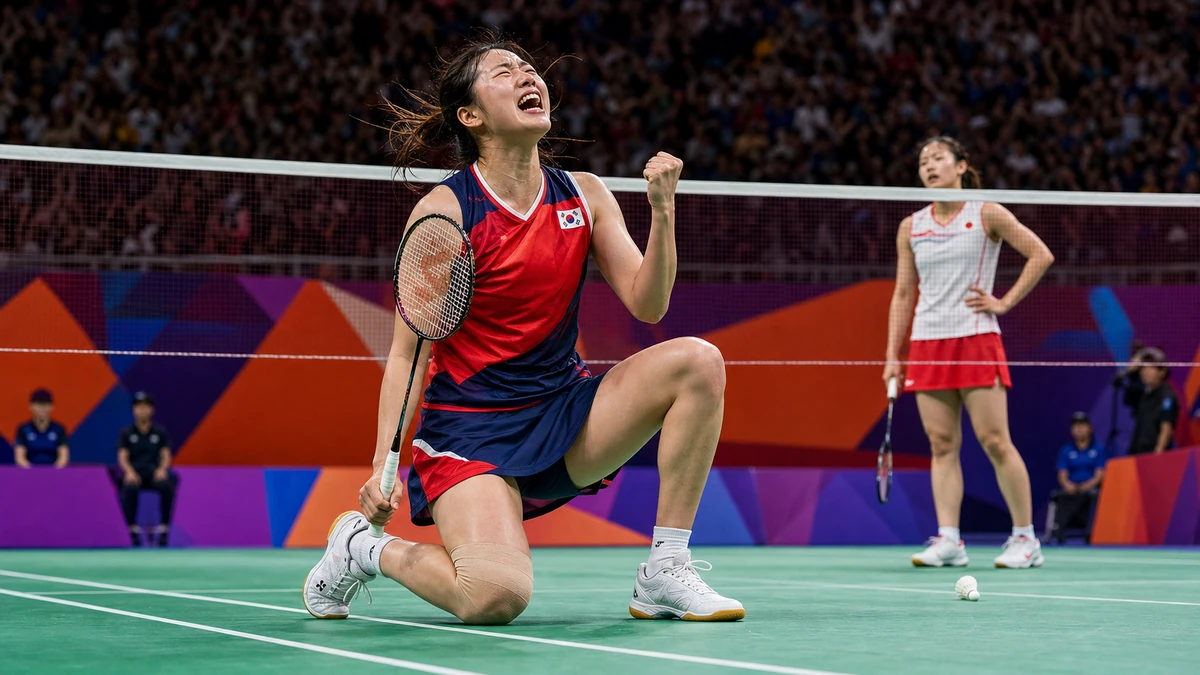
Image to help understand the article
A champion’s return, and more than a comeback story
An Se-young, the world’s top-ranked women’s singles badminton player from South Korea, won the 2026 BWF World Championships in New Delhi by beating Japan’s Akane Yamaguchi in straight games, 21-17, 21-14. On paper, that result looks like a clean, efficient victory by the No. 1 player over the No. 2 player. In context, it reads as something bigger: a reaffirmation of dominance after injury, a reminder of South Korea’s expanding reach in global badminton, and a signal to American audiences that one of the world’s most compelling women athletes is building a résumé that deserves broader attention outside Asia and Europe.
The key fact is not simply that An won. It is how she won. According to the Korean summary of the tournament, she did not drop a single game all the way through the event. That matters in any sport, but especially in badminton, where the margins at the elite level are thin, momentum can swing quickly, and the sport’s compressed scoring format rewards constant pressure. An was returning after dealing with pain in her left foot at last month’s Japan Open, where her winning streak was interrupted and questions naturally surfaced about whether she would be fully ready for the sport’s premier annual stage.
Instead of merely showing up healthy enough to compete, she returned looking unmistakably like the standard everyone else still has to meet. That distinction is the heart of this story. There is a big difference between coming back from injury and coming back without visible compromise. There is an even bigger difference between surviving a tournament draw and marching through it without surrendering a game. For South Korean fans, this was not just the recovery of a star. It was evidence that her 2023 world title was not a one-off breakthrough but part of a longer era of control.
For American readers who may know badminton mostly as a backyard game at family picnics or as a niche Olympic event, that context is essential. International badminton is one of the most demanding racket sports in the world, with explosive changes of direction, punishing schedules, and intense tactical battles. Its stars are national icons in parts of Asia in ways that may be closer to tennis, gymnastics or figure skating celebrity in the United States. An is not just winning tournaments; she is shaping the hierarchy of her sport in real time.
Why this title carries unusual weight
World championships are always meaningful, but not every title says the same thing. This one carries extra weight because it answered two questions at once. First, was An physically ready after the foot issue that disrupted her momentum? Second, could she still impose herself on the very best opponents immediately after a layoff? The answers came quickly and emphatically.
In the semifinals, An beat China’s Wang Zhiyi, the world No. 3. In the final, she beat Yamaguchi, the defending world champion and current world No. 2. Those are not symbolic victories or favorable draw outcomes. They are the sport’s inner circle. Korean reporting emphasized An’s sustained edge in these rivalries: she has dominated recent meetings with Wang and extended a winning streak over Yamaguchi as well. That matters because repeated success against the same elite opponents is one of the clearest signs that a player’s supremacy is structural, not accidental.
In American sports language, this is the difference between a hot postseason run and a dynasty-level pattern. A single major title can announce a star. Repeated wins over the same top competition, especially after setbacks, build the case for a defining athlete of the era. An now has that kind of profile. She first made history in 2023 when she became the first South Korean singles player to win the world championships. By reclaiming the title three years later, she has pushed her story beyond “historic first” into something more durable: sustained rule at the top of women’s badminton.
There is also a mental component here that athletes and coaches in any country would recognize. Injury does not only affect the body. It creates uncertainty, shortens the margin for error, and forces players to trust movements they may still be testing under pressure. An’s run in New Delhi suggests that her team did more than get her onto the court. They managed the comeback correctly. She reportedly canceled all international competition for about a month to focus on rehabilitation rather than forcing a quick return. In elite sport, that restraint can be as important as raw toughness. It may have preserved not just her tournament chances, but her long-term command of the tour.
South Korea’s badminton surge looks less like a moment and more like a cycle
An’s gold medal was the headline result, but it was not the only one. South Korea left the championships with two gold medals and one bronze across five disciplines, with medals in three events overall. That wider result matters because it suggests the country’s badminton success is not resting on one singular athlete, however brilliant she may be.
Korean coverage framed the tournament as evidence of a broader “golden era” for the national program, and that argument is not hard to see. Alongside An’s women’s singles title, South Korea also won gold in women’s doubles, a result described in Korean accounts as especially symbolic because it ended a 31-year wait of sorts in that event. The men’s doubles team, considered a strong contender for gold, took bronze. Put together, those outcomes show depth. In international sport, depth is often the difference between a great star and a great system.
That system-level success is important for two reasons. One is immediate: it gives South Korea more leverage and confidence across the badminton calendar, from coaching continuity to athlete development to Olympic planning. The other is reputational. In global sports, countries shape identity through repeated excellence in specific disciplines. Jamaica has sprinting. The United States has basketball and swimming. South Korea, already known worldwide for archery, short-track speed skating and increasingly for fencing, has a stronger case than ever to be seen as a badminton power that can compete across categories, not just in isolated cases.
American audiences are familiar with this kind of national sports branding even when they do not think of it in those terms. A generation of U.S. women’s soccer dominance was not only about stars like Mia Hamm or Megan Rapinoe; it was also about the pipeline behind them. The same is true in gymnastics, where one household name often represents a much deeper competitive apparatus. An Se-young’s success works in a similar way. She is the face. The New Delhi results suggest she is not the whole structure.
This also helps explain why her victory resonated so strongly in South Korea. The local response was not only about one athlete reclaiming a crown. It was about a broader sense that Korean badminton is not just producing medal hopefuls, but sustaining a world-class standard. Her win becomes the emblem of that trend.
What this means for the United States
For the United States, An’s victory is a reminder of a sports reality that often sits outside the mainstream American conversation: some of the world’s most commercially viable, emotionally intense and geopolitically connected competitions are happening in disciplines the U.S. sports industry still treats as peripheral. Badminton is one of them.
That does not mean badminton is insignificant in America. Far from it. The United States has large and passionate badminton communities, particularly among Asian American families and in metropolitan areas with strong immigrant ties to East and Southeast Asia. There are junior circuits, private academies, college club systems and a dedicated recreational base. Equipment brands, coaching businesses and streaming platforms all have a stake in badminton’s visibility. But the sport still lacks the broad national media presence that tennis, golf or even pickleball now command.
An Se-young’s rise offers a useful case study in how that could change over time. The Korean Wave, or “Hallyu,” has already transformed how American audiences consume culture from South Korea, from K-pop and Korean dramas to beauty products, food and fashion. Sports have not crossed over at the same scale, but the mechanism is familiar. Once American audiences recognize a star, a rivalry or a compelling national storyline, interest can build quickly. The most obvious comparisons are not within badminton but across sports: think of how Naomi Osaka broadened interest around tennis and identity, or how Shohei Ohtani turned Japanese baseball excellence into a mainstream American story because he was too extraordinary to ignore.
An is not yet an American household name, and badminton is not Major League Baseball. Still, the pathway is recognizable. She is young, accomplished, historically significant and tied to a country that already has substantial cultural soft power in the United States. For U.S. broadcasters and sports media, athletes like An present an opportunity: tell the story not as an obscure overseas result, but as a window into a global sport where excellence is concentrated, rivalries are rich and the U.S. has more cultural and business connections than it sometimes admits.
There is also a U.S.-Korea dimension beyond fandom. South Korea is one of America’s closest allies, and the relationship increasingly spans technology, entertainment, higher education and consumer markets. Sports are part of that ecosystem of influence, even when they do not dominate headlines. Korean stars who break through internationally strengthen the country’s brand in America. That can affect everything from sponsorship interest to event promotion to the appetite for Korean sports content on U.S. platforms. In a fragmented media economy, that kind of spillover matters.
For American companies, especially those in sportswear, wellness, streaming and youth athletics, global badminton remains an underappreciated market. The sport is huge across Asia, deeply followed in parts of Europe and increasingly accessible through digital platforms. If stars like An continue to create must-watch moments, companies that think internationally may find more value in badminton than traditional American sports assumptions would suggest.
Rivalries, recovery and the modern standard of greatness
One of the clearest themes in An’s latest title run is that modern greatness is measured not only by peak performance, but by repeatability under pressure. That sounds obvious, but it is worth stating because sports culture often overreacts to isolated moments. A champion’s real test comes when opponents study her, expectations rise and the body starts absorbing the cost of success.
An’s New Delhi performance checked all of those boxes. She returned carrying the burden that comes with being world No. 1. She faced top-ranked opponents rather than lower-seeded surprises. She did so after a recent injury concern. And she still controlled the tournament from start to finish. There is a reason Korean coverage reached for words like “perfect” and “flawless.” Those labels can be overused in sports writing. Here, they fit.
The Yamaguchi matchup also deserves special attention. Rivalries are the engines that make individual sports intelligible to broader audiences. Casual viewers may not know ranking systems or tour schedules, but they understand what it means when the reigning champion faces the current No. 1. Yamaguchi is not just another finalist. She is one of the defining players of this era and a standard-bearer for Japanese badminton, itself a formidable program. By beating her in straight games and widening the margin in the second game, An did more than win the title. She clarified the pecking order at least for now.
That clarity matters heading into future majors and the next Olympic cycle. In many sports, the top ranking is provisional, while the biggest tournaments reveal who truly controls the field. An’s latest result narrows that gap between ranking and reality. She is not merely listed first. She looks first.
There is also a broader lesson in how her comeback was handled. Elite sports have become more sophisticated about recovery, load management and the long view of athlete health. American fans hear those debates all the time in the NBA, NFL and women’s soccer. An’s decision to step away from competition, rehab properly and return only when ready reflects the same logic. The strongest message of her title may be that patient recovery, not relentless scheduling, is what protects greatness.
Why American readers should pay attention now
Stories like this can be easy for U.S. audiences to miss because badminton still sits outside the American sports mainstream. But if the last decade has shown anything, it is that American cultural attention is more global than ever. The old boundaries between “domestic” and “foreign” fandom are weaker. Americans watch English soccer before breakfast, follow Formula One through Netflix, buy Korean skincare at Target and stream Korean dramas on the same platforms that carry Hollywood movies. The audience is already prepared for more crossover than traditional sports desks sometimes assume.
An Se-young fits that moment. She offers excellence, a compelling injury-recovery narrative, a history-making profile and a connection to a South Korea that many Americans already engage with culturally. She also competes in a sport whose speed and athleticism are often underappreciated until people actually watch it. That combination could make her one of the easier badminton stars to introduce to English-speaking audiences if media organizations choose to tell the story well.
What comes next is as important as what happened in New Delhi. Can An maintain this level deep into the next phase of the calendar? Can her rivals, especially Yamaguchi and Wang, close the gap? Can South Korea convert this championship success into a longer program-wide dominance? And outside Asia, can broadcasters and sponsors better connect these achievements to consumers who may not realize how global the sport already is?
Those are not small questions. They touch on sports economics, national branding and the evolving map of international fandom. For now, the clearest conclusion is also the simplest. An Se-young did not just return from injury and win a title. She returned at the highest-stakes moment, beat the sport’s best, gave up nothing in games and strengthened South Korea’s claim to badminton supremacy. In an era when so much sports commentary chases novelty, her latest statement points to something more durable: not a surprise champion, but a champion defining the standard.
For American readers, that is the real takeaway. This is not merely a distant tournament result from a sport outside the usual U.S. spotlight. It is part of a larger story about where elite sport is thriving, how South Korea continues to expand its global influence, and why the athletes at the center of that expansion deserve a wider audience. If badminton is still treated as a fringe interest in much of the United States, performances like An’s are the kind that challenge that assumption. At a minimum, they demand attention. At best, they invite American fans to discover a sport — and a star — they may have underestimated.
Comments
Post a Comment