South Korea’s Top Court Reins In Automatic Firings for Military Service Refusal, Exposing a Broader Shift in Rights and Security
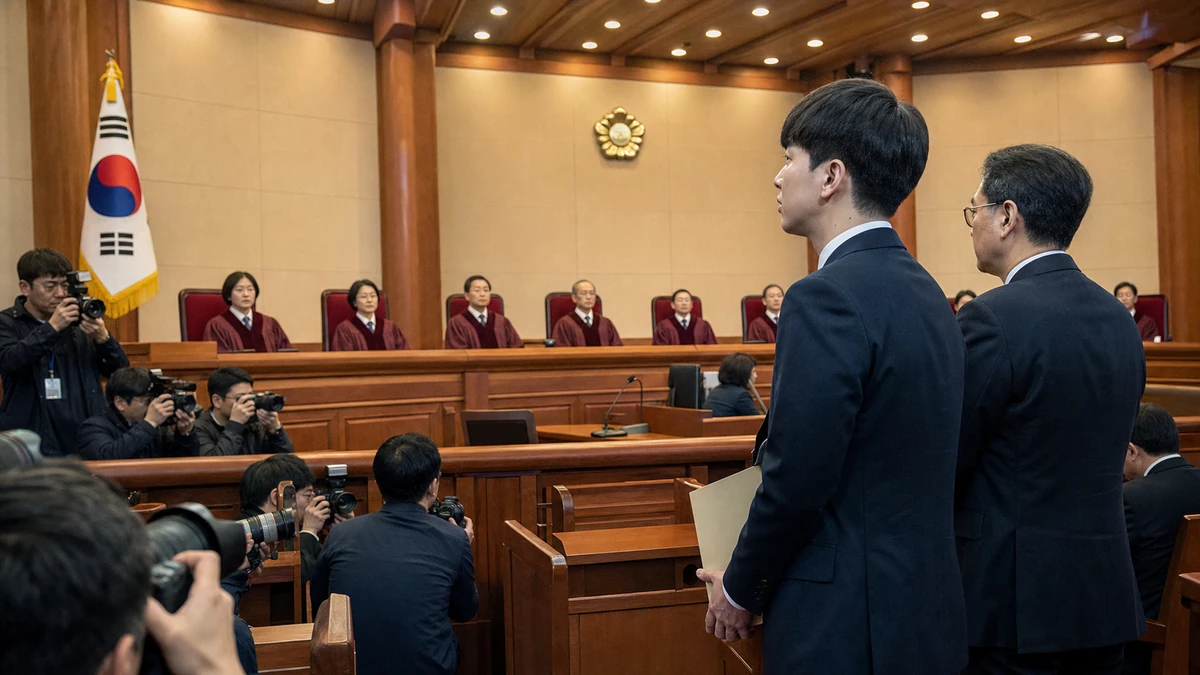
Image to help understand the article
A 64-year-old rule meets a modern constitutional test
South Korea’s Constitutional Court has struck at the logic of a decades-old law that required employers to automatically fire people who refused military service, ruling that the blanket approach does not fit the country’s constitution. The decision does not erase South Korea’s military draft, nor does it declare that refusing service carries no consequences. Instead, it targets something narrower but deeply important in any constitutional democracy: whether the state can impose a life-altering penalty without giving people a meaningful chance to explain why their case may be different.
At issue was Article 76, Paragraph 1 of South Korea’s Military Service Act, which barred state agencies, local governments and private employers from hiring draft evaders and required the dismissal of those already employed. In effect, once a person was categorized as having refused or evaded military service, the law pushed employers toward one mechanical result: termination. The Constitutional Court found that approach constitutionally incompatible because it did not distinguish among circumstances or allow for a review of whether there was a justifiable reason.
That may sound procedural, even technical. But in a country where military service remains one of the most politically charged and culturally sensitive civic obligations, procedure is substance. South Korea requires most able-bodied men to serve, a system shaped by the unresolved Korean War, the continued division of the peninsula and the ever-present threat from North Korea. For generations, draft compliance has been wrapped up with ideas of fairness, masculinity, sacrifice and citizenship. That is why military service controversies in South Korea often carry the emotional force that tax avoidance, flag controversies or disputes over selective service might have in the United States — and then some.
The court’s ruling lands with additional historical weight because the challenged provision dates back to the aftermath of the May 16 military coup in 1961, when South Korea was under a much more authoritarian political order. In practical terms, the court has now asked whether a punitive employment rule born in that era can survive in a 21st-century democracy that claims to balance national security with individual rights. Its answer was not to dismantle the state’s authority, but to say that even in a security-heavy system, automatic punishment has constitutional limits.
That makes this more than a labor law story and more than a military story. It is part of a broader South Korean reckoning over how far the state can go when enforcing duties that are widely accepted in principle but unequally burdensome in practice.
Why this decision matters beyond one clause
The core of the ruling is easy to miss if one focuses only on the headline. The Constitutional Court did not say that military service is optional. It did not invalidate all sanctions tied to refusal or evasion. What it questioned was the legal leap from a draft-related violation to mandatory job loss, regardless of context.
In constitutional and labor-law terms, that matters because military administration and employment are not the same thing. The state may punish someone for violating military service rules through one legal process, but that does not automatically justify a second penalty that strips away the person’s livelihood. When the same conduct triggers both military sanctions and a compulsory firing, the state is not merely enforcing service obligations; it is multiplying the consequences across unrelated parts of a person’s life.
That is the point legal analysts are likely to focus on. The problem was not simply severity. It was the absence of individualized review. Once the law operated as an on-off switch, neither the person affected nor the employer had much room to consider motive, circumstance or proportionality. The court signaled that this is where the constitutional balance broke down.
The ruling also shifts the center of gravity from automatic enforcement to case-by-case examination. According to the court’s reasoning as reported by South Korean media, it accepted that there may be a legitimate need for consequences in some cases. But it required a chance for the individual to present a justification. That procedural opening may sound modest, yet it fundamentally changes the logic of the system. The relevant question is no longer just whether military service was not completed. It also becomes why, under what circumstances, and whether those circumstances matter enough to alter the legal outcome.
That is a familiar constitutional move in democratic legal systems. Courts often leave the basic policy in place while demanding a more careful process. In the United States, judges frequently avoid sweeping away an entire area of law and instead force government agencies or employers to use narrower, more tailored standards. South Korea’s Constitutional Court appears to be taking a similar path here: not declaring the state powerless, but insisting that power be exercised with more precision.
The practical consequences could be significant. Employers who once had almost no choice may now face greater responsibility. They may have to hear explanations, assess whether a reason is legitimate and document how they reached a conclusion. In other words, a rule that once reduced employers to instruments of state policy may now require them to act more like decision-makers. That is an expansion of due process for workers, but it also creates uncertainty for institutions that prefer bright-line rules.
The deeper Korean context: conscription, fairness and the politics of obligation
To understand why this issue resonates so strongly in South Korea, American readers need to appreciate how central conscription is to public life there. South Korea remains technically at war with North Korea because the 1950-53 Korean War ended in an armistice, not a peace treaty. Nearly every major political question involving defense, deterrence and alliance management unfolds against that reality. Military service is not a distant civic abstraction. It is woven into family life, career planning, celebrity culture and electoral politics.
Most South Korean men are expected to serve for roughly a year and a half to nearly two years, depending on branch and assignment. The obligation can interrupt college, delay jobs, affect relationships and shape social status. Because so many people go through it, public sensitivity to perceived unfairness is intense. If one person appears to avoid service through wealth, influence or technical loopholes, the backlash can be ferocious.
That helps explain why South Korea has historically treated military service refusal not only as a legal issue but as a moral one. In public debate, refusing service has often been viewed through the lens of free-riding: benefiting from national protection while others bear the cost. That frame has made it politically difficult to argue for exceptions, even when the underlying claim involves conscience, religion or personal circumstances. For decades, critics of harsh enforcement could be portrayed as weak on security or indifferent to fairness.
But fairness cuts two ways. A rigid system can look fair because it treats everyone the same. Yet constitutional democracy often requires more than identical treatment. It asks whether the state is taking account of relevant differences. A person who intentionally manipulates the system to dodge service is not necessarily the same as someone whose refusal grows out of conscience, health, administrative dispute or another serious reason. The blanket firing rule collapsed those distinctions.
This tension — between equal burden-sharing and individualized justice — has been building in South Korea for years. The country has already undergone notable debate over conscientious objection, especially involving religious objectors such as Jehovah’s Witnesses, who long faced prison for refusing military service. South Korean courts and lawmakers have gradually moved toward recognizing alternative service in some contexts, though the issue remains controversial. The latest ruling should be seen within that longer arc. South Korea is not abandoning conscription. It is testing how to humanize and constitutionalize its enforcement.
The symbolism is especially striking because the rule had survived for 64 years. Laws created under earlier national-security doctrines often persist long after the political conditions that produced them have changed. When courts revisit them, the question is not simply whether the rule once made sense, but whether its assumptions still fit a society that has become wealthier, more rights-conscious and more legally sophisticated. South Korea today is a vibrant democracy, a major cultural exporter and a treaty ally of the United States. It is also still a frontline state. This ruling reflects that dual identity.
Why some advocates call it only a “half-step”
Not everyone who opposes harsh penalties for military service refusal is celebrating the decision as a clear victory. Some parties involved have reportedly described it as a “half-measure” or a “half-step,” and their criticism points to the ruling’s limits.
The court did not invalidate the entire legal framework surrounding employment consequences. It objected to the lack of a process for hearing whether there was a justifiable reason, not necessarily to the idea that dismissal could still happen in certain cases. For people directly affected, that distinction is enormous. A hearing on paper does not always lead to relief in practice. If the state or employers create a formal opportunity to explain oneself but rarely change the outcome, the lived reality may remain largely the same.
That concern is not hypothetical. The reporting around this case referenced the experience of Kim Min-hyung, a peace activist affiliated with the Korea-Vietnam Peace Foundation, whose workplace reportedly faced a demand tied to his military service refusal. Human rights groups and supporting organizations brought the matter to the National Human Rights Commission of Korea earlier this year. The case illustrates how military-service enforcement can move quickly from an administrative classification to a direct threat to someone’s current employment and social standing.
For rights advocates, then, the real test begins now. What will count as a “justifiable reason”? Who gets to decide? Will standards be transparent? Will similar cases be treated similarly across ministries, local governments and private companies? And how much deference will employers show to state agencies versus the individual employee standing in front of them?
Those are not minor implementation details. They are the whole story after a constitutional ruling like this one. Many legal reforms initially celebrated as breakthroughs have later disappointed because bureaucratic practice stayed rigid. On the other hand, seemingly narrow procedural decisions can become catalysts for major change if agencies, employers and lower courts take them seriously.
The phrase “half-step” is useful because it captures both realities at once. The ruling is significant because it punctures the legitimacy of automatic dismissal and recognizes that reasons matter. But it stops short of declaring that employment should never be linked to military service noncompliance. The old system has been weakened, not erased. Whether this becomes a historic turning point or a carefully managed adjustment will depend on what lawmakers and administrators do next.
What this means for the United States and American audiences
For Americans, this case may seem distant at first glance. The United States ended the draft in 1973 and relies on an all-volunteer military. While men ages 18 to 25 are still generally required to register with the Selective Service System, registration is not an everyday social dividing line in the way active conscription is in South Korea. There is no broad American equivalent of a system in which nearly every young man must pause civilian life for military duty and then reenter school or work on a delayed timeline.
Still, the South Korean ruling matters in the United States for several reasons. First, South Korea is one of America’s most important allies in Asia, and questions about how it balances security and democratic rights are not abstract to Washington. The U.S.-South Korea alliance is built not just on military cooperation but on shared claims about constitutional governance, rule of law and liberal democratic values. When South Korea’s top court says even national-security enforcement must be more individualized and rights-sensitive, American policymakers are likely to view that as evidence of democratic maturity, not strategic softness.
Second, South Korea’s domestic debates increasingly matter to American companies, universities and audiences because the Korean Wave is no longer a niche phenomenon. Korean entertainment, fashion, tech and consumer brands are deeply embedded in the U.S. market. American fans who follow K-pop stars or Korean actors are already familiar with how military service can interrupt careers, delay world tours or alter group dynamics. This ruling does not directly concern celebrities, but it sits within the same ecosystem of public sensitivity around draft obligations. It is one more reminder that conscription in South Korea is not a background institution; it shapes labor, reputation and social mobility across industries that Americans now watch closely.
Third, the legal principle at stake has an unmistakable U.S. echo: the tension between national obligation and employment rights. Americans have their own debates over how much off-the-job conduct or legal status should affect employment. Cases involving security clearances, immigration status, criminal records or political expression often turn on whether consequences are automatic or individualized. U.S. law does not map neatly onto South Korea’s system, but the underlying question is recognizable: When does the state go too far in turning one category of legal noncompliance into a permanent barrier to work?
American employers and human-resources professionals with operations in South Korea may also take a practical interest. If the ruling leads to new review procedures, multinational firms could face a more complex compliance environment. Automatic decisions tend to be easy to administer, even when harsh. Individualized review requires standards, documentation and legal judgment. Companies used to following a simple rule may now need closer guidance on what Korean law permits or requires when military-service issues intersect with employment.
There is also a broader geopolitical point. As Washington urges allies to strengthen deterrence and defense readiness, this case is a reminder that democracies do not measure resilience only by military capacity. They also measure it by whether institutions can revise old security-era rules without collapsing political consensus. For the United States, that is the more interesting lesson: a close ally under real threat is trying to update how it enforces duty without renouncing duty itself.
From automatic punishment to individualized review: a trend to watch
The most consequential way to read this ruling is not as a single legal event but as part of a larger trend in South Korea. Over time, the country has been moving away from blunt, one-size-fits-all enforcement in sensitive areas and toward more calibrated systems that retain state authority while expanding procedural protections.
That trend can be hard to see in real time because each step is contested and often incomplete. South Korea still places extraordinary social and political importance on military service. Public suspicion of exemptions remains strong. Any legal change that appears to soften consequences for refusal will face scrutiny from conservatives, veterans, families of servicemen and others who view unequal burden-sharing as corrosive. In that sense, the court’s carefully limited ruling may be politically strategic. It does not invite the accusation that judges are dismantling national defense. Instead, it asks the government to govern more carefully.
Yet careful governance can still produce major shifts. If lawmakers rewrite the law to create a meaningful explanation process, the culture around these cases may gradually change. Once authorities must articulate reasons and distinguish among cases, broad stereotypes become harder to sustain. Bureaucratic discretion can be dangerous, but it can also make room for nuance that rigid rules suppress.
There are risks as well. A vague “justifiable reason” standard could produce uneven outcomes, with one agency or employer taking a more generous view than another. That could trigger fresh criticism that the system has become arbitrary or politicized. It may also place uncomfortable burdens on employers, especially private organizations, to make judgments that feel quasi-governmental. South Korea could find itself moving from one problem — excessive rigidity — to another: inconsistent decision-making.
That is why the next phase matters more than the headline. The legislature and relevant agencies will need to decide whether to define categories clearly, create procedural safeguards, or leave broad discretion in place. The strength of the court’s intervention will be measured not by rhetoric but by implementation. Does the new process produce genuine review? Are written explanations required? Can workers appeal? Are employers protected from retaliation if they do not rush to fire? These are the technical questions that ultimately determine whether constitutional rights exist on paper or at work.
For observers of Korean democracy, this is also a revealing moment because it shows how older national-security structures are being revisited not through street protest alone, but through institutional legal reasoning. South Korea’s democracy has matured enough that a rule dating back to an authoritarian era can be challenged in constitutional language and partially undone through formal adjudication. That, in itself, tells a story about where the country is now.
What comes next in South Korea’s balancing act
South Korea now faces a familiar democratic challenge: how to preserve a widely supported civic duty while reducing unnecessary collateral damage. The court has made clear that the state may not treat employment as an automatic casualty of military service refusal without examining why the refusal occurred. But the ruling leaves open the harder work of design. Legislators and administrators must now create a system that separates justified from unjustified cases without hollowing out the broader framework of conscription.
The stakes are larger than this one clause. Military service in South Korea sits at the intersection of security, citizenship, masculinity, labor and class. Any reform in this area quickly becomes a proxy fight over national identity. That is why even a procedural decision can carry outsized meaning. It touches the question of whether the country sees obedience as the main civic virtue in security matters, or whether it is prepared to recognize that even in a vulnerable state, citizenship includes a right to be heard.
For the United States and other allies watching from abroad, the significance of the ruling lies in that balance. South Korea is not moving away from national defense. It is trying, however cautiously, to refine how a democracy disciplines people in the name of defense. That is a distinction worth paying attention to, especially at a time when many countries are rethinking the relationship between security and civil liberties.
In the end, the Constitutional Court’s decision is less a dramatic break than a warning shot at legal habits inherited from another era. A law built for automatic punishment no longer fits as neatly inside South Korea’s constitutional order as it once did. Whether the country responds with genuine reform or minimal compliance will show how far its rights culture has advanced — and how much room there is, even under the pressure of conscription and regional threat, for a more individualized idea of justice.
Comments
Post a Comment