Image to help understand the article
A Tokyo triumph that says more than just ‘sold out’
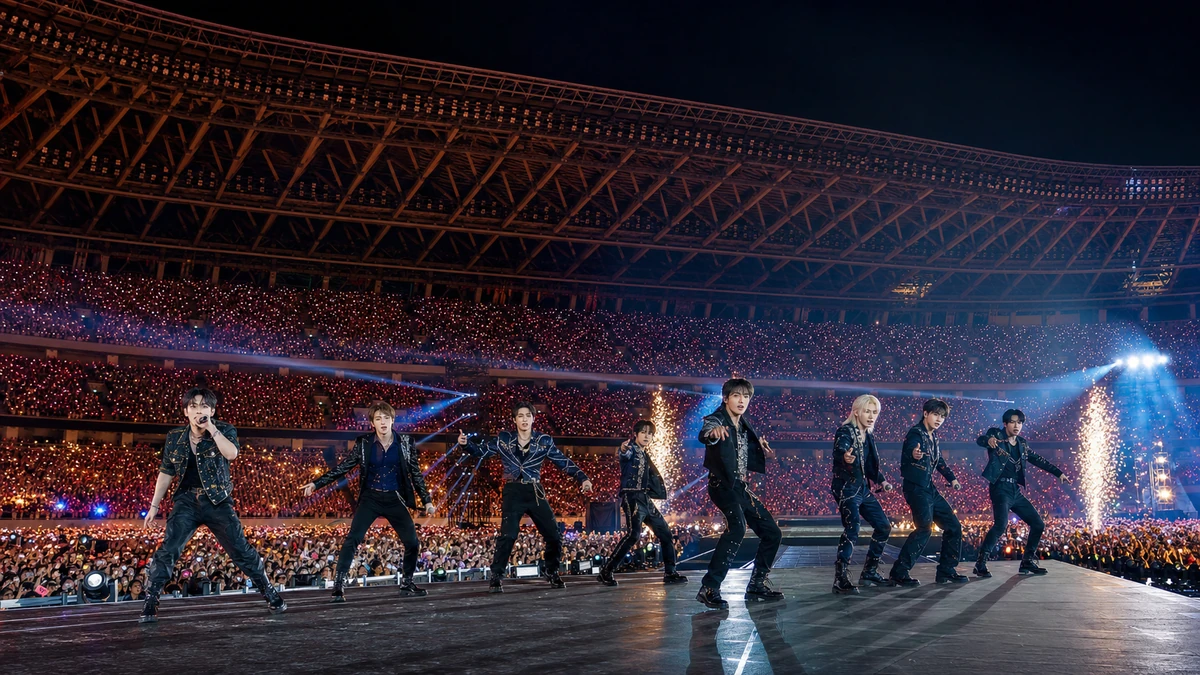
Stray Kids’ two-night stand at Tokyo’s National Stadium drew 140,000 fans on Aug. 29 and 30, a headline number that would be impressive in any market. But in the context of Asian pop, and especially the increasingly intertwined music economies of South Korea, Japan and the United States, the achievement points to something bigger than a pair of successful concert dates. According to JYP Entertainment, the South Korean company behind the group, Stray Kids became the first foreign male act to hold a solo concert at the venue, one of Japan’s most symbolic large-scale stages.
That distinction matters because Japan remains one of the world’s most important music markets, long known for its robust physical album sales, devoted fan culture and unusually strong live-performance business. For years, K-pop agencies treated success in Japan as both a major commercial goal and a test of staying power. Filling a big arena for one splashy night can be a sign of buzz. Filling multiple domes across multiple cities, then turning the country’s national stadium into a two-night event, suggests something sturdier: not just fandom, but a reliable touring franchise.
In other words, this was not merely a story about how many people showed up. It was a story about whether a group’s name alone can move tens of thousands of tickets across regions, dates and formats. On that count, Stray Kids appear to have crossed another threshold. Their Japanese leg of the new world tour, titled “Run It,” included seven sold-out shows across four cities: Nagoya, Osaka, Fukuoka and Tokyo. That kind of geographic spread matters in the concert business because it suggests demand is not concentrated in one urban center or driven only by social-media hype around a single prestige event.
For American readers, the closest analogy might be the difference between an artist trending online for one massive New York or Los Angeles show and an artist proving they can sell out stadium-caliber dates across several major U.S. markets. The latter is what defines a touring heavyweight. In that sense, Stray Kids’ Tokyo performance is best understood not as an isolated victory lap, but as evidence that the group has become a dependable live brand in one of the hardest and most lucrative concert markets in the world.
Why Japan still matters so much in the K-pop economy
To understand why this moment matters, it helps to understand Japan’s place in the Korean Wave, or “Hallyu,” the term used to describe the global spread of South Korean entertainment. Before K-pop became a fixture on the Billboard charts and at U.S. festivals, Japan was often the most important overseas proving ground for Korean acts. The market offered scale, loyal fans and a live-event culture willing to support repeat attendance, premium merchandise and fan-club ecosystems.
Japan is not just another stop on a world tour. For Korean entertainment companies, it has often functioned as a second home market, with separate album releases, Japanese-language songs, local TV appearances and carefully tailored promotions. Success there has historically required more than viral reach. It has demanded consistency, language adaptation, repeated fan engagement and the ability to turn interest into long-term spending.
That is part of what makes Stray Kids’ National Stadium concerts significant. The venue itself is symbolic, but the more important business signal may be that the group sold out all seven performances across four Japanese cities before extending the narrative further with three more announced dates at Tokyo Dome in November. Add those Tokyo Dome shows, and the group’s Japanese tour attendance is expected to reach 520,000. That is the kind of total that shifts the conversation from “popular idol group” to “major touring institution.”
For observers of the Korean entertainment industry, there is also another layer. K-pop’s global rise has often been measured by streaming numbers, YouTube views and chart milestones. Those are important, but they can sometimes obscure the financial and cultural power of live music. Concerts are where fandom becomes visible in physical space. They are also where an artist’s popularity becomes harder to dismiss as algorithmic or fleeting. A massive stadium crowd in Tokyo, especially one replicated across multiple cities, is a concrete indicator of market depth.
That matters at a time when K-pop companies are increasingly behaving less like traditional record labels and more like global intellectual property businesses. They do not just sell songs. They sell experiences: concerts, paid livestreams, merchandise, membership programs and a sense of communal participation. Stray Kids’ run in Japan illustrates how mature that model has become.
More than a record: How the concert itself reinforced Stray Kids’ growth story
The Tokyo shows were not presented simply as commemorative events built around the novelty of the venue. According to the details released after the concerts, Stray Kids used the set list to connect different eras of the group’s career, performing representative tracks including “Hellevator,” “Side Effects,” “MANIAC,” “God’s Menu,” “Thunderous” and newer material such as songs from the recent release “KARMA,” known in Korean coverage by the track grouping tied to “This and That.” The point was not just nostalgia. It was to compress the group’s artistic evolution into one large-scale live narrative.
That approach matters in a stadium environment. Big venues can magnify spectacle, but they can also expose thin catalogs or uneven pacing. A group that succeeds in an arena because fans know a handful of songs is not necessarily equipped to hold a stadium audience across a full evening. A stadium concert demands repertoire, sequencing and the ability to make songs from different phases of a career feel part of the same story. By mixing older signature tracks with newer work, Stray Kids did something many top touring acts aim for: they used familiarity to keep the crowd engaged while nudging fans toward the next chapter.
That is a hallmark of durable pop stardom. In the U.S., the biggest touring acts do not simply replay their greatest hits; they use the live show to convert present-tense relevance into future demand. That is also what Stray Kids appeared to do in Tokyo. The group used the concerts not only to celebrate a milestone, but to bridge into what comes next. During the show, members referenced their upcoming Japanese mini-album, “Hollow,” and announced three Tokyo Dome concerts scheduled for Nov. 6 through 8. That kind of onstage reveal is a classic arena-and-stadium tactic: turn one sold-out event into a launchpad for the next purchase.
The emotional tone mattered, too. After the performance, the members described the day as unforgettable and thanked fans for creating a scene “so incredible it was hard to believe.” That may sound like standard concert gratitude, but in idol pop the relationship between artists and fans is central to the product itself. K-pop fandom is participatory. Fans do not simply consume music; they organize, travel, collect, stream and help construct the symbolic meaning of milestones. In that sense, the 140,000 figure is not just a box-office statistic. It is also a measure of accumulated fan labor across years of engagement.
The livestream figure shows where the concert business is headed
The other number worth watching is 175,000. That is the combined total when the 140,000 in-person attendees are counted alongside paid livestream viewers for the Aug. 30 show. This detail may sound secondary compared with the stadium attendance, but it may be just as revealing about where the K-pop business is going.
Hybrid concert models, in which a live audience in the venue is paired with ticketed digital viewers around the world, expanded dramatically during the COVID-19 pandemic. Many industries abandoned their temporary digital workarounds once in-person events returned. K-pop did not. Instead, it refined them. Paid livestreams now operate less as emergency substitutes and more as permanent extensions of the concert economy.
For fans who cannot travel to Tokyo, cannot secure a seat or simply live too far away, the livestream turns a local event into a border-crossing fan experience. The audience is not physically together, but it is synchronized in time. That is a powerful commodity in fandom culture, where being present for the same moment matters almost as much as being present in the same place.
American music companies have experimented with similar ideas, from livestreamed festival sets to premium concert films, but K-pop agencies have often been more systematic in treating digital access as a core product rather than a side offering. They package concerts for both the building and the broadband connection. That strategy expands reach without requiring an artist to physically add more dates, and it creates a second layer of monetization around fan enthusiasm that is already peaking.
In business terms, Stray Kids’ Tokyo run demonstrates that a modern concert is no longer defined solely by the number of seats in a stadium. It is also defined by how effectively the event can be extended beyond its physical perimeter. The National Stadium shows were a huge in-person gathering, but they were also a global synchronized media event. For an industry built on transnational fandom, that combination is increasingly the point.
What this means for the United States
For the United States, Stray Kids’ Tokyo success is more than an overseas curiosity. It is another sign that K-pop’s center of gravity is no longer confined to one territory at a time. The same group that just filled one of Japan’s biggest venues also recently logged a ninth consecutive No. 1 on the Billboard 200, extending a streak that places Stray Kids among the most potent album acts of the 21st century by that measure. The implication for the American market is straightforward: K-pop is not just exporting songs into the U.S. anymore; it is training audiences to participate in a broader ecosystem of premium fandom spending.
That has consequences for American promoters, ticketing companies, venues, brands and even artists outside K-pop. When a Korean group can dominate album charts in the United States while simultaneously operating at stadium scale in Japan, it suggests a level of global coordination that many Western acts would envy. U.S. companies are paying attention because K-pop fans tend to be highly organized, highly mobile and unusually willing to spend on experiences that feel exclusive, collectible or communal.
There is also a strategic lesson here for the American live business. For years, U.S. music executives have looked at streaming as the clearest indicator of momentum. But K-pop continues to show that fandom density can matter more than mass casual listenership. A deeply committed global fan base may support repeat purchases across albums, merchandise, memberships and concert tickets in ways that traditional pop metrics do not fully capture. Stray Kids’ ability to translate U.S. chart dominance into sold-out Japanese stadium-scale performances reinforces the idea that fan infrastructure, not just playlist presence, is what drives the modern pop economy.
American audiences are also increasingly comfortable with non-English music in a way that would have seemed unlikely a decade ago. The success of K-pop, Latin music and other globally networked genres has weakened the old assumption that language is the main barrier to U.S. mainstream participation. In practical terms, that means Korean acts arriving in the United States no longer need to be treated as niche imports. They are now part of the same competitive touring and release environment as domestic stars.
For U.S.-Korea cultural ties, the growth is significant as well. Entertainment has become one of the most visible soft-power bridges between the two countries. Korean music, television and film reach American consumers directly, while U.S. chart systems, venues and brands increasingly play a role in validating and monetizing that reach. Stray Kids’ latest success in Japan, paired with their Billboard performance in the United States, underscores how Korean pop groups now operate across allied markets as truly global consumer brands.
And for American fans, the message is simple: what happens in Tokyo does not stay in Tokyo. It shapes tour planning, merchandising strategy, release schedules and the confidence with which Korean companies approach the U.S. market. A group that can move this much demand in Japan is likely to enter American negotiations with greater leverage, whether over stadium dates, sponsorships or distribution partnerships. That matters because it could mean bigger U.S. tours, more premium event offerings and more aggressive competition for major venues.
From chart records to touring power: what changed for Stray Kids
The most interesting part of this story may be the way different forms of success are starting to reinforce one another. K-pop groups have often excelled in one lane before fully breaking through in another: strong album sales but limited touring reach, huge online fandom but uneven local-market demand, or massive concert crowds without equivalent chart recognition in the United States. Stray Kids increasingly look like a group closing those gaps.
The Billboard 200 streak matters because it proves repeat purchasing power in the American market, even as debates continue over how to compare K-pop album strategies with those of Western acts. The Japan stadium and dome numbers matter because they show the group is not dependent on one chart system, one language market or one viral cycle. Together, those results suggest a broader industry shift: the biggest K-pop acts are now expected to win on several fronts at once.
That raises the competitive bar. For agencies, it is no longer enough to build a group with strong streaming numbers or a loyal domestic base. The modern benchmark is transnational monetization: can the act move albums in the United States, fill venues in Japan, activate digital audiences worldwide and keep fans engaged between releases? Stray Kids’ recent run suggests the answer, at least for now, is yes.
It also helps explain why the group’s Tokyo concerts were framed less as a one-off record and more as a marker of momentum. The announcement of new Japanese music and more live dates makes clear that the company sees this moment not as a culmination, but as an inflection point. That is usually how top touring acts think. They do not simply celebrate demand; they sequence it.
What to watch next in the K-pop touring economy
The next question is whether this scale of demand can be sustained, and how widely it can be replicated across the industry. Not every K-pop act can fill stadiums, and not every chart success translates into a durable live business. But Stray Kids’ latest numbers strengthen the case that the upper tier of K-pop is becoming more entrenched, not less, in the global concert economy.
That could have several ripple effects. One is venue escalation: groups that once aimed for arenas may push more aggressively toward stadiums or mixed stadium-dome strategies in Asia and North America. Another is greater reliance on paid digital extensions, including livestreams and on-demand concert packages, as companies seek to monetize demand that cannot fit inside the building. A third is more sophisticated local-market specialization, with separate release plans and touring arcs designed for Japan, the United States and other key territories.
For American readers who follow the Korean Wave, the larger lesson is that K-pop’s globalization is no longer best understood through internet virality alone. The real story is institutional. Korean companies have built repeatable systems for turning artists into cross-border live-event engines, and fans have shown they are willing to meet those systems with money, time and loyalty. Stray Kids’ 140,000-fan Tokyo stadium run, and the 175,000 total audience when livestream viewers are included, is one of the clearest recent examples of that machine working at full scale.
Seen that way, the Tokyo concerts were not just a triumph for one group or one weekend. They were a snapshot of where global pop is headed: fewer boundaries between markets, less separation between physical and digital fandom, and more value placed on artists who can convert cultural momentum into sustained, multinational audience behavior. For Stray Kids, that means a bigger stage. For the music business, including in the United States, it may mean a new standard for what global success looks like.
Comments
Post a Comment