Stray Kids’ Lee Know Donates to Nepal Flood Relief, Highlighting How K-pop’s Global Reach Is Expanding Beyond the Stage
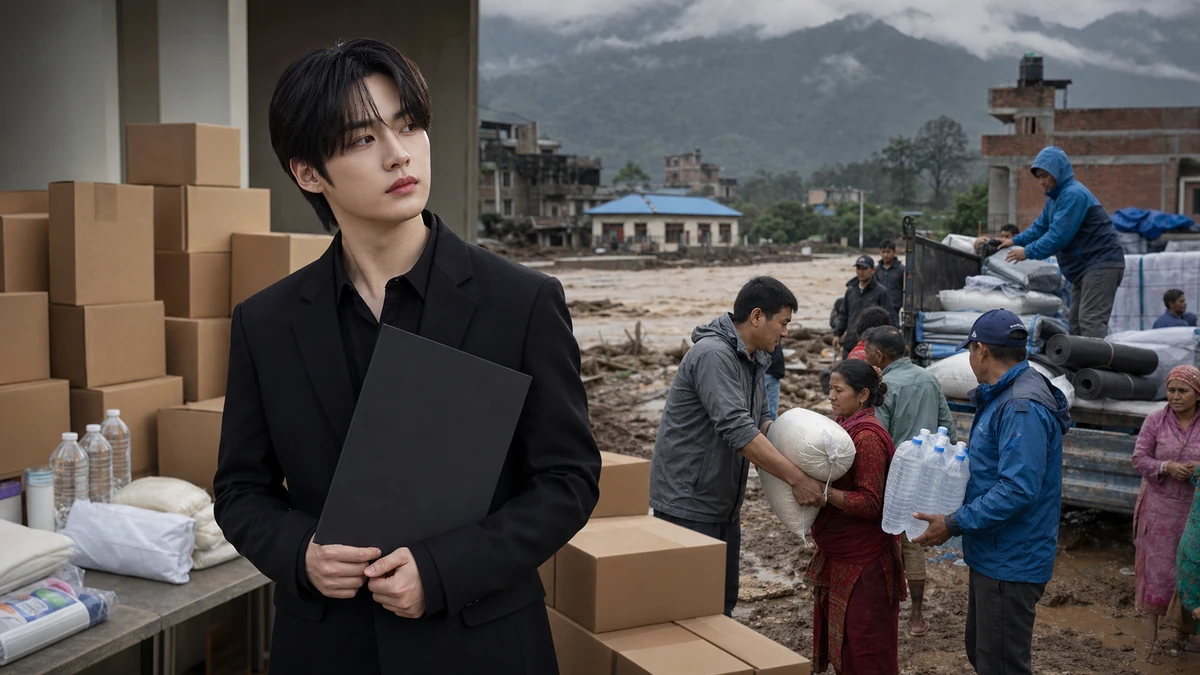
Image to help understand the article
A K-pop star’s donation carries weight beyond its dollar figure
Lee Know, a member of the South Korean boy group Stray Kids, has donated 100 million won — about $75,000 at recent exchange rates — to support emergency relief for flood victims in Nepal, according to his agency, JYP Entertainment. The money is being routed through World Vision, the international humanitarian organization, and is intended for some of the most urgent needs that follow a disaster: food, temporary shelter, clean water and sanitation.
On its face, that may sound like a familiar celebrity charity story. American audiences have seen versions of it for decades, from benefit telethons to individual donations from movie stars, athletes and musicians after hurricanes, wildfires and earthquakes. But in the context of modern K-pop, Lee Know’s gift matters for a larger reason. It shows how the influence built through global fandoms is increasingly being converted into humanitarian action far from the entertainment capitals where that influence was first generated.
That is especially notable here because the crisis is not in South Korea, and not in one of the biggest commercial markets for K-pop. Nepal sits outside the usual business conversation around album sales, stadium tours and streaming records. In that sense, the donation lands as more than a public-relations gesture tied to a strategic market. It suggests a broader understanding of what celebrity reach can do in an era when pop stars are no longer local or even simply national figures. They are international actors with audiences that stretch across borders, languages and causes.
Lee Know said he hoped his contribution could offer even “a small source of strength” to people going through a difficult time, while also expressing concern for relief workers on the ground. That wording is restrained by celebrity standards. It does not frame the donor as the center of the story, and it does not exaggerate what one contribution can accomplish. Instead, it points back to the people most affected — families who have lost stability, homes or access to safe drinking water — and to the workers trying to restore basic conditions after a natural disaster.
That matters in part because disaster coverage, whether in Asia or the United States, often turns human suffering into images, metrics and headlines. A donation aimed specifically at food, shelter, water and sanitation redirects attention to what recovery actually requires in the first days and weeks after a flood: not symbolism, but survival. In that respect, Lee Know’s contribution is significant not because it will solve a national emergency on its own, but because it is tailored to the kinds of interventions that can matter immediately.
Why the Nepal relief effort resonates beyond one news cycle
The most important details in this case are practical. Funds are expected to support food distribution, temporary housing and water and hygiene assistance. Those categories can sound bureaucratic in a press release, but they reflect a basic reality of disaster response recognized by aid groups from the Red Cross to USAID partners. Recovery does not begin with rebuilding roads or restoring tourism; it begins with keeping people alive, preventing disease and giving displaced families enough stability to get through the next day.
Food, shelter and safe water are not separate boxes so much as mutually reinforcing conditions. A family can receive rations and still remain at severe risk if it lacks a safe place to sleep. A temporary structure offers only partial relief if there is no clean water supply or sanitation. Anyone who followed American disaster coverage after Hurricane Katrina, Superstorm Sandy or the Maui wildfires knows how quickly public attention can move on even when basic infrastructure has not been restored. The same dynamic applies globally.
That is part of why celebrity donations can have outsize importance when they are attached to a trusted relief organization and a clearly defined use. They can accelerate funding in the period when speed matters most. They can also draw attention to emergencies that might not receive sustained international coverage, especially when they occur outside the geopolitical flashpoints that dominate American front pages and cable television. For many U.S. readers, Nepal appears in the news more often in relation to Mount Everest, tourism or the devastating 2015 earthquake than in connection with recurring climate-related disasters. A donation from a K-pop star with a large global fan base can reopen that line of attention.
In South Korea, this kind of giving also carries a particular cultural meaning. K-pop idols are often treated not only as entertainers but as public figures whose offstage conduct is closely watched by fans and the media. Charitable giving by stars is common enough that it no longer shocks the public, but it still functions as a marker of values. Fans do not simply consume songs, videos and choreography; they often track whether artists model generosity, humility and social awareness. That dynamic is not entirely different from what Americans expect from major stars, but K-pop fandom tends to be more organized, digitally connected and internationally responsive than many earlier fan cultures in the United States.
When a figure like Lee Know donates, the act is not just personal. It enters a wider ecosystem in which fans translate statements, circulate donation links, discuss the cause online and sometimes organize matching campaigns of their own. Even if no formal campaign follows, the architecture for transnational attention already exists. That is one reason K-pop’s philanthropic dimension deserves to be taken seriously: the genre’s influence is not measured only by Billboard positions or sold-out venues, but by how quickly its social networks can redirect public attention toward a crisis.
Stray Kids’ moment underscores a bigger shift in K-pop
The timing of the donation adds another layer. News of Lee Know’s contribution emerged as Stray Kids were also making headlines for concerts at Tokyo’s National Stadium, one of Japan’s marquee live-performance venues. The juxtaposition is striking. On one side is the spectacle of K-pop at its most commercially powerful: a major act playing one of the region’s biggest stages and reinforcing its place in the top tier of global pop. On the other is a quieter act of giving aimed at people far removed from the glamor of the concert business.
That split-screen image captures where K-pop is right now. For years, the industry’s international story was told mainly through metrics Americans recognize from their own music business: chart rankings, streaming milestones, arena tours, luxury-brand deals and crossover visibility. Those markers still matter. In fact, they matter more than ever because K-pop has become deeply woven into the economics of global entertainment, including the U.S. market. But the genre’s reach is also evolving into something less easily measured. As Korean acts grow more influential, the expectation that they will use that reach responsibly grows as well.
In American pop culture, there is a long history of stars using fame to champion causes, from Live Aid and post-9/11 benefit concerts to high-profile fundraising around racial justice, gun violence prevention and disaster relief. What feels newer in the K-pop context is the extent to which philanthropy has become part of the global reading of an artist’s public identity. Fans often pay close attention not just to whether a donation was made, but to how it was framed: whether the celebrity centered themselves, whether the aid was specific, and whether the action fit a broader pattern of conduct.
According to South Korean media reports citing Yonhap, Lee Know has been involved in helping people in need both inside and outside South Korea before. That history matters because audiences everywhere are more skeptical of one-off charity announcements than they used to be. In an era of image management and social-media branding, consistency is what gives a gesture credibility. The underlying question is familiar to Americans, too: Is this a carefully staged moment, or part of a real pattern of engagement? The available reporting points toward the latter, even if the public knows only part of the full picture.
The broader trend is that K-pop’s globalization is no longer just about export. It is about circulation: of money, attention, values and community norms. Korean entertainment companies once focused primarily on how to make acts legible to overseas consumers. Now their artists operate in a world where overseas audiences already understand the format and often expect something more from the people at its center. That “something more” can include activism, philanthropy and public expressions of solidarity that cross national lines.
What this means in the United States
For the United States, Lee Know’s donation is a reminder that K-pop is no longer a niche import or a youth trend sitting off to the side of American culture. It is part of the mainstream entertainment landscape, and with that comes a growing overlap between Korean celebrity influence and the social expectations Americans place on public figures. U.S. fans do not just stream songs and buy concert tickets; they participate in online communities that discuss ethics, representation, mental health, politics and charitable causes. When a Korean artist steps into humanitarian relief, American audiences notice in much the same way they would if a major U.S. pop star made a targeted disaster donation abroad.
The U.S. market is central to this story even if the disaster is in Nepal and the artist is Korean. Stray Kids are one of several K-pop acts that have built substantial visibility in America through touring, chart performance, social media and a fan base that spans far beyond Korean American communities. That audience includes teenagers, college students, young professionals and families in cities where K-pop concerts now draw crowds similar in intensity to fandoms around Taylor Swift, Beyoncé or Harry Styles. For those fans, an artist’s charitable action is not peripheral. It can shape loyalty, deepen emotional connection and influence whether the public sees the star as merely successful or genuinely consequential.
There is also a business angle. American entertainment companies, promoters, brands and nonprofit groups increasingly operate in spaces where K-pop artists have major pull. As that happens, U.S. institutions are learning what Korean entertainment firms have understood for years: fandom can mobilize not only around consumption but around values. A celebrity announcement can trigger fundraising, media attention and grassroots participation across continents within hours. That does not mean every charitable gesture becomes a movement, but it does mean American companies and organizations ignore K-pop’s civic potential at their own risk.
The U.S.-South Korea relationship provides another layer of relevance. The alliance is often discussed in terms of security, trade, technology and diplomacy. But culture is a major part of how the relationship is now experienced by ordinary people. K-pop, Korean film, television and beauty brands have changed how many Americans understand South Korea — not as a distant strategic partner alone, but as a source of globally resonant culture. When Korean artists engage in humanitarian giving, that too becomes part of the country’s soft power footprint. It reinforces an image of South Korea as not just culturally influential, but socially engaged.
There is a useful comparison here to American celebrity philanthropy after overseas disasters, whether after the 2004 Indian Ocean tsunami, the Haiti earthquake or humanitarian emergencies in Ukraine and Gaza. U.S. stars often help translate distant suffering into terms that domestic audiences can emotionally process. K-pop artists are increasingly doing something similar for global fan communities that include millions of Americans. In practical terms, that means Korean celebrities now occupy a role once reserved mostly for Western stars: interpreters of international concern for mass audiences.
That shift should not be overstated. One donation does not transform U.S. foreign awareness, and celebrity giving can never substitute for government aid, long-term development work or serious coverage of climate vulnerability. But it can change who pays attention, and attention remains a scarce resource in a media environment crowded with crises. For American readers and industry observers, that is the key takeaway. K-pop’s U.S. footprint is now large enough that its philanthropic signals can reverberate inside the American conversation.
The fan dimension: How K-pop communities turn attention into action
One reason this story deserves analysis rather than a brief item is that K-pop fandom operates differently from many older forms of pop fandom familiar to Americans. Fans are not just audiences. They are often volunteer translators, community organizers, streaming coordinators, charitable fundraisers and rapid-response amplifiers. In the United States, that has sometimes led to stereotypes about online intensity or competition between fandoms. But it has also produced a less appreciated reality: these communities can be highly effective at channeling collective energy toward causes once a signal is given.
That does not mean every fan will donate, or that every charitable mention becomes a campaign. It means the infrastructure exists. A short message from an artist can be reposted across multiple platforms, translated into several languages and contextualized for audiences in North America, Latin America, Europe and Southeast Asia in a matter of hours. Compare that with earlier eras of celebrity activism in the United States, when fans might hear about a cause mainly through television interviews, magazine coverage or charity singles. Today’s K-pop fandom is built for speed, scale and emotional immediacy.
There is also an educational component. Many American fans of Korean pop culture become, almost by necessity, learners of context. They pick up bits of language, understand industry norms, follow Korean media outlets and learn how different charitable groups operate. That does not make fandom a substitute for expertise, but it does create a public more open to cross-border stories than conventional assumptions about entertainment audiences would suggest. When an idol donates to Nepal flood relief, the story is not sealed within Korea. It becomes legible to international audiences who are already used to navigating cultural distance.
This is where Lee Know’s wording matters again. By framing his donation as a wish to offer even a small measure of strength, he leaves room for the crisis itself to remain central. For fans, that can be a cue. The artist is not asking to be praised for benevolence; he is signaling concern and directing visibility toward people in distress. In a media culture saturated with self-display, restraint can be powerful. It tells fans what kind of response is appropriate.
American readers may recognize a parallel in how some of the most effective celebrity interventions at home work best when they are specific, modest in tone and connected to credible organizations. Public trust is not easily won. It grows when the cause is concrete, the message is measured and the aid mechanism is clear. On that front, this donation follows a template that U.S. audiences increasingly prefer.
What to watch next as K-pop’s global influence matures
The bigger story is not simply that a star gave money after a disaster. It is that K-pop has reached a stage of global maturity where these acts of giving are becoming part of the industry’s broader public meaning. The question now is how that influence will develop. Will philanthropy remain mostly episodic and artist-driven, or will it become more structured through partnerships between entertainment companies, fan communities and international relief organizations? Will fans increasingly expect social engagement from top-tier acts in the same way they expect new music, tours and online content?
There are reasons to think the answer may be yes, at least in part. As K-pop companies expand internationally, they are navigating the same pressures that American entertainment firms face: consumers want values as well as products, especially from public figures whose influence is intensely personal. Younger audiences in particular often evaluate stars not only by talent, but by conduct. In that environment, humanitarian action can become one of the ways artists define what kind of public role they want to occupy.
Still, there are risks. Celebrity philanthropy can slide into branding if it becomes too polished, too frequent or too obviously aligned with image maintenance. It can also distort public understanding if donations are treated as solutions rather than as contributions to much larger relief systems. That is why the specifics in this case matter. The cause is real, the uses are concrete, and the framing is appropriately limited. It is not a claim to have fixed a disaster. It is an acknowledgment of need and a commitment of resources.
For Americans tracking the Korean Wave, this is also a sign that the movement’s significance now extends well beyond entertainment exports. Hallyu — the term used for the global spread of South Korean culture — once referred mainly to the rise of Korean dramas, pop music and film abroad. Today it also describes a more complicated web of influence involving identity, commerce, language, beauty standards, technology, diplomacy and, increasingly, public ethics. When an artist like Lee Know uses his platform to support flood victims in Nepal, that is part of Hallyu too.
In the end, the most meaningful element of the story may be the simplest one. A performer who was receiving cheers on one of Asia’s biggest stages also chose to direct resources toward people facing one of life’s most basic emergencies: the loss of safety and normalcy after a flood. That contrast — spectacle on one side, vulnerability on the other — says something important about celebrity in a connected world. Fame can stop at applause, or it can travel farther. In this case, it traveled toward relief.
For American audiences, that is worth paying attention to not because it is unusual for a celebrity to give, but because it shows how the center of global cultural influence keeps shifting. Korean pop stars are not just entering the U.S. market anymore. They are participating in the broader civic and humanitarian conversation that shapes what global stardom means. Lee Know’s donation will not end Nepal’s suffering. But it offers a clear example of how K-pop’s international power is being defined not only by who fills the stadium, but also by who uses that spotlight to illuminate need elsewhere.
Comments
Post a Comment