Suwon Samsung rallies from two goals down in stoppage-time drama, underscoring the grind of South Korea’s promotion race
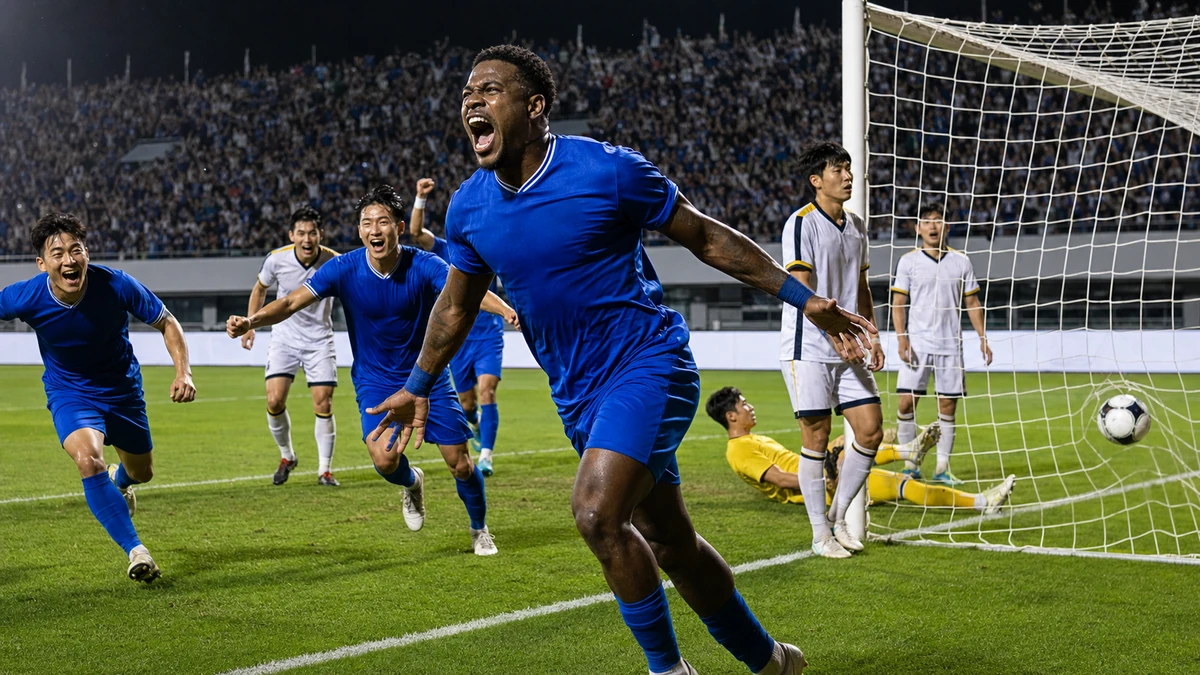
A comeback that felt bigger than a draw
On paper, it goes into the standings as a tie. In the emotional logic of a long soccer season, though, Suwon Samsung Bluewings’ 2-2 draw with Chungbuk Cheongju FC on Friday felt much closer to an escape act.
Suwon, one of South Korea’s best-known clubs, trailed by two goals on the road before Hayes struck in the 77th minute and again deep into stoppage time to salvage a point in a K League 2 match that swung from control to collapse and then, somehow, to survival. The result left Suwon on 37 points after 20 rounds, at least temporarily moving the club to the top of the second-division table while promotion rivals continued their own schedules.
For American readers more familiar with Major League Soccer, the broader setup is worth explaining. South Korea’s professional game is split into tiers, with K League 1 at the top and K League 2 beneath it. Unlike MLS, where teams cannot be relegated, clubs in South Korea live with promotion and relegation pressure every year. That means even a single point pulled from a bad night can carry outsized importance by the time the season ends.
That is what made this draw feel so significant. Suwon did not simply share points with Chungbuk Cheongju. It avoided a loss after appearing headed for one, preserving momentum in a crowded race where the difference between direct promotion, a playoff path and another year in the second division can come down to thin margins.
The timing of the goals told the story. Chungbuk Cheongju held a two-goal advantage into the final stretch, and Suwon looked set to leave empty-handed. Then Hayes changed the mood of the night with one finish that restored belief and another that erased defeat altogether. By the time the final whistle arrived, the feeling around the match had been completely reordered.
Why this matters beyond one summer night
Suwon is not just another second-division club trying to climb the ladder. The Bluewings are one of the traditional names in Korean soccer, a team with a large fan base, a long history and the kind of brand recognition that makes its presence in K League 2 feel unusual. For American sports fans, a rough analogy might be a legacy franchise from a major market suddenly finding itself in a lower league and trying to fight its way back under the glare of expectation.
That expectation changes the meaning of matches like this one. A draw away from home against a determined opponent is not normally the sort of result that sends supporters into celebration. But when a promotion favorite falls behind by two and still finds a way to take something from the game, it becomes a measure of resilience as much as quality.
There is also the pressure of the table. Suwon entered the match chasing first place in K League 2, with Busan IPark close behind and still scheduled to play later. In a promotion race, standings often shift from night to night, especially during the summer stretch when fixtures pile up and fatigue becomes a factor. Teams do not only win titles or promotion pushes with statement victories; they also do it by surviving the nights when they are second best for long stretches.
That was the value of Friday’s comeback. Had Suwon completed the full turnaround and won, it would have tightened its grip near the top. But even without all three points, the club kept itself from suffering the kind of setback that can ripple through a squad and fan base. In a league season, there is a special skill in refusing to lose.
For Chungbuk Cheongju, the game landed very differently. The club had a chance to secure a high-profile win over one of the division’s most recognizable teams and let it slip away in the closing moments. That is the cruelty of soccer and, in many ways, why the sport keeps its hold on supporters. Ninety minutes can turn on one lapse, one rebound, one spell of panic or one player catching fire at exactly the wrong time for the opponent.
Hayes becomes the face of the night
Every comeback needs a figure to center it, and on this night it was Hayes. His two second-half goals did more than change the scoreline. They changed the emotional temperature of the stadium and the calculus of the standings in a matter of minutes.
The first goal, in the 77th minute, did what late goals often do in soccer: It made everyone nervous. A 2-0 lead can feel safe until it becomes 2-1, and then every clearance matters more, every throw-in takes longer and every attack begins to carry a little more fear. One goal does not merely cut a deficit. It invites pressure and doubt into spaces that had seemed under control.
The second, scored in the 95th minute, was the dagger to Chungbuk Cheongju’s hopes and the lifeline Suwon desperately needed. In the box score, it counts the same as an equalizer scored in the 50th minute. In reality, a stoppage-time goal lands with a different weight. It denies the opponent the chance to respond. It wipes away the emotional preparation for victory. It sends one bench into relief and the other into disbelief.
American fans who grew up on sports built around the final drive, the buzzer-beater or the ninth-inning rally will recognize the rhythm. Soccer does not package drama in exactly the same way, but stoppage time serves a similar function. It is the sliver of chaos at the end of order, the stretch when every touch can become legend or regret. Hayes lived in that space Friday.
His performance also offered a reminder about the role individual finishing still plays in an era obsessed with systems, pressing and structure. Coaches can organize a team into dangerous areas, but someone still has to complete the move. Hayes took his moments and, in doing so, rewrote how the match will be remembered. Instead of becoming a cautionary tale about a promotion contender sleepwalking through an away game, it became a story about nerve, persistence and a striker who refused to let the result settle too early.
Chungbuk Cheongju’s missed chance says plenty, too
Lost in the comeback is the reality that Chungbuk Cheongju did many things well for much of the night. The home side built a two-goal lead and, for more than an hour, looked capable of delivering the kind of upset that can define a season for a club outside the spotlight.
Chungbuk Cheongju also entered the match with its own point of interest. The club is led by Portuguese manager Rui Quinta, its first foreign head coach. In Korean soccer, where domestic coaching networks have traditionally been influential, that detail matters. It reflects both the increasing internationalization of the league and the willingness of clubs outside the biggest brands to search for an edge in recruitment and tactics.
For much of the game, that edge seemed real. Holding Suwon down while taking a two-goal lead against a top side is not a fluke. It suggested organization, discipline and enough attacking purpose to trouble one of the division’s stronger teams. If Chungbuk Cheongju had closed out the win, the result would have sent a message well beyond one night’s standings. It would have marked the club as a genuine spoiler in the promotion race and an uncomfortable opponent for anyone with ambitions near the top.
Instead, the ending exposed the other side of competitive growth: learning how to finish games against clubs with greater experience, larger fan pressure and more individual quality. That is often one of the last steps for emerging teams in any league. Building a lead is one thing. Protecting it when the opponent surges and the clock becomes an enemy is another.
The disappointment for Chungbuk Cheongju should not erase the warning it delivered to the rest of the league. This was not a lucky underdog hanging on. This was a side that had Suwon in real trouble and, until late, appeared on course for a significant result. The lesson for the home team is painful but useful: against promotion contenders, concentration has to last until the last kick, not merely until the game feels won.
The standings are tight, and survival skills matter
One of the easiest mistakes in reading soccer standings is to treat every result as a simple matter of three points for a win, one for a draw and none for a loss. The math is basic. The meaning is not.
Suwon’s draw pushed the club to 37 points on an 11-4-4 record, enough to move into first place at least temporarily. But because Busan remained just behind on 36 points with a game still to play, the table was not settled. That uncertainty is part of what makes second-division races so tense. Teams often spend hours or days in first place without knowing whether they will remain there once the rest of the schedule catches up.
For American readers accustomed to conferences and playoff seeds, the best comparison might be the late summer push in baseball, when clubs scoreboard-watch almost as closely as they watch their own games. A team can complete a stirring comeback on Friday only to find itself bumped in the standings by Saturday night. That does not make the comeback meaningless. It just means every point enters a larger ecosystem of pressure.
In promotion races, durability becomes as important as brilliance. Clubs need the ability to dominate weaker opponents, but they also need the less glamorous habit of limiting damage on bad nights. Championship teams and promoted teams are not always the ones that look best every week. Often they are the ones that avoid emotional free-fall, that keep collecting enough points to stay alive until the decisive stretch.
Suwon’s performance offered both encouragement and warning. The encouragement is obvious: a team that can claw back two goals late has belief, depth of resolve and a striker capable of delivering under pressure. The warning is just as clear: falling behind by two to begin with is a dangerous habit, especially in a division where opponents grow more confident the longer the season goes. If Suwon wants to turn its stature into promotion, it will need more of the grit from the final minutes and less of the looseness that made the comeback necessary.
Summer heat is becoming its own opponent in Korea
This match also belongs to a wider story unfolding across South Korean soccer in August: heat and humidity are shaping outcomes in visible ways. On the same day, a K League 1 match between FC Seoul and Jeonbuk Hyundai Motors ended 0-0 in conditions reported at around 86 degrees Fahrenheit with humidity above 80 percent at kickoff. For anyone who has spent time in East Asia during midsummer, those numbers tell only part of the story. The air can feel heavy enough to wear.
That context matters when evaluating late comebacks and defensive collapses. Exhaustion is not an excuse, but it is part of the competitive reality. Pressing becomes harder, recovery runs slow by a fraction and concentration can fray in precisely the moments when teams most need calm. A match that begins as a tactical contest can end as a test of who still has enough legs and clarity to execute.
In that sense, Suwon’s comeback was not just dramatic; it was a display of endurance. The club remained aggressive late rather than accepting the shape of defeat. Chungbuk Cheongju, by contrast, could not carry its lead through the final stages. Over a season, those details accumulate. Summer soccer often rewards not only the most talented teams, but the ones best equipped to manage bodies, rotate lineups and stay mentally locked in while the weather drains everything else.
This, too, may need a bit of translation for American audiences. Korean league seasons unfold through monsoon rains, punishing humidity and compact scheduling, especially in a country where travel is manageable enough to allow frequent fixtures but recovery time can still be limited. Coaches talk openly about “enduring” stretches of the calendar, and that language is not melodrama. It reflects a real tactical and physical challenge built into the season.
When FC Seoul manager Kim Gi-dong said even standing on the bench was difficult in the humidity, he was underscoring a truth shared across the leagues: sometimes the goal in August is not to dazzle, but to get through. Suwon did that in the most dramatic way possible Friday.
What American readers should take from Korean soccer’s drama
For those who do not follow Korean soccer closely, this match offered a strong introduction to why the leagues deserve more international attention. The game had the elements that travel across cultures and sports: a favored club under pressure, a challenger on the verge of a breakthrough, a late comeback and a single player seizing the final act.
It also showcased some of the features that make Korean soccer distinct. There is the intensity of promotion and relegation, which turns midseason matches into emotionally loaded events. There is the blend of domestic identity and global influence, visible in foreign players, foreign managers and clubs balancing local tradition with international ambition. And there is the fan culture, where support for historic sides such as Suwon carries the kind of inherited loyalty American audiences might associate with long-rooted baseball or college football programs.
Most of all, Friday’s draw was a reminder that the most revealing games are not always the cleanest or most dominant. Sometimes they are the messy, frantic ones that expose a team’s character. Suwon did not leave Chungju looking invincible. It left looking stubborn, vulnerable and very much alive in the title race. Chungbuk Cheongju did not get the statement win it wanted, but it demonstrated enough quality to suggest it can trouble bigger names again.
That is why the result resonated beyond a simple split of the points. In the standings, it was one point apiece. In mood, it felt like rescue for Suwon and regret for Chungbuk Cheongju. In the broader picture of Korea’s soccer season, it was another sign that the race at the top may be decided not only by brilliance, but by which teams can keep their nerve when the legs are gone, the air is heavy and the clock says there is almost no time left.
On Friday night, Suwon found exactly enough time.
Comments
Post a Comment