Image to help understand the article
A costly shield shows its limits
Taiwan has spent heavily to protect some of its most sensitive military sites from the fast-growing threat of drones. But a recent audit has raised a troubling question: What happens when an expensive defense system is built for yesterday’s threat, while the adversary has already moved on to tomorrow’s?
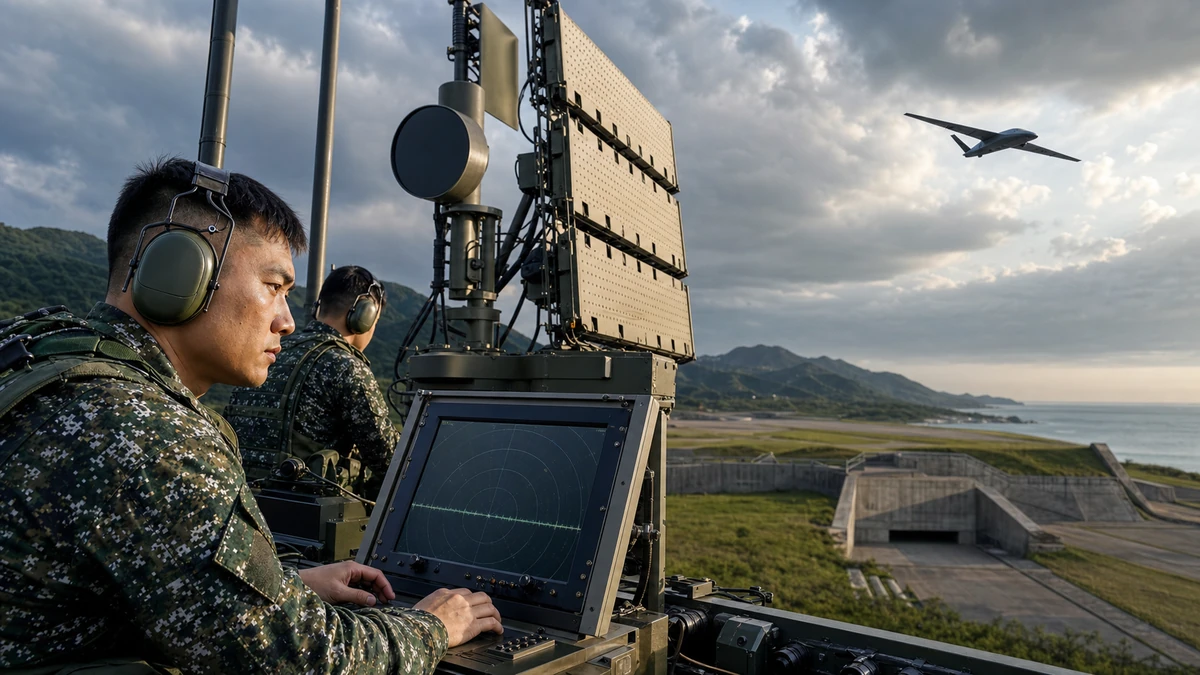
According to findings disclosed by Taiwan’s audit authorities and reported by the South China Morning Post, a fixed counter-drone defense network worth about $3.55 billion has significant flaws. The system, developed by Taiwan’s top military research institution, was deployed to protect air bases and other key military facilities. Yet auditors found that it could not detect or jam the frequencies used by newer Chinese military drones.
That matters because counter-drone defense is not simply about placing hardware around a base and calling it secure. It is a chain of actions. A system must first detect that a drone is present, then identify the communications or control signals it uses, and then interrupt, jam or otherwise neutralize it. If detection fails, the rest of the sequence may never start. If a drone is detected but cannot be jammed, commanders may know a threat is approaching without having an effective way to stop it.
The Taiwan case is striking not only because of the size of the investment, but because of what the failure says about modern military competition. In an era when drones are getting cheaper, smarter and more adaptable, static defensive systems can age quickly. The audit does not necessarily mean Taiwan has no way to respond to drones, nor does it prove that all of its air defenses are compromised. But it does suggest that one of the systems intended to protect its most important facilities may not perform as designed against the kinds of drones China is now fielding.
For American readers, the story resonates beyond the Taiwan Strait. It speaks to a broader lesson familiar to the Pentagon, U.S. defense contractors and even domestic police departments: Technology procured at enormous cost can become less effective if the threat evolves faster than the bureaucracy, procurement cycle and testing regime designed to answer it.
Why drones have changed the security equation
To understand why this audit is such a serious warning, it helps to understand how dramatically drones have changed warfare. Small uncrewed aircraft were once seen largely as surveillance tools or niche battlefield assets. Today, they are used for reconnaissance, targeting, electronic warfare and direct attack. In conflicts from Ukraine to the Middle East, drones have proven capable of harassing advanced militaries, identifying troop positions, damaging infrastructure and forcing commanders to rethink everything from camouflage to runway operations.
That evolution has made counter-drone defense one of the hottest sectors in military spending. The challenge is that drones are not one thing. They vary widely in size, cost, altitude, software and communications systems. Some depend on common radio frequencies. Others are designed to resist jamming, switch frequencies or operate with greater autonomy. That means a defensive system built around known signal patterns can become obsolete if the attacker updates the drone’s communications architecture, navigation method or software.
In plain terms, think of it less like building a wall and more like maintaining antivirus software. The threat does not stand still. It updates. It probes. It learns from earlier encounters. And if the defensive side is slow to patch its vulnerabilities, the weakness does not remain theoretical for long.
Taiwan’s fixed counter-drone network appears to embody that problem. A fixed system has a clear appeal. It can provide persistent protection around air bases and other strategic sites without the need to constantly redeploy equipment. But permanence is also a weakness if the system’s technical assumptions harden while the threat changes. A drone defense network installed around a known target can become a predictable environment for an adversary to study, map and exploit.
That is one reason the audit matters even beyond the specific findings on frequency detection and jamming. It points to a larger structural issue: whether fixed counter-drone systems can keep pace with rapidly changing threats unless they are continuously updated, aggressively tested and repeatedly validated against real-world adversary capabilities.
What this reveals about Taiwan’s defense challenge
Taiwan occupies a uniquely difficult security position. It faces a much larger military across the Taiwan Strait and has spent years trying to build deterrence through a mix of domestic weapons development, foreign purchases and hardening of critical infrastructure. Drones, especially those fielded by China’s People’s Liberation Army, complicate that strategy because they can pressure expensive fixed assets at relatively low cost.
Air bases and military facilities are especially important in this context. They are not just symbols of military readiness; they are functional hubs for aircraft operations, logistics and command. If a drone can approach such a facility undetected, or be detected but not disrupted, the consequences can range from surveillance and intelligence gathering to psychological pressure and operational disruption. Even when a drone attack does not destroy a target, it can force a military to change routines, move resources or operate under constant uncertainty.
The audit’s language, as summarized in reports, is important because it appears to describe a technical limitation rather than a minor administrative shortfall. This is not merely a story about delayed maintenance or uneven training at one installation. The issue appears to be that the system cannot detect or interfere with frequencies used by newer Chinese drones. That distinction is crucial. A maintenance problem can sometimes be fixed with discipline and management. A technical mismatch between defensive equipment and adversary systems can require redesign, upgrades or an entirely different procurement approach.
At the same time, caution is warranted. Public audit summaries rarely disclose the full picture, especially in a military context where secrecy is routine. It is possible Taiwan has overlapping or mobile systems that were not addressed in the report. It is possible the shortcomings apply under specific conditions rather than across every operational scenario. And it is possible Taipei will move quickly to modify the network or supplement it with new capabilities. What is clear, however, is that the audit has punctured the assumption that high spending alone guarantees effective protection.
That is a politically sensitive conclusion in Taiwan, where defense budgeting is closely watched and where public confidence in military preparedness plays a role in deterrence. A defense system protecting high-value targets cannot be judged mainly by the scale of its budget or the prestige of the institution that built it. It has to be judged by whether it works against the threat it is supposed to defeat now, not the one planners anticipated years earlier.
The deeper trend: defense systems are aging faster
The Taiwan case fits a larger pattern in global security: The lifecycle of military relevance is getting shorter. Weapons platforms and defensive systems once remained effective for long stretches with incremental improvements. That is increasingly less true in domains shaped by software, sensors, signals and autonomy.
Drones are an especially vivid example because their development cycle can be much faster and cheaper than that of traditional military platforms. A fighter jet program takes years and vast sums of money. A drone family can be modified more quickly, sometimes through changes in electronics, control systems or software that are difficult to spot from the outside. That asymmetry gives attackers options. They can search for seams in a defender’s sensor coverage or jamming profile without matching the defender dollar for dollar.
For governments, this creates a procurement dilemma. Bureaucracies are built to approve, fund, test and field systems through formal processes designed for accountability and reliability. Those procedures exist for good reasons, particularly when public money and national security are at stake. But they can also slow adaptation. By the time a system is procured, installed and certified, the threat it was designed to address may already have shifted.
This is why the audit’s most important implication may not be about one system’s shortcomings, but about the need for constant verification. A counter-drone network cannot be treated like a one-time construction project. It has to function more like a continuously updated service. New frequencies, new drone types and new attack methods require repeat testing. Auditors and defense planners must ask not simply whether a system met requirements when it was built, but whether those requirements still reflect battlefield reality.
That logic extends far beyond Taiwan. It applies to missile defense, cybersecurity, electronic warfare and maritime surveillance. In each case, the old assumption that fielding a system equals solving a problem is under pressure. The real contest increasingly lies in adaptation speed: who can identify new vulnerabilities first, patch them faster and sustain performance under changing conditions.
What this means for the United States
For the United States, Taiwan’s counter-drone gap is not just a regional defense story. It is a reminder of how vulnerable high-value targets can be when low-cost uncrewed systems evolve quickly. American military planners have already been grappling with this reality across the Indo-Pacific, the Middle East and Europe. The Taiwan audit gives that concern a concrete, allied case study.
The U.S. has deep strategic interests in Taiwan’s resilience, even while Washington maintains its longstanding policy framework on the island’s political status. American officials increasingly view Taiwan not only as a flashpoint in U.S.-China competition but also as a frontline laboratory in modern deterrence. If Taiwan’s fixed defenses against drones are showing strain, that matters to the Pentagon, to U.S. Indo-Pacific Command and to lawmakers who support military assistance, defense coordination and arms sales.
It also matters commercially. The U.S. defense industry is investing heavily in counter-uncrewed aircraft systems, often called counter-UAS. American companies, from major defense contractors to smaller technology firms, are pursuing sensors, electronic warfare tools, directed-energy systems and software designed to identify and defeat drones. Taiwan’s experience may strengthen arguments in Washington that allied partners need not just hardware deliveries, but faster upgrade pathways, more rigorous red-team testing and procurement models that better account for iterative threat changes.
There is also an unmistakable domestic parallel. The United States has seen growing concern about drones near military bases, airports, stadiums and critical infrastructure. In the American context, much of that concern has focused on hobbyist misuse, espionage risks, criminal applications or the challenge of identifying who is flying what near sensitive areas. But the underlying policy question is similar: Can the systems in place keep up as drones become more common, more capable and potentially more resistant to conventional countermeasures?
The comparison is not exact. Taiwan’s challenge is shaped by the presence of a nearby military adversary with advanced drone capabilities. The U.S. homeland threat environment is different. Still, the lesson translates cleanly: a defense architecture that looks robust on paper may prove thinner in practice if it has not been stress-tested against the latest technologies and tactics.
For American audiences, there is another point worth noting. U.S. debates about Taiwan often center on semiconductors, naval power or the risk of a great-power conflict. This story points to a less glamorous but increasingly central layer of security: the battle over airspace just above the ground, where inexpensive, adaptable drones can challenge even sophisticated militaries. In future crises, runway access, base survivability and sensor reliability may matter as much as headline-grabbing weapons programs.
U.S.-Taiwan ties and the politics of defense credibility
The audit may also sharpen scrutiny around how Taiwan spends defense money and how the United States evaluates the island’s preparedness. In Washington, support for Taiwan has broadened in recent years, but so has the expectation that Taipei must make difficult, practical choices about defense priorities. American analysts often describe this through the lens of an “asymmetric” strategy, meaning investments in capabilities that can survive, adapt and impose costs on a stronger attacker rather than relying primarily on prestige platforms.
A counter-drone network would seem to fit that logic. Protecting bases and key facilities from low-cost aerial threats is exactly the kind of practical mission that should matter in an asymmetric defense posture. If that network then proves unable to handle newer Chinese drones, critics may ask whether Taiwan’s defense institutions are moving fast enough, testing rigorously enough or building procurement systems capable of staying current.
That does not automatically undermine Taiwan’s broader defense strategy, but it does add pressure. U.S. lawmakers and defense officials have repeatedly emphasized resilience, stockpiles, civil defense and dispersed military capabilities. A report showing gaps around fixed military sites could reinforce arguments for layered defenses rather than reliance on a single technical solution. It may also encourage closer U.S.-Taiwan cooperation in areas such as electronic warfare, systems integration and realistic testing against emerging drone profiles.
Diplomatically, the issue touches credibility. Deterrence depends partly on perception. If China believes Taiwan’s fixed defenses have exploitable weaknesses, that could influence its planning or gray-zone pressure tactics, including surveillance flights and coercive demonstrations short of open conflict. Conversely, if Taiwan responds transparently and quickly by upgrading and validating its systems, the episode could become evidence of institutional responsiveness rather than weakness.
In that sense, the real significance of the audit may lie in what happens next. Defense failures uncovered in peacetime can be damaging, but they can also be useful if they trigger reform before a crisis tests the system in earnest. For allies and partners, discovering a vulnerability is bad. Discovering it early enough to fix it is far better than learning about it under fire.
What to watch next
The immediate question is whether Taiwan can close the gap quickly. The public reporting so far establishes the existence of significant flaws in the fixed counter-drone network and identifies newer Chinese drone frequencies as a problem. What it does not fully reveal is the scope: whether the issue affects all protected sites equally, whether software and hardware updates can solve it, or whether a more fundamental redesign is required.
That uncertainty makes several follow-up questions important. First, will Taiwan disclose how it plans to address the findings? Second, will there be evidence of more frequent or more realistic testing against evolving Chinese drone systems? Third, will Taipei lean more heavily on mobile, layered or distributed counter-drone tools rather than depending so much on fixed infrastructure? And fourth, will the episode influence how the U.S. and other partners think about supporting Taiwan’s defense modernization?
There is a broader industry question as well. Around the world, governments are pouring money into counter-drone systems because the threat is visible and urgent. But Taiwan’s experience suggests buyers should be asking harder questions before and after procurement. How often are systems retested against new frequencies and drone classes? How quickly can they be updated in the field? Are they evaluated in realistic operational conditions, or mainly against benchmark scenarios that do not reflect current adversary behavior?
For American readers, the story ultimately is not just about Taiwan or even just about China. It is about the new rhythm of defense in the drone era. Expensive systems may still matter, but their value depends less on their sticker price than on how often they are challenged, revised and proven in conditions that resemble the threats they will actually face.
Taiwan’s audit has exposed a gap between investment and effectiveness. That gap is strategically important because Taiwan sits at the center of one of the world’s most dangerous geopolitical fault lines. But it is also globally relevant because it captures a wider truth of modern security: In a contest shaped by rapid technological change, the side that adapts fastest may matter more than the side that spends most.
Comments
Post a Comment