Two Grand Slams, One Pennant Race: What Samsung’s Rout Says About the KBO’s Growing Appeal — and Why U.S. Fans Should Pay Attention
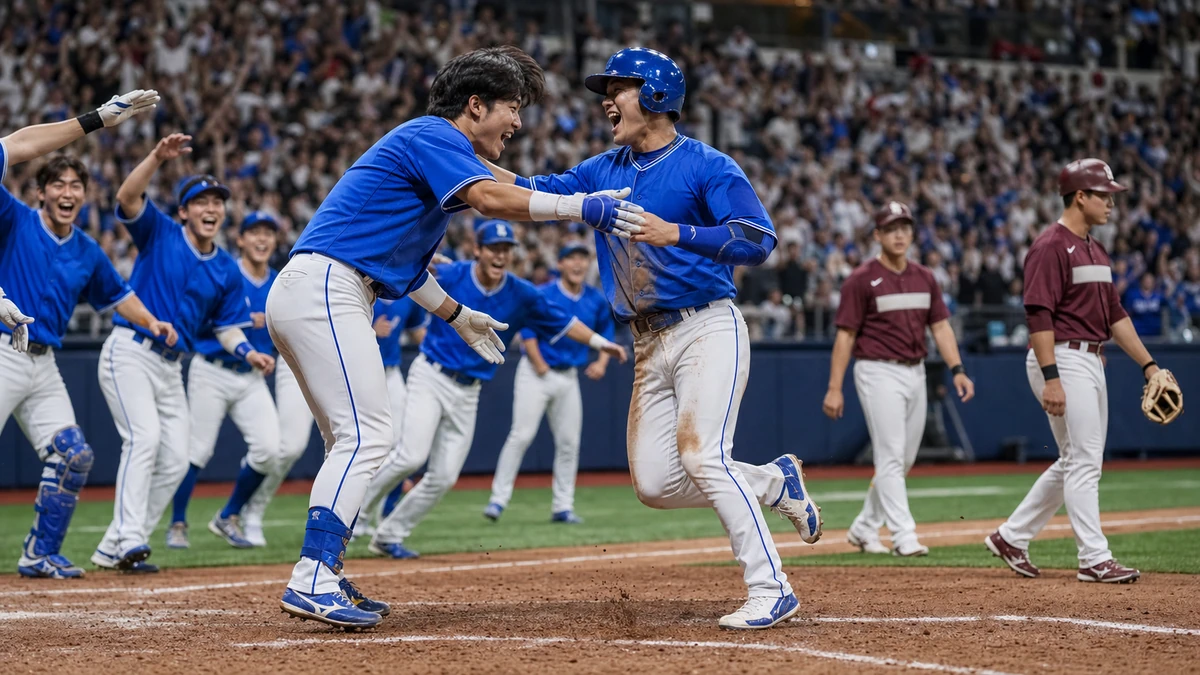
Image to help understand the article
A blowout that meant more than a blowout
On paper, the score was simple enough: the Samsung Lions beat the Kiwoom Heroes 12-2 on Friday in Seoul. But in the late stages of a Korean Baseball Organization season, when the standings tighten and every night begins to feel like a scoreboard watch, this was more than a lopsided win. It was the kind of game that crystallizes why South Korean baseball has become easier for international audiences — especially Americans — to understand, appreciate and, increasingly, follow.
Samsung’s victory at Gocheok Sky Dome, the domed stadium in western Seoul that has become one of the KBO’s most television-friendly settings, was powered by a rare feat: two grand slams in the same game by two different hitters. Veteran slugger Choi Hyung-woo broke the game open early with a first-inning grand slam, and Kim Young-woong all but buried Kiwoom with another in the fifth. Together, those two swings produced eight runs and turned a close race in the standings into the story of the night.
The Lions, now riding a three-game winning streak, remained in second place but pulled within a half-game of first-place kt wiz, which also won Friday. That matters because the KBO’s final weeks can resemble the stretch run of a tight Major League Baseball division race, except compressed by a smaller league, a more concentrated media spotlight and an atmosphere in which every shift in momentum can seem magnified. Samsung did not take over first place, but it did something nearly as important: it sent a message that its lineup is heating up at exactly the right time.
For American readers who may know Korean baseball mostly from the pandemic-era months of 2020, when ESPN aired KBO games before MLB returned, this was a reminder that the league’s appeal is not novelty alone. The KBO offers drama that translates across borders: playoff-style urgency, recognizable baseball tension, and emotional storylines built around veterans, prospects and comebacks. Friday’s game had all of that in one package.
There was the tactical move by Samsung manager Park Jin-man, who bumped Park Seung-gyu into the leadoff spot after a productive game the day before. There was the early unraveling of Kiwoom rookie starter Park Jun-hyeon, who issued consecutive walks after allowing a leadoff single. And there was Choi, the cleanup hitter, punishing the mistake and instantly changing the shape of the night. By the time Kim added his own grand slam later, the game had become not just a win but a statement about lineup depth, timing and belief.
Why two grand slams in one game resonate beyond the box score
Baseball fans in the United States do not need Korean fluency to understand the electricity of a grand slam. It is one of the sport’s most universally legible moments: bases loaded, one swing, instant eruption. When it happens twice in the same game, and by different hitters on the same team, it moves from exciting to memorable.
That is what happened in Seoul. Choi’s first-inning grand slam was the more immediate turning point. Samsung had gone scoreless against Park Jun-hyeon over two earlier starts this season, managing no runs in 12 innings against him before Friday. This time, the script flipped in the first inning. Park Seung-gyu singled to right to open the game, Kim Sung-yoon and Koo Ja-wook drew back-to-back walks, and Choi drove a fastball over the center-field wall. In one swing, Samsung answered a lingering matchup problem and grabbed control.
For Americans used to the language of October baseball, that kind of swing is what broadcasters call a “tone-setter.” It did more than create a 4-0 lead. It changed the psychological balance of the game. Kiwoom’s young starter was under pressure immediately, Samsung’s dugout had momentum, and the crowd saw a game plan click in real time. Park’s decision to alter the top of the order looked smart, and Choi’s execution gave it weight.
Kim’s fifth-inning grand slam carried a different kind of significance. If Choi’s blast was the opening statement, Kim’s was the exclamation point. Samsung already led 5-2 when it loaded the bases with no outs again. Kim, batting seventh and playing third base, sent the ball over the right-field wall and pushed the margin into runaway territory. In a game of changing possibilities, that was the swing that stripped Kiwoom of realistic hope.
The symmetry made the game stand out: two bases-loaded chances, two home runs, eight runs total. But the contrast between the hitters made it more compelling. Choi was the established run producer doing what middle-of-the-order veterans are paid to do. Kim was the younger power hitter trying to reclaim his season after injuries and inconsistency. One blast was about authority; the other was about revival.
That combination is part of what gives KBO baseball its distinct rhythm. The league often rewards contact and situational hitting more visibly than the all-or-nothing style that can dominate stretches of modern MLB, but power still matters enormously, especially in high-leverage spots. Friday’s game was a showcase of both KBO strategy and baseball’s oldest truth: traffic on the bases changes everything.
The Choi-Kim contrast tells a bigger story about timing, pressure and recovery
One reason this game carries meaning beyond a single night is the way it put two very different player arcs on the same stage. Choi, one of Korean baseball’s most accomplished veteran hitters, entered the night as the lineup anchor and delivered exactly the kind of stabilizing force contenders rely on down the stretch. Kim entered with a much shakier season behind him, and his grand slam felt less like confirmation than possibility.
According to Korean reports, Kim has spent much of this year fighting through physical setbacks, including repeated time on the injured list because of hamstring-area discomfort. He also spent time in the minors amid a slump. For a hitter who posted 28 home runs in 2024 and 22 in 2025, his power had largely gone missing this season, with just two home runs before Friday. That is the kind of stat line that invites doubt, whether in Seoul, St. Louis or anywhere else baseball is followed closely.
So when Kim said afterward that he was simply trying not to strike out and hoping to produce at least a fly ball to the outfield, the comment landed with familiar honesty. American audiences hear versions of that all the time from players emerging from slumps: simplify the at-bat, stop chasing the home run, focus on helping the team. Often that mindset is praised because it reflects baseball’s version of humility. The irony, of course, is that a restrained approach can still produce the game’s biggest swing.
Kim’s grand slam matters because it suggests Samsung may be getting a dangerous bat back just as the race tightens. In a long season, contenders are rarely defined only by their stars. They are often defined by the moment secondary or struggling pieces begin producing again. In MLB terms, it is the difference between a top-heavy lineup and one that suddenly offers no safe lane for opposing pitchers.
That is what Samsung showed Friday. Choi delivered from the cleanup spot, as expected. But Samsung also got leadoff traffic, patient at-bats that drew walks, and a decisive blast from the lower half of the order. That kind of layered offense is hard to game-plan against, especially in a weekend series that could help decide first place.
There is also a broader emotional logic to this game. Baseball seasons are long enough to produce private frustrations that only occasionally become public redemption. Fans in any country recognize the release that comes when a player who has labored through injuries or disappointment suddenly delivers in a huge moment. Kim’s swing was worth four runs on the scoreboard, but to Samsung supporters it likely carried a second value: renewed belief.
A pennant race is tightening, and the KBO’s upper tier is delivering real drama
Samsung’s win did not move the Lions into first because kt wiz also won, beating the Doosan Bears 5-4 on a walk-off hit in the ninth inning. If anything, that made the standings more compelling. Samsung improved to 66-44-3, a .600 winning percentage, while kt remained just ahead at 65-42-3, or .607. In the KBO standings, that leaves only a half-game between them.
For readers less familiar with the KBO, the tie column can make standings look slightly unusual compared with MLB, but the competitive tension is easy to grasp. A half-game gap in late summer is the baseball equivalent of seeing two runners come into the final stretch nearly shoulder to shoulder. Every win matters, but so does the manner of the win. A walk-off and a blowout can both count as one victory in the standings, yet they generate different kinds of momentum and pressure.
Samsung’s performance was especially timely because it came ahead of a crucial series with kt. If you are trying to chase down the league leader, there are few better ways to enter that kind of matchup than by proving your offense can create runs in multiple ways. The Lions did not rely on a string of lucky bounces or one isolated inning. They got on base, drew walks, punished mistakes and kept the pressure on.
The race is also larger than two teams. LG Twins and KIA Tigers both won Friday as well, staying within striking distance. That means the top of the KBO table is not merely close; it is crowded. In that environment, a team cannot treat wins against lower-ranked opponents as routine business. They become mandatory opportunities, and failing to capitalize can reshape the standings in a hurry.
This is one area where the KBO can feel especially intense to outside observers. Because the league has fewer teams and because fan loyalty in South Korea can be highly concentrated and deeply generational, pennant races often carry a persistent sense of public attention. Every notable result reverberates through television, mobile alerts, sports portals and fan communities. The emotional volume can feel high, particularly in big markets like Seoul and Daegu, Samsung’s home city.
Friday’s game fit squarely within that environment. Samsung did what contenders are supposed to do in late-season baseball: beat the team in front of them, do it convincingly and force the first-place club to keep answering. kt did answer, which means the pressure continues. That is good news for Korean baseball and for anyone abroad looking for a compelling race to follow.
What this means in the United States
For American audiences, Samsung’s big night is not just an entertaining overseas box score. It is part of a larger story about how Korean baseball continues to matter to the U.S. sports ecosystem — as content, as a scouting environment, as a cultural export and as a bridge in the broader U.S.-South Korea relationship.
First, there is the media and fan angle. Many Americans first encountered the KBO in 2020, when live Korean baseball filled an early-pandemic void before MLB resumed play. What began as necessity turned into genuine interest for some viewers. The league’s bat flips, organized cheering sections, colorful broadcasting style and tightly packed races offered a version of baseball that felt both familiar and refreshingly different. Games like Samsung’s 12-2 win help explain why that interest has not entirely vanished. The product is dramatic, the stars are legible, and the storylines travel well.
Second, there is the business angle. American media companies, streaming platforms and sports rights holders have learned that international leagues can build niche but loyal audiences in the United States. The KBO is not the English Premier League or Formula One in America, but it occupies the same broad category of sports properties that can gain ground if the presentation is smart and the storytelling is accessible. A game featuring two grand slams in a pennant race is exactly the kind of highlight that helps an overseas league cut through in a crowded U.S. market.
Third, there is the scouting and player-development angle. MLB clubs have long monitored Korea for talent, and the traffic is no longer unusual. Korean stars such as Ha-seong Kim, Hye-seong Kim, Jung Hoo Lee and others have made the KBO more visible to American front offices and fans alike. Even when a game does not feature a player on the brink of a move to MLB, it still contributes to the broader evaluation ecosystem by showing how teams deploy hitters, develop pitchers and manage pressure moments. A veteran like Choi and a rebound candidate like Kim represent the kind of player narratives scouts and analysts understand instinctively.
Fourth, there is the cultural diplomacy angle. Sports have long functioned as one of the softer but more effective channels in the U.S.-South Korea relationship, alongside entertainment, technology and education. Americans may engage Korea first through K-pop, Korean film or cuisine, but sports often deepen that familiarity by presenting daily routines, loyalties and public rituals. Baseball, in particular, offers a useful common language because it is one of the strongest points of cultural overlap between the two countries.
And finally, there is a comparison to the United States itself. American baseball fans regularly celebrate statement wins late in the season as signs that a club is rounding into playoff form. Think of the way analysts talk about a contender “finding its lineup” in August or September, or how one breakout performance from a struggling power bat can alter expectations for an entire series. Samsung’s win fits that pattern. It is not hard for an American audience to map this onto familiar MLB storylines. That is precisely why the KBO remains one of the easiest foreign leagues for U.S. fans to enter.
The bigger trend: Korean baseball is increasingly easy for global audiences to follow
What changed Friday was not simply the standings. What changed was the narrative temperature around Samsung. The Lions did not just win; they looked like a team peaking at the right moment, with strategic flexibility at the top of the order, veteran thunder in the middle and signs of life from a once-slumping power hitter deeper in the lineup. Those are the ingredients analysts look for when deciding whether a contender is real.
The game also underscored a broader point about the KBO as a product for global consumption. Korean baseball is no longer something outsiders notice only when an individual star leaves for MLB. It is increasingly watchable on its own terms because the league offers clean story arcs: close races, emotionally invested fan bases, strong local identities and enough cultural distinction to feel fresh without becoming inaccessible.
For Americans, that accessibility matters. The KBO’s atmosphere can be louder, more choreographed and more communal than the average MLB game, but the underlying stakes remain familiar. A veteran punishes a rookie’s early nerves. A manager’s lineup adjustment pays off. A slumping slugger finds redemption in a huge spot. The first-place chase tightens because both contenders win on the same night. These are baseball stories before they are Korean stories, which is exactly why they can travel.
What to watch next is straightforward. Can Samsung carry this offensive burst into its showdown with kt wiz? Can Kim turn one cathartic swing into a genuine late-season resurgence? And can the Lions keep pace in a top-heavy race where LG and KIA are still close enough to punish any stumble?
Those are local questions in South Korea, but they are also the kinds of questions that make sports feel global. On a humid summer night in Seoul, two grand slams transformed a regular-season game into something bigger: a snapshot of a league in full competitive bloom and a reminder that Korean baseball, at its best, speaks a language American fans already know how to hear.
Comments
Post a Comment