Ukraine’s Patriot Appeal to Japan Highlights a Bigger Question for U.S. Allies: How Far Can Civilian Defense Go Under Old Security Rules?
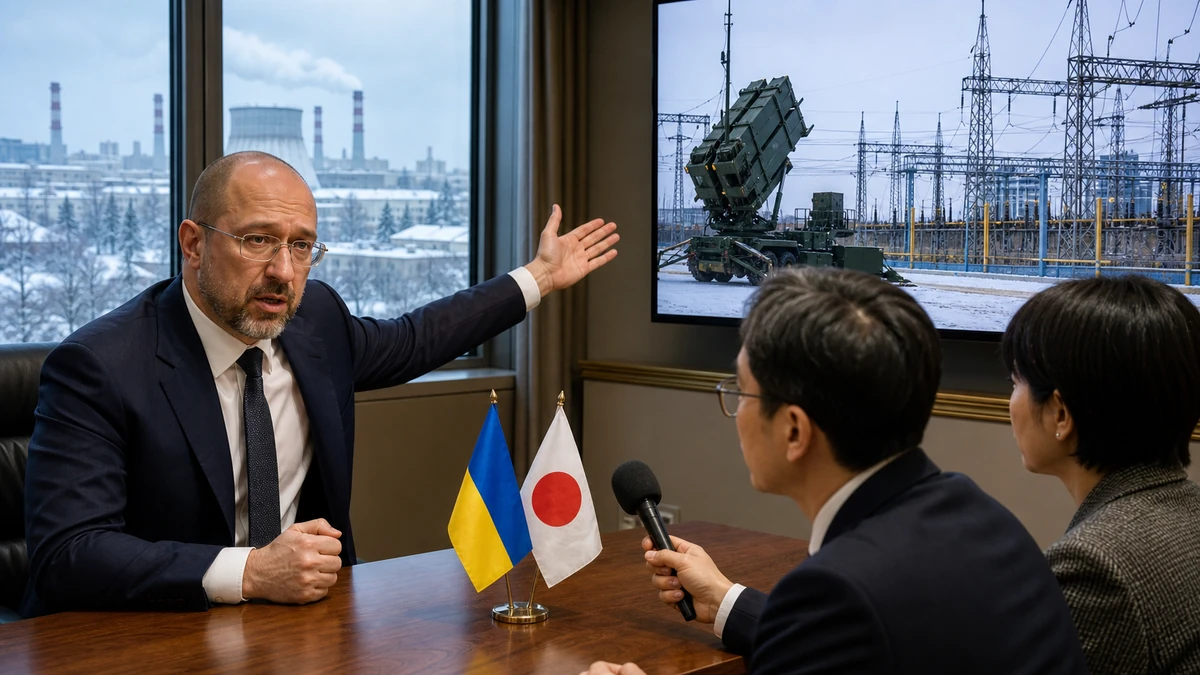
Image to help understand the article
Ukraine narrows its ask — and that is the point
Ukraine’s new prime minister, Serhii Koretskyi, has chosen an unusually specific way to make his case to Japan: He is not publicly asking for broad military aid, a new package of weapons or a vague show of solidarity. He is asking for one thing — Patriot interceptor missiles.
That precision matters. In wars that drag into their third year and beyond, governments often shift from sweeping appeals to focused requests tied to a single strategic need. In this case, Ukraine is signaling that its most urgent concern is not simply battlefield momentum but the protection of civilians and the infrastructure that keeps daily life functioning. Koretskyi, in an interview published by Japan’s Kyodo News, framed the need around defending people, power facilities and the country’s ability to endure the winter heating season.
For American readers, the logic is easy to understand even if the hardware is highly specialized. Patriot is one of the world’s most recognizable air and missile defense systems, familiar in the United States as a cornerstone of missile defense and a recurring feature of U.S. security assistance debates. When Ukraine asks for Patriots, it is asking for the ability to knock down incoming threats before they hit apartment blocks, substations and other essential targets. That makes the request about more than military positioning. It is also about keeping the lights on.
That distinction is central to how Ukraine appears to be presenting its case to Japan. Rather than emphasizing offensive capability or a broader escalation of military support, Koretskyi tied the request to civilian survival. In practical terms, missile defense can mean the difference between a damaged transformer and a functioning grid, between a difficult winter and a catastrophic one. In political terms, it is a way of asking a cautious U.S. ally to view missile support not only through a military lens but also through a humanitarian one.
The request also reveals something important about where the war stands now. Earlier stages of the conflict often focused international attention on tanks, artillery and long-range strike capability. Today, the protection of energy infrastructure is again moving to the center of the conversation. That reflects both the rhythm of the war and the calendar. As colder months approach, the defense of electrical networks becomes inseparable from the defense of civilian life. Ukraine’s message to Japan is that missile interception is not an abstract strategic asset. It is a public utility in wartime.
There is another reason this matters. Publicly naming a specific system puts pressure on a potential partner to answer in concrete terms. It is easier for governments to endorse Ukraine in broad language than to say yes or no to a particular military transfer. By naming the Patriot, Ukraine has made the question sharper: not whether Japan supports Ukraine in principle, but whether Japan is prepared to cross a line from moral and diplomatic backing into direct transfer of a high-profile defensive weapon.
Japan’s answer is cautious, and deeply revealing
Tokyo’s initial response was restrained and, at least for now, negative. Japan’s government said providing weapons to Ukraine would be difficult at present. That wording is familiar to anyone who follows Japanese security policy. It does not slam the door in theatrical terms, but it makes clear that the current answer is no unless major political and legal hurdles are addressed.
The significance lies in those hurdles. According to the Korean summary of the interview and Japan’s reaction, an actual transfer of Patriot missiles would require political leadership from Prime Minister Sanae Takaichi as well as a defense equipment transfer agreement. In other words, this is not the sort of support that can be improvised through sentiment or public pressure alone. It would require a deliberate decision at the top and a framework that makes such a transfer legally and institutionally possible.
That gap between strategic sympathy and formal action is a defining feature of contemporary Japanese security policy. Japan has moved substantially in recent years toward a more active defense posture, especially in response to China’s military rise, North Korea’s missile program and a worsening regional environment. But it still operates within political traditions and legal constraints shaped by the post-World War II era, when the country’s security identity was built around constitutional pacifism and severe limits on military activity abroad.
For U.S. audiences, there is an American analogy here, though not a perfect one. Think of the difference between Washington publicly supporting an ally and Congress authorizing a sensitive transfer that carries legal, political and diplomatic consequences. The rhetoric may be aligned, but the machinery of the state moves on its own timetable. In Japan, that timetable can be even more restrictive when the question involves weapon exports.
The phrase “difficult at present” is especially important. It suggests a government trying to acknowledge urgency without promising movement. It also reflects a reality common among U.S. allies: leaders may want to preserve flexibility, but they are often constrained by domestic procedure, coalition politics, public opinion and established legal practice. So while the wording leaves theoretical room for future change, it should not be mistaken for a quiet yes. At this stage, the only verified fact is that Japan is not prepared to agree under current conditions.
That matters because there is often a temptation, especially in international security coverage, to treat diplomatic ambiguity as momentum. In this case, the evidence does not support that conclusion. There is no announced negotiation, no new transfer framework and no public timeline for review. What exists is a clear Ukrainian request and a cautious Japanese response. The distance between those two positions is the story.
A war need collides with an ally’s rules
The standoff illustrates a larger problem facing countries that support Ukraine but are not structured for rapid military transfers. Ukraine is operating on wartime urgency. Its leaders are making decisions around the immediate protection of civilians, infrastructure and seasonal energy demand. Japan is operating on institutional time. Its leaders must weigh law, process, precedent and the political meaning of sending weapons into an active war.
Those are not simply different views. They are different clocks.
Ukraine’s argument is straightforward: the need for air defense is immediate, especially if energy infrastructure and residential life are at risk heading into winter. Delays are not neutral. They carry real consequences for households, hospitals, transit systems and basic governance. When the target is the power grid, missile defense becomes part of the social safety net.
Japan’s position, by contrast, is shaped by the structure of state decision-making. Even if Japanese leaders accept the humanitarian logic of protecting civilians, they still face the harder question of whether that justifies a transfer of military equipment long treated as politically sensitive. This is where the discussion becomes less about Ukraine alone and more about how democracies adapt old security rules to new kinds of conflict.
The Korean summary captures this tension well: Ukraine has tried to narrow the moral and political gap by emphasizing civilian protection instead of military escalation. That is a smart diplomatic move, and one American policymakers will recognize. In Washington, advocates of support for Ukraine have often framed air defense in similar terms, arguing that interceptor systems are fundamentally about shielding cities and infrastructure from attack. Yet persuasive framing does not automatically dissolve legal barriers. A compelling humanitarian case and an executable policy are not the same thing.
This is why the Patriot request has become a test case in support diplomacy. It asks whether a close U.S. ally can reinterpret or adapt its rules when the weapon in question is defensive, the target being protected is civilian infrastructure, and the stakes include the survival of a country facing sustained missile attacks. If the answer is still no, then the limits of allied support are sharper than public statements of solidarity sometimes suggest.
There is also a strategic communications lesson here. By making the appeal public through Japanese media, Ukraine ensured that the debate would not stay buried inside ministries. It moved the issue into public view, where Japanese officials must address not only the substance of the request but the broader image of Japan’s role in global security. That does not mean Tokyo will change course. But it does mean the costs of saying no are more visible, both internationally and domestically.
What this means for the United States
For Americans, the most important takeaway is not whether Japan ultimately sends Patriot missiles. It is what this episode says about the burden-sharing problem inside the U.S.-led alliance system.
The United States remains the central military supporter of Ukraine and the principal supplier of high-end air defense capability among Western allies. That creates both leverage and strain. Washington wants allies in Europe and Asia to do more for regional and global security. But when a case like this emerges, it exposes how uneven those capacities remain — not only in stockpiles, but in law, political culture and export rules.
From an American perspective, Japan’s hesitation is understandable and potentially frustrating at the same time. Understandable, because Japan’s defense posture has long been shaped by domestic restraint and a powerful norm against becoming directly involved in overseas conflicts. Frustrating, because the United States has spent years encouraging allies to take on greater security responsibilities and act more like strategic stakeholders. If even a narrowly framed request for defensive missiles to protect civilians cannot be accommodated, critics in Washington may ask what “more active ally” really means in practice.
This debate will resonate in U.S. policy circles because it touches on a broader American concern: the reliability of allied adaptation in a more dangerous world. The Biden and Trump eras, despite their many differences, have both featured versions of the same question — are U.S. allies prepared to shoulder greater responsibility when rules written for an earlier era collide with present-day threats? Japan is hardly alone in facing that test. European allies have confronted similar debates over tanks, long-range missiles and air defense stocks. But the symbolism is especially sharp in Japan’s case because Tokyo is so central to America’s Indo-Pacific strategy.
There is also an industrial angle. Patriot is not just a weapon system; it is part of a larger U.S.-allied defense ecosystem involving production, licensing, replenishment and strategic prioritization. When governments discuss providing interceptors, they are also confronting hard questions about supply chains and inventory. Americans have heard versions of this at home in debates over munitions production and the ability of U.S. industry to support multiple theaters at once. A request like Ukraine’s therefore lands in Washington not only as a diplomatic matter but as a reminder of how finite advanced air defense resources can be.
For American audiences, another familiar reference point is the way civilian infrastructure has become central in modern war. In the United States, discussions of homeland resilience usually focus on cyberattacks, grid vulnerability and disaster preparedness. Ukraine’s experience shows how those concerns look under missile bombardment. That helps explain why interceptor systems carry such urgency. They are not only military assets; they are infrastructure protection tools. U.S. officials and lawmakers who already view air defense through that lens may see Ukraine’s request to Japan as a reasonable extension of a burden-sharing model Washington has long advocated.
At the same time, American officials are likely to understand that pushing Japan too hard on a sensitive transfer could backfire. The U.S.-Japan alliance depends on steady trust and careful alignment, especially as both countries manage security tensions with China and North Korea. Washington’s interest is not simply in extracting one decision from Tokyo, but in encouraging a longer-term evolution of Japanese security policy that is politically sustainable.
Why this matters beyond Japan and Ukraine
The deeper significance of this episode is that it highlights a transition in global security politics. For years, international support debates often revolved around whether countries were willing to help. Increasingly, the more complicated question is what kinds of help democratic states are institutionally built to provide.
That is a different and more revealing test.
Many of America’s allies now agree on the broad threat environment. Russia’s war in Ukraine, North Korean missile advances and the growing assertiveness of China have narrowed the space for strategic ambiguity. But consensus on threat perception does not automatically produce consensus on action. Some governments can move quickly on sanctions but slowly on arms. Others can provide humanitarian aid more easily than military equipment. Still others have the political will but lack the legal framework.
Japan sits at the center of this pattern. It is a wealthy democracy, a treaty ally of the United States, and a country that has gradually expanded its security profile. Yet it remains constrained by a distinct postwar policy culture. That makes Japan a useful case study in the mismatch between strategic importance and policy flexibility. If Tokyo ultimately cannot move on a request framed around civilian defense, that will underscore how much of the international order still runs through rules written for a less volatile time.
Ukraine understands this, which is likely why its messaging is so carefully designed. By emphasizing citizens, energy facilities and winter heat, Kyiv is effectively arguing that the old categories no longer fit. A missile aimed at a power plant is not merely a battlefield threat. It is an attack on public health, economic continuity and social stability. Defensive interceptors, under this logic, are not only instruments of war but tools of humanitarian protection.
Whether governments accept that logic is likely to shape the next phase of alliance politics. The issue will not be limited to Ukraine. It will arise in future crises wherever civilian systems become military targets and democratic allies must decide whether their rules are flexible enough to meet the moment. That is one reason this otherwise narrow story has outsized importance. It is not only about one country asking another for one type of missile. It is about how 21st-century democracies classify defense itself.
What to watch next
For now, the facts remain limited and should be kept separate from speculation. Ukraine has made a public request to Japan for Patriot interceptor missiles. Japan has responded that providing weapons to Ukraine is difficult at present. Any actual transfer, according to the available reporting summarized here, would require political leadership from the prime minister and a defense equipment transfer agreement. No negotiation timetable or policy shift has been announced.
Still, there are several indicators worth watching.
First is whether Japanese officials continue to treat the matter as closed for now or begin to discuss procedural pathways in more detail. Even a technical conversation about legal mechanisms would not guarantee action, but it would suggest the request has advanced from public messaging into policy review.
Second is whether the issue is framed inside Japan primarily as a military export question or as part of a broader civilian-protection debate. That distinction could shape public support. If the conversation stays centered on “sending weapons,” resistance may remain strong. If it shifts toward “protecting civilians and energy systems,” the politics may become more fluid.
Third is the role of the United States. Washington may not need to publicly pressure Tokyo for this episode to matter. Simply by existing, the request forces another look at how allied capabilities, legal authorities and industrial constraints line up. In the long run, that may be the more important development. The United States is increasingly asking allies to be not just sympathetic partners but operational contributors in a world of overlapping security crises.
Finally, there is the broader seasonal reality. Ukraine’s emphasis on winter is not rhetorical decoration. Energy infrastructure has been a recurring pressure point in the war, and every month matters when defense planners are trying to protect grids, heating systems and civilian morale. That urgency explains why Kyiv made a narrow, direct appeal. It also explains why a cautious answer from Tokyo carries more weight than an ordinary diplomatic exchange.
In the end, this story is less about a sudden breakthrough than about a stubborn gap: the gap between a country fighting to keep its population warm and its power flowing, and an allied democracy whose laws and politics make the most obvious form of help difficult to deliver. For American readers, that gap should feel familiar. It is the same fault line running through much of today’s alliance politics — strong statements of support on one side, slower and more constrained instruments of action on the other.
Ukraine’s request has made that contradiction impossible to ignore. Whether Japan eventually changes its answer, the question will remain for the United States and its allies alike: In an era when civilian infrastructure is a battlefield, can old security rules keep up with new forms of defense?
Comments
Post a Comment