
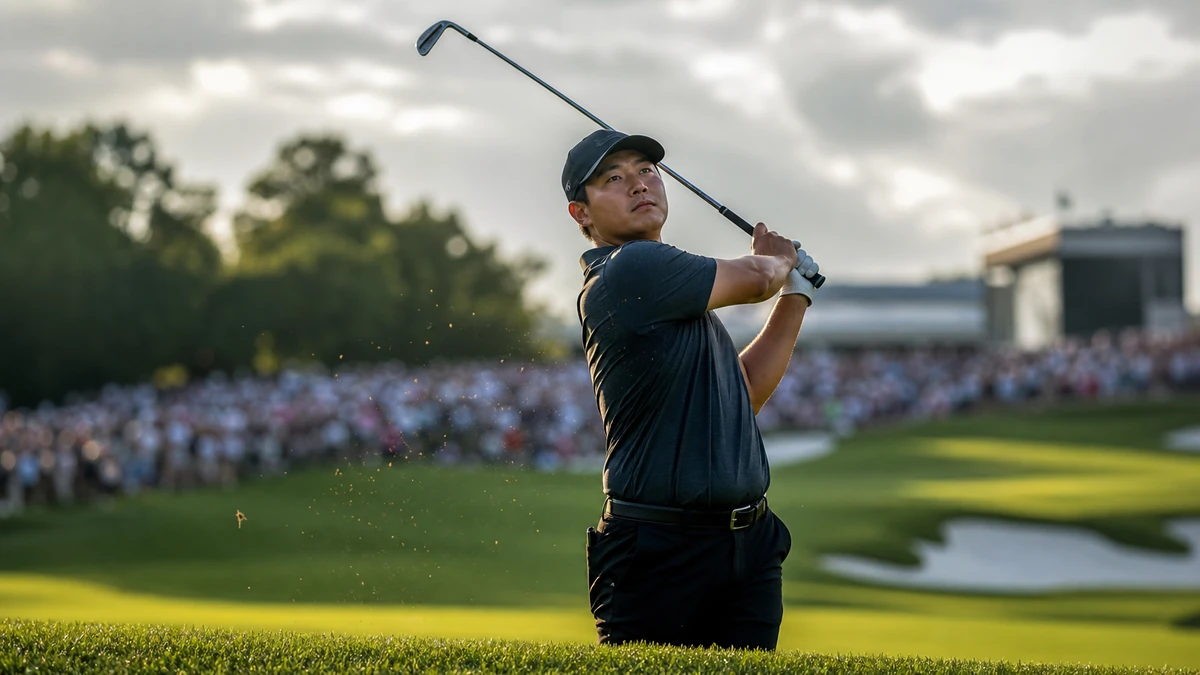
Image to help understand the article
A top-10 finish that meant more than it looked like
On paper, Im Sung-jae’s week ended with mixed signals. The South Korean star finished tied for 10th at the BMW Championship, a strong result in one of the PGA Tour’s toughest events, but it was not enough to get him into the Tour Championship, the season-ending finale reserved for the top 30 players in the FedEx Cup standings. In the narrowest, most immediate sense, that is a disappointment. Missing the Tour Championship means missing the PGA Tour’s final showcase of the season and, in practical terms, falling short of one of the year’s clearest benchmarks for elite consistency.
But sports seasons, especially in golf, are rarely defined by a single gate. Im’s finish at the BMW Championship also lifted him from No. 62 to No. 57 in the men’s world rankings, a five-spot jump announced after the event. That rise matters because it keeps alive another path to a major stage: automatic qualification for the International Team in the Presidents Cup, the biennial competition that pits a U.S. team against a team drawn from the rest of the world outside Europe.
That dual reality is the real story. Im did not make one finish line, but he improved his standing for another. For casual American sports fans, it may sound contradictory. How can a player miss the PGA Tour’s final playoff event and still come away in a better competitive position? The answer lies in the way golf measures success through overlapping systems, each with its own logic, incentives and consequences. One ranking determines who survives the FedEx Cup playoffs. Another helps decide who is considered one of the world’s best players. In Im’s case, those systems delivered different verdicts on the same week.
That is why his tied-for-10th finish resonated in South Korea and deserves attention in the United States as well. It was not just a nice result. It was a reminder that a player can fall short of one high-profile target and still strengthen his larger standing in the game. For Im, that matters now because the season is at the point where ranking movement is no longer just cosmetic. It can shape selection, visibility and momentum heading into one of golf’s few team events with a truly international identity.
And for anyone following the broader globalization of men’s golf, this is the kind of week worth noticing. Im’s result did not produce a trophy, but it kept him in the conversation where top players want to live: not simply as a participant on tour, but as a contender for events that carry national and regional meaning.
Why the rankings tell two different stories
To understand why this matters, it helps to separate two systems that American sports audiences may instinctively lump together. The FedEx Cup is the PGA Tour’s season-long points race. Think of it as a mix of playoff seeding and postseason qualification in a way that is somewhat familiar to fans of the NBA or NASCAR: regular-season performance earns a player the right to keep advancing, and by late August the field narrows quickly. The Tour Championship is the last stop, and only the top 30 in FedEx Cup points get in.
The Official World Golf Ranking serves a different purpose. It is meant to reflect a player’s performance across events over time, not simply whether he advanced through the PGA Tour’s playoff funnel. It is less about surviving one postseason structure and more about establishing global status. That distinction can seem abstract until it affects something tangible, such as eligibility for international team competition.
Im’s week is a vivid example. He did not earn enough in the FedEx Cup race to reach the Tour Championship. Yet his performance at the BMW Championship was strong enough, against a high-level field, to improve his world ranking. The same tournament effectively told two stories about him: one that said he fell short of a specific playoff threshold, and another that said he remains highly competitive against elite opposition.
That is not a contradiction so much as a lesson in what late-season golf actually rewards. The FedEx Cup is ruthless about position. Finish outside the line and the door closes. The world ranking is more interpretive, asking what a player’s results say about his level in a broader sense. A tied-for-10th finish in a loaded event can still matter significantly there, even if it comes too late to rescue a playoff campaign.
In that sense, Im’s situation is familiar beyond golf. American fans have seen versions of it in other sports. A baseball player can miss the playoffs with his team but still raise his standing in award voting with a strong finish. An NFL quarterback can be left out of the postseason yet strengthen his market and reputation through late-season play. The immediate outcome and the broader evaluation do not always point in the same direction.
For Im, the practical implication is clear: the Tour Championship is gone, but the chance to be judged among the International Team’s strongest players remains alive. That makes his rise to No. 57 more than a statistical footnote. It is a statement that his season, while imperfect, still carries competitive weight at exactly the moment when selection debates sharpen.
The Presidents Cup angle makes this more than a rankings update
The most important next chapter is the Presidents Cup. For readers in the United States, the event can sometimes live in the shadow of the Ryder Cup, which features the U.S. against Europe and carries a deeper popular mythology. But the Presidents Cup occupies an increasingly important place in golf’s global story because it showcases how broad and competitive the sport has become outside the traditional U.S.-Europe axis.
The International Team’s automatic qualifiers are determined by world ranking, and Im currently sits seventh among those candidates, just one spot outside the top six automatic places. That is the tension in this story. He is not safely in, and nothing in the available facts guarantees he will make it. But he is close enough that his rise this week materially changes the conversation. Instead of fading from the picture after missing the Tour Championship, he remains on the doorstep of a prominent team event.
That matters especially for South Korea, where Im is one of the leading faces of men’s golf. A Presidents Cup berth would not simply be another line on his resume. It would place him on a global team stage against an American side stocked with top PGA Tour talent. According to the source material, the U.S. automatic qualifiers include BMW Championship winner Wyndham Clark, along with Scottie Scheffler, Cameron Young, Sam Burns, Russell Henley and Collin Morikawa. That is the caliber of opposition at stake.
From a narrative standpoint, the appeal is obvious. A player who missed one of the PGA Tour’s biggest season-ending events could still find himself competing in one of golf’s most visible international match-play settings. For fans, that is compelling because team events reveal dimensions of golf that stroke play often does not: emotional swings, national pride, pairings, strategy and the pressure of playing not only for yourself but for a side.
For Korean fans, the excitement is even more specific. The country has long produced world-class women golfers and has also developed a serious, deeply engaged golf audience on the men’s side. When a Korean male player has a pathway to an event where the opponent is effectively Team USA, the stakes become easier for casual viewers to feel. It is no longer only about a ranking, a cut line or a paycheck. It is about representation.
That is why Im’s tied-for-10th finish can be celebrated even though it did not solve every problem. It revived possibility. In sports, especially individual sports, that can be the difference between a season seeming to fade out and a season carrying intrigue into its final weeks.
What this means in the United States
For American audiences, Im’s movement in the rankings is about more than one Korean player trying to hold onto a team-event chance. It is another sign of how tightly connected the U.S. golf ecosystem has become to Asia, and to South Korea in particular. The PGA Tour remains the sport’s most visible week-to-week stage for much of the world, which means American broadcasters, sponsors, equipment companies and tournament organizers all benefit when international stars remain relevant deep into the season.
That is especially true with Korean players, whose fan bases often extend far beyond Korea itself. In the United States, Korean American communities have long been important audiences for golf, and the broader rise of Korean popular culture — from K-pop and Korean film to food, fashion and streaming dramas — has made Korean public figures more legible to mainstream American consumers than they might have been a generation ago. A golfer like Im is not a crossover celebrity in the mold of a pop star, but he exists in an environment where interest in Korean talent is no longer niche.
There is also a business dimension. American golf depends on international relevance. Networks want storylines that travel. Sponsors want recognizable names in multiple markets. Equipment makers and apparel brands want athletes who connect U.S. fans to Asia’s affluent golf consumers. A player such as Im, who has established himself on the PGA Tour and remains in contention for events like the Presidents Cup, helps sustain that bridge.
From a competitive standpoint, the United States also benefits from the depth of the international field. American sports leagues are strongest when the talent pool is global. The NBA became a more compelling product as international stars transformed the league. Baseball’s international pipeline has long been central to its identity. Golf is no different. A Presidents Cup that includes accomplished players from South Korea, Japan, Australia, Canada and Latin America gives American fans a broader, more modern version of the sport than a purely domestic tour narrative ever could.
And there is a diplomatic undertone, even if it stays in the background. The U.S.-South Korea relationship is usually discussed in terms of security, trade and technology. Sports rarely lead that conversation, but they deepen it. Korean players competing in America, drawing support from Korean fans and Korean Americans, and taking part in events that place them directly opposite U.S. stars all contribute to a more textured people-to-people relationship. Not every golf story needs to carry geopolitical weight, but in a media landscape that increasingly values global cultural exchange, this kind of athletic visibility matters.
So for the United States, Im’s rise is not just a curiosity from overseas sports pages. It fits a larger pattern: Korean athletes are no longer occasional visitors to American sports culture. They are recurring participants in it, and their success or near-success affects audiences, sponsors and storylines here at home.
Why this moment fits a bigger trend in Korean sports
Im’s late-season bounce also speaks to a broader shift in how Korean athletes are understood internationally. For years, South Korea’s sports export story in the United States was often told through a handful of recognizable archetypes: the major league pitcher, the LPGA star, the Premier League soccer player, the Olympic archer. Those figures still matter, but the picture is now wider and more continuous. Korean athletes increasingly operate as regular presences in elite global circuits rather than isolated exceptions.
In golf, that has been particularly visible. South Korea built one of the world’s most formidable pipelines in women’s golf, and that success helped normalize the idea of Korean excellence in a sport long associated in the American imagination with country clubs, suburban privilege and Western institutions. Men’s golf has not produced the same sustained depth at the very top, which is part of why Im’s status matters so much. He is not simply another tour player. He is one of the clearest reference points for Korean men’s golf on the game’s biggest weekly stage.
The response to his BMW Championship finish reflects that reality. The enthusiasm is not only about a tied-for-10th finish. It is about resilience and relevance. He did not win. He did not make the final playoff event. Yet he still moved upward in a ranking that can open another door. That kind of grind-it-out narrative often resonates strongly with Korean sports audiences, who tend to reward persistence and toughness, especially in athletes competing abroad.
American readers may recognize a similar appeal in the way U.S. sports culture admires players who “keep themselves in the fight” late in a season. What differs is the national lens. When a Korean athlete does that on an American tour, the meaning often expands beyond the individual. He is not just salvaging his own season. He is also carrying expectations for a country that watches closely when its athletes succeed in U.S.-based competitions.
That is one reason stories like this travel well beyond golf diehards. They are about status as much as scorecards. A five-place rise in the world ranking may sound modest to a general audience, but in this context it functions as proof that a player remains in the top tier of the conversation, even when the biggest immediate headline says he came up short.
What to watch next
The central question now is whether Im can convert this ranking momentum into a Presidents Cup automatic berth. As the source summary makes clear, he is currently seventh among International Team candidates, with the top six in the world-ranking-based race earning automatic spots. The next ranking update after the Tour Championship will be decisive for that specific issue.
There is no guarantee. That uncertainty is important. Im is close, not secure. His rise to No. 57 keeps the possibility alive; it does not settle it. But that is precisely why this moment matters. In late-season golf, staying alive in the math is often its own achievement, especially after a disappointment that might otherwise have ended the discussion.
Beyond selection, there is also the question of trajectory. Sports analysts often talk about form at the end of a season as a clue to what comes next. Im’s tied-for-10th finish matters because it came in a strong field and because it produced visible ranking improvement. He did not simply tread water. He demonstrated enough competitiveness to change his position. For a player trying to remain central in the global game, that is meaningful evidence.
American fans should also watch how stories like this shape coverage of international golfers on U.S. tours. Too often, the frame is binary: either a player made the championship field or he failed. Im’s week is a reminder that elite sport does not always move in straight lines. A season can close one avenue while opening another. A player can miss the headline event and still emerge with more leverage than he had before.
That nuance is increasingly important in a globalized sports environment, where rankings, qualification systems and international team events overlap in complicated ways. Im’s BMW Championship did not end with a breakthrough trophy or a celebratory final-round charge into the Tour Championship. Instead, it produced something subtler but still consequential: a restored sense of possibility.
For South Korean fans, that possibility centers on whether one of the country’s leading male golfers can earn another place on a world stage. For American readers, it offers a useful lens into how golf now works as an international business, cultural exchange and competitive ecosystem all at once. Im Sung-jae may have missed one finale, but he remains very much part of the season’s unfinished story — and in modern golf, that can matter almost as much as the event you just failed to reach.


0 Comments