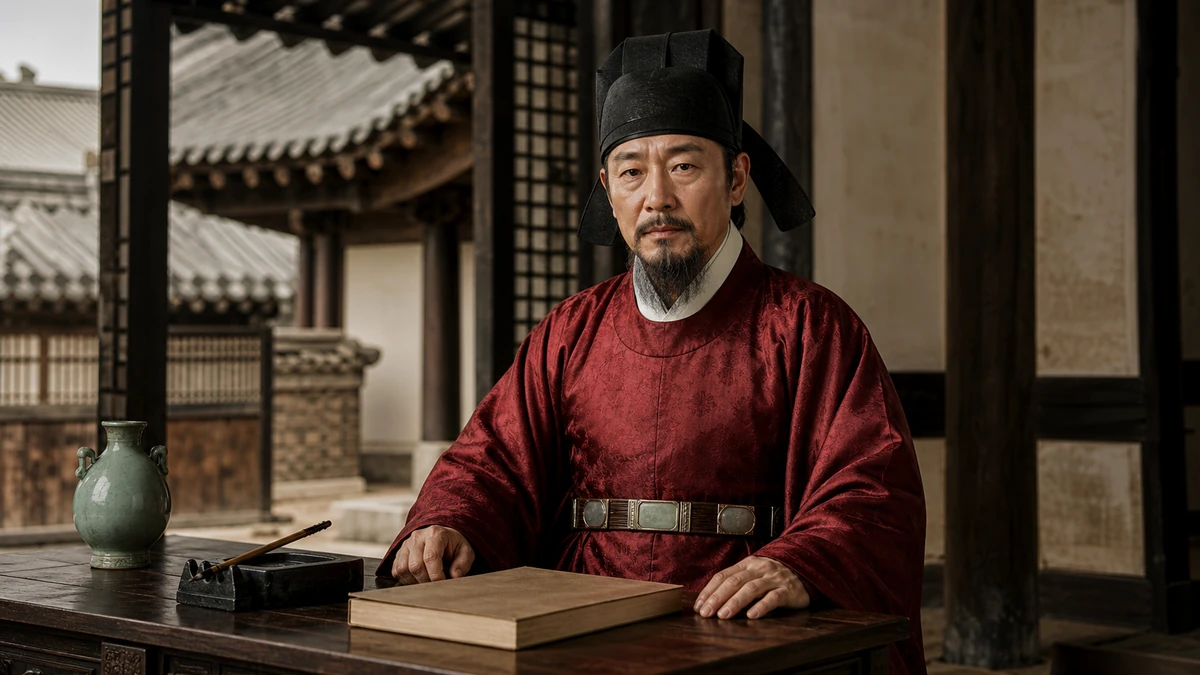
Image to help understand the article
A statesman at the edge of a collapsing kingdom
In the United States, the founding era tends to come with a familiar cast of characters: pragmatic revolutionaries, constitutional thinkers and men whose reputations rest on whether they chose rebellion or loyalty when the old order broke apart. Korea has its own version of that argument, and one of its most enduring figures is Jeong Mong-ju, the 14th-century scholar-official and diplomat remembered for trying to save a dying kingdom without abandoning his principles.
Jeong was born in 1338, near the end of the Goryeo dynasty, the medieval Korean kingdom that ruled from 918 to 1392. For many English-speaking readers, Goryeo may be best known as the source of the modern name “Korea.” By Jeong’s lifetime, however, the dynasty was under extraordinary pressure: entrenched aristocratic power, rural distress, military threats along the frontier and a rapidly changing regional order shaped by the fall of the Mongol Yuan dynasty and the rise of the Ming in China.
That combination of domestic decay and geopolitical upheaval helps explain why Jeong remains such a potent figure in Korean memory. He was not simply a court scholar or a loyalist in the abstract. He belonged to a generation of rising Neo-Confucian officials who believed the state needed reform. He studied, taught and served at the highest levels of government. He also helped define how Goryeo would respond to major changes beyond its borders. In that sense, he was both an intellectual and a practitioner of power.
What makes Jeong so compelling is that he stood at the very point where reform and revolution split apart. He appears in Korean history not as a passive defender of the status quo, but as a man who shared many of the same concerns as later founders of the next dynasty. He wanted corruption reduced, public ethics restored and statecraft grounded in a more rigorous moral philosophy. Where he differed was on the question that haunts many societies in crisis: Can a broken political order be repaired, or must it be replaced?
In Korean historical memory, Jeong’s answer defines him. He chose reform without regicide, institutional repair without dynastic overthrow. That decision eventually cost him his life, but it also gave him a symbolic afterlife that few medieval officials anywhere have enjoyed. He became a shorthand for incorruptible loyalty, principled public service and moral seriousness in times of political collapse.
For modern readers, especially in democracies that regularly debate whether institutions should be remade or restored, Jeong’s story lands as more than a historical curiosity. It speaks to a timeless political problem: how far a reformer should go when the system he serves may no longer be salvageable.
The making of a Confucian scholar-official
To understand Jeong’s role, it helps to understand the social class from which he emerged. He came from a yangban lineage, part of the hereditary elite that supplied officials and scholars to premodern Korean states. But the summary of his family background suggests something more specific and historically important: Jeong’s household reflected the rise of a newer class of scholar-officials tied to regional landed interests rather than only to the most entrenched aristocratic power centers. In late Goryeo, that mattered.
This was the world that produced what Korean historians often call the “new scholar-officials,” or sinjin sadaebu, a group that increasingly embraced Neo-Confucianism as both a moral philosophy and a program for public order. For American readers, Neo-Confucianism can sound like an obscure doctrinal label, but its role in East Asian history was closer to a combined ethical, educational and political framework. It shaped ideas about family duty, official conduct, proper ritual, government legitimacy and social hierarchy. In Korea, it became the language through which reform-minded elites criticized corruption and imagined a more disciplined state.
Jeong’s early life is framed in Korean accounts by stories that underline his exceptional promise. His childhood names changed more than once, tied in part to dream narratives attached to his family. Those tales belong to a long East Asian tradition in which unusual births or symbolic dreams foreshadow future greatness. More important historically is the portrait of a gifted child with extraordinary memory, deep devotion to books and a moral education reinforced at home. His mother is said to have taught him through verse not to stain a pure life by mixing with the base and corrupt. Whether repeated literally or symbolically, such stories help explain how later generations understood him: as a figure whose integrity was visible from the beginning.
Jeong first studied classical Chinese learning with his father and later became associated with the leading intellectual circles of his time, especially those linked to the scholar Yi Saek. Some records, as the source notes, do not fully settle the teacher-student relationship in a modern documentary sense. But the broader point stands: Jeong was part of the cluster of late Goryeo thinkers who helped bring Neo-Confucian scholarship to a new level of prestige and influence.
He excelled in the civil service examinations, the competitive exams that served for centuries across East Asia as a main route into officialdom. Americans might think of them as a blend of elite college admissions, bar exams and federal hiring rolled into one, with the added weight of moral philosophy and literary performance. Jeong did more than pass. He placed first in multiple stages of the state examinations, launching a career that would move fluidly between scholarship, administration and diplomacy.
His reputation also grew through conduct that Confucian society prized deeply: filial devotion and ritual sincerity. After his father’s death, he reportedly observed an extended mourning period by the grave, winning royal recognition. He later stepped back from office again after his mother’s death to carry out mourning rites with unusual rigor. To modern readers, those acts may seem intensely private, even old-fashioned. In Jeong’s political culture, they were public evidence of fitness to govern. Moral discipline at home was understood as training for moral discipline in office.
That point is crucial. Jeong did not become influential merely because he was learned. He rose because scholarship, ritual observance and public service were all seen as inseparable. In late Goryeo, that made him exactly the kind of figure reformers and rulers needed, even if they did not always agree on where reform should lead.
Reform, rivalry and the question of whether a state can be saved
One reason Jeong looms so large in Korean history is that he stood among other towering late Goryeo figures whose choices shaped the transition to the next era. He moved in the same circles as Jeong Do-jeon, another major Neo-Confucian thinker who would later become one of the chief architects of the Joseon dynasty. In their earlier years, the two men were not natural enemies. They shared concerns about a decaying order, abusive power and the need to bring government back into alignment with moral principle.
That shared diagnosis is important because it complicates the simplistic image of Jeong as nothing more than a conservative defender of a failed regime. By the account in the Korean source, he and Jeong Do-jeon both recognized the need to reform corrupt late Goryeo society and loosen the grip of entrenched elites over common people. The difference was not whether change was necessary. The difference was what kind of change remained legitimate.
This distinction has echoes in many national histories, including America’s. There are moments when reformers agree on the disease but split over the cure: New Deal liberals versus revolutionaries, civil rights legal strategists versus separatists, institutionalists versus those who conclude the system cannot be redeemed from within. In Jeong’s world, that divide hardened around the ultimate question of dynastic change. Could Goryeo be repaired through moderate reform, or did justice require replacing the ruling house entirely?
Jeong chose the first option. Jeong Do-jeon and, ultimately, the political coalition around military leader Yi Seong-gye moved toward the second. Yi would go on to found the Joseon dynasty in 1392, ruling as King Taejo. Jeong’s break with that camp therefore placed him on the losing side of Korean history in a narrow political sense. Yet it also secured his stature in a moral sense. He became the man who would not convert expediency into principle simply because the balance of power shifted.
That should not be mistaken for naivete. Jeong was no sheltered academic disconnected from public affairs. He took part in government, served on the frontier and had firsthand knowledge of state weakness. He even appears to have admired aspects of Yi Seong-gye’s character during joint military activity against Jurchen forces in the northeast. The later rupture was therefore not born of ignorance. It was born of political judgment. Jeong could appreciate talent and still reject the revolutionary path that talent eventually served.
His life also reveals the tensions of late Goryeo politics beyond the dynasty question. He intervened to retrieve and bury the body of Kim Deuk-bae, a military figure who had been condemned and executed after great service to the state. That episode underscores a pattern visible throughout Jeong’s career: a refusal to let factional convenience erase merit or basic justice. In a political culture often shaped by purges, accusations and shifting court alliances, Jeong’s insistence that public virtue and public judgment should align became part of his legend.
Put differently, Jeong’s significance lies not just in dying for Goryeo at the end. It lies in the long record before that final act, a record showing how he thought government should work and why he believed legality, moral consistency and legitimate authority still mattered even in crisis.
The scholar who helped Korea navigate a changing world
If Jeong were remembered only for loyalty, he would still occupy an honored place in Korean history. But he matters just as much for diplomacy and intellectual statecraft. That part of the story deserves special attention because it places him in a wider Asian context, one that can be easy to miss when medieval Korean history is told only as an internal dynastic drama.
During Jeong’s lifetime, East Asia was undergoing a major geopolitical reordering. The Mongol-led Yuan dynasty had dominated the region, but in 1368 the Ming dynasty was established in China. For a kingdom like Goryeo, this was not an abstract development. It posed immediate questions of recognition, tribute, legitimacy and survival. Which regime should be treated as the rightful power on the mainland? How quickly should policy adjust? What posture would best preserve the smaller state’s autonomy and safety?
The source credits Jeong with recognizing the need to accept the Ming as the new legitimate Chinese state and to build diplomatic relations accordingly. In effect, he saw that ideology and realism did not have to be enemies. Neo-Confucian political thought gave him one vocabulary for order, but he was also attentive to actual shifts in power. That combination is one reason he stands out. He was not merely reciting doctrine. He was using a moral-political framework to guide foreign policy during a regional transition.
His diplomatic career contains one especially vivid episode. In 1372, while returning from a mission connected to the Ming court, his ship was wrecked in a storm. Others drowned, but Jeong survived after nearly two weeks stranded on a rocky islet. According to the traditional account, he protected a letter from the Ming founder, the Hongwu Emperor, keeping it dry against his chest despite the ordeal. Whether remembered partly for dramatic effect or not, the story conveys how later generations viewed him: as a man whose devotion to state duty survived physical extremity.
The episode also mattered politically. It is said to have strengthened Ming trust in him, and he later returned to Goryeo with enhanced standing. That trust was no small asset. At moments when the Korean court hesitated to face diplomatic fallout, including after incidents that angered the Ming, Jeong reportedly argued for direct explanation and apology rather than evasion. For a medium-size kingdom next to a far more powerful neighbor, that instinct was strategic as much as ethical.
His intellectual authority reinforced his diplomatic value. As an instructor at the state academy, Seonggyungwan, Jeong earned admiration for expounding Confucian classics with unusual mastery. Later tradition even remembered him as a foundational figure in Korean Neo-Confucian learning, sometimes calling him a progenitor of Eastern learning. That phrase should not be read literally in a global sense, but within Korean intellectual history it signals something substantial: Jeong helped localize and institutionalize a body of thought that would dominate Korean political culture for centuries.
For American readers, the key point is that Jeong represents a type familiar across history but rare in practice: the scholar who can actually govern. He was not simply a ceremonial thinker placed in office for prestige. He taught doctrine, judged conduct, served administratively, accompanied military campaigns and helped reposition his country within a changing international order. In modern terms, he looked at once like a public intellectual, a senior civil servant and a foreign policy adviser.
What Jeong Mong-ju means in the United States
For Americans, a story like Jeong’s can seem very distant at first glance, tucked deep inside the medieval history of a close ally on the other side of the Pacific. But his relevance in the United States today is larger than it may appear, because Korean history increasingly travels through American classrooms, streaming platforms, museums, fan communities and foreign policy debates. As the Korean Wave broadens beyond pop culture into food, film, television, literature and historical storytelling, figures like Jeong become part of how Americans encounter Korea not just as a trendsetter, but as a civilization with a long political and intellectual tradition.
That matters commercially as well as culturally. American audiences already consume Korean content at scale, from Netflix historical dramas to K-pop documentaries and translated fiction. When global entertainment companies look for Korean stories with broad appeal, they often search for narratives with familiar emotional architecture: idealism versus power, loyalty versus ambition, the collapse of an old order and the making of a new one. Jeong’s life contains all of those elements. In American terms, he belongs to the kind of historical canon that can be packaged as prestige television, museum interpretation or educational media precisely because the stakes are legible across cultures.
There is also a deeper diplomatic relevance. The U.S.-South Korea alliance is usually discussed in terms of North Korea, semiconductors, defense spending and China strategy. Those are the urgent topics, and rightly so. But durable alliances also rest on whether each side has a serious understanding of the other’s history. Jeong’s story offers Americans a window into long-running Korean political themes: the value placed on education, the moral burden attached to public office, the memory of navigating pressure from larger neighboring powers and the recurring tension between reform and rupture.
American institutions already wrestle with their own versions of those questions. Universities debate the civic purpose of elite education. Government agencies struggle to maintain public trust. Foreign policy professionals argue about how middle powers and allies should manage competition between larger states. Jeong’s world is not America’s world, but the structural dilemmas are recognizable. That makes him useful not as an exotic historical figure, but as a comparative one.
There is a business angle here, too. U.S. publishers, streamers and cultural organizations that want to deepen American engagement with Korea often default to modern success stories: technology giants, Oscar-winning films, chart-topping groups. Those are real and important, but they can flatten Korea into a contemporary brand. Historical figures like Jeong widen the picture. They allow American companies to invest in Korean narratives that emphasize depth, not just novelty. For an audience increasingly interested in origin stories and national memory, that is not a niche proposition. It is a market opportunity grounded in the fact that cultural influence grows stronger when people understand the past behind the present.
Just as importantly, Jeong’s reputation helps explain why loyalty, integrity and educational authority still resonate so strongly in South Korean public discourse. Americans watching Korean politics, media or entertainment sometimes notice that historical references carry unusual force. That is partly because school curricula, civic memory and popular culture keep figures like Jeong alive. To understand modern South Korea, including the values projected through its soft power, it helps to know the moral heroes in its historical imagination.
Why his story endures in Korean memory
Jeong’s final political choice made him unforgettable. As late Goryeo gave way to the new Joseon order, he refused to transfer loyalty to the rising regime. In Korean tradition, that decision culminates in his death at Seonjuk Bridge, a site still associated with his martyrdom. The story has been retold for centuries because it dramatizes a question Korea’s elite could never entirely escape under Confucian rule: What does a righteous minister owe a failing sovereign and a failing state?
That question can sound alien to modern democratic ears, but it is better understood as part of a broader ethical problem. When institutions lose legitimacy, what is the duty of those still inside them? Is loyalty virtuous because it resists opportunism, or is it destructive because it delays necessary change? Jeong’s life remains powerful because it does not settle that debate cleanly. He is celebrated for refusing betrayal, yet the dynasty he served still fell. His opponents succeeded politically, and the Joseon state they built would last more than 500 years.
That paradox is exactly why he survives as more than a one-note hero. If history belonged only to winners, Jeong would be a footnote. Instead, he became one of Korea’s defining moral exemplars because his defeat clarified values later generations wanted to preserve even under a new dynasty. Joseon, for all its revolutionary origins, still honored scholarly integrity, ritual seriousness and the ideal of principled service. In a sense, the new order absorbed part of the ethical prestige of the man who had opposed its birth.
He also endures because he can be read in more than one way. Nationalists see a patriot. Confucian moralists see an exemplar of loyalty and filial duty. Political historians see a moderate reformer overtaken by harder forces. Diplomatic historians see a sophisticated actor who grasped the significance of Ming power. Intellectual historians see a transmitter and consolidator of Neo-Confucian learning. Each reading captures something real, and together they explain why he remains central rather than marginal.
For English-speaking audiences, that richness matters. Too often, premodern Asian figures are presented as flat symbols rather than complex political actors. Jeong deserves better. He was not simply “loyal unto death,” as a textbook capsule might put it. He was a thinker operating amid frontier conflict, court intrigue, ideological change and international realignment. The loyalty for which he is most famous was the endpoint of a broader political philosophy, not the whole of it.
What to watch when history becomes trend
There is a broader trend here that goes beyond one medieval statesman. As Korean culture continues expanding globally, the next frontier may be historical interpretation: which parts of Korea’s past get exported, how they are framed for foreign audiences and which values become legible across borders. Stories like Jeong’s are especially well positioned because they combine court politics, moral drama and geopolitical relevance. They can travel through television and film, but they also fit the growing appetite for substantive background behind today’s headlines about Seoul, Washington and Beijing.
The timing matters. South Korea is no longer simply an object of Western curiosity; it is a major producer of narratives that shape how global audiences imagine modernity, celebrity, class conflict and national identity. As that influence deepens, there is a natural move backward from K-pop and prestige dramas into the historical figures who define Korean ideas of virtue, authority and reform. Jeong sits near the center of that map.
For American readers, the challenge is to resist reading him through easy Western analogies alone. He is not Korea’s Thomas More, though there is a resemblance in conscience and state service. He is not a straightforward counterpart to America’s founding patriots, because he opposed rather than led a successful regime change. But those comparisons can still be useful if handled carefully. They remind us that across cultures, societies remember the people who refused to separate political action from moral belief, even when history moved against them.
In that sense, Jeong Mong-ju belongs not only to Korea’s past but to a living global conversation about institutions, legitimacy and the character required to serve a state in dangerous times. His story begins in the final century of Goryeo, but it reaches far beyond the end of that kingdom. It helps explain how Korea thought about order, how it navigated a changing world and why questions of loyalty and reform still resonate so powerfully today.
That is why he remains worth reading now, especially in the United States, where Korea is often encountered first through the speed of its modern success. Jeong slows that picture down. He reminds foreign audiences that behind South Korea’s contemporary influence lies a much older history of ideas, arguments and political choices. And in that older history, few figures stand taller than the scholar-diplomat who tried to save a kingdom without surrendering his conscience.
Comments
Post a Comment