Image to help understand the article
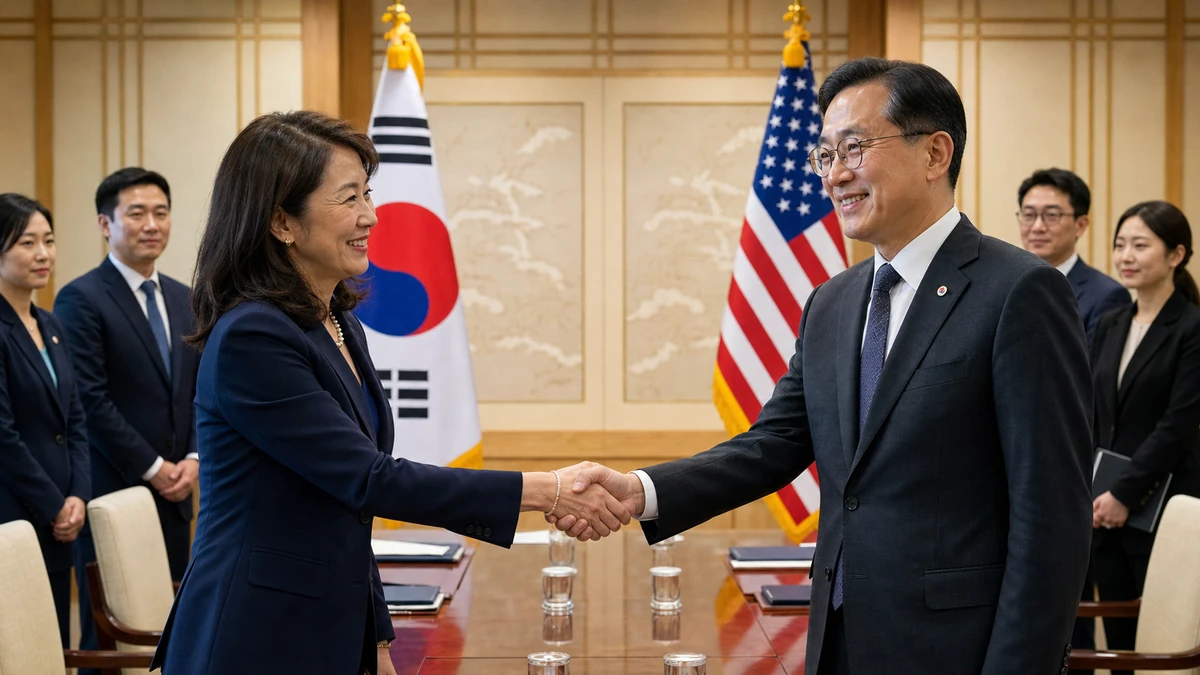
A ceremonial meeting with a policy message
In diplomacy, the order of a new ambassador’s first meetings can send a message long before any formal agreement is announced. That is why an early meeting in Seoul between newly arrived U.S. Ambassador Michelle Steel and South Korean Industry Minister Kim Jung-kwan is drawing attention far beyond the usual protocol calendar. According to the Korean account, Steel met Kim on Aug. 14 at the Government Complex Seoul, and aside from the customary initial contact with South Korea’s foreign minister, Kim was the first cabinet-level official from the Korean government she met.
On paper, that may sound procedural. In practice, it suggests that trade, industrial policy and investment are near the top of the bilateral agenda at a moment when the U.S.-South Korea relationship is increasingly defined not only by North Korea, military coordination and summit diplomacy, but also by factories, supply chains and strategic capital flows. South Korea’s Ministry of Trade, Industry and Energy is the government body responsible for industrial policy and major trade issues. When a new U.S. ambassador moves quickly to meet that ministry’s chief, the symbolism is hard to miss.
That symbolism should not be overstated. The meeting order alone does not prove Washington made a specific demand, nor does it confirm a new policy line. No public record in the source material says the two sides agreed on a tariff arrangement, set an investment timetable or discussed a specific dollar amount. But in diplomacy, especially economic diplomacy, symbolism often serves as an early indicator of what both sides consider urgent. In this case, the urgency appears to revolve around the mechanics of economic interdependence: South Korean investment in the United States, strategic industrial cooperation and the handling of trade friction before it becomes a public dispute.
For American readers, the easiest analogy may be this: imagine a newly arrived foreign ambassador in Washington choosing, after the secretary of state, to prioritize an early high-level meeting with the commerce secretary or U.S. trade representative rather than with a more traditionally political or cultural portfolio. It would not settle policy, but it would tell business leaders, lawmakers and investors where the real action may be.
How trade and investment moved to the center of the alliance
For decades, the U.S.-South Korea alliance has been understood in America primarily through a security lens. That is not surprising. U.S. troops remain stationed on the Korean Peninsula, North Korea’s nuclear program drives much of the alliance’s strategic logic, and many Americans first encounter South Korea in headlines about missile launches or defense summits. But that framing is now incomplete.
The modern U.S.-South Korea relationship is also a manufacturing story, an energy story and a technology story. South Korean conglomerates and suppliers have become major investors in the United States, especially in sectors Washington now treats as strategic: semiconductors, batteries, electric vehicles, shipbuilding and advanced manufacturing. In recent years, South Korean firms have announced or expanded large projects in states such as Georgia, Tennessee and Texas, helping transform the alliance into something that looks less like a Cold War security pact and more like a full-spectrum economic partnership.
That shift helps explain why a meeting with South Korea’s industry minister matters. Industrial policy is no longer a dry technocratic subject. In both Washington and Seoul, it sits at the intersection of national security, job creation and geopolitical competition. The Biden and Trump eras alike, though different in tone and method, have reflected a broader American consensus that trade can no longer be treated as separate from strategic rivalry, especially where China, critical minerals, advanced chips and manufacturing resilience are concerned. South Korea, as a close treaty ally with globally competitive manufacturers, is central to that calculation.
In Seoul, the same pressures are visible from the other side. South Korea depends heavily on exports, is deeply plugged into global supply chains and must navigate between its security alliance with the United States and its economic exposure to major overseas markets. That makes trade diplomacy unusually sensitive. A meeting like this one, even without a public readout of substance, fits a broader pattern: economic cooperation is no longer a secondary chapter in the alliance. It is one of the main texts.
What the Korean side is signaling — and what it is not
The Korean summary makes an important distinction that is easy to lose in the noise of trade coverage. It says South Korea’s presidential office confirmed that the two countries are in close discussions through various channels on strategic investment projects. That is the confirmed fact. What remains unconfirmed are the more dramatic claims in some media reports suggesting U.S. pressure tied to timelines for South Korean investment and even the possibility of tariffs rising above 15% if investment is delayed.
That distinction matters because trade reporting often turns rumor into assumed policy before governments have said anything definitive. The presidential office, according to the summary, did not validate the contents of any email, did not confirm that tariff threats were formally delivered and did not verify reporting about emergency internal meetings in the way some headlines implied. Instead, it drew a narrower line: there are active discussions, they are happening through multiple channels, and details have not been publicly disclosed.
For readers used to the rhythms of Washington policy coverage, this should sound familiar. Governments frequently confirm that talks are underway while refusing to discuss leverage, sticking points or negotiating tactics. That does not mean the behind-the-scenes conversation is minor. Often it means the opposite. The more commercially and politically sensitive the issue, the less likely officials are to speak plainly before there is something concrete to announce.
There is another reason for caution. The source material itself warns against treating diplomatic scheduling as a substitute for policy outcomes. A meeting can be meaningful without being decisive. The fact that Steel met Kim early tells us trade and industry are a priority lane in the relationship. It does not tell us the precise U.S. ask, the Korean response or how close the two sides are to any understanding. At this stage, the encounter is better read as a signal of direction than as evidence of destination.
Why this matters in the United States
For Americans, the significance of this diplomatic moment lies in how deeply South Korean investment is now woven into the U.S. economy. South Korea is not just a security ally or a source of cultural exports like K-pop, K-dramas and Oscar-winning films. It is also one of the foreign partners helping shape what American reindustrialization looks like on the ground.
When U.S. officials talk about friend-shoring, supply-chain resilience or strategic manufacturing, South Korea is often part of the practical answer. Korean companies have been central players in batteries, semiconductors and clean-energy manufacturing, sectors that have become politically salient in both parties because they touch wages, inflation, industrial competitiveness and national security. In many parts of the United States, a discussion about South Korea is no longer limited to diplomacy specialists in Washington. It is a local economic development story involving construction sites, tax incentives, union debates, state governors and community colleges training workers for high-tech plants.
That is why even a relatively opaque diplomatic meeting can matter to American audiences. If Washington is indeed focused on the pace and scale of South Korean investment, that has implications for U.S. jobs, state-level politics and the credibility of America’s broader industrial strategy. It also affects U.S. companies that rely on Korean partners, components or joint ventures. In other words, this is not just a Seoul story. It is part of a larger American debate over whether the United States can rebuild strategic manufacturing capacity with the help of allies, and on what terms.
There is also a political lesson here for American readers: economic diplomacy with allies can be every bit as complicated as diplomacy with rivals. U.S. officials want more allied investment and closer industrial alignment, but allies also have their own domestic pressures, timelines and bargaining leverage. South Korea may be a close partner, but it is not simply an extension of U.S. policy. Its government must balance relations with Washington, corporate interests at home and the realities of global competition. That makes meetings like this one important markers of negotiation, not merely of ceremony.
The larger trend: from consumer Korean Wave to strategic Korean capital
For many Americans, South Korea’s rise has been most visible through culture. Over the past decade, the Korean Wave — known in Korean as Hallyu, a term that refers to the global spread of Korean popular culture — has reshaped how Americans see the country. K-pop groups sell out stadiums, Korean series dominate streaming charts and Korean beauty and food have become part of mainstream consumer life. That cultural familiarity matters because it changed the baseline: more Americans now recognize South Korea as a major influence, not a niche export economy.
But the next phase of South Korea’s presence in the United States is less about playlists and more about plants, patents and policy. The same country that captured American attention through entertainment is increasingly relevant to U.S. debates over battery production, semiconductor investment and advanced manufacturing ecosystems. That transition helps explain why trade and industrial diplomacy now carry such symbolic weight.
In that sense, the Steel-Kim meeting can be read as part of a bigger evolution in bilateral ties. The alliance is moving from one anchored primarily in deterrence and consumer familiarity to one built around strategic economic integration. That integration is not abstract. It is visible in federal subsidies, state recruitment packages, corporate site-selection battles and the race among U.S. regions to attract foreign direct investment tied to the energy transition and technology competition.
American readers may recognize a parallel in the way Japanese investment came to be understood in the United States over time. Once discussed mainly through trade tensions and consumer brands, it eventually became inseparable from the local American economies where Japanese companies built factories, hired workers and embedded themselves in regional supply chains. South Korea is now undergoing a similar, though not identical, shift in the U.S. imagination. Its importance is becoming structural rather than merely cultural.
What to watch next
The most important thing to watch is not whether one meeting produced an immediate breakthrough. It is whether future official statements begin to put more detail around the strategic investment projects both governments say they are discussing. If that happens, it would clarify whether the current emphasis is on accelerating already planned projects, resolving regulatory or policy friction, or expanding cooperation into new sectors.
A second question is whether tariff talk becomes formal policy language or remains a media-side interpretation of private pressure. At the moment, based on the facts provided, there is no public basis to state that the United States has definitively tied delayed South Korean investment to a specific tariff increase. That restraint is important. Markets and companies respond quickly to tariff expectations, and responsible reporting has to separate confirmed government positions from politically explosive but unverified claims.
Third, watch how often economic portfolios appear in the ambassador’s early public schedule. If additional meetings cluster around trade, manufacturing, energy and investment, the case becomes stronger that Washington wants its mission in Seoul to treat commercial strategy as a front-line diplomatic function. That would fit a global trend in U.S. foreign policy: embassies are increasingly expected not just to manage state-to-state relations in the classic sense, but also to facilitate supply-chain security, industrial cooperation and economic alignment among allies.
Finally, watch whether South Korean officials continue to frame these talks as multi-channel discussions. That phrase matters. It suggests economic diplomacy is not being handled in a single room or by a single ministry, but through overlapping contacts among the presidential office, trade officials and the U.S. Embassy. That is often how major cross-border investment questions are managed when they touch both politics and commerce. It also means the real significance of this week’s meeting may only become clear later, once its place in the broader negotiation architecture comes into view.
An alliance increasingly measured in economic leverage
The safest conclusion from the facts available is also the most revealing. A newly arrived U.S. ambassador met South Korea’s industry minister unusually early in her tenure, and South Korea says it is already in close talks with Washington on strategic investment projects through multiple channels. That combination does not prove a deal, a threat or a timetable. But it does show where the center of gravity is moving.
For years, Americans were taught to think of the U.S.-South Korea relationship in terms of troops, summits and missile defense. Those elements remain vital. Yet they no longer tell the whole story. Increasingly, the alliance is also measured in semiconductor capacity, battery supply chains, industrial subsidies and the politics of who builds what, where and how fast. In that world, an ambassador’s calendar can function almost like an index of strategic priorities.
That is what makes this otherwise procedural encounter noteworthy. It offers a snapshot of a bilateral relationship that is becoming more economically muscular, more commercially entangled and more directly relevant to American workers, companies and consumers. The diplomatic choreography in Seoul is not just about manners. It is about where both governments believe the next major tests — and opportunities — in the alliance will be found.
And for U.S. audiences, that may be the biggest takeaway. The future of America’s partnership with South Korea will be shaped not only in security briefings and summit communiques, but also in investment negotiations, ministry meetings and the quieter forms of economic statecraft that rarely generate viral headlines. This meeting did not settle those questions. It simply illuminated, with unusual clarity, which questions now matter most.
Comments
Post a Comment