Why a Pair of Memorial Messages Matters: What South Korea and China’s 34-Year Diplomatic Anniversary Signals for Washington and the Wider World
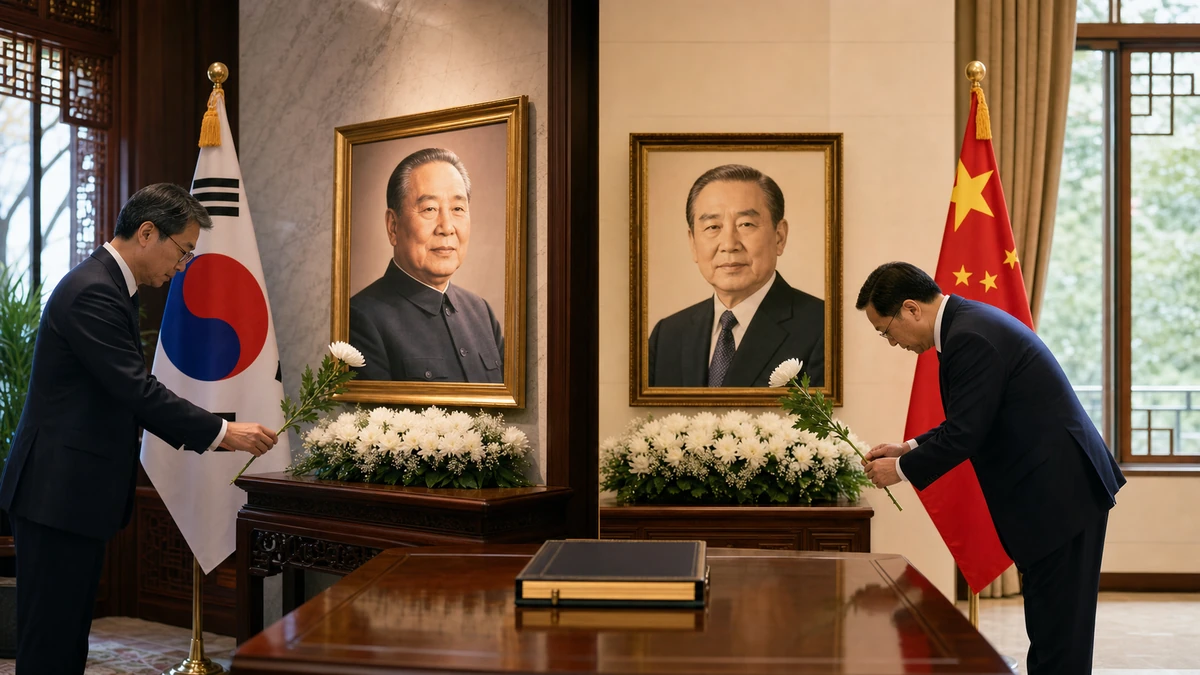
Image to help understand the article
A diplomatic anniversary with no deal — and still plenty to say
On paper, this was a quiet anniversary. There was no summit, no joint communique, no trade package and no breakthrough on one of East Asia’s many live disputes. Instead, on the 34th anniversary of diplomatic ties between South Korea and China, the two countries’ ambassadors chose a more understated act: each publicly honored a historical figure from the other side who helped make normalization possible in 1992.
That may sound ceremonial, even minor, to readers used to measuring diplomacy by tariffs, military deployments or photo ops between heads of state. But in Asia — and especially in relationships weighed down by history, nationalism and shifting power balances — symbolism is not a sideshow. It is part of the machinery. Which words are chosen, whose memory is invoked, and in what language a message is delivered can reveal as much about the current climate as a formal policy paper.
According to the Korean account, South Korea’s ambassador to China, Noh Jae-heon, posted a message in Chinese on Weibo, one of China’s biggest social media platforms. He paid tribute to Deng Xiaoping, the late Chinese leader whose reform-and-opening policies transformed China and created the conditions for broader engagement with the outside world, including South Korea. The Chinese ambassador in Seoul, for his part, issued a message honoring former South Korean President Roh Tae-woo, who played a central role in Seoul’s diplomatic opening to Beijing.
No one announced a new era in relations. That is precisely why the exchange is noteworthy. At a time when Seoul and Beijing have often looked at each other through the harder vocabulary of strategic rivalry, supply-chain risk, technology controls and regional alignments, both diplomats reached instead for a language of memory, respect and shared origin. They did not try to paper over differences with a flashy statement. They returned to the beginning and reminded audiences that the relationship was built, from the start, by choices on both sides.
The deeper story here is not simply that two ambassadors marked a date on the calendar. It is that they used the anniversary to revive a common narrative about how the relationship began: not as a sudden transaction, but as the product of political change, opening and a gradual accumulation of mutual understanding. In a region where official relationships are frequently tested by domestic politics and great-power competition, that kind of “memory diplomacy” can serve as a stabilizing signal. It says, in effect, that even if the present is complicated, the relationship still has a history worth protecting.
Why 1992 still matters in East Asia
To understand why this anniversary carries weight, American readers need to place 1992 in context. South Korea and China did not always have formal ties. During the Cold War, Seoul recognized Taipei, not Beijing, while China was aligned with North Korea. Diplomatic normalization between South Korea and the People’s Republic of China in August 1992 was therefore not a routine bureaucratic step. It was one of the major realignments of post-Cold War Asia.
For South Korea, establishing relations with China was part of a broader strategy of opening diplomatic channels beyond the rigid blocs of the Cold War. Roh Tae-woo, who served as South Korea’s president from 1988 to 1993, pursued what became known as Nordpolitik, a policy loosely comparable to outreach strategies used in divided geopolitical environments elsewhere. In American terms, it was a recognition that isolation of adversarial camps had limits and that diplomacy with former rivals could create new room for maneuver. The logic was practical as much as ideological: China mattered economically, strategically and politically, especially on any long-term approach to the Korean Peninsula.
For China, the timing was tied to a larger national transformation. Deng Xiaoping’s reform and opening-up program had already begun to reshape China’s economy and its global posture. Beijing was no longer content to remain outside the world trading system or to define its foreign relations primarily through revolutionary alliances. Engagement with South Korea fit a broader turn toward pragmatic diplomacy, economic development and external connectivity.
The relationship that followed became one of the most important in the region. China grew into South Korea’s largest trading partner. South Korean companies expanded their presence in the Chinese market. Cultural exchange widened dramatically, helping lay the groundwork for what would later become the global rise of Korean popular culture — the Korean Wave, or Hallyu, encompassing music, TV dramas, film, fashion and beauty products. Even when political friction disrupted cultural and business ties, the scale of interdependence remained difficult to ignore.
That is what makes the ambassadors’ messages significant. They were not just honoring two deceased leaders. They were restating the original logic of normalization: openness made contact possible; contact led to understanding; understanding led to formal relations. In a moment when regional politics often emphasize decoupling, de-risking and blocs, that older sequence carries its own quiet argument.
The meaning of “memory diplomacy” in a tense regional climate
One of the more revealing details from the Korean summary is that the South Korean ambassador used a Chinese idiom often translated as “When drinking water, remember the source.” In Chinese cultural and political communication, such classical expressions are not decorative flourishes. They signal cultural fluency, respect for the audience and an effort to speak within the listener’s historical frame rather than merely projecting one’s own.
That matters because anniversaries in diplomacy are never just about the past. They are about the present relationship and the future one both sides want to keep available. The choice to invoke a familiar Chinese saying while honoring Deng suggested that Seoul was not only recounting history but doing so in a way designed to resonate with Chinese readers directly. Posting on Weibo underscored the same point: the intended audience was not just diplomats in conference rooms, but the broader Chinese public sphere.
There is also significance in the reciprocal structure of the messages. Each ambassador highlighted the other country’s historical figure rather than merely praising his own side’s accomplishments. That is a subtle but meaningful departure from the more common nationalist script in which states center their own leaders and their own virtue. Here, the format itself conveyed a shared proposition: South Korea-China normalization was not a gift bestowed by one side on the other. It was a jointly made opening, enabled by political decisions in both capitals.
This is why the episode can be read as “memory diplomacy” rather than event diplomacy. Event diplomacy aims at immediate deliverables — a deal, a visit, a declaration. Memory diplomacy tries to manage the emotional and historical vocabulary around a relationship, especially when immediate results are hard to produce. It is less about solving disputes on a given day than about preserving a framework in which future talks remain possible.
That does not mean symbolic gestures should be romanticized. They are not a substitute for policy, and they cannot erase genuine disagreement. South Korea and China still face tensions over security, regional strategy, public opinion and economic dependence. In recent years, Seoul’s closer alignment with the United States on technology, security and Indo-Pacific coordination has complicated its China policy. Beijing, meanwhile, increasingly expects its neighbors to be sensitive to Chinese core interests and has shown willingness to use economic pressure when displeased. Symbolism cannot reverse those structural realities.
But symbolism can establish tone, and tone matters. In diplomacy, especially between important neighbors with dense economic ties and real political mistrust, tone can affect whether disagreements remain manageable or harden into something broader. By returning to the shared origin story of 1992, both ambassadors appear to be signaling that however strained the current environment may be, the relationship should still be handled within a vocabulary of mutual recognition rather than mutual dismissal.
What this means for the United States
For American readers, the most important question is not simply what these messages mean for Seoul and Beijing. It is what they reveal about the strategic environment in which the United States is deeply involved. South Korea is one of America’s closest allies, bound to Washington by a longstanding security treaty, extensive trade ties and growing cooperation in advanced manufacturing, semiconductors, batteries and defense. China, of course, is the United States’ principal geopolitical competitor and one of its most consequential economic counterparts. When Seoul and Beijing recalibrate tone, Washington should pay attention.
The first reason is practical. The United States has an interest in a stable relationship between South Korea and China, even if Washington’s own ties with Beijing remain fraught. American policymakers have spent years trying to strengthen trilateral coordination among the United States, South Korea and Japan while also reducing strategic vulnerabilities in key supply chains. None of that is helped if Seoul-Beijing relations deteriorate to the point of repeated retaliation or prolonged political freeze. South Korea occupies a critical place in the global technology ecosystem. Its firms are major players in semiconductors, displays, electric vehicle batteries and consumer electronics. Instability in South Korea’s relationship with China can reverberate through U.S. companies, investors and consumers.
The second reason is political. Washington has increasingly encouraged allies to think about economic security in strategic terms, particularly around sensitive technology and dependence on Chinese manufacturing. South Korea has responded by deepening cooperation with the United States, including through investment in American manufacturing. Korean conglomerates have become central to U.S. industrial policy ambitions in areas like chips and clean energy. At the same time, South Korea cannot simply detach itself from China, a giant neighboring market and a country with direct influence over the regional balance, including the North Korea question. That means Seoul’s foreign policy will continue to involve careful calibration, not a simple all-or-nothing choice.
The third reason involves public diplomacy and culture. For many Americans, South Korea is no longer a distant security partner known mainly through the Korean War or North Korea headlines. It is a cultural powerhouse. K-pop acts sell out stadiums in Los Angeles and New York. Korean films and series have reshaped mainstream American entertainment. Korean beauty brands line U.S. store shelves. Korean food has moved from niche to mainstream in many American cities. China, too, remains a huge factor in the economics of Asian entertainment, even as regulatory and political constraints complicate access. The broader regional climate affects how Korean companies, creators and cultural exports navigate global markets, including the United States.
There is a comparable American reference point here. In U.S. politics and business, public gestures that honor the architects of a bilateral relationship often serve to reassure markets and allies during uncertain moments. Think of the way American leaders invoke the architects of the post-World War II alliance system, or how anniversaries like the Camp David accords or the normalization of U.S.-Vietnam ties are used to signal continuity even when fresh agreements are absent. The Korean and Chinese ambassadors’ exchange belongs to that same family of political messaging. It is a reminder that sometimes the point of a diplomatic anniversary is not to reveal something new, but to prevent the erosion of something old and still important.
For Washington, then, the takeaway is not that Seoul is moving away from the United States or that Beijing has scored a strategic breakthrough. The more modest — and more accurate — reading is that South Korea continues to insist on diplomatic range. It can strengthen alliance ties with the United States while still preserving a language of respect and engagement toward China. American policymakers, and American audiences, should expect more of this balancing behavior, not less. The challenge for the U.S. side is to understand that allied resilience in Asia often depends on maintaining multiple channels at once.
Beyond one anniversary: A trend toward managing friction without pretending it has vanished
If there is a broader trend here, it is the growing importance of managing relationships that are too valuable to abandon and too contested to describe in simple terms. South Korea and China fit that description. So do many of America’s relationships in Asia. The old expectation that countries would sort neatly into one camp or another has become harder to sustain in a region defined by overlapping trade networks, security dependencies and domestic political pressures.
The Korean summary makes clear that no new policy package came out of the anniversary. That limitation is important. Analysts should resist overstating the event as a turning point. Yet it would also be a mistake to dismiss it as empty ceremony. In periods when formal breakthroughs are unlikely, states often work through signaling, language and historical framing. Those tools help keep relations from drifting into total estrangement. They can also prepare the ground for more substantive engagement later.
This pattern is especially visible in East Asia, where disputes over history, sovereignty and memory can sharply affect present-day politics. Governments know that public opinion matters, and public opinion is often shaped by how the past is narrated. By choosing a mutual, respectful commemoration rather than dueling nationalistic claims, the two ambassadors seemed to be offering a controlled reminder that their countries’ relationship has not only a contested present but also a cooperative origin.
That is a useful distinction. Much analysis of Asian geopolitics now defaults to confrontation: U.S.-China rivalry, military risk in the Taiwan Strait, North Korean missile launches, supply-chain nationalism, sanctions and countermeasures. Those are real and consequential. But they do not erase a parallel reality in which states continue to search for ways to stabilize ties at the margins, often through highly symbolic acts. The diplomatic choice is not always between harmony and hostility. Frequently it is between disciplined management and uncontrolled deterioration.
Seen that way, the anniversary messages reflect a broader regional logic: if leaders cannot yet advance the relationship through ambitious agreements, they can at least preserve a shared grammar for future engagement. That grammar, in this case, includes openness, gradual understanding, mutual recognition and respect for the political figures who made normalization possible. It is not a solution to the region’s problems. But it is a way of resisting a slide into total zero-sum thinking.
What to watch next in Seoul, Beijing and Washington
The key question now is whether this symbolic exchange remains a one-day observance or becomes part of a wider effort to stabilize South Korea-China ties. Because no concrete follow-up was announced, the answer will have to come from what happens next: whether officials keep using conciliatory language, whether working-level contacts become more active, and whether either side can insulate practical cooperation from strategic distrust.
Watch, first, the language used by both governments in the coming months. Diplomatic tone often changes before policy does. If public statements continue to emphasize respect, communication and historical continuity, that would suggest both capitals want to prevent a further downturn. If the rhetoric hardens quickly again, the anniversary messages may look more like an isolated ceremonial gesture than a meaningful signal.
Second, watch the economic dimension. South Korea and China remain deeply intertwined commercially, even as South Korean firms diversify and hedge against geopolitical risk. American companies should pay attention here as well. Any easing or tightening in the bilateral atmosphere can affect regional investment decisions, sourcing strategies and consumer markets. The U.S. business community has learned over the past decade that East Asian diplomacy is not an abstract matter; it can shape everything from semiconductor planning to entertainment distribution.
Third, watch how the relationship intersects with Washington’s agenda. The United States will continue pressing forward on alliance coordination, technology controls and Indo-Pacific security. South Korea will continue participating in that framework. But Seoul is also likely to keep preserving room for direct engagement with Beijing, whether on trade, regional diplomacy or broader strategic messaging. The more mature American response is to recognize that this is not necessarily disloyalty or drift. It is the reality of geography and interdependence.
Finally, watch the cultural sphere. In an era when Korean soft power has a truly global footprint, shifts in the political environment between South Korea and China can carry implications for media, fan communities, brand partnerships and the larger Asian cultural marketplace. American audiences often encounter Korean international influence first through music, television, movies and beauty brands, not through policy papers. That makes the underlying diplomatic climate more relevant to U.S. consumers than it might initially appear.
In the end, the 34th anniversary of South Korea-China diplomatic ties was not about a dramatic reset. It was about something subtler and, in some ways, more durable: the effort to keep a complicated relationship legible to itself. By honoring Deng Xiaoping and Roh Tae-woo, the two ambassadors reminded their audiences that normalization began with leaders willing to look beyond old alignments and recognize new realities. For Americans trying to make sense of Asia’s strategic landscape, that is the real lesson. Even amid rivalry, countries still reach for memory, language and historical respect to keep the door open. In a region where so much now feels polarized, that may not be everything. But it is not nothing.
Comments
Post a Comment