Why South Korea’s Check on Chinese Cabbage Matters Beyond Seoul — and What U.S. Consumers Should Understand About the Food Safety Signal
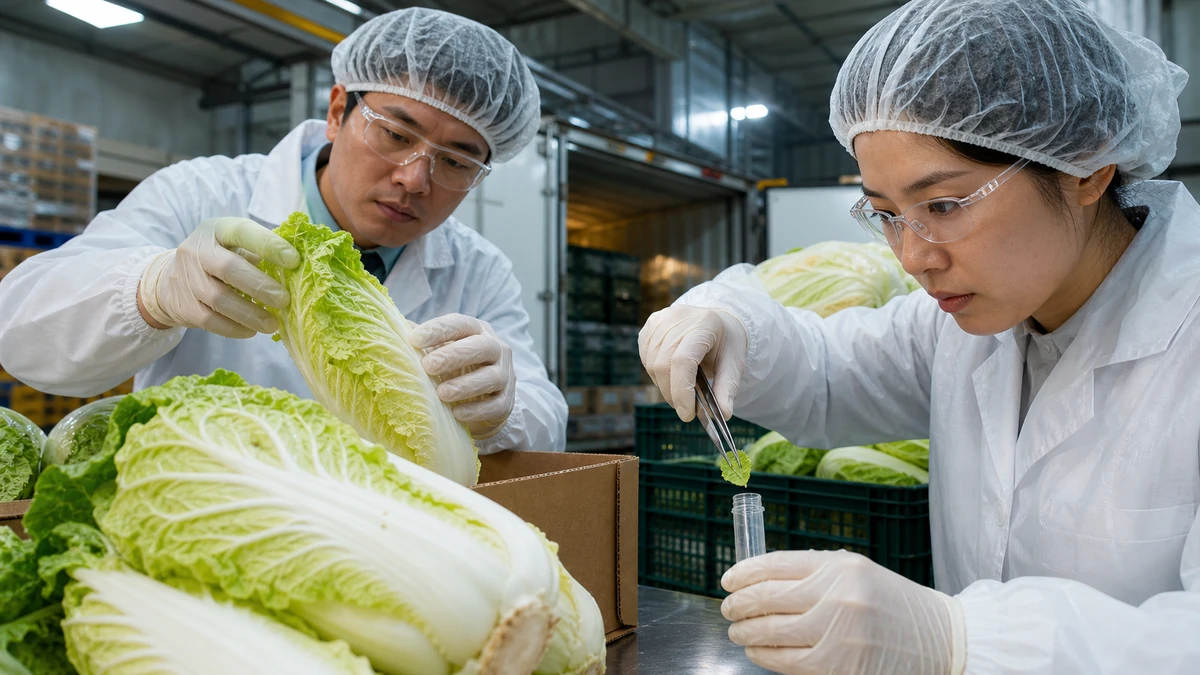
Image to help understand the article
A food safety alert in Korea is raising broader questions about global produce supply chains
South Korea’s food and drug safety ministry said this week that it is trying to determine whether Chinese cabbage linked to formaldehyde use in parts of China was ever exported to South Korea, an important distinction that matters as much as the chemical itself. The ministry also said it has tightened import inspections on cabbage from China while it seeks more information through official channels, including the Chinese Embassy.
That may sound like a narrow regulatory update, but it speaks to a much larger issue familiar to American consumers: how governments respond when troubling reports about food safety emerge abroad before officials can confirm whether the affected products ever reached store shelves at home. In this case, South Korean authorities are not saying contaminated cabbage has been found in domestic circulation. They are saying they are checking whether the specific cabbage at issue entered the country at all.
That gap between a possible hazard and a confirmed exposure is the core of the story. Formaldehyde is widely recognized as a dangerous substance and is classified as a known human carcinogen under international and U.S. health frameworks. But a report that a hazardous chemical was improperly used somewhere in an overseas food supply chain is not the same thing as proof that consumers in another country bought, handled or ate that food.
South Korean regulators appear to be treating that distinction carefully. Based on the information made public so far, the government response has two tracks: first, verify whether the cabbage implicated in China was exported to South Korea; second, intensify inspection of Chinese cabbage imports while that verification is underway. That is less dramatic than a recall, seizure or confirmed contamination notice, but in some ways it is more revealing. It shows how modern food safety systems often work in the period before a headline becomes a full-blown crisis.
For readers in the United States and other English-speaking countries, the episode is a useful reminder that food safety stories often unfold in stages. The first stage is the foreign incident. The second is the traceability question: did the product cross the border? The third is import inspection. The fourth, if warranted, is domestic enforcement. South Korea is still working through the early stages. That means alarm is understandable, but certainty would be premature.
What exactly South Korea has confirmed — and what it has not
The facts released so far are limited but important. Authorities in China reportedly uncovered cases in some rural areas where formaldehyde had been used to maintain the freshness of cabbage. China’s central government then ordered a special investigation. In response, South Korea’s Ministry of Food and Drug Safety said it is checking whether the cabbage in question was exported to Korea and has strengthened import inspections on cabbage from China.
What has not been confirmed is just as important. South Korea has not announced that the specific cabbage tied to formaldehyde use was imported into the country. It has not said the product was distributed in Korean markets. It has not reported consumer exposure. And it has not, based on the public summary available, identified particular shipments, distributors, regions or retailers.
That may seem like a technical distinction, but it is the difference between a preventive response and a confirmed public health incident. News consumers often collapse several separate statements into one: that a problem was found in another country, that a government is checking whether related goods were imported, and that the goods were sold domestically. Those are not interchangeable facts. South Korean officials, to their credit, appear to be drawing those lines explicitly.
The ministry’s enhanced inspections also should not be misunderstood as proof that all Chinese cabbage is suspect. Regulators often broaden screening in response to a specific warning because they need a wider net before they can narrow the risk. That does not mean every product from the country of origin is unsafe. It means authorities are trying to determine whether a defined risk exists within a larger category of imports.
In practical terms, the current public message from Seoul is caution without conclusion. There is enough concern to justify closer scrutiny. There is not yet enough confirmed evidence to say the hazardous cabbage entered South Korea’s consumer market. For the public, that can feel unsatisfying. For regulators, it is often exactly where a responsible investigation begins.
Why formaldehyde triggers such a strong reaction
Any mention of formaldehyde in food is likely to produce immediate fear, and not without reason. In the U.S., most people know formaldehyde from discussions about industrial materials, embalming fluid, certain building products or occupational exposure. It is not something consumers expect to hear about in relation to fresh produce. That alone makes the story arresting.
Formaldehyde’s classification as a known carcinogen gives the headline extra force, but chemical classifications and consumer risk assessments are not identical. Public health agencies distinguish between hazard and exposure. A hazard refers to the inherent capacity of something to cause harm. Exposure concerns whether people actually encountered it, in what amount, for how long and under what conditions. A substance can be dangerous in principle, yet the real-world risk to consumers depends on whether contaminated goods reached them and at what levels.
That is why South Korea’s verification process matters. The reporting so far suggests the issue began with a local freshness-preservation practice in parts of China, not with a broad official finding that all cabbage exports were compromised. If that reporting holds, the central question becomes traceability: can the implicated cabbage be linked to export channels leading to South Korea?
American readers have seen similar dynamics in other food safety cases, even when the substance involved was different. Think of how U.S. officials handle outbreaks tied to lettuce, onions, peanut products or infant formula ingredients. The early stage is often full of uncertainty and broad concern. Investigators identify a possible problem, start tracing supply lines, widen or intensify inspections, and only later determine whether the issue was isolated, systemic, imported, domestic or already circulating in commerce.
That process can frustrate consumers who want instant answers, but it reflects a hard reality of a globalized food system. Produce moves fast. Supply chains span multiple jurisdictions. Traceability records may involve farms, packers, brokers, shipping companies, customs authorities, wholesalers and retailers across borders. By the time a suspicious practice is exposed in one place, regulators elsewhere are racing to answer a narrower but urgent question: did it reach us?
Why this matters so much in South Korea, where cabbage is more than just a vegetable
To understand why this story is commanding attention in South Korea, it helps to understand what cabbage means there. For many Americans, cabbage is a familiar but not central staple — perhaps coleslaw at a barbecue, corned beef and cabbage around St. Patrick’s Day, or kimchi at a Korean restaurant. In South Korea, napa cabbage occupies a much more foundational place in everyday food culture because it is a main ingredient in kimchi, the fermented side dish that anchors countless meals.
Kimchi is not just a condiment in Korea. It is a daily food, a marker of home cooking, a symbol of culinary identity and, increasingly, a major export associated with the global Korean Wave. That means concerns about cabbage quality can quickly take on outsized cultural and political meaning. A safety question involving cabbage is not merely about one produce item; it touches a core ingredient in one of the country’s most iconic foods.
That helps explain why the distinction between “Chinese cabbage” as a broad import category and “the specific cabbage linked to formaldehyde use” matters so much. South Korea imports agricultural products, including produce, for a variety of economic reasons, but consumers are highly sensitive to food origin, seasonal price swings and quality controls — especially when a product has strong ties to household staples.
In recent years, kimchi itself has become a point of both national pride and commercial competition. South Korean brands sell packaged kimchi at home and abroad, while imported kimchi and imported ingredients have also been part of the market. That means a story about cabbage sourced from China can resonate beyond immediate health concerns, touching debates about import dependence, domestic agriculture and consumer trust.
None of that changes the facts of the current case. South Korea still has not confirmed that the implicated cabbage entered the country. But it does explain why the government’s public messaging needs to be precise. In a food culture where cabbage is directly tied to a deeply familiar dish, vague warnings can quickly fuel anxiety, rumor and overreaction. Clear distinctions between what is known, what is suspected and what is still under investigation are essential.
What this means for the United States and other Western markets watching Korean food grow
For American readers, the direct impact of this case may be limited for now, but the implications are not. Korean food is no longer a niche category in the United States. Kimchi is sold at Costco and Whole Foods. Korean barbecue chains have gone mainstream. Major U.S. food companies and retailers increasingly treat Korean flavors as a durable consumer trend, not a novelty. That means developments affecting Korean food regulation and supply confidence can ripple outward into American retail, restaurant and consumer conversations.
There is no public evidence in the summary available that the cabbage in question was exported to the United States, nor is there any indication that U.S. authorities are investigating related imports. It would be irresponsible to suggest otherwise. But the broader lesson is very relevant to the American market. As Korean cuisine expands in the U.S., American consumers are becoming more connected to the same upstream agricultural and ingredient networks that matter in South Korea.
That affects several constituencies in the United States. Importers and distributors of Korean food products pay close attention to any overseas safety concern that could affect sourcing confidence or consumer perception, even when no direct U.S. exposure has been identified. Retailers that stock kimchi, Korean meal kits or produce used in Korean cooking are keenly aware that food safety headlines can change buying behavior fast. And Korean American consumers, who often act as both core customers and cultural translators for the broader U.S. market, may be especially attuned to how these stories are framed.
There is also a policy and diplomatic dimension. The United States and South Korea have a deep trade relationship, and food standards are part of the trust architecture that underpins it. When Korean regulators move quickly to scrutinize imports tied to a foreign safety concern, that sends a signal to global partners, including the U.S., about the seriousness of oversight in one of America’s key Asian allies. In an era when consumers increasingly care about where food comes from, credible inspection systems are not only a health matter but a trade asset.
American readers can also relate this to familiar domestic cases. The U.S. food system has seen its own controversies involving imported seafood, produce and processed foods, as well as domestic contamination scares that tested regulatory credibility. One lesson repeats: markets can absorb bad news when authorities communicate clearly, differentiate possibility from proof, and explain what action is being taken while facts are still coming in. South Korea’s response, at least so far, fits that template better than a rushed declaration would.
This is really a story about trust, traceability and the politics of imported food
On one level, the current Korean inquiry is about cabbage. On another, it is about the modern politics of food trust. Consumers rarely see the full chain behind a fresh vegetable: how it was grown, treated, stored, transported and cleared for entry. They encounter the final product on a shelf, in a restaurant or inside a packaged meal. When a foreign report suggests something may have gone wrong earlier in the chain, confidence depends on whether regulators can reconstruct the path quickly and explain the results plainly.
That is why the phrase “checking whether it was imported” matters more than it may initially appear. Traceability is the heart of contemporary food safety. The question is not only whether a harmful practice occurred somewhere, but whether records can identify the farms, lots, exporters and shipments involved. If authorities can map that chain with precision, they can target action narrowly, reassure consumers when appropriate and avoid unfairly stigmatizing an entire category of products from a country or region.
Without that precision, fear often fills the gap. Consumers may assume all Chinese cabbage is risky, even though the known issue concerns cabbage in some Chinese localities and South Korea is still trying to determine whether any implicated product entered Korean trade channels. That kind of overgeneralization has consequences. It can damage legitimate businesses, distort markets and turn a specific safety concern into a broad nationalist or anti-import backlash.
The challenge for officials is balancing urgency with restraint. Move too slowly, and consumers accuse regulators of minimizing risk. Speak too broadly, and they may trigger unnecessary panic or unfairly implicate safe products. South Korea’s two-track response — verifying export links while strengthening inspections — reflects a middle path. It tells the public the warning is being taken seriously without overstating what is established.
That approach is especially important in Asia, where cross-border food trade is dense and public memories of past safety controversies remain strong. But it is equally resonant in the United States, where trust in institutions is often fragile and food scares can quickly become political. The best antidote to panic is not silence. It is careful disclosure about what is known, what is unknown and what happens next.
What to watch next as the investigation develops
The next phase of this story will likely turn on three things. First is what Chinese authorities determine in their own special investigation: how widespread the practice was, where it occurred, and whether the implicated cabbage entered export channels. Second is what South Korean officials learn through diplomatic and regulatory inquiries about shipments bound for Korea. Third is what intensified import inspections in South Korea actually find.
Those three streams of information need to line up. If Chinese investigators identify the affected supply routes and South Korean import records show no overlap, that would support reassurance — though regulators would still need to communicate that clearly to calm consumers. If records suggest possible overlap, the question would shift to whether inspection data, shipment histories or distribution records point to actual entry and circulation in South Korea. Only then would the story move from preventive scrutiny into a confirmed domestic exposure issue.
The public should also watch how transparently results are released. In food safety reporting, the final answer matters, but so does the clarity of the path taken to reach it. If regulators explain what they checked, what they found and what remains uncertain, trust tends to hold even when the news is incomplete. If the messaging becomes vague or contradictory, suspicion can deepen regardless of the outcome.
For American audiences following Korea, the broader trend is worth noting. As Korean culture continues its global rise — from K-pop and streaming dramas to beauty products and food exports — scrutiny of the systems behind those exports will only intensify. Success in global markets brings not only attention and opportunity, but also higher expectations for standards, transparency and rapid crisis communication. Korea is hardly unique in that regard; it is simply experiencing the same pressures that come with becoming a major cultural and consumer brand.
For now, the most responsible reading of this episode is also the least sensational one. A troubling food safety practice was reported in parts of China. China’s central government ordered a special investigation. South Korea responded by trying to determine whether the implicated cabbage was exported there and by increasing inspections on Chinese cabbage imports. What has not yet been established is whether that cabbage actually entered South Korea’s consumer market.
That distinction may not produce the most dramatic headline, but it is the one that matters most. In a global food economy, the difference between a warning sign and a confirmed exposure is everything. South Korea is now working to define that line. The outcome will matter not only for Korean consumers, but for international observers — including Americans — who increasingly share in the same interconnected food system.
Comments
Post a Comment