Image to help understand the article
Why Zelenskyy is pushing back now
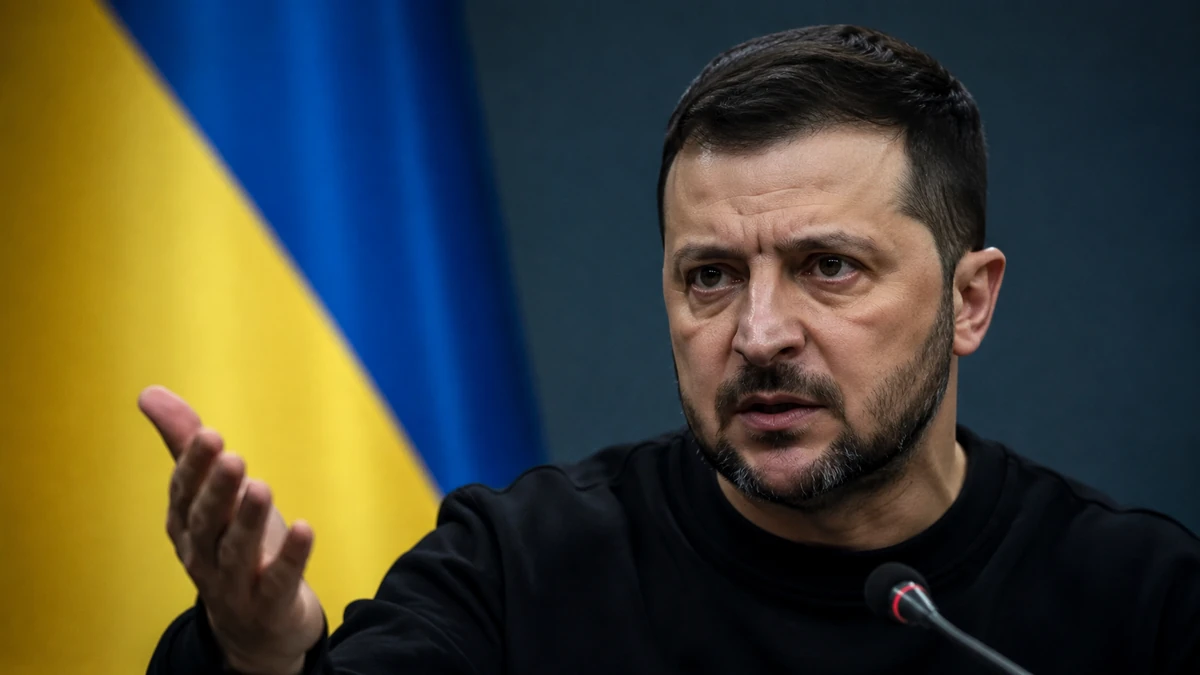
Ukrainian President Volodymyr Zelenskyy is drawing a hard line against calls to hold national elections while Russia’s full-scale war continues, arguing that a vote under current conditions could fracture the country at the very moment it is trying to survive. In remarks carried by AFP, Reuters and Bloomberg, Zelenskyy said pressing ahead with an election during wartime could unleash a “tsunami” of division and create enormous risks for Ukraine. His language was unusually stark even by wartime standards: He suggested that if the goal were to wreck the country, then moving toward elections now would be one way to do it.
That response matters not simply because it rejects a political timetable. It gets at a deeper question that democracies rarely face in peacetime but must confront in war: How does a government preserve legitimacy when the usual mechanisms of democratic accountability become difficult, distorted or even dangerous to carry out? Elections are normally the clearest answer. But war changes the conditions that make elections meaningful. Millions of citizens may be displaced. Soldiers are deployed on the front. Some territory is occupied or under regular attack. Campaigning can be unequal or unsafe. Information spaces are vulnerable to manipulation. And even if ballots are cast, the larger question remains whether the public would trust the result as fair.
For American readers, it may help to think of elections not as a ritual that automatically produces legitimacy, but as a system that depends on broad buy-in. The United States has experienced intense disputes over voting rules, mail ballots, misinformation and public trust under far less extreme conditions. Ukraine is dealing with all of those concerns in the shadow of missile strikes, mass displacement and existential war. Zelenskyy’s argument, in essence, is that in such an environment, an election could stop functioning as a stabilizing democratic process and instead become a trigger for internal conflict.
That does not settle the matter. Delaying elections also carries political costs. The longer a war drags on, the more difficult it becomes for any government to answer a basic democratic question: By what means is popular consent being renewed? Zelenskyy’s comments therefore do more than reject an immediate vote. They expose the central tension of wartime democracy: the collision between democratic legitimacy and political stability.
In ordinary times, leaders are often judged by whether they meet election deadlines. In extraordinary times, they are judged by whether they can protect both the state and the democratic system without allowing one to destroy the other. That is the narrow path Zelenskyy is trying to walk, and it is why this debate in Kyiv is resonating far beyond Ukraine.
When democratic legitimacy collides with wartime survival
The strongest point in Zelenskyy’s position is also the most uncomfortable for democracies to admit: An election is not automatically democratic simply because it is held. The legitimacy of a vote depends on conditions that allow citizens to participate freely, hear competing arguments, evaluate leaders and accept the outcome. War can undermine each of those conditions.
Ukraine’s case makes the dilemma especially sharp. Large numbers of Ukrainians have been displaced internally or have fled abroad. Military personnel are serving under battlefield conditions that would complicate access to voting. Russian attacks continue to threaten infrastructure and civilian life. Campaigning, debate and media access would unfold in an environment shaped by emergency powers and national-security imperatives. If one candidate or party claimed the government used wartime tools to tilt the field, or if opponents questioned turnout from occupied or front-line areas, a post-election dispute could become more than a normal democratic argument. It could cut into military morale, social cohesion and international confidence.
Zelenskyy’s repeated use of words such as “division,” “enormous risk” and “destroy” signals that he sees the threat not as administrative inconvenience but as a national-security issue. That rhetorical framing raises the political stakes. Once wartime elections are described as a path toward fracture, people calling for them can be cast not merely as procedural purists but as actors willing to endanger the national war effort. That may strengthen Zelenskyy’s case in the short term, but it also creates a burden for his government. If elections are postponed in the name of unity, authorities will have to show that postponement is not simply a convenient shield against competition.
This is where the issue becomes more complicated than a one-day headline. The real debate is not elections versus no elections in some abstract sense. It is what standards should determine whether an election under wartime conditions would produce more legitimacy or more instability. That distinction matters because democracies cannot rely forever on emergency logic without clarifying its limits. If the war continues, Ukrainians and their foreign partners will likely keep asking what benchmarks would make a future vote possible: greater territorial security, safer infrastructure, broader political agreement, credible voting access for displaced citizens, or some combination of those factors.
In that sense, Zelenskyy’s remarks may be less the end of an argument than the beginning of a more precise one. He has clearly said no to elections now. The unanswered question is what would have to change before that answer could become yes.
The danger in the delay is real, too
It is important not to flatten this issue into a simple defense of wartime postponement. The concerns on the other side are serious, even if Zelenskyy currently appears to hold the stronger immediate case. Democracies depend on periodic renewal of authority. When elections are repeatedly deferred, doubts can grow about representation, accountability and concentration of power. Those doubts do not disappear just because the security rationale is understandable.
This is especially true in a long war. At the outset of a national emergency, publics often grant leaders extraordinary latitude. Over time, however, emergency measures can harden into a political environment where normal competition is narrowed, criticism is more easily dismissed and governing legitimacy begins to rest more on necessity than consent. That does not mean such governments are illegitimate. It means the burden of explanation grows heavier.
For Zelenskyy, that burden is likely to increase, not decrease, if the war remains protracted. It will not be enough to repeat that wartime conditions are exceptional. He and his government may need to articulate more clearly how political accountability is being preserved absent an election, how dissent and scrutiny remain possible, and what conditions would make a future vote credible. In democracies, choosing not to hold an election is itself a major political act. It requires justification not just in security terms, but in democratic ones.
That is also where critics of wartime delay face their own test of seriousness. If they argue that elections are necessary, they need to answer difficult practical questions rather than rely on democratic symbolism alone. How would candidates campaign fairly in a country under attack? How would displaced civilians vote? How would the integrity of balloting be protected from Russian disruption, cyberattacks or propaganda? How would losing factions be persuaded to accept a result produced under radically unequal wartime conditions? A vote that deepens disputes over legitimacy could undermine the very democratic confidence it is supposed to reinforce.
What this debate reveals, then, is a broader truth often missed in Western political rhetoric: Democratic principles and democratic procedures are closely related, but they are not always identical in crisis. A state can hold to democratic values while concluding that a particular procedure, at a particular moment, would not function as intended. The hard part is proving that such an exception is temporary, necessary and bounded.
What this means for the United States
For the United States, the significance of this debate goes well beyond sympathy for Ukraine or interest in one leader’s political future. Washington is Ukraine’s most important foreign backer, and American military, financial and diplomatic support has made the country’s internal political stability a matter of direct U.S. concern. If Ukraine were to move into a bitter election fight during an active war, the consequences would almost certainly ripple through debates in Congress, among U.S. allies and across the American public.
There is also a deeper American angle. The United States likes to frame support for Ukraine as support for democracy against authoritarian aggression. That narrative has been central to how the war is explained to U.S. voters, lawmakers and allies. But the wartime election debate reveals that democracy under attack does not always look like democracy in a civics textbook. American audiences are accustomed to viewing elections as the basic proof of legitimacy. Ukraine’s dilemma forces a harder conversation: Can postponing an election under extreme conditions be compatible with democratic defense, or does it risk weakening the very values the West says it is protecting?
That question matters politically in the U.S. because Ukraine aid has increasingly been filtered through domestic partisan arguments. Skeptics of continued assistance may point to delayed elections as evidence of democratic erosion. Supporters may counter that holding a vote under bombardment would be performative at best and destabilizing at worst. Either way, Ukraine’s internal political choices are likely to become talking points in American debates over foreign aid, alliance commitments and democratic credibility.
There is a practical dimension as well. U.S. policymakers and election experts understand that election integrity depends not only on legal scheduling but on secure administration, trusted institutions and public acceptance of results. American elections, even in a stable homeland, have faced disinformation, lawsuits and bitter disputes over legitimacy. It is not difficult for U.S. officials to imagine how much worse such tensions could become in a country fighting for survival against an adversary adept at information warfare. In that sense, Zelenskyy’s warning may sound less like a rejection of democracy than a recognition of how fragile democratic procedures can be under siege.
For American companies, media organizations and civic institutions, this moment is also instructive in a broader way. Ukraine has become a case study in the modern relationship between conflict, digital information and public trust. U.S. tech platforms, broadcasters, analysts and nonprofit democracy groups will be watching closely because the same questions that haunt Ukraine in extreme form — how to maintain legitimacy, guard against manipulation and keep a polarized public invested in fair outcomes — are versions of problems the U.S. grapples with at home. The scale is different. The context is incomparable. But the underlying anxieties are familiar.
Most of all, the U.S. stake lies in what kind of partner Ukraine remains during a drawn-out war. American support depends not only on battlefield performance but on confidence that Ukraine’s institutions retain public credibility. Zelenskyy’s challenge is to persuade allies that postponing an election now protects the state without hollowing out its democratic core. Washington, in turn, will have to decide how much procedural flexibility it is willing to accept from a democracy fighting an existential war.
A larger global question about democracy in emergencies
Ukraine’s situation is unique in its specifics, but the underlying issue is much larger. Around the world, governments facing war, insurgency, coups, states of emergency or severe internal upheaval often confront the same dilemma: whether normal democratic timing can survive abnormal political conditions. That does not mean every government that delays elections deserves deference. Quite the opposite. History is full of leaders who used crisis as a pretext to extend power. That is precisely why wartime or emergency postponements are so politically fraught.
What makes Ukraine different in the eyes of many Western governments is that it is not merely managing unrest; it is resisting a full-scale external invasion while trying to preserve state institutions. Even so, the line between necessary exception and dangerous precedent is never self-enforcing. Democracies have to define it in practice, often in real time, with incomplete information and high stakes.
Zelenskyy’s remarks highlight that war changes the political meaning of time itself. In peacetime, a missed electoral deadline is usually interpreted as democratic failure. In wartime, adhering to a deadline regardless of conditions can itself be portrayed as reckless. The calendar does not disappear, but it becomes entangled with questions of survival, morale and command continuity. That is why this story has drawn international attention. It is not just about whether Ukrainians vote this year or next year. It is about whether democratic legitimacy can be sustained when the very tools designed to renew it may, under certain conditions, intensify instability.
Another reason the issue resonates globally is that it underscores how much democracies depend on social trust. Elections work not simply because votes are counted, but because enough people accept the rules, the process and the result. War shreds trust, fragments public space and makes every institutional decision vulnerable to suspicion. In that environment, even a technically competent election can fail politically if large parts of society see it as incomplete, coerced or strategically manipulated.
That is why Zelenskyy’s “tsunami” metaphor matters. He appears to be warning not about Election Day chaos alone, but about the entire chain reaction a wartime campaign could trigger: intensified factional conflict, recriminations over fairness, disputes over results and weakened unity in the face of Russia. Whether one agrees with him or not, the metaphor captures a central reality of wartime politics: the most damaging effects of a decision may come not in the first moment, but in the cascading aftershocks.
What to watch next in Ukraine’s political debate
The immediate takeaway from Zelenskyy’s remarks is clear: He is firmly opposed to holding elections while current wartime conditions persist. But the longer-term importance of his position will depend on what comes next. If the debate shifts from “Should there be an election now?” to “What conditions would make an election credible later?” then Ukraine may be entering a more substantive phase of discussion about wartime governance.
Several issues will be worth watching. One is whether the government offers a more detailed framework for how political legitimacy is maintained during a prolonged conflict. Another is whether opposition figures, civil society groups or international partners push for clearer benchmarks on timing and conditions for future voting. A third is whether the public continues to accept the tradeoff between unity and electoral renewal, especially if the war grinds on without a decisive turning point.
International reaction will matter, too. Western allies have generally prioritized Ukraine’s resilience and defense capacity, but they are also deeply invested in its democratic identity. If Zelenskyy’s government can pair election postponement with transparent explanation and visible accountability, foreign partners may see the decision as prudent. If the postponement comes to look open-ended or politically self-serving, it could create new friction, particularly in countries where support for Ukraine is already contested.
For American readers, the most important lesson may be that democracy in wartime is not measured by one symbol alone. Elections remain the gold standard of political legitimacy, but they are not magic. They require conditions under which losers can concede, winners can govern and citizens can trust the process enough to move forward together. Zelenskyy is arguing that Ukraine does not currently have those conditions. His critics worry that waiting too long brings dangers of its own. Both concerns are real.
That is what makes this more than a procedural dispute. It is a test of whether a country under relentless external assault can preserve both cohesion and democratic credibility without pretending that normal politics is still possible. Ukraine’s answer, whatever form it ultimately takes, will be watched closely not only because of the war itself, but because it forces democracies everywhere to confront an uncomfortable truth: In moments of extreme crisis, legitimacy is not just about following the calendar. It is about convincing a society — and its allies — that the rules being bent today are not being broken for good.
Comments
Post a Comment